Posts Tagged ‘metaphors’
“The metaphors we use deliver us hope, or they foreclose possibility”*…

It feels only too clear that the global order that defined geopolitics, geoeconomics, and life in the world’s constituent parts is changing fundamentally. But what lies on the other side of this change? It’s a sucker’s bet to try to predict that outcome with any precision; there’s just too much fundamental uncertainty. As Antonio Gramsci said (of another era, though he might have been describing ours): “The old world is dying, and the new world struggles to be born: now is the time of monsters.”
Still, it’s important that we try. It’s only by wrestling with what’s going on to determine what’s possible, then what’s desirable, that we can shape a future in which we want to live.
The models and metaphors that we use are key to that wrestling. Our natural inclinations seem to tend in one of two directions. Either we tweak the models we have to try to accomodate the change that we see… which seems to work until (given that the change just keeps on coming) it doesn’t. Or we flip to the opposite– we imaging that everything simply falls apart. In geopolitical/geoeconomic terms, we assume that we get an incrementally-revised version of the world order that we’ve known; or we imagine dissolution (into what tends to be called a “multi-polar” world)… neither of which imagines materially different world orders that, as hard as they are to describe, are entirely plausible. Part of our problem in visualizing those new orders is our lack of models and metaphors for them…
The two pieces featured here posit frameworks and metaphors that, while they may or may not prove to be “accurate” in any comprehensive way, can help us open our thinking, and model the ways in which fresh metaphors can help us see problems anew and find new solutions.
First a piece from Trine Flockhart, from the Global (Dis)Order International Policy Programme of the British Academy and The Carnegoe Endowment for International Peace, part of a recent book)…
Is global order a thing of the past? Is the liberal international order fraying and what is
happening to previously stable alliances and cooperative relationships such as the
transatlantic relationship or the relationship between the United States and Canada? Not
such a long time ago, these questions would have been regarded as alarmist, but today the
prospect of large-scale order transformation is part and parcel of daily debates. This rupture
is probably as important as the transformation that followed the end of the Second World War,
and together with the simultaneous transformations in technology and science, the impact
on people and societies may well be on par with the Industrial Revolution. As Gramsci wrote
from his prison cell, we live ‘in times of monsters’ where ‘the old world is dying and the new one
struggles to be born’(Gramsci & Buttigieg 1992). In these circumstances, we see the political
consequences in populist parties as voters seek certainty in an uncertain and turbulent world,
whilst policymakers struggle to find their feet in the emerging world and seek to manage the
fallout from the ending of the old world.
To ensure that the policy decisions of today are relevant for the geopolitical reality of tomorrow,
policymakers must have a clear sense about the likely outcome of the ongoing transformation
– in other words what kind of global order will be in place and what kind of relationships can
be expected within it? These are big and complex questions that have no easy answers, yet
many scholars and policy practitioners seem to already have their answer – the world will be
multipolar (Ashford 2023; Bekkevold 2023; Borrell 2021). At least anecdotally, it seems there
is widespread agreement that the international system is transforming from a unipolar system
anchored in American hegemony, to a multipolar system reflecting the shift of power to a larger
number of states. However, although the idea that the international system will be multipolar
is persuasive, and although the use of analytical concepts such as polarity can be useful for
gaining an overview of complex matters, we must be aware that polarity as a concept rests on
a specific form of analysis that tends to emphasize states, sameness, power and interest, and
which is only partially sighted when it comes to values, identities, lesser powers and complexity.
I worry that the focus on multipolarity, means that policymakers are trying to understand the
current order transformation through conceptual lenses that are blurred and not very relevant.
This article presents a different position. It starts from the counterintuitive position that
it is logically implausible for the global ordering architecture to return to an international
system that was in place a century ago. Those suggesting that we are currently witnessing
a return to multipolarity emphasise shifts in the global distribution of power and the rising
number of powerful states, most notably China. These are certainly important changes, but
The arrival of the multi-order world and its geopolitical implications
other important changes are overlooked, which suggest a fundamentally different global
ordering architecture is in the making. Continuing to portray the world as multipolar belies the
complexity, significance, and extent of many other important changes. This paper presents an
alternative interpretation of the ongoing global order transformation, demonstrating why it will
be neither bipolar nor multipolar but rather multi-order.
A multi-order world is a global ordering architecture consisting of several international orders.
Gramsci was right that order transformations take time, so the multi-order architecture is still
in development, but can be glimpsed through the existence of three independent international
orders already clearly visible within the global ordering architecture – the American-led liberal
international order (albeit that American leadership under Trump is currently in question),
the Russian-led Eurasian order, and the Chinese-led Belt and Road order.1 Other orders and
other forms of relationships of importance are also in the making suggesting a more complex
architecture than a multipolar one. The paper does not claim to present a full picture of the
emerging ordering architecture but seeks merely to demonstrate the importance of embracing
new thinking to contemplate the possibility of an entirely new form of international system
in which multiple international orders with very different dynamics and different behavioural
patterns make up the global ordering architecture. The perspective brings into light important
relationships and dynamics that are not readily apparent in the multipolar perspective –
especially that relationships within orders are just as important as relations between different
international orders, and it leaves room for considering other aspects than powershifts and for
acknowledging the importance of other actors than just a handful of “pole states”. I argue that
awareness of the subtle differences between the multi-order architecture and more traditional
polarity-based understandings is an essential first step towards timely strategic policymaking
fit for the multi-order world.
The paper proceeds in four moves. First, I outline three significant events over the past four
years which only partially fit the polarity-based narrative. Second, I outline the multi-order
perspective by focusing on order as a condition, a social domain, and as practices of ordering.
Thirdly, I show how changes in three characteristics of the global system indicate a multi-order
world rather than a multipolar one. Finally, I briefly consider some of the broader geopolitical
implications of a multi-order world and demonstrate the importance of ordering dynamics
within and between international orders. The picture that emerges challenges some of the
most foundational assumptions about international relations and global order including the
prospect of achieving convergence around common rules in multilateral governance to meet
shared challenges…– “The arrival of the multi-order world and its geopolitical implications”
The second, by Jessica Burbank, takes a different– and in some ways, more provocative– tack…
… A new world order is here. States (countries) are no longer the highest form of power globally. Power has shifted to wealthy individuals who work in groups and operate across borders: syndicates of capital.
Syndicates of capital cannot be categorized as legal or illegal. They exist primarily in the extralegal sphere, where either no regulations apply to their behavior or, where laws do exist, there is no entity powerful enough to enforce them in a manner that asserts control over the syndicates’ behavior.
In many occasions, capital is both the power source for syndicates, and the shared goal. Wealthy individuals form syndicates if their strategic objectives align. Those objectives typically revolve around securing new capital flows and preserving existing ones. Syndicates’ power is vast but fragile. If all members of a syndicate were cut off from accessing capital and the resources they control, they would lose their power.
Author’s Note: Sorry to disappoint the conspiracy theorists, but I am not speaking of secret societies, the illuminati, or a cabal. Syndicates of capital do not hide their power, nor do they operate in secret. Their multi-billion dollar deals and contracts are publicly disclosed. They are also not united in ethnic background, religious, or political beliefs.
It is not enough to say: ‘democracies are being replaced with oligarchies because wealthy individuals have too much power in society.’ That may be true, but is not the full picture. Oligarchies are states run by a small group of wealthy individuals. That may accurately describe the politics of one nation, but it does not suffice to describe how power is organized on a global scale.
‘Global oligarchy’ also falls short of describing how power is organized in our world, because there is not one small group of wealthy individuals, there are many, and they compete. Still, the identification of oligarchs is useful for global political analysis because many of the oligarchs within a state also operate globally as leaders or members ofsyndicates of capital.
The new world order emerged before it could be identified. Platitudes like: “our world has gone crazy,” served as an emotional crutch, and an implicit acknowledgement that we lack a sound analysis of contemporary global power. What has felt like an ineffable force, an inexplicable undercurrent of darkness, is the ambiance of global dominion by syndicates of capital.
Though abstract, examining how global power is organized is essential to understanding the world we live in. Developing a coherent framework for evaluating global affairs allows us to more effortlessly make sense of current events. You’ll be surprised how quickly things click and how easily your mind makes connections when you absorb the news with a conception of syndicates of capital…
Both are eminently worth reading in full: whether or not one buys all– or any– of either set of conclusions, the mental calisthenics are the point…
###
As we muse on metaphors, we might recall that it was on this date in 1279 that Mongol forces led by Kublai Khan were victorious at the Battle of Yamen— ending the Song dynasty in China. Kublai has already conquered parts of northern and southern China, and had declared the Yuan dynasty (with himself as the emperor “Great Yuan”). With the fall of the Song, the Mongols ruled all of continental East Asia under Han-style Yuan rule, which was a division of the Mongol Empire.

“I have said before that metaphors are dangerous”*…

… still, metaphor animates much of our thought and of the received wisdom that it can become. Quinn Slobodian unpacks the ways in which metaphors of the natural sciences loom large in the neoliberalism conception, then walks us through its myriad permutations, concluding with metaphor’s corrosion at the hands of Silicon Valley’s reactionary accumulation regime…
Polyps confounded political theorists in the 18th century. The creatures that collectively make up coral reefs acted in ways that defied both expectations of divine design and the established hierarchy of the animal kingdom. How could these lowest of organisms create such enormous structures—especially ones that appeared to be the product of one mind? How could microscopic creatures obstruct the ships of the most powerful forces on Earth, rupturing their hulls and forcing them to chart their way around polyp metropoli risen into islands? It’s no wonder that the anarchist anthropologist James C. Scott later drew an analogy between polyps and peasants. “Just as millions of anthozoan polyps create, willy-nilly, a coral reef,” he wrote, “so do thousands upon thousands of individual acts of subordination and evasion create a political or economic barrier reef of their own.”
The historian of science Whitney Barlow Robles quotes Scott in her wonderful book, Curious Species, where she explains how coral unsettled certainties. Fed by sunlight like grass, plants with their tentacles laid down layers of limestone. The power of polyps turned ideas of agency on their head, a molecular sightless mass acting as architect. Robles imagines it would be like “suddenly learning that butterflies, not people, planted all the trees in Central Park.”
It was a similar wonder at the endless events of the natural world that led classical liberals to draw connections between the order of nature and the order created by human exchange in the profane world of political economy. Philip Mirowski reminds us that natural metaphors serve double duty: they are “reassuring and graphically concrete images of order, situating humanity squarely at home in ‘its’ universe” while they also tame the disorder of nature, making “an unintelligible alien world comprehensible.”
Nature offered what Deirdre McCloskey calls the ”metaphors economists live by.” Because so much of our politics relies on an explicit and implicit understanding of economics, this means we live by those metaphors too. The intellectual movement of neoliberalism arrived at its ideas of the good society by thinking with and through nature. As the post-Cold War consensus around neoliberal globalization crumbles and the boundaries of individual freedom narrow, new metaphors might help us understand the successor ideology…
[Slobodian outlines the intellectual history of neoliberalism, from Friedrich Hayek, its intwined connection with he sciences, and the centrality of the “garden” metaphor in economics. He describes the displacement of the graden with the “swarm” and argues that it is now being wrestled into a mechanistic, surveillance-centric vision of control– a factory…]
… In Curious Species, Whitney Robles reminds us that the polyp agglomerations—those coral structures built by tiny, collective labor—were dubbed “colonies” in the language of the European merchant empires and the Romans before them. The metaphor was no accident. Colonial science mapped political fantasies onto biological forms.
Robles insists that the polyps were never docile subjects. Yet, however resilient, the polyps are not immortal. When the waters around them acidify and warm, these vast reef-structures bleach and break apart. The microorganisms that once formed a community detach from the whole and float away—winking, fluttering, nearly invisible. A nothing. A dispersal. Polyp politics does not just teach us about creation. It teaches us about endings, too.
The neoliberal imagination, when it looked to nature, saw spontaneous order, unplanned complexity, and the beautiful unpredictability of emergent systems. But it often underestimated the possibility of collapse—not as failure of planning, but as a systemic consequence of the very freedom it prized.
What happens when the waters change? When the reef dissolves?
In our current moment, we are no longer just asking how order emerges, but how it vanishes. We are watching the garden trodden underfoot, the swarm militarized, the factory reinstalled as a total system of command. And in this long shift—from polyps to protocols, from butterflies to drones—there is a profound political lesson.
Freedom, when real, is fragile. So is spontaneity. So is improvisation. The forces of order may begin in a coral reef or a Central Park meadow, but they can end in a codebase, a drone cloud, or a boardroom with no windows.
The question is no longer whether we can find metaphors from the natural world to describe human society. It is whether we can preserve the kinds of life that those metaphors once made thinkable…
As Robert Frost once said, “unless you are educated in metaphor, you are not safe to be let loose in the world”: “Garden, Swarm, Factory,” from The Ideas Letter and @open-society.bsky.social.
Apposite: “Artificial intelligence” as we’re being encouraged to understand and accept it is a lie that depends on a worldview the richest people on the planet need you to believe in, namely that intelligence is “measurable and hierarchical” “Toolmen.”
And further: “A Reality Check for Tech Oligarchs.”
* Milan Kundera
###
As we analyze our analogies, we might send lyrical birthday greetings to a master of metaphor, Walt Whitman; he was born on this date in 1819. A poet, essayist, and journalist; he also wrote two novels. Whitman is considered one of the most influential poets in American and world literature. He incorporated both transcendentalism and realism in his writings and is often called the father of free verse. His work was controversial in his time, particularly his 1855 poetry collection Leaves of Grass, which was described by some at the time (and again, more recently) as obscene for its overt sensuality.
Whitman grew up in Brooklyn, where over time he moved from printing to teaching to journalism, becoming the editor of the Brooklyn Daily Eagle in 1846. He began experimenting with a new form of poetry, revolutionary at the time, free of a regular rhythm or rhyme scheme, that has come to be known as “free verse.” In 1855, Whitman published, anonymously and at his own expense, the first edition of Leaves of Grass— which was revolutionary too in its content, celebrating the human body and the common man. Whitman spent the rest of his life revising and enlarging Leaves of Grass; the ninth edition appeared in 1892, the year of his death.

Whitman and the Butterfly, from the 1889 edition of Leaves of Grass (source: Library of Congress)
“Every living thing is made of cells, and everything a living thing does is done by the cells that make it up”*…
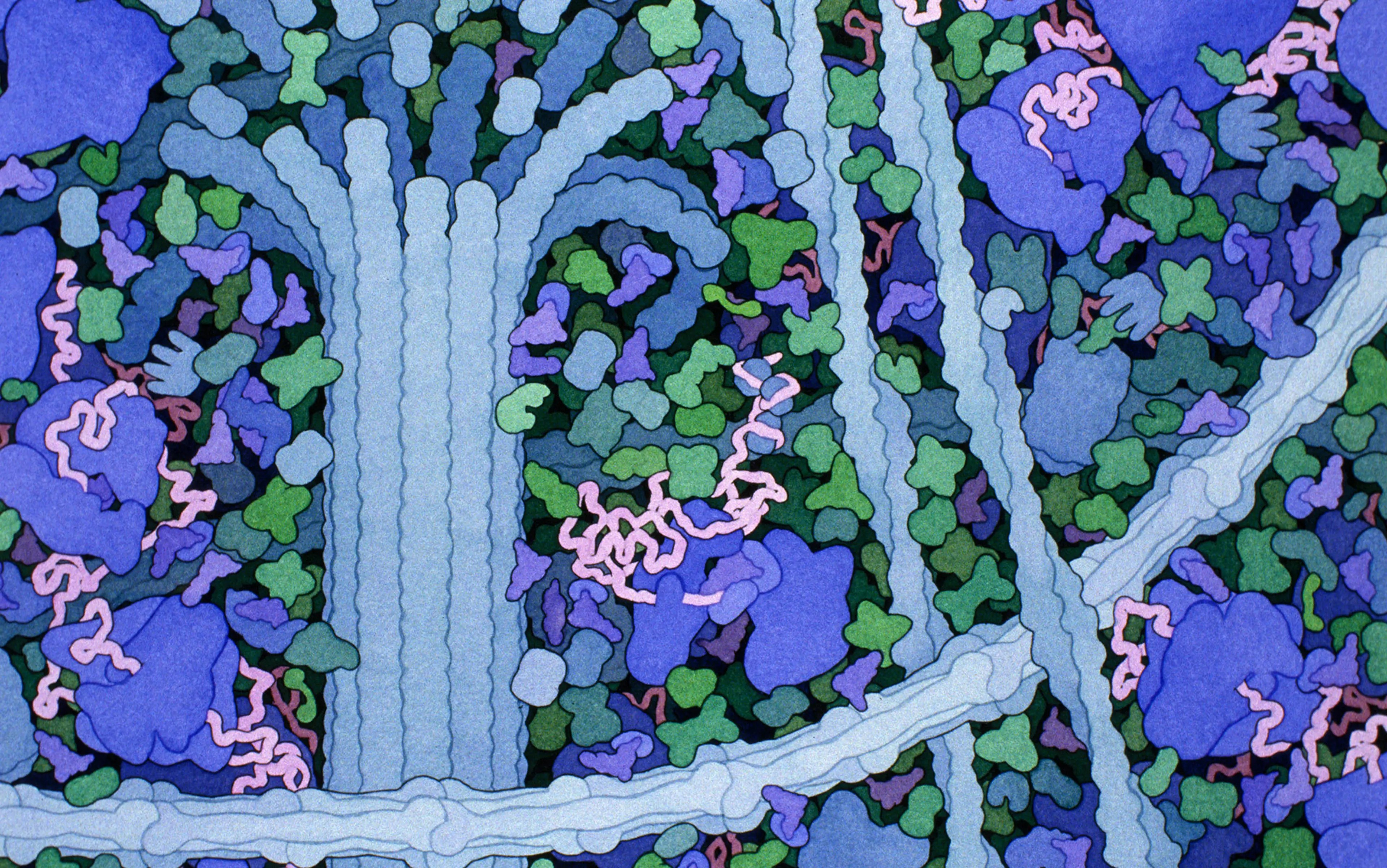
And so, as Charudatta Navare explains, we need to be thoughtful about how we talk about them, as prevailing scientific narratives project human social hierarchies onto nature in misleading ways…
When you think about it, it is amazing that something as tiny as a living cell is capable of behaviour so complex. Consider the single-cell creature, the amoeba. It can sense its environment, move around, obtain its food, maintain its structure, and multiply. How does a cell know how to do all of this? Biology textbooks will tell you that each eukaryotic cell, which constitutes a range of organisms from humans to amoeba, contains a control centre within a structure called the nucleus. Genes present in the nucleus hold the ‘information’ necessary for the cell to function. And the nucleus, in turn, resides in a jelly-like fluid called the cytoplasm. Cytoplasm contains the cellular organelles, the ‘little organs’ in the cell; and these organelles, the narrative goes, carry out specific tasks based on instructions provided by the genes.
In short, the textbooks paint a picture of a cellular ‘assembly line’ where genes issue instructions for the manufacture of proteins that do the work of the body from day to day. This textbook description of the cell matches, almost word for word, a social institution. The picture of the cytoplasm and its organelles performing the work of ‘manufacturing’, ‘packaging’ and ‘shipping’ molecules according to ‘instructions’ from the genes eerily evokes the social hierarchy of executives ordering the manual labour of toiling masses. The only problem is that the cell is not a ‘factory’. It does not have a ‘control centre’. As the feminist scholar Emily Martin observes, the assumption of centralised control distorts our understanding of the cell.
A wealth of research in biology suggests that ‘control’ and ‘information’ are not restricted at the ‘top’ but present throughout the cell. The cellular organelles do not just form a linear ‘assembly line’ but interact with each other in complex ways. Nor is the cell obsessed with the economically significant work of ‘manufacturing’ that the metaphor of ‘factory’ would have us believe. Instead, much of the work that the cell does can be thought of as maintaining itself and taking ‘care’ of other cells.
Why, then, do the standard textbooks continue to portray the cell as a hierarchy? Why do they invoke a centralised authority to explain how each cell functions? And why is the imagery so industrially loaded?…
We need better metaphors to describe cellular life: “The cell is not a factory,” from @charudatta_n in @aeonmag.
* cytologist and author L.L. Larison Cudmore
###
As we avoid anthropomorphism, we might recall that it was on this date in 1981 that the first patent for a life form (U.S. No. 4,259,444) was issued to Ananda Chakrabarty (who had done his research at GE). Chakrabarty had developed Pseudomonas bacterium (now called Burkholderia cepacia) which can be used to clean up toxic spills (as it can break down crude oil into simpler substances that can even become food for aquatic life)– an ability possessed by no naturally occurring bacteria.
The application had been originally denied by the patent office, on the grounds that under patent law at that time, living things were generally understood to not be patentable subject matter under 35 U.S.C. § 101.
Chakrabarty (and GE) appealed (to the Board of Patent Appeals and Interferences), lost, and appealed again ( the United States Court of Customs and Patent Appeals) and prevailed…. At which point, the Patent Office (led by director Sydney Diamond) appealed in civil court.
Ultimately, the Supreme Court ruled (5-4, Diamond v. Chakrabarty) in Chakrabarty’s favor. As Chief Justice Warren Burger wrote for the majority, life can be patented if they are the outcome of “human ingenuity and research” and not “nature’s handiwork”– a ruling that cleared the way for patents to be issued on genetically-engineered mice and other animals, seeds, and more.

You must be logged in to post a comment.