“Every living thing is made of cells, and everything a living thing does is done by the cells that make it up”*…
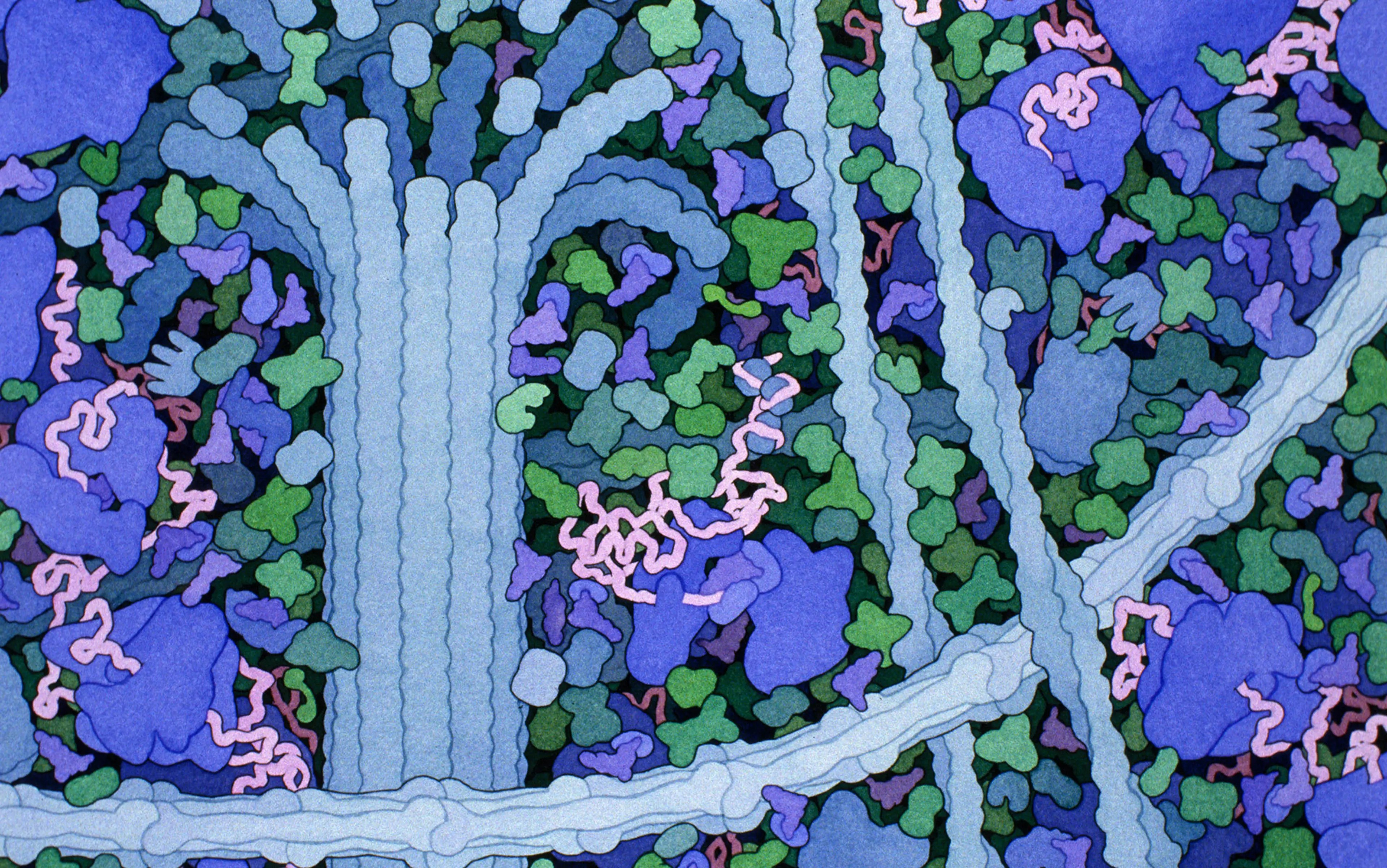
And so, as Charudatta Navare explains, we need to be thoughtful about how we talk about them, as prevailing scientific narratives project human social hierarchies onto nature in misleading ways…
When you think about it, it is amazing that something as tiny as a living cell is capable of behaviour so complex. Consider the single-cell creature, the amoeba. It can sense its environment, move around, obtain its food, maintain its structure, and multiply. How does a cell know how to do all of this? Biology textbooks will tell you that each eukaryotic cell, which constitutes a range of organisms from humans to amoeba, contains a control centre within a structure called the nucleus. Genes present in the nucleus hold the ‘information’ necessary for the cell to function. And the nucleus, in turn, resides in a jelly-like fluid called the cytoplasm. Cytoplasm contains the cellular organelles, the ‘little organs’ in the cell; and these organelles, the narrative goes, carry out specific tasks based on instructions provided by the genes.
In short, the textbooks paint a picture of a cellular ‘assembly line’ where genes issue instructions for the manufacture of proteins that do the work of the body from day to day. This textbook description of the cell matches, almost word for word, a social institution. The picture of the cytoplasm and its organelles performing the work of ‘manufacturing’, ‘packaging’ and ‘shipping’ molecules according to ‘instructions’ from the genes eerily evokes the social hierarchy of executives ordering the manual labour of toiling masses. The only problem is that the cell is not a ‘factory’. It does not have a ‘control centre’. As the feminist scholar Emily Martin observes, the assumption of centralised control distorts our understanding of the cell.
A wealth of research in biology suggests that ‘control’ and ‘information’ are not restricted at the ‘top’ but present throughout the cell. The cellular organelles do not just form a linear ‘assembly line’ but interact with each other in complex ways. Nor is the cell obsessed with the economically significant work of ‘manufacturing’ that the metaphor of ‘factory’ would have us believe. Instead, much of the work that the cell does can be thought of as maintaining itself and taking ‘care’ of other cells.
Why, then, do the standard textbooks continue to portray the cell as a hierarchy? Why do they invoke a centralised authority to explain how each cell functions? And why is the imagery so industrially loaded?…
We need better metaphors to describe cellular life: “The cell is not a factory,” from @charudatta_n in @aeonmag.
* cytologist and author L.L. Larison Cudmore
###
As we avoid anthropomorphism, we might recall that it was on this date in 1981 that the first patent for a life form (U.S. No. 4,259,444) was issued to Ananda Chakrabarty (who had done his research at GE). Chakrabarty had developed Pseudomonas bacterium (now called Burkholderia cepacia) which can be used to clean up toxic spills (as it can break down crude oil into simpler substances that can even become food for aquatic life)– an ability possessed by no naturally occurring bacteria.
The application had been originally denied by the patent office, on the grounds that under patent law at that time, living things were generally understood to not be patentable subject matter under 35 U.S.C. § 101.
Chakrabarty (and GE) appealed (to the Board of Patent Appeals and Interferences), lost, and appealed again ( the United States Court of Customs and Patent Appeals) and prevailed…. At which point, the Patent Office (led by director Sydney Diamond) appealed in civil court.
Ultimately, the Supreme Court ruled (5-4, Diamond v. Chakrabarty) in Chakrabarty’s favor. As Chief Justice Warren Burger wrote for the majority, life can be patented if they are the outcome of “human ingenuity and research” and not “nature’s handiwork”– a ruling that cleared the way for patents to be issued on genetically-engineered mice and other animals, seeds, and more.

You must be logged in to post a comment.