Posts Tagged ‘art’
“Last night I stayed up late playing poker with Tarot cards. I got a full house and four people died.”*…

In Lewis Carroll’s Nursery Alice (an abridged edition he created for very young children), Alice snaps at the Queen, “Who cares for you? You’re nothing but a pack of cards!”
Well, Elie Bursztein does. Currently the AI cybersecurity technical and research lead at Google and Deepmind, he has had a storied career in tech. He also has a long and loving relationship with cards. In 2023, he established the Etteilla Foundation to house and build on his collection of antique decks (and related books and historical artifacts) and to “democratize access to this unique art form, its history, and its secret role in occult practices.”
Standard decks, transformations decks (where the artists incorporates the card’s pips into their art), classic tarot, divination tarot, and oracle decks– they’re all on display at…
“Discover amazing playing cards from ancient times,” courtesy of @ebursztein.bsky.social.
* Steven Wright
###
As we come up aces, we might recall that it was on this date in 1940 that an ancestor of the art featured above was discovered: a teenager named Marcel Ravidat found the entrance to Lascaux Caves in southwest France when his dog investigated a hole left by an uprooted tree. Ravidat collected three friends, then followed his dog down what turned out to be the narrow entrance into a cavern, where they came upon (part of) the now-storied collection of wall markings— 15,000- to 17,000-year-old paintings, consisting mostly of animal representations– that are among the world’s finest examples of art from the Upper Paleolithic period.

“Bell, book, and candle shall not drive me back, / When gold and silver becks me to come on”*…

via Wikimedia Commons
During the reign of Elizabeth I, Shakespeare’s theater company was under the patronage– and protection– of Elizabeth’s Lord Chamberlain (a series of nobel appointees over the years of her reign). In 1594, one of those Chamberiains– Henry Carey, 1st Baron Hunsdon— oversaw the formation of that troupe, The Lord Chamberlain’s Men. But with Elizabeth’s death in 1603, Shakespeare and his colleagues switched their allegiance to her successor, James (or more formally, James VI and I).
Emily Zarevich suggests that one of the impacts of that change was the creation of one of theater’s most memorable trios, arguing that the ever-pragmatic Shakespeare added witches to the Scottish play to please his new patron…
If you’ve ever worked as a freelance creator, you might understand the importance of constructing your material to meet your client’s tastes. It was no different in the early seventeenth century.
[In 1603] James VI of Scotland traveled to England to claim the throne as James I of England, following the childless Elizabeth I’s death. James brought with him a wife, three children, a court of Scots, and a lot of eccentricities. One of those eccentricities was James’s obsessive fixation on witches. Star playwright William Shakespeare saw a golden opportunity to get into the king’s good graces and wrote a play with witches as a main plot driver.
The dark, starkly political story of the tragedy Macbeth wouldn’t go anywhere without the three spooky witches, as Shakespeare scholar George Walton Williams outlines. The witches predict Macbeth’s ascension to the Scottish throne and launch him on a campaign of treachery and bloodshed, though they don’t help him perform his evil deeds. This was Shakespeare’s unique take on witches, who were usually cast in literature as more active villains. From Shakespeare’s perspective, an individual’s own decisions determine their destiny, not necessarily the interference of black magic.
Williams draws on the research of other drama critics to expand on this, proposing that “we must listen to the prophecy: the witches prophesied that Macbeth should be king hereafter. There is nothing here that indicates, as the late Professor Harbage has well said, that in order to be king hereafter Macbeth must be murderer first.”
Shakespeare presented Macbeth to a superstitious king who feared magic and tended to blame witches for many of the ills that fell upon both his home and adopted country. Macbeth, also an unstable Scottish king, blames the witches for the ills caused by his own murderous decisions. According to historian Howell V. Calhoun, James I spent his own literary career defaming witches and accusing them of supposed crimes.
“James had firsthand experience with the malign activity of witches, and he left a careful record of it in his pamphlet Newes From Scotland declaring the damnable life and death of Doctor Fian, a notable Sorcerer, which appeared in 1591,” Calhoun documents. “The whole affair hinged about the evil activities of Dr. Fian (alias John Cunningham), Agnis Sampson, and the North Berwick witches, in their attempt to destroy the ship on which James was returning from Denmark with his bride [Anne of Denmark].” James’s collection of “evidence” led to the violent persecution of accused party.
And then there was James I’s three-book treatise Daemonologie, his magnum opus. As Calhoun summarizes, the first part “takes up the subject of magic and necromancy, the second treats of witchcraft and sorcery, and the third discourses of all kinds of spirits and specters. The king’s intention in this work was to prove two things, “the one, that such diuelish artes haue bene and are,” and the other, “what exact trial and seuere punishment they merite.”
Though Shakespeare certainly appealed to James’s interests with the Scottish play, the two men held divergent views on what witches did and not do. If James I of England had written Macbeth, the three witches would have met a rather grisly end. Shakespeare, however, leaves their fates unknown…
“Double, double toil and trouble,” indeed…
Whence the witches: “King James I and the Macbeth Witches,” from @jstordaily.bsky.social.
* Shakespeare, King John
###
As we watch the fire burn, and cauldron bubble, we might recall that it was on this date in 1601, not long after the ascension of James, that William’s father, John Shakespeare, was buried at Holy Trinity Church in Stratford-upon-Avon. His son joined his father there 15 years later.

“If one could only catch that true color of nature. The very thought of it drives me mad.”*…

From ochre to lapis lazuli, Stephanie Krzywonos opens a door into the entangled histories of our most iconic pigments, revealing how colors hold stories of both lightness and darkness. She begins…
OCHRE
Darkness filled Font-de-Gaume cave. But dark is not the same as the color black. Dark means little or no light. Black isn’t an absence, but a presence.
Font-de-Gaume contains the only polychromatic prehistoric cave art still open to the public. Lascaux, fourteen miles away, closed to visitors in 1963: the carbon dioxide and humidity from human sweat and breath was damaging the paintings. Outside the cave in daylight, large beige-grey marbled cliffs overhung the habitable cottages of Les Eyzies-de-Tayac and the ruins of human shelters around 40,000 years old. Here, in 1868, a geologist uncovered the bones of five Cro-Magnon skeletons, which, at the time, were the earliest known examples of Homo sapiens sapiens—us. Homo sapiens, in Latin, means the wise human. Inside the cave, 250 earth-colored images of reindeer, bison, woolly mammoths, ibexes, horses, and a wolf haunted the walls. Most of the animals were outlined in thick black lines and filled in with rich, earthy ochre paint.
Pigment, a form of nature, is an insoluble substance that gives color to paint and other materials. The melanin in hair, skin, and eyes is a pigment, so is the chlorophyll in plants. Ochre—found decorating 350,000-year-old paleolithic bones—is the oldest colored pigment used by humans. In 2008, archaeologists discovered a 100,000-year-old painting kit in a cave in South Africa which included ochre pigments, an abalone shell used as a palette, a stone for grinding, and bone spatulas for mixing and dabbing the paste. Ochre is life in the form of a paste. To make it, gather earth, specifically clay or rock from land rich in mineral oxides. If not already a powder, crush it, then mix with liquid like fish oil, animal fat, blood, or saliva. Ochre’s iron oxides vary in color, from pale yellow to brown and red, but the oldest documented ochre pigment is red. In the languages of the many ancient Aboriginal cultures who used ochre, there is no distinction between ochre’s color and its substance, ancestral land. We still use red ochre in lipstick.
In the cave, our guide, Blaise, told us that experts thought the artist, or artists, intended these paintings for worship, reverence, and ceremony and painted on scaffolding by the flickering light of reindeer fat. Blaise also told us the artists were tall and dark-skinned—we would call them Black. As a so-called “person of color,” this intrigued me.
Our battery-powered light was steady and still as it illuminated a bison placed so precisely that the natural lumpiness of the rock wall made its bulk look real. Blaise asked us to imagine how the movement of the flames would have made the animals look alive, their muscles rippling and quivering on a canvas made of rock. In front of me, a female reindeer kneeled, and a male tenderly licked her forehead. The image was around 16,000 years old. Between 10,000 and 11,000 years ago, as the planet warmed and our last ice age ended, all of the reindeer in these paintings retreated northward with glaciers or were hunted to extinction.
Blaise asked us to stand near a different wall, then turned on a light. An outline of an artist’s hand was inches from my face. The hand seemed to pulse. Maybe it was just my heart pumping blood behind my eyes. The artist had filled his mouth with the same ochre used to color the animals, held up his large left hand, then sprayed ochre paint against the wall. Whose blood, whose spit, whose fat was this? The artist could have been hunting, been doing anything else in sunlight, but chose to enter the dark to paint, to love what is, to record a reindeer kiss forever, or for as long as rock lasts.
These artists didn’t just try to capture what they loved—they left a warning. One motif in prehistoric cave art, Blaise said, was to paint the most dangerous, violent animals in the deepest part of the cave. We were not allowed to travel deeper inside of Earth to see them: Font-de-Gaume, this museum of prehistoric art, was re-discovered in 1901, and already people had destroyed too many paintings. The animals in the very back were a woolly rhinoceros, a lion, and the profile of a human face, on which a tear appears to fall.
Maybe, as reindeer herds dwindled, the artists were expressing their sorrow and regret. Perhaps the face is saying: if we are not wise, our loves can lead down hideous paths…
Continue around the wheel: “Museum of Color,” from @stephkrzywonos.bsky.social in @emergencemagazine.bsky.social.
* Andrew Wyeth
###
As we ponder pigment, we might recall that it was on this date in 1810 that a work in sympathy with Krzywonos’ first appeared: Johann Wolfgang von Goethe‘s Theory of Colors (Zur Farbenlehre, literally, ‘On color theory’).
Though he is, of course, remembered– and revered– for Faust and so much more, Goethe considered Theory of Colors his most important work. In it, he contentiously (and incorrectly) characterized color as arising from “the dynamic interplay of light and darkness through the mediation of a turbid medium.” Scientists have coalesced around (and built upon) Isaac Newton’s theory.
Still, Goethe was the first systematically to study the psychological effects of color; his observations of the effect of opposed colors led him to a symmetric arrangement of his color wheel, “for the colors diametrically opposed to each other… are those which reciprocally evoke each other in the eye.” Indeed, after being translated into English by Charles Eastlake in 1840, his theory became widely adopted by the art world, most notably by J. M. W. Turner and later, the Pre-Raphaelites and Wassily Kandinsky.
As Ernst Lehrs wrote, “In point of fact, the essential difference between Goethe’s theory of colour and the theory which has prevailed in science (despite all modifications) since Newton’s day, lies in this: While the theory of Newton and his successors was based on excluding the colour-seeing faculty of the eye, Goethe founded his theory on the eye’s experience of colour.” Or, as Wittgenstein put it (in Culture and Value, MS 112 255:26.11.1931): “I believe that what Goethe was really seeking was not a physiological but a psychological theory of colours.”

“Sitting with a deck of cards in your hand all day is an obsession”*…
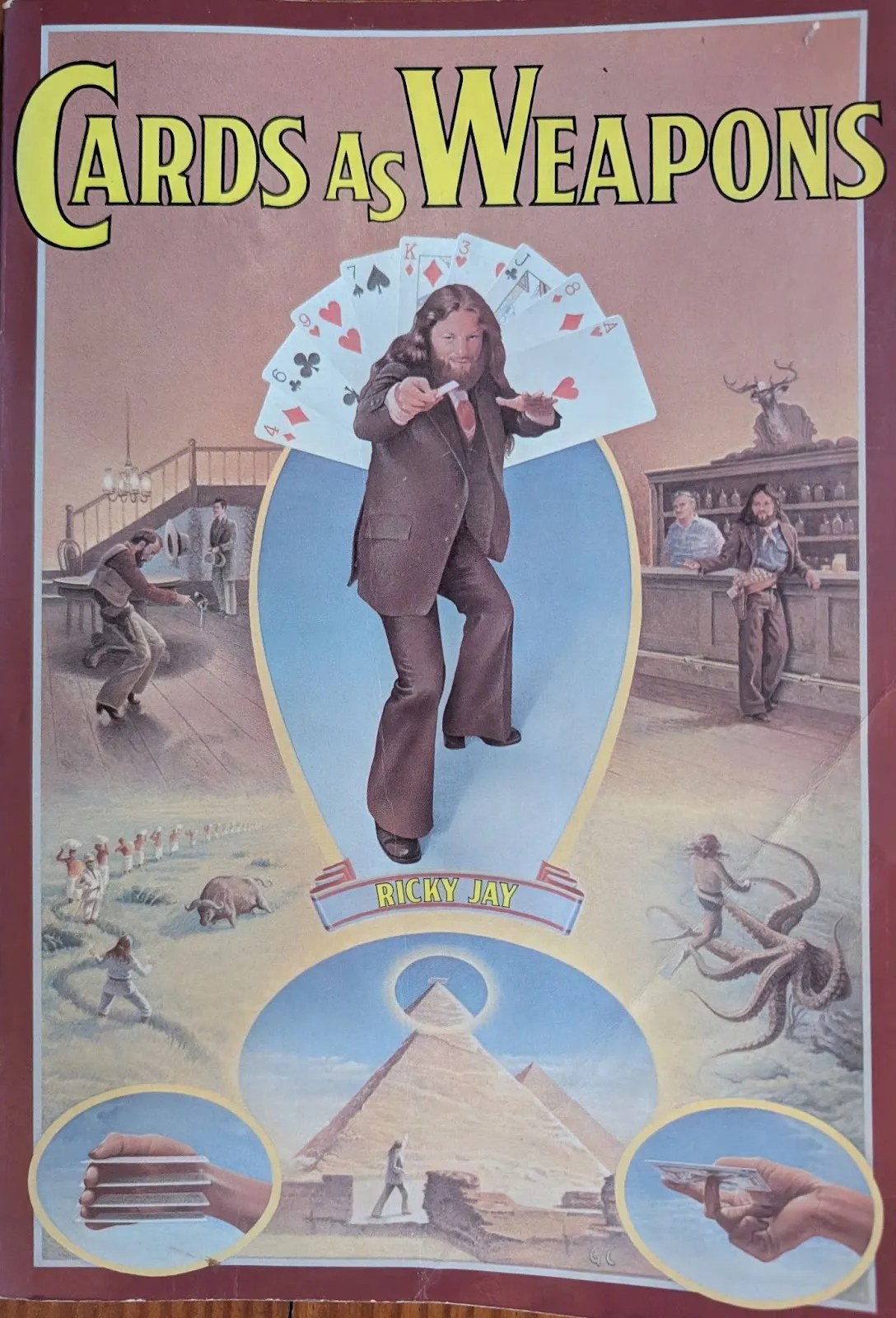
Long-time reader will know of your correspondent’s affection and respect for the late, great Ricky Jay (see. e.g., here and here). The estimable Quentin Hardy (and here), recalls the happy experience of seeing Jay perform his remarkable stage show, “Ricky Jay and His 52 Assistants” (“who were, of course, an ordinary deck of cards, serving under his complete domination”) and the realization that it triggered…
… Ricky Jay – it seems absurd to reduce that mellifluous name to its given or surname components, and parodically stuffy to write “Mr. Jay” – was primarily a close magician, moving cards and coins in all sorts of magical ways. He was also renowned as a card thrower, onstage penetrating a watermelon at 10 paces, and tossing a card as far as 190 feet, or at 90 miles per hour. He was an actor, an engaging writer, a bibliophile, and a deeply learned historian of freaks, cons, conjurers, armless calligraphers, and other nonstandard humans.
What I saw of his secret, I believe, illuminated his talent and his other motivating interests.
I don’t remember details of his lacerating onstage game, though it was excellent entertainment for us marks and his audience. After a couple of minutes we were swept off so he could move on to another amazement. But not before I saw his thumb.
Ricky Jay’s thumb was a seemingly unassuming digit, at rest beneath the clever patter, the astonishing cards dancing across the table, and the beautiful fingers controlling the cards’ movements, then recalling them to their correct place in the deck. By chance, I noticed this thumb running alongside the deck in between deals, and even though the magician was talking to me I sensed a sensitive side communication between the thumb and the man.
It was akin to watching wild nature, when an animal’s excellence is at one with its environment. No, it was better: It was wild nature guided by a fierce human intelligence. I saw him talking to the audience, but he was in a side conversation with a thumb that knew by feel where every card was. This knowledge was the outcome of focused years, which had extended the man’s talent beyond his body into the deck of cards. The state would be aspirational, except a dolt such as I (and, sorry, likely you too, dear reader) can hardly imagine this state of perfection.
What was his trick? The trick was training so deep that his thumb knew where every card was, and could say where it needed to go next. While he was talking, he was checking in with it, making sure everything was in its place as he readied himself for the next seamless adventure.
This may sound comical, but I was awed by a moment of man and thumb, and all that had gone into it. I saw hours of work, a pursuit beyond training with the goal of melding oneself with an object, until the practitioner and the object are completely attuned.
There are other examples of this fusion of identity with an action or object. Jimi Hendrix, as he moved from a band guitarist to a phenomenon, practiced leaning against a wall, so he wouldn’t hurt himself when he fell asleep. W.C. Fields, like Ricky Jay the product of a childhood he’d as soon forget, practiced the juggling that made him a vaudeville star over a boardinghouse bed, so he could likewise collapse, then get up and resume. The classical violinist Chee-yun Kim, who fell asleep playing the piano at age 3 (her mother, terrified, moved her to the fiddle), once forgot to eat during a three-day recording session. There are many more examples…
… I think about Ricky Jay’s thumb, and practicing so hard that part of you enters a physical object, when I think of his breakthrough book, “Learned Pigs and Fireproof Women.” A compendium of extraordinary performers in history, it memorializes the high divers, master memorizers, poison drinkers and fire resisters, and the woman who wrote, simultaneously, four different words with her hands and feet. Some performers are mountebanks, but the most moving passages are about people whose circumstances compelled them to will themselves into something superhuman.
It may be necessity, as in the case of the armless pianist who played with his toes. Or it may be pure chance, as befell Leon Rauch, a hallucinating teenage runaway who met a conjuror, and threw himself into close magic and contortionism. He gained worldwide fame as LaRoche, when he trapped himself in a small sphere and shifted his center of gravity sufficiently to roll up a 50-foot vertical spiral, an adult curled up like a fetus, dazzling the world as he climbed far above them. Far from his origins, too. Call it “dedication” or “obsession.” The goal is transformation, and an escape into a new self.
Ricky Jay, and many other extraordinary entertainers, encourage their reputation as hard-edged guys in a hard world. Indeed, both he and his mentor, the magician Dai Vernon, sought out card cheats, con men, fakes, and other scoundrels. They were searching for the mechanics of their treachery on the unwitting. These villains were presumably not interested in transformation, but simply grift.
Over the years. I have given copies of “Learned Pigs” to more than one acquaintance going through a difficult time, and to this day I keep a few spare copies on hand. It works like magic. Until today I have not disclosed Ricky Jay’s secret: There is no secret, there is only the desire and will for transformation that is inside us all…
A great magician, and an estimable escape artist of a different kind: “Ricky Jay’s Thumb.”
* Ricky Jay
###
As we shuffle and cut, we might recall that it was on this date in 1975 that the master tapes of the ELO album, Face the Music, went to the pressing plant. It featured “Strange Magic” and was their first to earn a platinum record.

“To the vector belong the spoils”*

Long-time readers will know of your correspondent’s love for animator extraorinaire Chuck Jones (e.g., here). “Ellsworth Toohey” in Boing Boing reminds us that the master’s range was broad…
In 1965 animator Chuck Jones adapted a short picture book called The Dot and The Line: a romance in lower mathematics as a 9-minute cartoon. It follows a rigid blue line who adores a carefree red dot; she, however, swoons for a swaggering squiggle.
Rejected, the line enrolls in self-improvement boot camp, bending, flexing and inventing dazzling angles until he can sketch cathedrals with a single stroke. When the squiggle tries to match the precision, his chaotic scribbles collapse, and the dot chooses discipline over disorder.
Narrated with champagne-dry wit by Robert Morley, the film unfolds on spare backgrounds that feel lifted from a Mondrian canvas, while the squiggle’s jittery form was drawn on rice paper so the ink could literally misbehave. Norton Juster, author of the 1963 book, adapted his own text, seasoning math jokes with romantic wisdom: “To the vector belong the spoils.”
The short captured the 1965 Oscar for Best Animated Short, one of MGM’s final cartoons and proof that Jones could do more than torment coyotes. Decades later, its crisp pop-art minimalism still inspires…
“Chuck Jones’ 1965 Oscar-winning cartoon about a lovesick like and a dallying dot,” from @boingboing.net.
* Norman Juster
###
As we learn from the best, we might recall that it was on this date in 1967 that Chuck Jones gave AFI Report an edited and slightly abridged copy of the speech he had just given at the the World Animation Retrospective, held in Montreal in 1967. (That year was Canada’s 100th birthday and the country celebrated by hosting Expo ’67 in Montreal. The animation retrospective, curated by Louise Beaudet for the Cinémathèque Québecoise was part of the celebration.) The quarterly publication of the American Film Institute subsequently published it, under the title “Animation is a Gift Word,” in a 1974 issue devoted to animation.
Animation festivals were a relatively new idea at the time. Annecy had started in 1960, but festivals in Zagreb and Hiroshima were still in the future. The Montreal event may have been the first international animation gathering on North American soil. Close to 200 animation professionals attended from North America, Europe and Asia.
The list of attendees can only be described as impressive. The U.S. was represented by people from both coasts: Chuck Jones, Bob Clampett, Ward Kimball, Ub Iwerks, Abe Levitow, Pete Burness, June Foray, Paul Frees, Bill Hurtz, Steven Busustow, Les Goldman, Dave Hilberman, Jimmy Murakami, Milt Gray, Michael Lah, Fred Wolf, Walter Lantz, Bill Littlejohn, Art Babbitt, Bill Tytla, J.R. Bray, Otto Messmer, Pepe Ruiz, Edith Vernick, Shamus Culhane, John Culhane, I. Klein, Ruth Gench, Arnold Gillespie, Grim Natwick, Tissa David, Barrie Nelson, Dave Fleischer, Paul Terry, Mordi Gerstein, Ed Smith, Robert Breer, Richard Rauh, Phil Klein, Al Stahl, and Ruth Kneitel.
Canadian attendees included Norman McLaren, Grant Munro, Gerry Potterton, Mike Miller, and Ron Tunis.
Europeans included Len Lye, Peter Foldes, Fedor Khitruk, Jean Image, Bretislaw Pojar, John Halas, Bruno Bozzetto, Dusan Vukotic, Zelimir Matko, Ivan Ivanov-Vano, and S. Mancian.
A historian present on the site could have written a history of animation just by talking to the attendees…
– source
For photos of that remarkable crowd, see the link just above and here.
And for the text of the speech, see here.

You must be logged in to post a comment.