Posts Tagged ‘cards’
“Last night I stayed up late playing poker with Tarot cards. I got a full house and four people died.”*…

In Lewis Carroll’s Nursery Alice (an abridged edition he created for very young children), Alice snaps at the Queen, “Who cares for you? You’re nothing but a pack of cards!”
Well, Elie Bursztein does. Currently the AI cybersecurity technical and research lead at Google and Deepmind, he has had a storied career in tech. He also has a long and loving relationship with cards. In 2023, he established the Etteilla Foundation to house and build on his collection of antique decks (and related books and historical artifacts) and to “democratize access to this unique art form, its history, and its secret role in occult practices.”
Standard decks, transformations decks (where the artists incorporates the card’s pips into their art), classic tarot, divination tarot, and oracle decks– they’re all on display at…
“Discover amazing playing cards from ancient times,” courtesy of @ebursztein.bsky.social.
* Steven Wright
###
As we come up aces, we might recall that it was on this date in 1940 that an ancestor of the art featured above was discovered: a teenager named Marcel Ravidat found the entrance to Lascaux Caves in southwest France when his dog investigated a hole left by an uprooted tree. Ravidat collected three friends, then followed his dog down what turned out to be the narrow entrance into a cavern, where they came upon (part of) the now-storied collection of wall markings— 15,000- to 17,000-year-old paintings, consisting mostly of animal representations– that are among the world’s finest examples of art from the Upper Paleolithic period.

“Sitting with a deck of cards in your hand all day is an obsession”*…
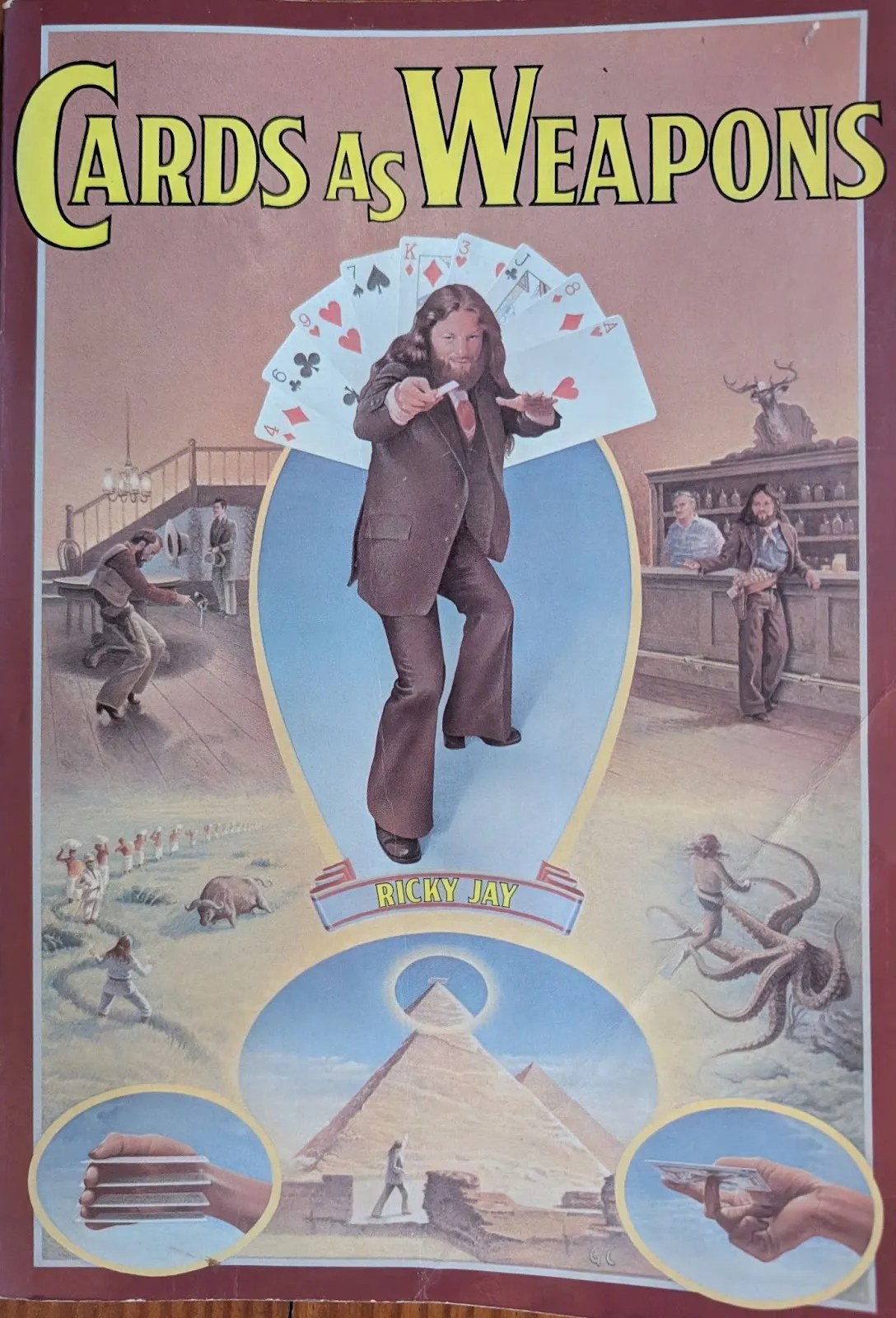
Long-time reader will know of your correspondent’s affection and respect for the late, great Ricky Jay (see. e.g., here and here). The estimable Quentin Hardy (and here), recalls the happy experience of seeing Jay perform his remarkable stage show, “Ricky Jay and His 52 Assistants” (“who were, of course, an ordinary deck of cards, serving under his complete domination”) and the realization that it triggered…
… Ricky Jay – it seems absurd to reduce that mellifluous name to its given or surname components, and parodically stuffy to write “Mr. Jay” – was primarily a close magician, moving cards and coins in all sorts of magical ways. He was also renowned as a card thrower, onstage penetrating a watermelon at 10 paces, and tossing a card as far as 190 feet, or at 90 miles per hour. He was an actor, an engaging writer, a bibliophile, and a deeply learned historian of freaks, cons, conjurers, armless calligraphers, and other nonstandard humans.
What I saw of his secret, I believe, illuminated his talent and his other motivating interests.
I don’t remember details of his lacerating onstage game, though it was excellent entertainment for us marks and his audience. After a couple of minutes we were swept off so he could move on to another amazement. But not before I saw his thumb.
Ricky Jay’s thumb was a seemingly unassuming digit, at rest beneath the clever patter, the astonishing cards dancing across the table, and the beautiful fingers controlling the cards’ movements, then recalling them to their correct place in the deck. By chance, I noticed this thumb running alongside the deck in between deals, and even though the magician was talking to me I sensed a sensitive side communication between the thumb and the man.
It was akin to watching wild nature, when an animal’s excellence is at one with its environment. No, it was better: It was wild nature guided by a fierce human intelligence. I saw him talking to the audience, but he was in a side conversation with a thumb that knew by feel where every card was. This knowledge was the outcome of focused years, which had extended the man’s talent beyond his body into the deck of cards. The state would be aspirational, except a dolt such as I (and, sorry, likely you too, dear reader) can hardly imagine this state of perfection.
What was his trick? The trick was training so deep that his thumb knew where every card was, and could say where it needed to go next. While he was talking, he was checking in with it, making sure everything was in its place as he readied himself for the next seamless adventure.
This may sound comical, but I was awed by a moment of man and thumb, and all that had gone into it. I saw hours of work, a pursuit beyond training with the goal of melding oneself with an object, until the practitioner and the object are completely attuned.
There are other examples of this fusion of identity with an action or object. Jimi Hendrix, as he moved from a band guitarist to a phenomenon, practiced leaning against a wall, so he wouldn’t hurt himself when he fell asleep. W.C. Fields, like Ricky Jay the product of a childhood he’d as soon forget, practiced the juggling that made him a vaudeville star over a boardinghouse bed, so he could likewise collapse, then get up and resume. The classical violinist Chee-yun Kim, who fell asleep playing the piano at age 3 (her mother, terrified, moved her to the fiddle), once forgot to eat during a three-day recording session. There are many more examples…
… I think about Ricky Jay’s thumb, and practicing so hard that part of you enters a physical object, when I think of his breakthrough book, “Learned Pigs and Fireproof Women.” A compendium of extraordinary performers in history, it memorializes the high divers, master memorizers, poison drinkers and fire resisters, and the woman who wrote, simultaneously, four different words with her hands and feet. Some performers are mountebanks, but the most moving passages are about people whose circumstances compelled them to will themselves into something superhuman.
It may be necessity, as in the case of the armless pianist who played with his toes. Or it may be pure chance, as befell Leon Rauch, a hallucinating teenage runaway who met a conjuror, and threw himself into close magic and contortionism. He gained worldwide fame as LaRoche, when he trapped himself in a small sphere and shifted his center of gravity sufficiently to roll up a 50-foot vertical spiral, an adult curled up like a fetus, dazzling the world as he climbed far above them. Far from his origins, too. Call it “dedication” or “obsession.” The goal is transformation, and an escape into a new self.
Ricky Jay, and many other extraordinary entertainers, encourage their reputation as hard-edged guys in a hard world. Indeed, both he and his mentor, the magician Dai Vernon, sought out card cheats, con men, fakes, and other scoundrels. They were searching for the mechanics of their treachery on the unwitting. These villains were presumably not interested in transformation, but simply grift.
Over the years. I have given copies of “Learned Pigs” to more than one acquaintance going through a difficult time, and to this day I keep a few spare copies on hand. It works like magic. Until today I have not disclosed Ricky Jay’s secret: There is no secret, there is only the desire and will for transformation that is inside us all…
A great magician, and an estimable escape artist of a different kind: “Ricky Jay’s Thumb.”
* Ricky Jay
###
As we shuffle and cut, we might recall that it was on this date in 1975 that the master tapes of the ELO album, Face the Music, went to the pressing plant. It featured “Strange Magic” and was their first to earn a platinum record.

“Patience’s design flaw became obvious for the first time in my life: the outcome is decided not during the course of play but when the cards are shuffled, before the game even begins. How pointless is that?”*…
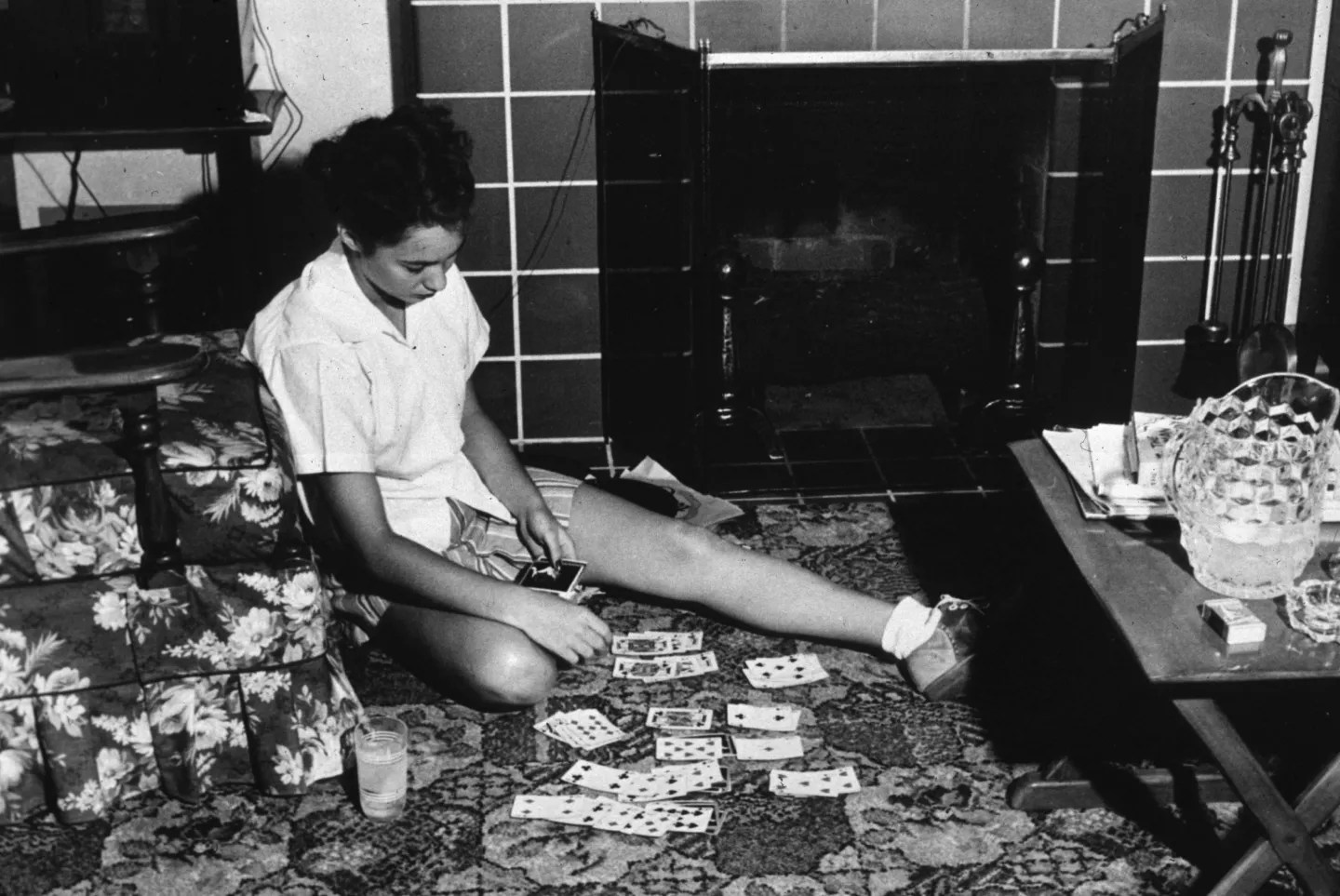
As Simone de Rochefort explains, Patience– or as we tend to know it, solitaire— illustrates the way in which some of humanity’s oldest toys are our most complex…
… last year, I got addicted to Solitaire.
Why me.
During the dark final days of 2024, I was averaging 12 wins per day in Sawayama Solitaire, one of the Solitaires created by developer Zachtronics. Sawayama Solitaire is a variant of Klondike — the one that’s been bundled into every version of Windows since 1990.
Some games of Sawayama Solitaire felt impossible. Some were absurdly easy. Most of them were a satisfying detangling of cards that had me immediately pressing that “new game” button once I got the win.
How was the most basic card game on Earth owning my life like this?
I think it’s because we don’t understand playing cards.
In 1969, as protests raged against the Vietnam War and counterculture made waves across the nation, a magician [and dear friend of Ricky Jay] named Persi Diaconis went to college.
Diaconis had been a professional magician since age 14, and was skilled in sleight-of-hand tricks. But it was probability that fascinated him.
He went on to take a degree in statistics. He became a world-renowned mathematician. In 1992, he proved that it takes seven riffle shuffles to truly randomize a 52-card deck, alongside fellow mathematician Dave Bayer. His research on card shuffling has implications for scientific fields as far-flung as the study of glass melting and the creation of magnets.
He doesn’t know how Solitaire works.
“One of the embarrassment of applied probability is that we can not analyze the original game of solitaire,” he wrote in the abstract for an academic talk called “The Mathematics of Solitaire,” given at the University of Washington in 1999. The talk has been given several times over the years, and is currently viewable on YouTube. One of his most recent appearances, in 2024, reiterates that despite all the technical advances we’ve made in science and mathematics, the complexity of cards is still somewhat a black box.
“What’s the chance of winning, how to play well, how do various changes of rules change the answers?” Diaconis wrote. “Surely you say, the computer can do this. Not at present, not even close.”
It’s not hard to see the relationship between magic and math. Cards contain limitless possibilities. In fact, math tells us there are more combinations of cards in a 52-card deck than there are atoms on Earth.
Writing for Quanta Magazine, Erica Klarreich asked mathematician Ron Graham what that means in practice. He told her, “If everyone had been shuffling decks of cards every second since the start of the Earth, you couldn’t touch 52 factorial,” the number of possible arrangements of a 52-card deck. Klarreich goes on: “Any time you shuffle a deck to the point of randomness, you have probably created an arrangement that has never existed before.”
So that’s nuts…
More amazement at “No one understands how playing cards work,” from @polygon.com.
And here:
* David Mitchell, Cloud Atlas
###
As we shuffle along, we might spare a thought for Christiaan Huygens; he died on this date in 1695. A mathematician, physicist, engineer, astronomer, and inventor, he was a key figure in the Scientific Revolution. In physics, Huygens made seminal contributions to optics and mechanics, while as an astronomer he studied the rings of Saturn and discovered its largest moon, Titan. As an engineer and inventor, he improved the design of telescopes and invented the pendulum clock, the most accurate timekeeper for almost 300 years. A talented mathematician and physicist, his works contain the first idealization of a physical problem by a set of mathematical parameters, and the first mathematical and mechanistic explanation of an unobservable physical phenomenon.
Relevantly to the piece above, Huygens also contributed to the development of probability theory and statistics. In 1665 he visited Paris and encountered the work of Fermat and Pascal, which led him to write what was, at the time, the most coherent presentation of a mathematical approach to games of chance in De Ratiociniis in Ludo Aleae (On reasoning in games of chance)– a work contains early game-theoretic ideas.

“I am sorry I have not learned to play at cards. It is very useful in life: it generates kindness and consolidates society.”*…

Day after tomorrow– this this Wednesday, the 27th– Sotheby’s will be auctioning the late, great Ricky Jay’s remarkable collection of magic publications and artifacts…
… You have the rare opportunity to get your hands on a complete guide to the base practices of highwaymen, sharpers, swindlers, money-droppers, duffers, setters, mock-auctions, quacks, bawds, jilts, etc. in eighteenth-century London.
That text is part of The Ricky Jay Collection, perhaps the world’s greatest assemblage of books on magic, deception, and trickery. As detailed in this enjoyable New York Times report, the Sotheby’s sale is a cornucopia of oddities from the late conjurer.
What’s really for sale — beyond the Houdini posters, guides to card tricks, and beautiful landscapes painted by armless entertainers — is the source material for Ricky Jay’s storytelling.
Jay (1946-2018) was, by all accounts, one of the world’s greatest practitioners of legerdemain, a word that literally translates as light of hand [see here for its amusing etymology]. In other words, he did card tricks. But not just any card tricks: His 1977 book Cards As Weapons (available for free here!) begins with a letter to the Secretary of Defense explaining just how valuable his skills might be:
“Drawing on techniques developed hundreds of years ago by ‘ninja’ assassins, I have developed my own system of self-defence based solely on a pack of cards,” he wrote. “I believe I have discovered a viable method of reducing the defence budget while keeping a few steps ahead of the Russkies.”
And Jay could indeed pierce the skin of a watermelon with a playing card from across a room. But when you came right down to what he did with his 52 assistants, the man was famous for moving pieces of waxed paper around on a table. The gulf between collating stationery and “the theatrical representation of the defiance of natural law” was filled by his deep knowledge and ready wit.
One of his signature tricks was The Four Queens, in which the waxed rectangles with the Qs in their corners are blended into the pack and need to be reunited. Or as Jay framed it, “I have taken advantage of these tenderly nurtured and unsophisticated young ladies by placing them in positions extremely galling to their aristocratic sensibilities.”
You can really see the storytelling taking shape here in his Sword of Vengeance trick. What do shogun assassins have to do with cards? That’s exactly what you forget to ask until it’s too late:
Jay’s ability to unspool a story was clearly infectious, as his profilers couldn’t resist taking flights of erudition.
“He’s like someone carving scrimshaw while surrounded by Macy’s Thanksgiving Day dirigibles,” wrote Tom Carson in Grantland.
“His patter was voluble, embroidered with orotund, baroque locutions; he would describe the watermelon rind, for instance, as the ‘thick pachydermatous outer melon layer’,” wrote Mark Singer in The New Yorker.
To include him in the pantheon of Great Wits is to recognize why he amassed The Ricky Jay Collection and what he learned from it. The shaggy dog story, as previously detailed in GWQ #101, is a psychological non-sequitur: You follow it at great length to eventually learn it goes nowhere. But in Ricky Jay’s dexterous hands, the story was an ideal way to distract you from his dexterous hands. His words were how he could really transport the audience into a world of wonders. It’s as if he harnessed the shaggy dogs and mushed them through the Iditarod…
The wit that powered the tricks: “Ricky Jay’s slight of tongue,” from Benjamin Errett (@benjaminerrett)
* Samuel Johnson
###
As we riffle and cut, we might send accomplished birthday greetings to Marion Eileen Ross; she was born on this date in 1928. An actress with a long history in film (e.g., The Glenn Miller Story, Sabrina, Lust for Life, Teacher’s Pet, Some Came Running, and Operation Petticoat), she is best remembered for her role as Marion Cunningham on the sitcom Happy Days, on which she starred from 1974 to 1984 and for which she received two Primetime Emmy Award nominations. (That said, your correspondent will always remember her for her remarkable performances as Grandma SquarePants in SpongeBob SquarePants.)

“Everyone should be able to do one card trick, tell two jokes, and recite three poems, in case they are ever trapped in an elevator”*…

When watching a magician perform some card tricks, it’s a legitimate question to ask: “Would you be able to cheat at a card game?” Most performers will smirk and wink, implying they could. Truth is: they probably can’t. Sleight-of-hand with cards for conjuring and entertainment purposes is one thing; gambling techniques to cheat at cards is a whole other story. Sometimes these two domains overlap, in that liminal zone of the so called “gambling demonstrations.” However, the gamblers’ “real work” entails a very different skillset from that of a magician—while true gambling techniques are among the most fascinating and difficult to master.
In the realm of gambling techniques with cards, one name immediately commands undivided admiration and respect. That name is Steve Forte. It’s no hyperbole to say that what Forte can do with a pack of cards borders the unbelievable; his skillful handling is the closest thing to perfection in terms of technique. Here is a taste of his smooth and classy dexterity:
Steve Forte’s career spans over 40 years within the gambling industry. After dealing all casino games and serving in all casino executive capacities, he shifted gears to a spectacularly successful career as a professional high-stakes Black Jack and Poker player; shifting gears again, he later became a top consultant in the casino security field. To dig deeper into Forte’s adventurous and shapeshifting life, the go-to place is the enduring profile penned by R. Paul Wilson for the October 2005 issue of Genii Magazine.
Although Forte spent his whole professional career in the gambling world, in the early ’90s he became widely known in the magic community after releasing his famous Gambling Protection Video Series. These tapes turned him into an almost mythical figure, someone with a uniquely vast repertoire of gambling moves, and the remarkable ability to execute these moves—all of them—flawlessly. These tapes still remain the gold standard for any serious gambling enthusiast.
In 2009, the Academy of Magical Arts honored Steve Forte with a Special Fellowship Award, in recognition of his outstanding creative contribution…
Ferdinando Buscema (@ferdinando_MED), himself a master magician and experience designer, with an appreciation in Boing Boing: “What Steve Forte can do with a pack of cards borders on the unbelievable.”
* Daniel Handler
###
As we hold ’em close, we might celebrate a magician of another sort, Brewster Kahle; on this date in 1996 he founded the Internet Archive, home of the Wayback Machine, the Open Library (and its coronavirus-catastrophe-response cousin, the National Emergency Library), and so much more…

You must be logged in to post a comment.