“Sitting with a deck of cards in your hand all day is an obsession”*…
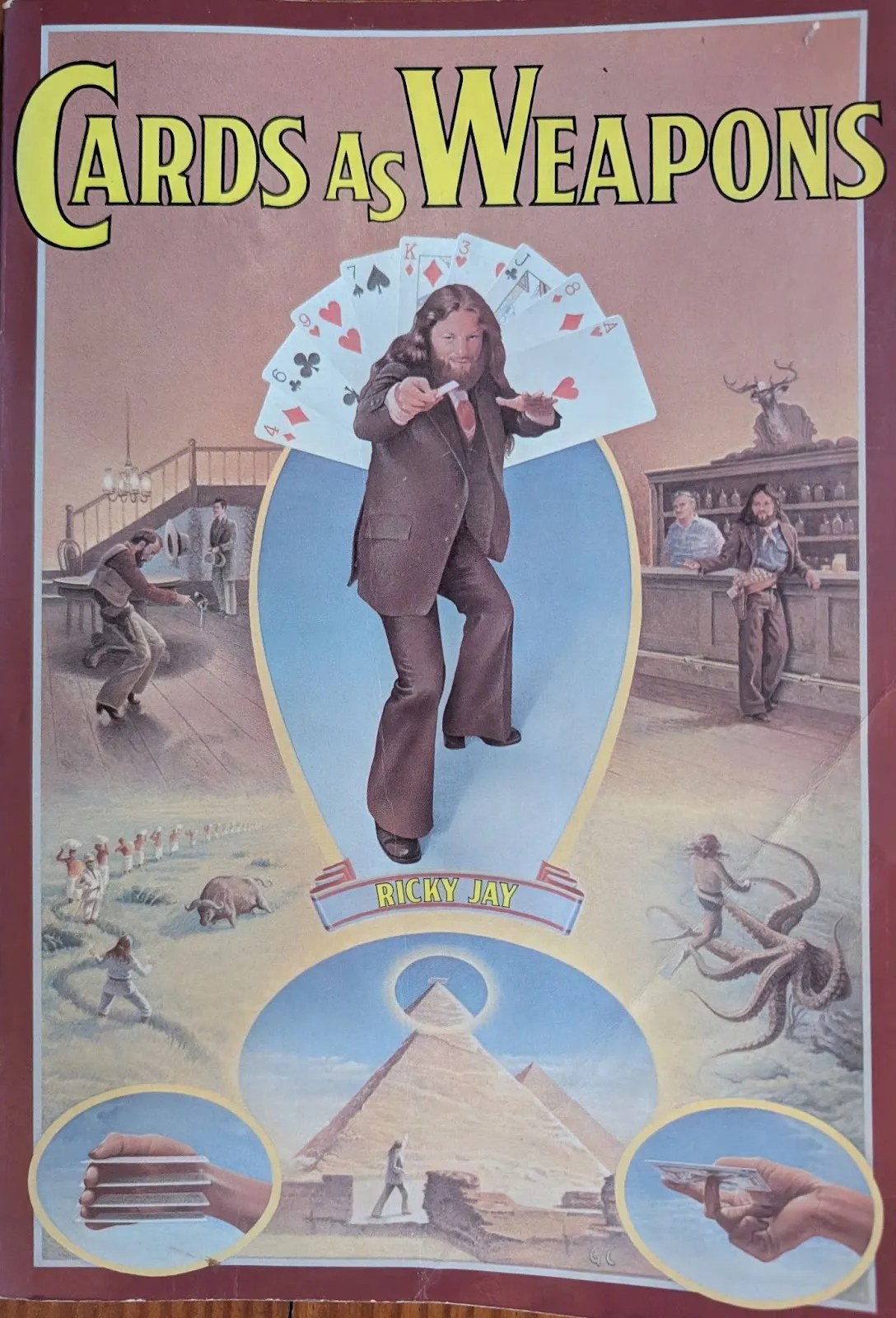
Long-time reader will know of your correspondent’s affection and respect for the late, great Ricky Jay (see. e.g., here and here). The estimable Quentin Hardy (and here), recalls the happy experience of seeing Jay perform his remarkable stage show, “Ricky Jay and His 52 Assistants” (“who were, of course, an ordinary deck of cards, serving under his complete domination”) and the realization that it triggered…
… Ricky Jay – it seems absurd to reduce that mellifluous name to its given or surname components, and parodically stuffy to write “Mr. Jay” – was primarily a close magician, moving cards and coins in all sorts of magical ways. He was also renowned as a card thrower, onstage penetrating a watermelon at 10 paces, and tossing a card as far as 190 feet, or at 90 miles per hour. He was an actor, an engaging writer, a bibliophile, and a deeply learned historian of freaks, cons, conjurers, armless calligraphers, and other nonstandard humans.
What I saw of his secret, I believe, illuminated his talent and his other motivating interests.
I don’t remember details of his lacerating onstage game, though it was excellent entertainment for us marks and his audience. After a couple of minutes we were swept off so he could move on to another amazement. But not before I saw his thumb.
Ricky Jay’s thumb was a seemingly unassuming digit, at rest beneath the clever patter, the astonishing cards dancing across the table, and the beautiful fingers controlling the cards’ movements, then recalling them to their correct place in the deck. By chance, I noticed this thumb running alongside the deck in between deals, and even though the magician was talking to me I sensed a sensitive side communication between the thumb and the man.
It was akin to watching wild nature, when an animal’s excellence is at one with its environment. No, it was better: It was wild nature guided by a fierce human intelligence. I saw him talking to the audience, but he was in a side conversation with a thumb that knew by feel where every card was. This knowledge was the outcome of focused years, which had extended the man’s talent beyond his body into the deck of cards. The state would be aspirational, except a dolt such as I (and, sorry, likely you too, dear reader) can hardly imagine this state of perfection.
What was his trick? The trick was training so deep that his thumb knew where every card was, and could say where it needed to go next. While he was talking, he was checking in with it, making sure everything was in its place as he readied himself for the next seamless adventure.
This may sound comical, but I was awed by a moment of man and thumb, and all that had gone into it. I saw hours of work, a pursuit beyond training with the goal of melding oneself with an object, until the practitioner and the object are completely attuned.
There are other examples of this fusion of identity with an action or object. Jimi Hendrix, as he moved from a band guitarist to a phenomenon, practiced leaning against a wall, so he wouldn’t hurt himself when he fell asleep. W.C. Fields, like Ricky Jay the product of a childhood he’d as soon forget, practiced the juggling that made him a vaudeville star over a boardinghouse bed, so he could likewise collapse, then get up and resume. The classical violinist Chee-yun Kim, who fell asleep playing the piano at age 3 (her mother, terrified, moved her to the fiddle), once forgot to eat during a three-day recording session. There are many more examples…
… I think about Ricky Jay’s thumb, and practicing so hard that part of you enters a physical object, when I think of his breakthrough book, “Learned Pigs and Fireproof Women.” A compendium of extraordinary performers in history, it memorializes the high divers, master memorizers, poison drinkers and fire resisters, and the woman who wrote, simultaneously, four different words with her hands and feet. Some performers are mountebanks, but the most moving passages are about people whose circumstances compelled them to will themselves into something superhuman.
It may be necessity, as in the case of the armless pianist who played with his toes. Or it may be pure chance, as befell Leon Rauch, a hallucinating teenage runaway who met a conjuror, and threw himself into close magic and contortionism. He gained worldwide fame as LaRoche, when he trapped himself in a small sphere and shifted his center of gravity sufficiently to roll up a 50-foot vertical spiral, an adult curled up like a fetus, dazzling the world as he climbed far above them. Far from his origins, too. Call it “dedication” or “obsession.” The goal is transformation, and an escape into a new self.
Ricky Jay, and many other extraordinary entertainers, encourage their reputation as hard-edged guys in a hard world. Indeed, both he and his mentor, the magician Dai Vernon, sought out card cheats, con men, fakes, and other scoundrels. They were searching for the mechanics of their treachery on the unwitting. These villains were presumably not interested in transformation, but simply grift.
Over the years. I have given copies of “Learned Pigs” to more than one acquaintance going through a difficult time, and to this day I keep a few spare copies on hand. It works like magic. Until today I have not disclosed Ricky Jay’s secret: There is no secret, there is only the desire and will for transformation that is inside us all…
A great magician, and an estimable escape artist of a different kind: “Ricky Jay’s Thumb.”
* Ricky Jay
###
As we shuffle and cut, we might recall that it was on this date in 1975 that the master tapes of the ELO album, Face the Music, went to the pressing plant. It featured “Strange Magic” and was their first to earn a platinum record.

You must be logged in to post a comment.