Posts Tagged ‘SpongeBob SquarePants’
“This is not your average, everyday darkness. This is… ADVANCED darkness.”*…
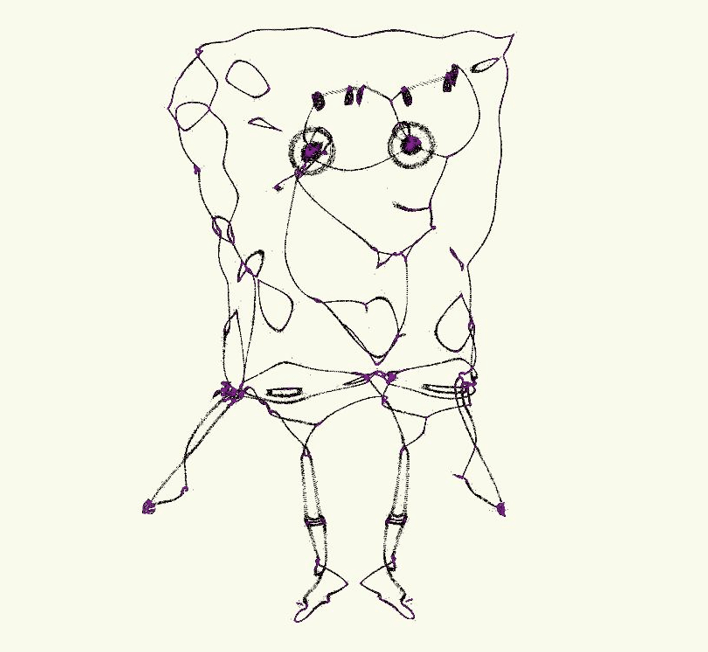
As Rob Beschizza explains, Pere Rosselló, an astrophysics student at Universidad de La Laguna in Tenerife, Spain, has created an animation depicting the gravitational collapse of Spongebob…
Beschizza muses…
Just imagine being part of a civilization on the cusp of attaining a decent model of the universe’s origins—somewhere between Halley and Lemaître, and you start plotting backwards from where we are and where the Big Bang should be you find Spongebob instead. Running the numbers again and again. Such a universe has no need of Lovecraft, cosmic horror would be right there in the maths.
Rosselló [also] solved a three-body problem: the one of animating three bodies to look really cool…
“N-body simulation of the gravitational collapse of Spongebob Squarepants,” by @PeRossello via @Beschizza in @BoingBoing.
* SpongeBob, “Rock Bottom“
###
As we deconstruct deconstruction, we might recall that it was on this date (in an unspecified year) that SpongeBob met the green seahorse Mystery.
“The gods do not visit you to remind you what you know already”*…

Or do they? As the estimable Emily Watson explains, one woman– Edith Hamilton— had a great deal to do with our acquaintance with the mythology of ancient Greece and Rome, and in a way that had as much to do with the present as the past…
The discipline of “classical” literature has long been associated with social gatekeeping. The mastery of Latin and ancient Greek—or at least enough of an acquaintance to be able to trot out a well-worn tag from Horace and prompt knowing chuckles over the brandy—has often provided a useful qualification for passing as a gentleman and keeping out the plebs (Latin for “common people”) or hoi polloi (ancient Greek for “the many”). It is understandable that George Eliot’s Maggie Tulliver eagerly whizzes through the Latin textbooks neglected by her idle brother Tom, or that Thomas Hardy’s Jude, hoping in vain to escape the obscurity of provincial poverty, slogs through his Greek dictionary until late into the night. For these fictional characters, like many of their real-life equivalents, ancient languages and literature provided the most visible bar against entry into a “higher” social class.
Even in the 20th and 21st centuries, the subject has maintained a close association with systems of exclusion based on income, education, race, and gender…
Over the past century, there have been numerous attempts to provide wider access to the supposed treasures of Greek and Roman antiquity to those once excluded from its riches. In the early 20th century, translations of ancient texts became more widely available, ranging from Gilbert Murray’s wonderfully ornate and virtuosic renditions of Euripides to Hilda Doolittle’s much starker modernist free verse. The Loeb Classical Library was founded in 1911 and featured fairly inexpensive editions of these ancient texts in their original languages, with an English translation on the facing page. These translations heralded a new age in which once-inaccessible works of classical literature became more accessible to a far wider range of people. As Virginia Woolf noted in 1917, it was the Loeb Library editions that helped make it “respectable” for the “amateur” (including female ones) to muddle through Aeschylus.
After the First World War, an ever-larger number of colleges and universities in the United States began to offer classes on ancient texts studied in translation, with no expectation that students would be able to read even a little of the originals. By the early 20th century, the study of ancient literature and history was often considered a prerequisite for understanding contemporary issues in Europe and the United States—regions that were now often lumped together under the term “the West.” The Columbia Core, the first such course in the United States, was developed in 1919 with the explicit goal of showing students the “unique features of the western world,” a world that apparently had begun in ancient Greece and that had now reached its apex in the American present.
The goal of connecting US citizens to a long, largely fabricated notion of “Western civilization” seemed increasingly urgent in the aftermath of a war that had torn the nations of Europe apart. The fantasy of a common “Western” heritage shared by white Europeans and North Americans appeared as a prophylactic against future wars, at least between those who could qualify as “Westerners.” But it also did something else. By excluding the numerous surviving ancient texts and cultural artifacts from the rest of the world, these new courses on “Western civilization” suggested that premodern “civilization” was the exclusive property of the “West”—enabling a kind of mythical/historical justification for continued domination of those peoples deemed to have come from outside this exclusive group, whether it was Black and Asian Americans in the United States or the millions still living under imperial and colonial rule in Asia and Africa.
By the 1920s, a sizable market for popular classics books and translations had emerged in the United States. A new publishing firm, W.W. Norton, decided to seize on it and signed up a recently retired Latin teacher and private school headmistress named Edith Hamilton to translate a trio of Greek tragedies and write two surveys of ancient literature, The Greek Way and The Roman Way. Published in quick succession in the 1930s, these volumes proved to be an immediate success. Along with Mythology, her retelling of the Greco-Roman legends, the books made Hamilton a household name. Mythology has never been out of print since then and has remained an extraordinary commercial success, enriching her heirs and publishers to this day. Probably no other single person has had such an impact in shaping the perceptions of classical literature and mythology in the United States for almost a century.
How did a retired Latin schoolteacher (Hamilton was 62 when The Greek Way was published), with limited formal education and almost no scholarly credentials, come to be one of the most influential “classicists” of the 20th century? Victoria Houseman’s annalistic new biography, American Classicist, does not quite see this question as the puzzle it is, in part because Houseman has so much admiration for her subject that Hamilton’s successes are largely taken for granted. But the book still makes for gripping reading, as we trace the trajectory of Hamilton’s life from her activist youth (she was a member of the Baltimore Equal Suffrage League), through her various travels in Europe and Asia, her health troubles (she was a breast cancer survivor), her fascinating romantic partnerships with other women, to her second career as a popularizer of the ancient world and as a public intellectual who became closely associated with wealthy and powerful conservative groups in the US…
Read on for more of Hamilton’s remarkable– and cautionary– story: “Ancient Worlds,” from @EmilyRCWilson (@emilyrcwilson.bsky.social) in @thenation.
###
As we contemplate classics, we might send aquatic birthday greetings to Squidward Tentacles; today is his (fictional) birthday. A main characters of the SpongeBob SquarePants franchise, he is SpongeBob’s and Patrick’s grumpy neighbor and the former’s coworker at the Krusty Krab who lives in an Easter Island head. He is a mostly unpleasant artist and musician, and his favorite hobbies are painting self-portraits and playing the clarinet.
Though Squidward’s name contains the word “squid,” he is an octopus.

“I am sorry I have not learned to play at cards. It is very useful in life: it generates kindness and consolidates society.”*…

Day after tomorrow– this this Wednesday, the 27th– Sotheby’s will be auctioning the late, great Ricky Jay’s remarkable collection of magic publications and artifacts…
… You have the rare opportunity to get your hands on a complete guide to the base practices of highwaymen, sharpers, swindlers, money-droppers, duffers, setters, mock-auctions, quacks, bawds, jilts, etc. in eighteenth-century London.
That text is part of The Ricky Jay Collection, perhaps the world’s greatest assemblage of books on magic, deception, and trickery. As detailed in this enjoyable New York Times report, the Sotheby’s sale is a cornucopia of oddities from the late conjurer.
What’s really for sale — beyond the Houdini posters, guides to card tricks, and beautiful landscapes painted by armless entertainers — is the source material for Ricky Jay’s storytelling.
Jay (1946-2018) was, by all accounts, one of the world’s greatest practitioners of legerdemain, a word that literally translates as light of hand [see here for its amusing etymology]. In other words, he did card tricks. But not just any card tricks: His 1977 book Cards As Weapons (available for free here!) begins with a letter to the Secretary of Defense explaining just how valuable his skills might be:
“Drawing on techniques developed hundreds of years ago by ‘ninja’ assassins, I have developed my own system of self-defence based solely on a pack of cards,” he wrote. “I believe I have discovered a viable method of reducing the defence budget while keeping a few steps ahead of the Russkies.”
And Jay could indeed pierce the skin of a watermelon with a playing card from across a room. But when you came right down to what he did with his 52 assistants, the man was famous for moving pieces of waxed paper around on a table. The gulf between collating stationery and “the theatrical representation of the defiance of natural law” was filled by his deep knowledge and ready wit.
One of his signature tricks was The Four Queens, in which the waxed rectangles with the Qs in their corners are blended into the pack and need to be reunited. Or as Jay framed it, “I have taken advantage of these tenderly nurtured and unsophisticated young ladies by placing them in positions extremely galling to their aristocratic sensibilities.”
You can really see the storytelling taking shape here in his Sword of Vengeance trick. What do shogun assassins have to do with cards? That’s exactly what you forget to ask until it’s too late:
Jay’s ability to unspool a story was clearly infectious, as his profilers couldn’t resist taking flights of erudition.
“He’s like someone carving scrimshaw while surrounded by Macy’s Thanksgiving Day dirigibles,” wrote Tom Carson in Grantland.
“His patter was voluble, embroidered with orotund, baroque locutions; he would describe the watermelon rind, for instance, as the ‘thick pachydermatous outer melon layer’,” wrote Mark Singer in The New Yorker.
To include him in the pantheon of Great Wits is to recognize why he amassed The Ricky Jay Collection and what he learned from it. The shaggy dog story, as previously detailed in GWQ #101, is a psychological non-sequitur: You follow it at great length to eventually learn it goes nowhere. But in Ricky Jay’s dexterous hands, the story was an ideal way to distract you from his dexterous hands. His words were how he could really transport the audience into a world of wonders. It’s as if he harnessed the shaggy dogs and mushed them through the Iditarod…
The wit that powered the tricks: “Ricky Jay’s slight of tongue,” from Benjamin Errett (@benjaminerrett)
* Samuel Johnson
###
As we riffle and cut, we might send accomplished birthday greetings to Marion Eileen Ross; she was born on this date in 1928. An actress with a long history in film (e.g., The Glenn Miller Story, Sabrina, Lust for Life, Teacher’s Pet, Some Came Running, and Operation Petticoat), she is best remembered for her role as Marion Cunningham on the sitcom Happy Days, on which she starred from 1974 to 1984 and for which she received two Primetime Emmy Award nominations. (That said, your correspondent will always remember her for her remarkable performances as Grandma SquarePants in SpongeBob SquarePants.)

You must be logged in to post a comment.