Posts Tagged ‘theories’
“I regard consciousness as fundamental. I regard matter as derivative from consciousness. We cannot get behind consciousness. Everything that we talk about, everything that we regard as existing, postulates consciousness.”*…

The image above is from an engaging essay on “Why we need to figure out a theory of consciousness.” But, as Robert Lawrence Kuhn argues, in practice the issue with “the Hard Problem” might better be understood as the need to choose among, then build upon (one or a few of) the myriad theories that we have. Helpfully, Kuhn has surveyed and mapped that theoretical landscape…
Explanations of consciousness abound and the radical diversity of theories is telling. Explanations, or theories, are said to work at astonishingly divergent orders of magnitude and putative realms of reality. My purpose here must be humble: collect and categorize, not assess and adjudicate. Seek insights, not answers.
Unrealistically, I’d like to get them all, at least all contemporary theories that are sufficiently distinct with explanations that can surmount an arbitrary hurdle of rationality or conceivability. Falsification or verification is not on the agenda. I’m less concerned about the ontological truth of explanations/theories than in identifying them and then locating them on a “Landscape” to enable categorization and assess relationships. Next, I assess implications of categories for “big questions.” Thus, this Landscape is not about how consciousness is measured or evolved or even works, but about what consciousness is and what difference it makes.
It’s the classic “mind-body problem:” How do the felt experiences in our minds relate to the neural processes in our brains? How do mental states, whether sensory, cognitive, emotional, or even noumenal (selfless) awareness, correlate with brain states? The Landscape of Consciousness explanations or theories I want to draw is as broad as possible, including those that cannot be subsumed by, and possibly not even accessed by, the scientific method. This freedom from constraint, as it were, is no excuse for wooly thinking. Standards of rationality and clarity of argument must be maintained even more tenaciously, and bases of beliefs must be specified even more clearly.
I have two main aims: (i) gather and describe the various theories and array them in some kind of meaningful structure of high-level or first-order categories (and under Materialism, subcategories); and (ii) assess their implications, with respect to four big questions: meaning/purpose/value (if any); artificial intelligence (AI) consciousness; virtual immortality; and survival beyond death.
Theories overlap; some work together. Moreover, while a real-world landscape of consciousness, even simplified, would be drawn with three dimensions (at least), with multiple kinds and levels of nestings—a combinatorial explosion (and likely no closer to truth)—I satisfice with a one-dimensional toy-model. I array all the theories on a linear spectrum, simplistically and roughly, from the “most physical” on the left (at the beginning) to the “least physical” on the right (near the end). (I have two final categories after this spectrum.) The physicalism assumed in Materialism Theories of consciousness is characterized by naturalistic, science-based perspectives, while non-materialism theories have various degrees of nonphysicalist perspectives outside the ambit of current science and in some cases not subject to the scientific method of experimentation and replicability.
Please do not ascribe the relative importance of a theory to the relative size of its description. The shortest can be the strongest. It sometimes takes more words to describe lesser-known theories. For each description I feel the tension between conciseness and completeness. Moreover, several are not complete theories in themselves but ways to think about consciousness that strike me as original and perhaps insightful…
There follows are survey of the strands of thought/theory depicted here:

Absolutely fascinating: “A landscape of consciousness: Toward a taxonomy of explanations and implications,” from @RobertLawrKuhn via @RogersBacon1…
… Who also published this apposite article: “A Paradigm for AI Consciousness.”
* Max Planck
###
As we examine explanations, we might send communicative birthday greetings to Camillo Golgi; he was born on this date in 1843. A biologist and pathologist, he discovered a staining technique called black reaction (sometimes called Golgi’s method or Golgi’s staining in his honor) in 1873, a major breakthrough in neuroscience. He was the first to identify axons and dendrites and their functions. He also identified the sense receptors of muscular sensations. Several structures and phenomena in anatomy and physiology are named for him, including the Golgi apparatus, the Golgi tendon organ and the Golgi tendon reflex.
Golgi’s investigations into the fine structure of the nervous system earned him (with the Spanish histologist Santiago Ramón y Cajal) the 1906 Nobel Prize for Physiology or Medicine.

“The pursuit of science is a grand adventure, driven by curiosity, fueled by passion, and guided by reason”*…

Adam Mastroianni on how science advances (and how it’s held back), with a provocative set of suggestions for how it might be accelerated…
There are two kinds of problems in the world: strong-link problems and weak-link problems.
Weak-link problems are problems where the overall quality depends on how good the worst stuff is. You fix weak-link problems by making the weakest links stronger, or by eliminating them entirely.
Food safety, for example, is a weak-link problem. You don’t want to eat anything that will kill you. That’s why it makes sense for the Food and Drug Administration to inspect processing plants, to set standards, and to ban dangerous foods…
…
Weak-link problems are everywhere. A car engine is a weak-link problem: it doesn’t matter how great your spark plugs are if your transmission is busted. Nuclear proliferation is a weak-link problem: it would be great if, say, France locked up their nukes even tighter, but the real danger is some rogue nation blowing up the world. Putting on too-tight pants is a weak-link problem: they’re gonna split at the seams.
It’s easy to assume that all problems are like this, but they’re not. Some problems are strong-link problems: overall quality depends on how good the best stuff is, and the bad stuff barely matters. Like music, for instance. You listen to the stuff you like the most and ignore the rest. When your favorite band releases a new album, you go “yippee!” When a band you’ve never heard of and wouldn’t like anyway releases a new album, you go…nothing at all, you don’t even know it’s happened. At worst, bad music makes it a little harder for you to find good music, or it annoys you by being played on the radio in the grocery store while you’re trying to buy your beetle-free asparagus…
Strong-link problems are everywhere; they’re just harder to spot. Winning the Olympics is a strong-link problem: all that matters is how good your country’s best athletes are. Friendships are a strong-link problem: you wouldn’t trade your ride-or-dies for better acquaintances. Venture capital is a strong-link problem: it’s fine to invest in a bunch of startups that go bust as long as one of them goes to a billion…
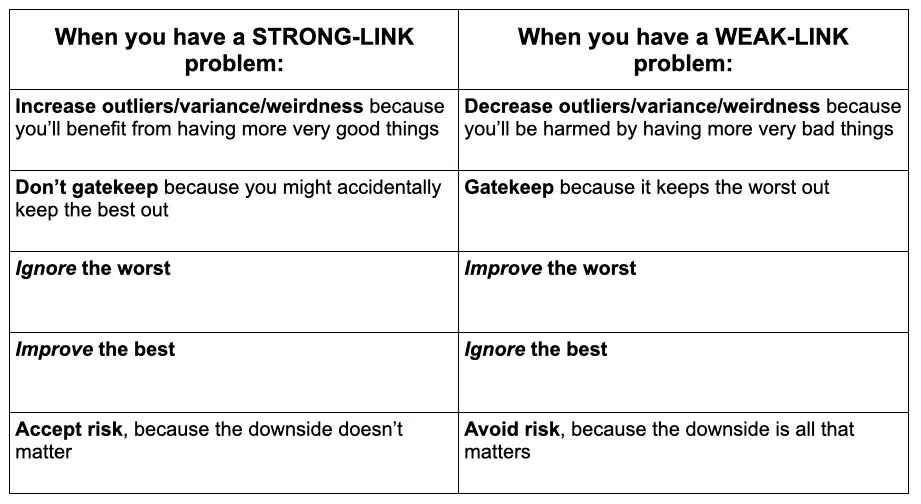
In the long run, the best stuff is basically all that matters, and the bad stuff doesn’t matter at all. The history of science is littered with the skulls of dead theories. No more phlogiston nor phlegm, no more luminiferous ether, no more geocentrism, no more measuring someone’s character by the bumps on their head, no more barnacles magically turning into geese, no more invisible rays shooting out of people’s eyes, no more plum pudding…
Our current scientific beliefs are not a random mix of the dumbest and smartest ideas from all of human history, and that’s because the smarter ideas stuck around while the dumber ones kind of went nowhere, on average—the hallmark of a strong-link problem. That doesn’t mean better ideas win immediately. Worse ideas can soak up resources and waste our time, and frauds can mislead us temporarily. It can take longer than a human lifetime to figure out which ideas are better, and sometimes progress only happens when old scientists die. But when a theory does a better job of explaining the world, it tends to stick around.
(Science being a strong-link problem doesn’t mean that science is currently strong. I think we’re still living in the Dark Ages, just less dark than before.)
Here’s the crazy thing: most people treat science like it’s a weak-link problem.
Peer reviewing publications and grant proposals, for example, is a massive weak-link intervention. We spend ~15,000 collective years of effort every year trying to prevent bad research from being published. We force scientists to spend huge chunks of time filling out grant applications—most of which will be unsuccessful—because we want to make sure we aren’t wasting our money…
…
I think there are two reasons why scientists act like science is a weak-link problem.
The first reason is fear. Competition for academic jobs, grants, and space in prestigious journals is more cutthroat than ever. When a single member of a grant panel, hiring committee, or editorial board can tank your career, you better stick to low-risk ideas. That’s fine when we’re trying to keep beetles out of asparagus, but it’s not fine when we’re trying to discover fundamental truths about the world…
The second reason is status. I’ve talked to a lot of folks since I published The rise and fall of peer review and got a lot of comments, and I’ve realized that when scientists tell me, “We need to prevent bad research from being published!” they often mean, “We need to prevent people from gaining academic status that they don’t deserve!” That is, to them, the problem with bad research isn’t really that it distorts the scientific record. The problem with bad research is that it’s cheating.
I get that. It’s maddening to watch someone get ahead using shady tactics, and it might seem like the solution is to tighten the rules so we catch more of the cheaters. But that’s weak-link thinking. The real solution is to care less about the hierarchy…
Here’s our reward for a generation of weak-link thinking.
The US government spends ~10x more on science today than it did in 1956, adjusted for inflation. We’ve got loads more scientists, and they publish way more papers. And yet science is less disruptive than ever, scientific productivity has been falling for decades, and scientists rate the discoveries of decades ago as worthier than the discoveries of today. (Reminder, if you want to blame this on ideas getting harder to find, I will fight you.)…
…
Whether we realize it or not, we’re always making calls like this. Whenever we demand certificates, credentials, inspections, professionalism, standards, and regulations, we are saying: “this is a weak-link problem; we must prevent the bad!”
Whenever we demand laissez-faire, the cutting of red tape, the letting of a thousand flowers bloom, we are saying: “this is a strong-link problem; we must promote the good!”
When we get this right, we fill the world with good things and rid the world of bad things. When we don’t, we end up stunting science for a generation. Or we end up eating a lot of asparagus beetles…
“Science is a strong-link problem,” from @a_m_mastroianni in @science_seeds.
* James Clerk Maxwell
###
As we ponder the process of progress, we might spare a thought for Sir Christopher Wren; he died on this date in 1723. A mathematician and astronomer (who co-founded and later served as president of the Royal Society), he is better remembered as one of the most highly acclaimed English architects in history; he was given responsibility for rebuilding 52 churches in the City of London after the Great Fire in 1666, including what is regarded as his masterpiece, St. Paul’s Cathedral, on Ludgate Hill.
Wren, whose scientific work ranged broadly– e.g., he invented a “weather clock” similar to a modern barometer, new engraving methods, and helped develop a blood transfusion technique– was admired by Isaac Newton, as Newton noted in the Principia.

“For the moment we might very well can them DUNNOS (for Dark Unknown Nonreflective Nondetectable Objects Somewhere)”*…

When does one give up on a hypothesis?…
In 1969, the American astronomer Vera Rubin puzzled over her observations of the sprawling Andromeda Galaxy, the Milky Way’s biggest neighbour. As she mapped out the rotating spiral arms of stars through spectra carefully measured at the Kitt Peak National Observatory and the Lowell Observatory, both in Arizona, she noticed something strange: the stars in the galaxy’s outskirts seemed to be orbiting far too fast. So fast that she’d expect them to escape Andromeda and fling out into the heavens beyond. Yet the whirling stars stayed in place.
Rubin’s research, which she expanded to dozens of other spiral galaxies, led to a dramatic dilemma: either there was much more matter out there, dark and hidden from sight but holding the galaxies together with its gravitational pull, or gravity somehow works very differently on the vast scale of a galaxy than scientists previously thought.
Her influential discovery never earned Rubin a Nobel Prize, but scientists began looking for signs of dark matter everywhere, around stars and gas clouds and among the largest structures in the galaxies in the Universe…
But… over the past half century, no one has ever directly detected a single particle of dark matter. Over and over again, dark matter has resisted being pinned down, like a fleeting shadow in the woods. Every time physicists have searched for dark matter particles with powerful and sensitive experiments in abandoned mines and in Antarctica, and whenever they’ve tried to produce them in particle accelerators, they’ve come back empty-handed. For a while, physicists hoped to find a theoretical type of matter called weakly interacting massive particles (WIMPs), but searches for them have repeatedly turned up nothing.
With the WIMP candidacy all but dead, dark matter is apparently the most ubiquitous thing physicists have never found. And as long as it’s not found, it’s still possible that there is no dark matter at all. An alternative remains: instead of huge amounts of hidden matter, some mysterious aspect of gravity could be warping the cosmos instead…
Dark matter is the most ubiquitous thing physicists have never found; Ramin Skibba (@raminskibba) wonders if it isn’t time to consider alternative explanations: “Does dark matter exist?” in @aeonmag.
* Bill Bryson on dark matter, in A Short History of Nearly Everything (2003)
###
As we interrogate the invisible, we might send observant birthday greetings to Val Logsdon Fitch; he was born on this date in 1923. A particle physicist, he shared the 1964 Nobel Prize in Physics with his collaborator James Cronin for their experiments proving that some subatomic reactions do not adhere to fundamental symmetry principles (and are therefore indifferent to the direction of time).
By examining the decay of K-mesons, they proved that a reaction run in reverse does not retrace the path of the original reaction, which showed that the reactions of subatomic particles are not indifferent to time. Thus the phenomenon of CP violation was discovered… and thus was demolished the faith that physicists had previously had that natural laws were universally governed by symmetry.

“A mind that is stretched by a new idea can never go back to its original dimensions”*…
Alex Berezow observes (in an appreciation of Peter Atkins‘ Galileo’s Finger: The Ten Great Ideas of Science) that, while scientific theories are always being tested, scrutinized for flaws, and revised, there are ten concepts so durable that it is difficult to imagine them ever being replaced with something better…
In his book The Structure of Scientific Revolutions, Thomas Kuhn argued that science, instead of progressing gradually in small steps as is commonly believed, actually moves forward in awkward leaps and bounds. The reason for this is that established theories are difficult to overturn, and contradictory data is often dismissed as merely anomalous. However, at some point, the evidence against the theory becomes so overwhelming that it is forcefully displaced by a better one in a process that Kuhn refers to as a “paradigm shift.” And in science, even the most widely accepted ideas could, someday, be considered yesterday’s dogma.
Yet, there are some concepts which are considered so rock solid, that it is difficult to imagine them ever being replaced with something better. What’s more, these concepts have fundamentally altered their fields, unifying and illuminating them in a way that no previous theory had done before…
The bedrock of modern biology, chemistry, and physics: “The ten greatest ideas in the history of science,” from @AlexBerezow in @bigthink.
* Oliver Wendell Holmes
###
As we forage for first principles, we might send carefully-calcuated birthday greetings to Georgiy Antonovich Gamov; he was born on this date in 1904. Better known by the name he adopted on immigrating to the U.S., George Gamow, he was a physicist and cosmologist whose early work was instrumental in developing the Big Bang theory of the universe; he also developed the first mathematical model of the atomic nucleus. In 1954, he expanded his interests into biochemistry and his work on deoxyribonucleic acid (DNA) made a basic contribution to modern genetic theory.
But mid-career Gamow began to shift his energy to teaching and to writing popular books on science… one of which, One Two Three… Infinity, inspired legions of young scientists-to-be and kindled a life-long interest in science in an even larger number of other youngsters (including your correspondent).

You must be logged in to post a comment.