“Most things are never meant”*…
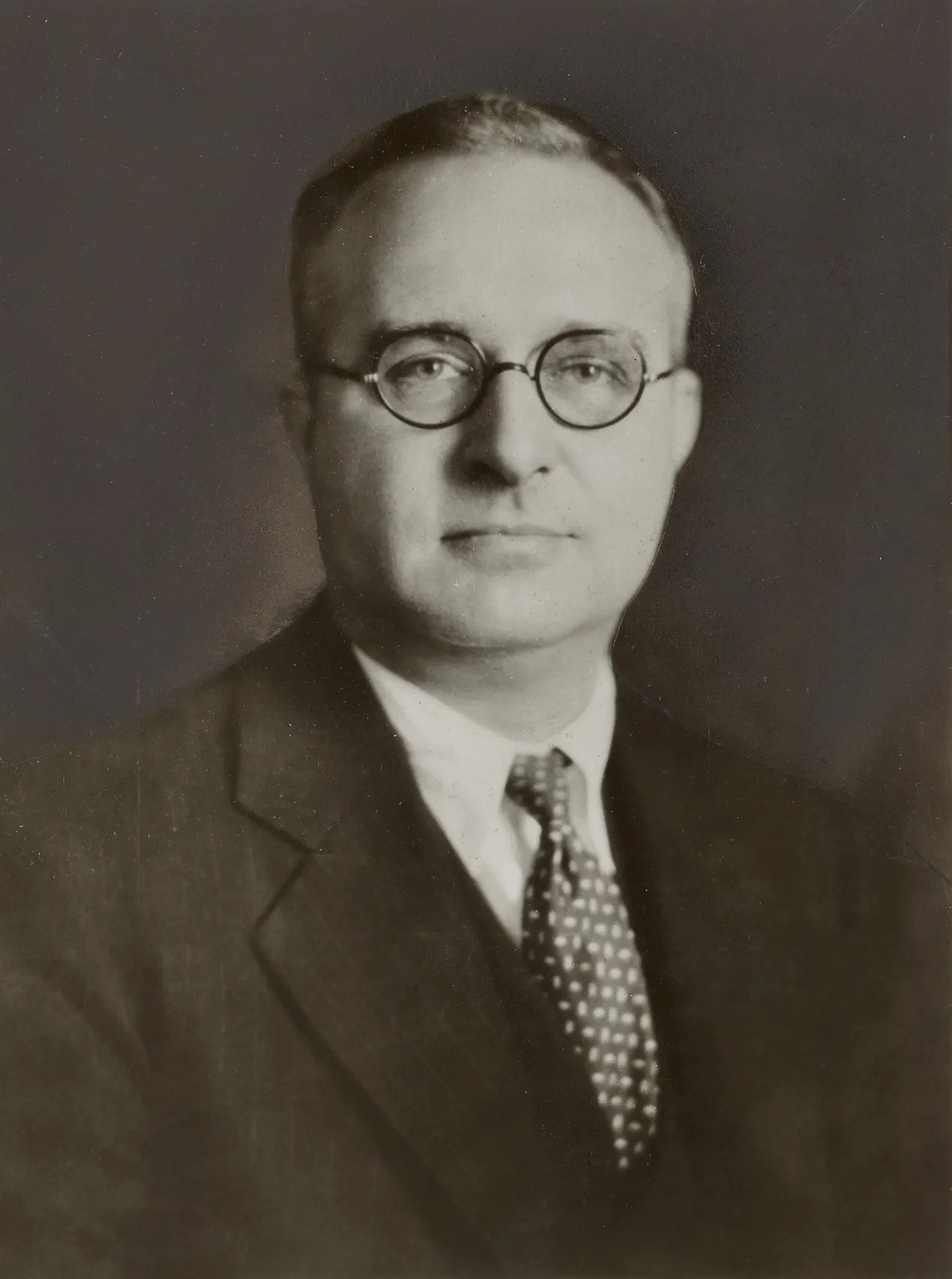
From Dan Russell‘s nifty (and in this instance, all-too-appropriately-named) newsletter, Unanticipated Consequences, an “appreciation” of a gentleman into whom (Roughly) Daily has run before (e. g, here)…
If you set out to design a supervillain to destroy the biosphere, create a jovial, optimistic mechanical engineer from Ohio who wanted to make the world a slightly more convenient place. Thomas Midgley Jr. was not a mad scientist plotting global ruin from a diabolical evil-genius lair, he was an enthusiastic tinkerer, and as a friend once commented, had “ten ideas a minute, nine of them screwy, but the tenth a lulu.” He wrote light verse, loved music, and held over a hundred patents. As a teenager, he used elm-tree juice instead of spit to throw unhittable curveballs. He was, by all accounts, a charming guy who merely sought practical solutions to the day’s pressing technological annoyances. What could go wrong?
Yet, by the time his career was over, Midgley had introduced two of the most globally destructive chemical compounds in human history. He became, as one historian aptly put it, a one-man environmental disaster. His legacy is the ultimate cautionary tale for the modern innovator: a masterclass in the massive, terrifying, and utterly unanticipated consequences of design choices…
[Russell tells the stories of Midgley’s pair of consequential inventions: the additive “lead” (tetraethyl lead, a neurotoxin) in gasoline and the refrigerant CFC (the use of which ripped a hole in the ozone layer). He recounts Midgley’s death (literally) in the grip of another of his inventions, then concludes…]
… What do we do with the ghost of Thomas Midgley? It is easy, with a century of hindsight, to look back at the millions of cardiovascular deaths, the plummeting IQs, and the shredded stratosphere, and label him a monster. But that ignores the fundamental mechanics of innovation. The Midgley story is a stark reminder of the massive delta between human intent and ecological reality.
When we invent, we are almost always trying to solve a local, immediate pain point. Engines rattle and refrigerators explode. Midgley looked at these problems and offered brilliant and simple solutions. But biology and atmosphere are deeply intertwined and heavily networked systems. The consequences of introducing synthetic compounds into these systems don’t spool out in days or weeks; they unfold across generations.
Midgley did not want to poison the world. He wrote poetry about human dominance over the Earth, genuinely believing that science could only make the future better. If forced to concede the environmental damage of his inventions, he likely would have plunged headlong into the lab to invent safe substitutes. But he lacked the conceptual tools, the time horizon, and the humility to imagine that the very things that made his inventions magical—the cheap and effective solution of lead and the unyielding stability of Freon—were exactly what made them apocalyptically awful for humanity.
The history of Thomas Midgley is a brilliantly clear, slightly horrifying reminder: sometimes, the most dangerous things in the world are brought to us by a friendly guy with a periodic table in his pocket, just trying to stop that really annoying noise in his car…
The bane of unintended consequences: “New Ways to Poison an Entire Planet: The Legacy of Thomas Midgley, Jr.”
* Philip Larkin, “Going, Going“
###
As we consider consequences, we might acknowledge that there are some consequences ourecall that on this date in 1908, at around 7:15 am, northwest of Lake Baikal, Russia, a huge fireball nearly as bright as the Sun was seen crossing the sky. Minutes later, there was a huge flash and a shock wave felt up to 400 miles away. Over Tunguska, a meteorite over 50-m diameter, travelling at over 60,000 mph penetrated Earth’s atmosphere, heated to about 10,000 ºC and detonated 6 to10 km above the ground. The blast released the energy of 10-50 Megatons of TNT, destroying 830 square miles of forest and leaving almost no trace of life. (As the area was essentially unpopulated, estimates are that only three people died.) The Tunguska rock came from the Taurid Meteor storm that crosses Earth’s orbit twice a year.
Midgley’s story is a reminder that we need to take all of the care we can to protect ourselves from unintended harms that we might inflict on oursleves. A meteor strike is, of course, not the product of a human choice– and in 1908, outside our control. But today, there is something we can do: check in with the B612 Foundation.

@roughlydaily For those left "hanging" about Midgely's death, from Wikipedia: In 1940, at the age of 51, Midgley contracted polio and was left severely disabled. He devised an elaborate system of ropes and pulleys to lift himself out of bed. On November 2, 1944, at the age of 55, he was found dead at his home in Worthington, Ohio. He had been killed by his own device after he became entangled in it and died of strangulation.[26][27][28][29] His death was ruled a suicide by the coroner.
book_dragon
June 30, 2026 at 3:55 am