Posts Tagged ‘meteor’
“Most things are never meant”*…
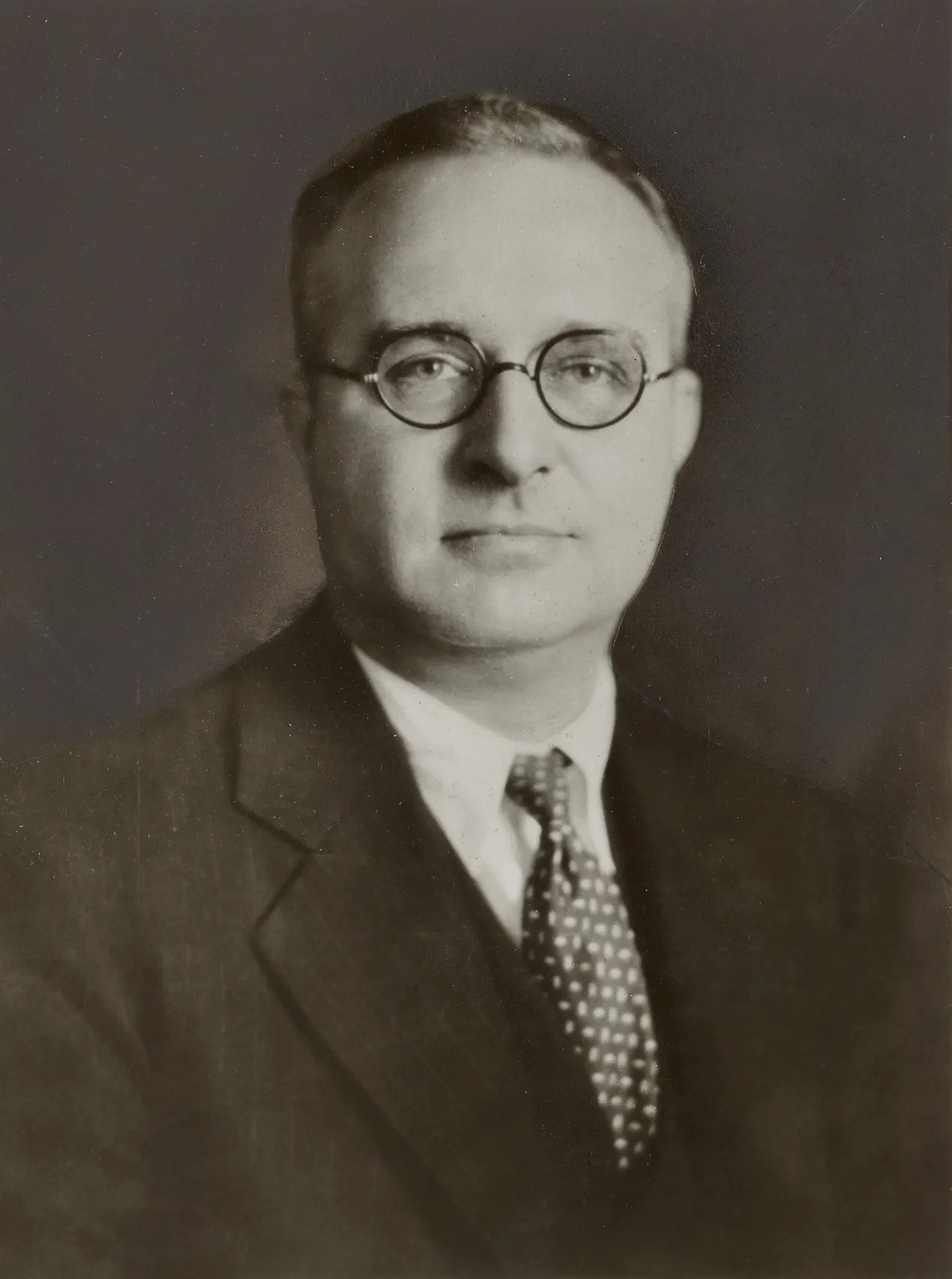
From Dan Russell‘s nifty (and in this instance, all-too-appropriately-named) newsletter, Unanticipated Consequences, an “appreciation” of a gentleman into whom (Roughly) Daily has run before (e. g, here)…
If you set out to design a supervillain to destroy the biosphere, create a jovial, optimistic mechanical engineer from Ohio who wanted to make the world a slightly more convenient place. Thomas Midgley Jr. was not a mad scientist plotting global ruin from a diabolical evil-genius lair, he was an enthusiastic tinkerer, and as a friend once commented, had “ten ideas a minute, nine of them screwy, but the tenth a lulu.” He wrote light verse, loved music, and held over a hundred patents. As a teenager, he used elm-tree juice instead of spit to throw unhittable curveballs. He was, by all accounts, a charming guy who merely sought practical solutions to the day’s pressing technological annoyances. What could go wrong?
Yet, by the time his career was over, Midgley had introduced two of the most globally destructive chemical compounds in human history. He became, as one historian aptly put it, a one-man environmental disaster. His legacy is the ultimate cautionary tale for the modern innovator: a masterclass in the massive, terrifying, and utterly unanticipated consequences of design choices…
[Russell tells the stories of Midgley’s pair of consequential inventions: the additive “lead” (tetraethyl lead, a neurotoxin) in gasoline and the refrigerant CFC (the use of which ripped a hole in the ozone layer). He recounts Midgley’s death (literally) in the grip of another of his inventions, then concludes…]
… What do we do with the ghost of Thomas Midgley? It is easy, with a century of hindsight, to look back at the millions of cardiovascular deaths, the plummeting IQs, and the shredded stratosphere, and label him a monster. But that ignores the fundamental mechanics of innovation. The Midgley story is a stark reminder of the massive delta between human intent and ecological reality.
When we invent, we are almost always trying to solve a local, immediate pain point. Engines rattle and refrigerators explode. Midgley looked at these problems and offered brilliant and simple solutions. But biology and atmosphere are deeply intertwined and heavily networked systems. The consequences of introducing synthetic compounds into these systems don’t spool out in days or weeks; they unfold across generations.
Midgley did not want to poison the world. He wrote poetry about human dominance over the Earth, genuinely believing that science could only make the future better. If forced to concede the environmental damage of his inventions, he likely would have plunged headlong into the lab to invent safe substitutes. But he lacked the conceptual tools, the time horizon, and the humility to imagine that the very things that made his inventions magical—the cheap and effective solution of lead and the unyielding stability of Freon—were exactly what made them apocalyptically awful for humanity.
The history of Thomas Midgley is a brilliantly clear, slightly horrifying reminder: sometimes, the most dangerous things in the world are brought to us by a friendly guy with a periodic table in his pocket, just trying to stop that really annoying noise in his car…
The bane of unintended consequences: “New Ways to Poison an Entire Planet: The Legacy of Thomas Midgley, Jr.”
* Philip Larkin, “Going, Going“
###
As we consider consequences, we might acknowledge that there are some consequences ourecall that on this date in 1908, at around 7:15 am, northwest of Lake Baikal, Russia, a huge fireball nearly as bright as the Sun was seen crossing the sky. Minutes later, there was a huge flash and a shock wave felt up to 400 miles away. Over Tunguska, a meteorite over 50-m diameter, travelling at over 60,000 mph penetrated Earth’s atmosphere, heated to about 10,000 ºC and detonated 6 to10 km above the ground. The blast released the energy of 10-50 Megatons of TNT, destroying 830 square miles of forest and leaving almost no trace of life. (As the area was essentially unpopulated, estimates are that only three people died.) The Tunguska rock came from the Taurid Meteor storm that crosses Earth’s orbit twice a year.
Midgley’s story is a reminder that we need to take all of the care we can to protect ourselves from unintended harms that we might inflict on oursleves. A meteor strike is, of course, not the product of a human choice– and in 1908, outside our control. But today, there is something we can do: check in with the B612 Foundation.

“When the world changes faster than species can adapt, many fall out”*…

(Roughly) Daily recently considered the newly-unearthed fossil record of the asteroid strike that led to the extinction of the dinosaurs. But what if that asteroid had missed?
An asteroid slammed down and did away with all the dinosaurs, paving the way for such developments as the human race, capitalism, and posting on the internet: it’s the story we all know and love. Yet if things had shaken out differently—if the asteroid had stayed in its place, and the dinosaurs allowed to proceed with their business—what would things have looked like?
Would the earth be a pristine, unsmogged paradise, or would the dinosaurs have somehow evolved into even more rapacious profiteers/industrialists, wrecking the world with their dinosaur refineries and dinosaur dark money? The latter scenario being totally implausible, what’s a likely answer to the question of what our world would look like if that asteroid never hit it?…
Nine scientists– geologists, paleontologists, and evolutionary biologists– provide some fascinating “alternative history”: “What If the Asteroid Never Killed the Dinosaurs?”
* The Sixth Extinction: An Unnatural History
###
As we explore the road not taken, we might recall that it was on this date in 1869 that the American Museum of Natural History was incorporated. Its founding had been urged in a letter, dated December 30, 1868, and sent to Andrew H. Green, Comptroller of Central Park, New York, signed by 19 persons, including Theodore Roosevelt, A.G. Phelps Dodge, and J. Pierpont Morgan. They wrote: “A number of gentlemen having long desired that a great Museum of Natural History should be established in Central Park, and having now the opportunity of securing a rare and very valuable collection as a nucleus of such Museum, the undersigned wish to enquire if you are disposed to provide for its reception and development.” Their suggestion was accepted by Park officials; the collections were purchased– and thus the great museum began. It opened April 27, 1871.

“The blazing meteor, when it descends to earth, is only a stone”*…

The odds of being hit by a meteorite are extremely low. You’re far more likely to die in a car crash or a fire than you are to die from a meteorite strike. It’s also more likely that you’ll be killed by lightning or a tornado – both of which are extremely rare. However, there’s bad news too – you have a higher chance of being hit by a meteorite than you do of winning the lottery…
Oh, and avoid the United States (and India)! See why at: “What Are Your Chances of Being Hit by a Meteorite?”
* Henry Wadsworth Longfellow
###
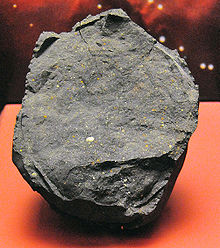
As we duck and cover, we might recall that it was on this date in 1969 that a large meteorite fell near Murchison in Victoria, Australia. Both because it was an observed fall (its bright fireball was seen by many) and because it proved to be rich in organic compounds (an abundance of amino acids), it has been one of the most-studied meteorites.
UFOs (Unusual Feynman Objects)…
Richard Feynman was a once-in-a-generation intellectual. He had no shortage of brains. (In 1965, he won the Nobel Prize in Physics for his work on quantum electrodynamics.) He had charisma. (Witness this outtake from his 1964 Cornell physics lectures [available in full here].) He knew how to make science and academic thought available, even entertaining, to a broader public. (We’ve highlighted two public TV programs hosted by Feynman here and here.) And he knew how to have fun. The clip above brings it all together.
From Open Culture (where one can also find Feynman’s elegant and accessible 1.5 minute explanation of “The Key to Science.”)
As we marvel at method, we might recall that it was on this date in 1864 that Giovanni Batista Donati made the first spectroscopic observations of a comet tail (from the small comet, Tempel, 1864 b). At a distance from the Sun, the spectrum of a comet is identical to that of the Sun, and its visibility is due only to reflected sunlight. Donati was able to show that a comet tail formed close to the Sun contains luminous gas, correctly deducing that the comet is itself partially gaseous. In the spectrum of light from the comet tail, Donati saw the three absorption lines now known as the “Swan bands” superimposed on a continuous spectrum.

You must be logged in to post a comment.