Posts Tagged ‘dinosaur’
“O bliss of the collector, bliss of the man of leisure!… Ownership is the most intimate relationship one can have to objects. Not that they come alive in him; it is he who comes alive in them.”*…
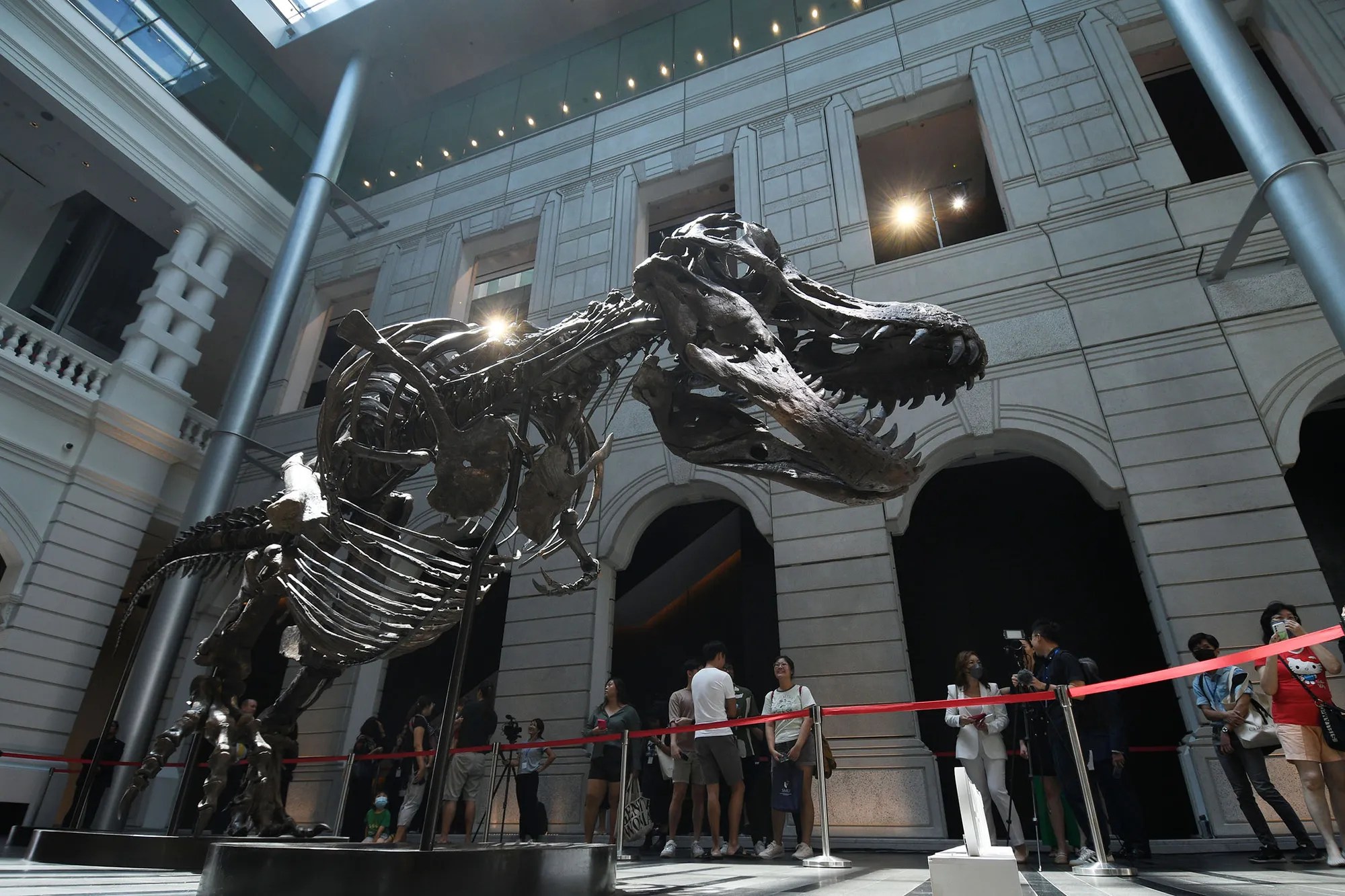
Readers may have seen news of the sale of “Gus,” a T. Rex skeleton that fetched a record $50,130,000 at Sotheby’s in New York last Tuesday. It’s part of a trend.
Devon Pendleton reports that dinosaurs have become an asset class for billionaires, with alarming implications for science… and, unsurprisingly, the market is about as orderly and genteel as a starving T. Rex. She uses a different recent sale, one that went pear-shaped, as an example…
It was supposed to be an unprecedented sale for the world’s wealthiest collectors. Shen, a Tyrannosaurus rex, was set to be the first of its kind ever sold at auction in Asia. The reconstructed creature, whose name means “godlike” in Chinese, was tens of millions of years old and longer than a city bus, frozen midstep with its massive skull cocked, jaws agape, as if ready to snatch up an onlooker. Christie’s was auctioning off Shen in November 2022, alongside works by Picasso, and it was expected to sell for $15 million to $25 million.
Dinosaur skeletons had recently become a hot new asset class, coveted by the ultrarich, not unlike sports franchises or Fabergé eggs. They offered a mix of glamour and primal appeal to a certain type of high-net-worth buyer—someone who might find the conventional art market fussy or convoluted but couldn’t deny the allure of a T. rex. “It could gobble you up in one bite. It’s just an amazing creature,” says billionaire Dan O’Dowd, who bought his T. rex, Samson, for a bargain $600,000 in 2009. “It’s the best trophy kind of thing you could own.”
Two years before the Shen auction, Christie’s had sold a T. rex named Stan, said to be one of the most complete and best-preserved specimens ever found, for $31.8 million, trouncing the top-end presale estimate of $8 million. And two years after the Shen auction, financier Ken Griffin spent $44.6 million on a stegosaurus (“a vegetarian,” O’Dowd notes). Leonardo DiCaprio, Nicolas Cage and other celebrities have gotten in on the dino game too.
A dinosaur’s value, like a painting’s or sculpture’s, derives from a protean mix of provenance, desire and authenticity—the last one hard to define, let alone prove, and in the case of an auction, up to the buyer to verify. Christie’s marketing blitz for Shen included the claim that it was one of the most “scientifically studied T. rex skeletons to come to auction,” featuring it in a short promotional video in which the camera cinematically races in for tight shots of its menacing talons and gaping jaw as eerie electronic music pulses in the background. Christie’s made clear that the winning bidder would also get renaming rights, a tradition in which T. rexes in circulation are often given human names.
A month before Shen was supposed to arrive at Christie’s in Hong Kong, it was put on display at Singapore’s Victoria Theatre and Victoria Concert Hall, a stately neoclassical building with a grand clock tower. Families, tourists and prospective buyers in chauffeured Bentleys came to see the T. rex in the flesh, so to speak. But Shen never made it to the auction block…
[Pendleton unpacks the full–and fascinating– tale of Shen. She concludes…]
… In recent years the dinosaur market has gotten only more exuberant. Last year at Sotheby’s a juvenile Ceratosaurus—smaller than a T. rex, but just as carnivorous—sold for $30.5 million, five times its high estimate. Some collectors, including Abu Dhabi’s new natural history museum and German biotech investor Christian Angermayer, are funding teams of bone hunters to scour the fossil-rich western US. Todd Graves, the billionaire behind Raising Cane’s Chicken Fingers, emerged as a collector when he lent his triceratops skull to the Louisiana Art & Science Museum.
And on July 14 in New York, Sotheby’s held what was hyped to be the hottest T. rex auction yet. Gus, as the creature is named, was described as 61% complete by bone count and 75% to 80% by bone mass with “an exceptionally preserved skull.” As the bids climbed, the auctioneer tempted potential buyers. “Try a bigger bite,” she said. “It’s a T. Rex after all.” Gus sold for $50.1 million, the highest ever paid for a dinosaur at auction.
Billionaires and their toys: “The Bone Rush,” gift article from @bloomberg.com.
###
As we ponder possession, we might recall that it was on this date in 1983 that a new species of flesh‑eating dinosaur nicknamed “Claws,” later formally named Baryonyx walkeri was announced…
A huge new dinosaur skeleton has been unveiled to the media at the Natural History Museum in London.
Plumber and amateur fossil hunter Bill Walker, 55, found a foot-long claw belonging to the flesh-eating beast at a clay pit in Surrey in January.
When he found the rock containing the talon he tapped it and the whole thing cracked.
Palaeontologists reconstructed it and dated the remains at 125 million years old, describing them as the find of the century…
… Nicknamed Claws, the dinosaur would have been slightly smaller than the Tyrannosaurus Rex – with teeth like steak knives – and was probably a sub-species of the Megalosaurus.
– source

“When the world changes faster than species can adapt, many fall out”*…

(Roughly) Daily recently considered the newly-unearthed fossil record of the asteroid strike that led to the extinction of the dinosaurs. But what if that asteroid had missed?
An asteroid slammed down and did away with all the dinosaurs, paving the way for such developments as the human race, capitalism, and posting on the internet: it’s the story we all know and love. Yet if things had shaken out differently—if the asteroid had stayed in its place, and the dinosaurs allowed to proceed with their business—what would things have looked like?
Would the earth be a pristine, unsmogged paradise, or would the dinosaurs have somehow evolved into even more rapacious profiteers/industrialists, wrecking the world with their dinosaur refineries and dinosaur dark money? The latter scenario being totally implausible, what’s a likely answer to the question of what our world would look like if that asteroid never hit it?…
Nine scientists– geologists, paleontologists, and evolutionary biologists– provide some fascinating “alternative history”: “What If the Asteroid Never Killed the Dinosaurs?”
* The Sixth Extinction: An Unnatural History
###
As we explore the road not taken, we might recall that it was on this date in 1869 that the American Museum of Natural History was incorporated. Its founding had been urged in a letter, dated December 30, 1868, and sent to Andrew H. Green, Comptroller of Central Park, New York, signed by 19 persons, including Theodore Roosevelt, A.G. Phelps Dodge, and J. Pierpont Morgan. They wrote: “A number of gentlemen having long desired that a great Museum of Natural History should be established in Central Park, and having now the opportunity of securing a rare and very valuable collection as a nucleus of such Museum, the undersigned wish to enquire if you are disposed to provide for its reception and development.” Their suggestion was accepted by Park officials; the collections were purchased– and thus the great museum began. It opened April 27, 1871.

“Extinction is the rule. Survival is the exception.”*…

In one fell swoop, Robert DePalma may have filled in the gap in the fossil record
On August 5, 2013, I received an e-mail from a graduate student named Robert DePalma. I had never met DePalma, but we had corresponded on paleontological matters for years, ever since he had read a novel I’d written that centered on the discovery of a fossilized Tyrannosaurus rex killed by the KT impact. “I have made an incredible and unprecedented discovery,” he wrote me, from a truck stop in Bowman, North Dakota. “It is extremely confidential and only three others know of it at the moment, all of them close colleagues.” He went on, “It is far more unique and far rarer than any simple dinosaur discovery. I would prefer not outlining the details via e-mail, if possible.” He gave me his cell-phone number and a time to call.
I called, and he told me that he had discovered a site like the one I’d imagined in my novel, which contained, among other things, direct victims of the catastrophe. At first, I was skeptical. DePalma was a scientific nobody, a Ph.D. candidate at the University of Kansas, and he said that he had found the site with no institutional backing and no collaborators. I thought that he was likely exaggerating, or that he might even be crazy. (Paleontology has more than its share of unusual people.) But I was intrigued enough to get on a plane to North Dakota to see for myself…
Douglas Preston recounts what he found: the young paleontologist looks increasingly likely (as other scientists assess his work) to have discovered a record of the most significant event in the history of life on Earth, the missing fossil evidence that recounts the almost-instant extinction of most life on the planet: “The Day the Dinosaurs Died.”
See a second-by-second visualization of the event here.
And for more on the threat that asteroids still present, and how we can protect the Earth from a repeat of that mass extinction, visit the B-612 Foundation.
The Varieties of Scientific Experience
###
As we extricate heads from the sand, we might spare a thought for a scientific forebearer of DePalma’s, Edward Drinker Cope; he died on this date in 1897. A paleontologist and comparative anatomist (as well as a noted herpetologist and ichthyologist), Cope led many natural history surveys in the American West for the precursors of the U.S. Geological Survey, making important finds on his trips, including dinosaur discoveries.

“The metabolic rate of geology is too slow for us to perceive it”*…
email readers click here for video
Researchers modeled continental drift, going back 240 million years ago, on the scale of millimeters per year. It starts really slow and as if the supports give way to the separating pressure, there’s a relative burst of movement.
The full paper is in Nature, and the interactive version, which is a bit rough around the edges, can be found here. Select the time, rotate the planet around, and press play to watch the continents break apart.
From Flowing Data: “Continental drift, from 240 million years ago to present.”
(While the changes are slow, they are in fact detectable in the course of a human life; c.f., “Australia’s Entire GPS Navigation is Off By 5 Feet.”)
* Russell Banks, Continental Drift
###
As we slip and slide, we might spare a thought for William Buckland; he died on this date in 1856. A English theologian who became Dean of Westminster, he was also a paleontologist (who wrote the first full account of a fossil dinosaur, which he named Megalosaurus) and a geologist (who was known for his effort to reconcile geological discoveries with the Bible and anti-evolutionary theories). A gentleman of some eccentricity, Buckland undertook his field work wearing an academic gown.

“Ain’t Nobody Here But Us Chickens”*…

A newly discovered dinosaur species that paleontologists have dubbed the “chicken from hell” is among the largest feathered dinosaurs ever found in North America.
The 11-foot-long (3-meter-long), 500-pound (225-kilogram) Anzu wylieiis an oviraptorosaur—a family of two-legged, birdlike dinosaurs found in Central Asia and North America. These dinosaurs ranged in size from a few pounds to over a metric ton, according to a study published March 19 in the journal PLOS ONE.
With its toothless beak, long legs, huge feet, and claw-tipped arms, A. wyliei looked like a devilish version of the modern cassowary, a large ground bird found in Australia.
It was “as close as you can get to a bird without being a bird,” said study leader Matt Lamanna, a vertebrate paleontologist at the Carnegie Museum of Natural History in Pittsburgh. (See “Pictures: Dinosaur’s Flashy Feathers Revealed.”)
The dinosaur’s well-preserved skeletons suggest it was a wide-ranging eater, munching on a variety of vegetation and perhaps small animals.
The species emerged from three 66-million-year-old skeletons excavated from the fossil-rich Hell Creek formation of South and North Dakota, starting in the late 1990s. The third skeleton was found more recently, and it took years to identify and study all the remains…
Read the whole story at “New ‘Chicken From Hell’ Dinosaur Discovered.”
* Song title and lyric by Alex Kramer and Joan Whitney; recorded in 1946 by Louis Jordan and His Tympany Five.
###
As we rethink those chicken wings, we might spare a thought for Raymond Cecil Moore; he died on this date in 1974. A geologist and paleontologist, Moore did pioneering work on Paleozoic crinoids, bryozoans, and corals (invertebrate organisms existing 570 to 245 million years ago). Among other things, he showed that fossil stemmed forms, sometimes called “sea lilies,” while they bear a superficial resemblance to flowers, were actually animals. Moore is probably best known as the founder and editor of the landmark multi-volume Treatise of Invertebrate Paleontology.

Moore (on left), with William W. Hambleton, and Frank C. Foley.
You must be logged in to post a comment.