Posts Tagged ‘curiosity’
“The mind is not a vessel to be filled, but a fire to be kindled”*…

(Roughly) Daily is, in effect, a kind of notebook, a commonplace book. So it will be no surprise that your correspondent found today’s featured piece fascinating.
Jillian Hess, a professor who studies the history of note-taking, shares the lessons she took from her review of the papers of the remarkable Richard Feynman…
Formal education, at its best, prepares us for a life of learning. After all, we are only in school for a fraction of our lives and there is so much to learn!
Richard Feynman (1918-1988) understood the value of self-education. He was a Nobel Prize-winning theoretical physicist, a member of the Manhattan Project at the age of 25, and a dynamic public intellectual who never stopped learning.
Often touted as one of history’s greatest learners, Feynman taught himself a dizzying amount of science. I wanted to see his notes for myself—to observe the great autodidact thinking on the page. So, I visited his archives at Caltech in February…
… In the archives, I saw… for myself: Feynman’s notebooks contain imprints of thinking in real-time—the work as it happened. They were instruments for thinking through uncertainty.
What follows is a list of note-taking principles for self-education that I gathered while studying Feynman’s notebooks.
Start with First Principles: Feynman’s “Things I Don’t Know About” Notebook
Discussions about Feynman’s learning process usually draw from this notebook, which he compiled as a Ph.D. student at Princeton. The contents include mechanics, mathematical methods, and thermodynamics. Clearly, he knew something about these topics, but he found his understanding superficial. So, his response was to take the subject apart—to break it down into “the essential kernels” …
[Hess illustrates this principle, then unpacks two others: “create a reading index” and “keep learning.” She continues…]
… Uncertainty is Interesting
This is my biggest takeaway: We should fear certainty more than doubt. Learning to live with uncertainty is an essential aspect of learning, as Feynman said in 1981:
You see, one thing is, I can live with doubt and uncertainty and not knowing. I think it’s much more interesting to live not knowing than to have answers which might be wrong.
And then, in an echo of his “Notebook of Things I Know Nothing About,” compiled four decades prior, he adds:
…I’m not absolutely sure of anything, and there are many things I don’t know anything about.
If a man as celebrated for his genius as Feynman felt that way, certainly the rest of us have a lot more to learn…
[And she concludes…]
… Notes on Feynman’s Notes:
Use notes to think: Feynman didn’t think through problems in his head and then turn to his notebooks. Instead, he used his notebooks to think through problems. His thought process required paper.
Start with first principles: “Why” is a very powerful question. And asking why can lead us back to the fundamentals and help us understand them in an entirely new light. This applies to any subject. Feynman has helped me think of note-taking as a kind of expedition. Use your notes to dig deeper into topics you think you already understand.
Never stop learning: How wonderful would it be if we could hold onto the excitement of learning we had as children? After all, the world didn’t get less interesting. It’s worth returning to the note-taking methods you used in school to see if they are still useful in adulthood. I particularly like Feynman’s high school method of taking 30 minutes to understand a subject before he allowed himself to take notes on it.
[Then leaves us with the man himself, “in all his radiant, enthusiastic, brilliance”…]
On “Richard Feynman’s Notes For Self-Education.”
Pair with: “Curiosity Is No Solo Act“: “it gains its real power when embedded in webs of relationship and shared meaning-making”… something that Feynman’s life also demonstrated (as you can see in his autobiography and/or in James Gleick‘s biography, Genius)
* Plutarch
###
As we light that fire, we might spare a thought for Jeremy Bernstein; he died on this date last year. A physicist who woked on nuclear propulsion for Project Orion and held research and teaching positions at Stevens Institute of Technology, the Institute for Advanced Study, Brookhaven National Laboratory, CERN, Oxford University, University of Islamabad, and École Polytechnique, he is better remembered as a gifted popular science writer and profiler of scientists.
Bernstein wrote 30 books, and scores of magazine articles for “general readers”– for The New Yorker, where he was a staff writer from 1961 to 1995, and for The Atlantic Monthly, the New York Review of Books, and Scientific American, among others.
Of Feynman, Bernstein wrote “[his] Mozartean genius in physics seemed to be combined with an almost equally Mozartean urge to play the clown.” (in which, of course, Feynman was in the good company of Einstein, Claude Shannon, and others :-)

“Curiosity is, in great and generous minds, the first passion and the last”*…

From the arcane through the mysterious to the perplexing, a glorious collecton of obscure– but fascinating– knowledge…
Freakpages is a community-curated directory of esoteric articles across the internet, primarily from Wikipedia. Here, we encourage you to learn about interesting topics you have never heard of…
… divided into categories (Society, History, Technology, Psychology, Physics, Biology, Chemistry, Finance, Philosphy), with continuously refreshed selections from both the curators and the community.
A few examples: Egregore, Operation Northwoods, Matrioshka Brain, Zeigarnik Effect, Retrocausality, Horizontal Gene Transfer, Strange Matter Seeding, Keynesian Beauty Contest, Chinese Room…
So many more at: Freakpages
[Image above: source]
###
As we explore, we might spare a thought for a man driven by an endles spirit of inquiry, William Thomson, 1st Baron Kelvin; he died on this date in 1907. A mathematician, mathematical physicist, and engineer considered by many “the Newton of his era,” Lord Kelvin was instrumental in the formulation of the first and second laws of thermodynamics, and contributed significantly to unifying physics, which was then in its infancy of development as an emerging academic discipline. He received the Royal Society’s Copley Medal in 1883 and served as its president from 1890 to 1895. In 1892 he became the first scientist to be elevated to the House of Lords. Absolute temperatures are stated in units of kelvin in his honor.

“Curiosity has its own reason for existing”*…

Brian Klaas on how it is we know where we are– a riff from his recent book, Fluke: Chance, Chaos, and Why Everything We Do Matters that covers everything from navigational neurons to the calculation of longitude (with helpful updates to Dava Sobel’s estimable account)– and on how that history demonstrates the importance of curiosity…
We now navigate the world with ease, our location pinpointed by satellites floating high above us in the heavens, but it was not always so. How have our brains evolved to explore a complex landscape? And how did an 18th century government harness the dreams of crackpots and obsessive craftsmen to solve one of the most important questions of them all: where am I? The answer lies with an extraordinary story, linking neurons with naval history…
[Klass illustrates the cost of bad navigation [naval disasters], explains how animals [including humans] use “magnetic maps to navigate by a kind of dead reckoning], and unpacks the many obstacles to determining longitude at sea [mainly that it depended on very accurate time-keeping, a problem at sea with current clocks. The British Parliament offered a monumental cash prize for solving the conundrum, but there were no winners… until John Harrison came along…]
… John Harrison changed everything.
Harrison had little formal education, but was masterful working with wood and was fascinated by clocks. At first, he had difficulty convincing the scientific establishment of his ideas, but soon, his clocks dazzled. He refined them over decades—in one case spending seventeen years working on a single clock—producing five timepieces, the first working marine chronometers. Little by little, they improved, making it plain that scientific impossibility was becoming reality, forged through the determination and inventiveness of a self-taught craftsmen with a laudable obsession with problem-solving and timekeeping.
Harrision came up with several innovations that changed not just marine history, but world history. His clocks solved the problem of oil by designing it away; his timepieces—seemingly miraculously—employed several new anti-friction devices, facilitated by, among other innovations, using a naturally oily wood. Then, taking his genius one step further, Harrison invented the caged roller bearing, a nearly frictionless mechanism that later helped unleash the industrial revolution by improving machinery. Caged roller bearings are still used in “virtually every complex machine made today.”
To solve the problem of pendulums that elongate or shrink in varied climates, Harrison invented a bimetallic mechanism of canceling these expansions and contractions out. By combining brass and steel, he could effectively ensure that any bit of the mechanism that elongated would be offset as “the downward expansion of the steel rods is counteracted by the upward expansion of the brass rods.” Harrison’s related invention of the bimetallic strip is still used today and has been instrumental in thermometers, gas safety valves in ovens, electric circuit breakers, and cars, to name a few…
…
… For centuries, Harrison’s innovations changed history, and revolutionized navigation on the seas. That only changed in the early 20th century, when the wireless telegraph and radio signals made it possible to transmit time signals across vast distances to shipboard receivers. Finally, GPS—using satellites—eclipsed methods that relied on earthbound timekeeping.
But the tale of longitude—and the ongoing scientific sleuthing into the neurons we use to navigate across shorter distances—yield three important lessons.
First, government prizes can act as a crucial catalyst for scientific innovation. The industrial revolution and the rise of British naval superiority were both partially unleashed due to an investment of just two million pounds in today’s value [the prize offered by Parlaiment]. We should be developing many more state-funded scientific prizes today, particularly for research into neuroscience, as the 21st century will likely be defined by our understanding of complex cognition, both artificial and human.
Second, scientific snobbery—and excluding people from innovation based on credentialism—could have kept Harrison’s ideas from emerging, delaying crucial progress. It’s a cautionary tale for the modern world, in which our degrees are often wrongly imagined as an accurate shorthand for our intellectual worth.
Finally, the tale of longitude highlights the intellectual incuriosity of our modern age, in which we, to an unprecedented degree, drift through the world while rarely pausing to ask “how does that work?” We happily tap our destination into Google Maps, never wondering how the solution to what is now such a banal task as navigation changed the fate of the world forever.
In one wonderful psychology study, participants were asked if they knew how a toilet worked. “Of course!” the participants replied. “Great!” said the scientists. “Please write down, or draw, how it works.”
At that point, the participants realized they had no idea how a toilet works much beyond how to make it flush. As
Adam Mastroianni highlights: “This isn’t specific to toilets—you can get it with everything from spray bottles to helicopters.” This is known as the “illusion of explanatory depth,” where we imagine that we understand something, but are completely flummoxed when we’re asked how it actually works. Gravity is another great example. (Try explaining, in detail, exactly why stuff falls down, other than saying that masses exert forces on each other. Sure, but how?).
The point, then, is that human problems are often best solved by diverse—but stubborn thinkers—who are insatiably curious and relentlessly ask two simple questions that we mostly take for granted: “Why?” and “How?”
Countless lives were saved and the trajectory of world history shifted across centuries, all because one clockmaker couldn’t get those questions out of his head…
On the abiding importance of curiosity: “The Thrilling Tale of Longitude and Our Neurons of Navigation,” from @brianklaas.
* Albert Einstein
###
As we find our place, we might recall that this date in 1896 is important to the technology that ultimately replaced the chronometer in navigation: it was the day that Guglielmo Marconi applied for British Patent number 12039 regarding a system of telegraphy using Hertzian waves. We call it radio.

“I would rather have questions that can’t be answered than answers that can’t be questioned”*…

… or, as Confucius would have it, “real knowledge is to know the extent of one’s ignorance.” Happily Wikenigma is here to help…
Wikenigma is a unique wiki-based resource specifically dedicated to documenting fundamental gaps in human knowledge.
Listing scientific and academic questions to which no-one, anywhere, has yet been able to provide a definitive answer. [949 so far]
That’s to say, a compendium of so-called ‘Known Unknowns’…
Consider, for example…
How do marine turtle accurately migrate thousands of kilometers for nesting?
Can Beal’s conjecture be proved?
Can one solve the “envelope paradox”?
Do “naked singularities” exist?
What is the etymology of the word “plot” (which appears only in English)?
What are the function, importance, and evolutionary history of human “inner speech”?
One could– and should– go on: Wikenigma, via @Recomendo6.
* Richard Feynman
###
As we wonder, we might spare a thought for a man who embodied curiosity, Marvin Minsky; he died on this date in 2016. A biochemist and cognitive scientist by training, he was founding director of MIT’s Artificial Intelligence Project (the MIT AI Lab). Minsky authored several widely-used texts, and made many contributions to AI, cognitive psychology, mathematics, computational linguistics, robotics, and optics. He holds several patents, including those for the first neural-network simulator (SNARC, 1951), the first head-mounted graphical display, the first confocal scanning microscope, and the LOGO “turtle” device (with his friend and frequent collaborator Seymour Papert). His other inventions include mechanical hands and the “Muse” synthesizer.

“The element of mystery to which you want to draw attention should be surrounded and veiled by a quite obvious, readily recognisable commonness”*…
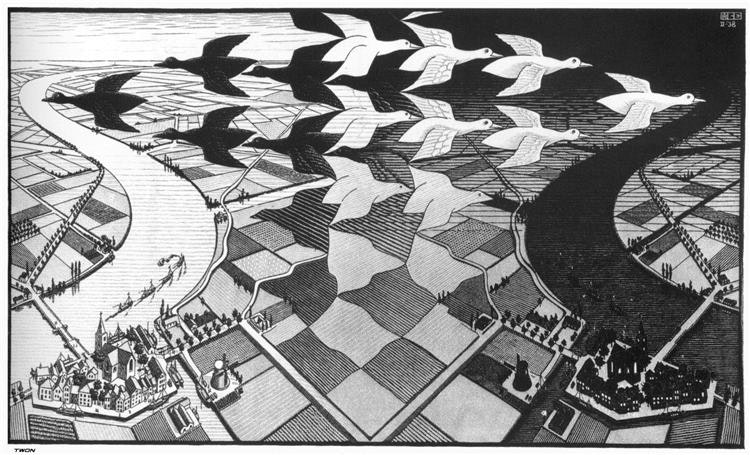
An appreciation of the marvelous M.C. Escher…
Despite being a fan of Rennaisance Art and the work of the Impressionists, he feels increasingly pulled in a different direction…
When you look at this picture, you’re flipping between world views. Either you’re seeing the white birds, and the bright, presumably sunlit day scene with its cheerful flotilla of steam ships puffing their way upriver – or you’re seeing the black birds, and your eye is drawn to the night-shrouded landscape where the houses have their lights on and the sky’s already eaten the horizon & is creeping nearer…
Except, that’s not quite right. The black birds are in the daylight side, and the white ones are flying into the night. These aren’t just mirror images: they’re like the Ancient Chinese yin-yang symbol, each side containing part of its opposite…
Escher’s love of the fantastical is primarily inspired by what he sees around him, not what he can dream up out of next to nothing… By looking closely at the real world, and trying to understand how it works, Escher will invite his initially small but intensely loyal fanbase to explore some very strange mysteries indeed.
…

It’s the 1960s now, and nonconformity is all the rage. Hair is getting longer, psychedelics-powered artistry is flourishing, and anything that seems to scream to hell with the rules is increasingly in vogue… Because of the fantastical elements of his work, Escher is acquiring a reputation as a surrealist. As a self-identifying “reality enthusiast,” it’s the very last thing he wants. Take Ascending & Descending, where he’s clearly turning his imagination to the futility of so much in the human-centred world. In a letter to a friend, he says:
“Yes, yes, we climb up and up, we imagine we are ascending; one step is about 10 inches high, terribly tiring – and where does it get us? Nowhere.”
But until the end of his career, his work will continue to speak to something deeper – a rebellion against human incuriosity, or a constant rallying-cry for the act of paying attention…
Read it in full: “Fooling With Certainty: The Impossibly Real Worlds Of MC Escher,” from Mike Sowden (@Mikeachim)
* M. C. Escher
###
As we look closely, we might recall that it was on this date in 1859 that our perspective was shifted in a different kind of way: Charles Darwin published The Origin of the Species. Actually, on that day he published On the Origin of Species by Means of Natural Selection, or the Preservation of Favoured Races in the Struggle for Life; the title was shortened to the one we know with the sixth edition in 1872.

(Roughly) Daily will be on a brief Thanksgiving hiatus, returning when the the tryptophan haze has passed…
You must be logged in to post a comment.