Posts Tagged ‘longitude’
“Curiosity has its own reason for existing”*…

Brian Klaas on how it is we know where we are– a riff from his recent book, Fluke: Chance, Chaos, and Why Everything We Do Matters that covers everything from navigational neurons to the calculation of longitude (with helpful updates to Dava Sobel’s estimable account)– and on how that history demonstrates the importance of curiosity…
We now navigate the world with ease, our location pinpointed by satellites floating high above us in the heavens, but it was not always so. How have our brains evolved to explore a complex landscape? And how did an 18th century government harness the dreams of crackpots and obsessive craftsmen to solve one of the most important questions of them all: where am I? The answer lies with an extraordinary story, linking neurons with naval history…
[Klass illustrates the cost of bad navigation [naval disasters], explains how animals [including humans] use “magnetic maps to navigate by a kind of dead reckoning], and unpacks the many obstacles to determining longitude at sea [mainly that it depended on very accurate time-keeping, a problem at sea with current clocks. The British Parliament offered a monumental cash prize for solving the conundrum, but there were no winners… until John Harrison came along…]
… John Harrison changed everything.
Harrison had little formal education, but was masterful working with wood and was fascinated by clocks. At first, he had difficulty convincing the scientific establishment of his ideas, but soon, his clocks dazzled. He refined them over decades—in one case spending seventeen years working on a single clock—producing five timepieces, the first working marine chronometers. Little by little, they improved, making it plain that scientific impossibility was becoming reality, forged through the determination and inventiveness of a self-taught craftsmen with a laudable obsession with problem-solving and timekeeping.
Harrision came up with several innovations that changed not just marine history, but world history. His clocks solved the problem of oil by designing it away; his timepieces—seemingly miraculously—employed several new anti-friction devices, facilitated by, among other innovations, using a naturally oily wood. Then, taking his genius one step further, Harrison invented the caged roller bearing, a nearly frictionless mechanism that later helped unleash the industrial revolution by improving machinery. Caged roller bearings are still used in “virtually every complex machine made today.”
To solve the problem of pendulums that elongate or shrink in varied climates, Harrison invented a bimetallic mechanism of canceling these expansions and contractions out. By combining brass and steel, he could effectively ensure that any bit of the mechanism that elongated would be offset as “the downward expansion of the steel rods is counteracted by the upward expansion of the brass rods.” Harrison’s related invention of the bimetallic strip is still used today and has been instrumental in thermometers, gas safety valves in ovens, electric circuit breakers, and cars, to name a few…
…
… For centuries, Harrison’s innovations changed history, and revolutionized navigation on the seas. That only changed in the early 20th century, when the wireless telegraph and radio signals made it possible to transmit time signals across vast distances to shipboard receivers. Finally, GPS—using satellites—eclipsed methods that relied on earthbound timekeeping.
But the tale of longitude—and the ongoing scientific sleuthing into the neurons we use to navigate across shorter distances—yield three important lessons.
First, government prizes can act as a crucial catalyst for scientific innovation. The industrial revolution and the rise of British naval superiority were both partially unleashed due to an investment of just two million pounds in today’s value [the prize offered by Parlaiment]. We should be developing many more state-funded scientific prizes today, particularly for research into neuroscience, as the 21st century will likely be defined by our understanding of complex cognition, both artificial and human.
Second, scientific snobbery—and excluding people from innovation based on credentialism—could have kept Harrison’s ideas from emerging, delaying crucial progress. It’s a cautionary tale for the modern world, in which our degrees are often wrongly imagined as an accurate shorthand for our intellectual worth.
Finally, the tale of longitude highlights the intellectual incuriosity of our modern age, in which we, to an unprecedented degree, drift through the world while rarely pausing to ask “how does that work?” We happily tap our destination into Google Maps, never wondering how the solution to what is now such a banal task as navigation changed the fate of the world forever.
In one wonderful psychology study, participants were asked if they knew how a toilet worked. “Of course!” the participants replied. “Great!” said the scientists. “Please write down, or draw, how it works.”
At that point, the participants realized they had no idea how a toilet works much beyond how to make it flush. As
Adam Mastroianni highlights: “This isn’t specific to toilets—you can get it with everything from spray bottles to helicopters.” This is known as the “illusion of explanatory depth,” where we imagine that we understand something, but are completely flummoxed when we’re asked how it actually works. Gravity is another great example. (Try explaining, in detail, exactly why stuff falls down, other than saying that masses exert forces on each other. Sure, but how?).
The point, then, is that human problems are often best solved by diverse—but stubborn thinkers—who are insatiably curious and relentlessly ask two simple questions that we mostly take for granted: “Why?” and “How?”
Countless lives were saved and the trajectory of world history shifted across centuries, all because one clockmaker couldn’t get those questions out of his head…
On the abiding importance of curiosity: “The Thrilling Tale of Longitude and Our Neurons of Navigation,” from @brianklaas.
* Albert Einstein
###
As we find our place, we might recall that this date in 1896 is important to the technology that ultimately replaced the chronometer in navigation: it was the day that Guglielmo Marconi applied for British Patent number 12039 regarding a system of telegraphy using Hertzian waves. We call it radio.

“How many things have been denied one day, only to become realities the next!”*…

In 1603, a Jesuit priest invented a machine for lifting the entire planet with only ropes and gears.
Christoph Grienberger oversaw all mathematical works written by Jesuit authors, a role akin to an editor at a modern scientific journal. He was modest and productive, and could not resist solving problems. He reasoned that since a 1:10 gear could allow one person to lift 10 times as much as one unassisted, if one had 24 gears linked to a treadmill then one could lift the Earth… very slowly.
Like any modern academic who prizes theory above practice, he left out the pesky details: “I will not weave those ropes, or prescribe the material for the wheels or the place from which the machine shall be suspended: as these are other matters I leave them for others to find.”
You can see what Grienberger’s theoretical device looked like here.
For as long as we have had mathematics, forward-thinking scholars like Grienberger have tried to imagine the far limits of engineering, even if the technology of the time was lacking. Over the centuries, they have dreamt of machines to lift the world, transform the surface of the Earth, or even reorganise the Universe. Such “megascale engineering” – sometimes called macro-engineering – deals with ambitious projects that would reshape the planet or construct objects the size of worlds. What can these megascale dreams of the future tell us about human ingenuity and imagination?
What are the biggest, boldest things that humanity could engineer? From planet lifters to space cannons, Anders Sandberg (@anderssandberg) explores some of history’s most ambitious visions – and why they’re not as ‘impossible’ as they seem: “The ‘megascale’ structures that humans could one day build.”
* Jules Verne (imagineer of many megascale projects)
###
As we think big, we might send very carefully measured birthday greetings to (the other noteworthy) John Locke; he was born on this date in 1792. A geologist, surveyor, and scientist, he invented tools for surveyors, including a surveyor’s compass, a collimating level (Locke’s Hand Level), and a gravity escapement for regulator clocks. The electro-chronograph he constructed (1844-48) for the United States Coast Survey was installed in the Naval Observatory, in Washington, in 1848. It improved determination of longitudes, as it was able to make a printed record on a time scale of an event to within one one-hundredth of a second. When connected via the nation’s telegraph system, astronomers could record the time of events they observed from elsewhere in the country, by the pressing a telegraph key. Congress awarded him $10,000 for his inventions in 1849.

“If you think this Universe is bad, you should see some of the others”*…

FIRST OF FOUR?: The first Copernican revolution moved the Earth out of the center of the solar system. The second recognized that there are many planets in our galaxy, and the third that there are many galaxies in the observable universe. Proving that our universe is one among many would represent a fourth Copernican revolution.
A challenge for 21st-century physics is to answer two questions. First, are there many “big bangs” rather than just one? Second—and this is even more interesting—if there are many, are they all governed by the same physics?
If we’re in a multiverse, it would imply a fourth and grandest Copernican revolution; we’ve had the Copernican revolution itself, then the realization that there are billions of planetary systems in our galaxy; then that there are billions of galaxies in our observable universe. But now that’s not all. The entire panorama that astronomers can observe could be a tiny part of the aftermath of “our” big bang, which is itself just one bang among a perhaps infinite ensemble.
At first sight, the concept of parallel universes might seem too arcane to have any practical impact. But it may (in one of its variants) actually offer the prospect of an entirely new kind of computer: the quantum computer, which can transcend the limits of even the fastest digital processor by, in effect, sharing the computational burden among a near infinity of parallel universes…
Cambridge physicist and Astronomer Royal Martin Rees suspects that our universe is one island in an archipelago: “The Fourth Copernican Revolution.”
* Philip K. Dick
###
As we find our place, we might recall that it was on this date in 1884 that 41 delegates from 25 nations, meeting in Washington, DC for the International Meridian Conference, adopted Greenwich as the universal meridian. They also established that all longitude would be calculated both east and west from this meridian up to 180°.

“When reality and your dreams collide, typically it’s just your alarm clock going off”*…

Mary Smith using peas as an alarm clock in London’s East End
The modern worker rolls out of bed, groans, and turns off an alarm clock. But industrial-era British and Irish workers relied on a different method for rising each morning. In the 19th century and well into the 20th, a human alarm clock known as a “knocker-up” (knocker-upper) would trawl the streets and wake paying customers in time for work. Armed with sticks—or, in the case of Mary Smith, a pea shooter—they tapped on windows or blasted them with dried peas.
During the Industrial Age, people toiled at unusual hours in mines or factories. They could have used alarm clocks—adjustable versions had been invented by the mid-19th century. But they were still relatively expensive items, and unreliable ones, at that.
Whether they wielded rods or pea shooters, knocker-ups became familiar presences throughout the United Kingdom. Many of them were older, and woke people up professionally for many years—they often wouldn’t leave people’s houses until they were sure they were awake…
More of this timely tale in “Remembering the ‘Knocker-Ups’ Hired to Wake Workers With Pea Shooters.”
* Crystal Woods
###
As we sleep in, we might spare a thought for Regnier Gemma Frisius; he died on this date in 1555. A physician, mathematician, cartographer, philosopher, and instrument maker, he created important globes, improved the mathematical instruments of his day, and applied mathematics in new ways to surveying and navigation. Indeed, he was the first to explain how measurement of longitude could be made from elapsed time measurements with a portable timepiece– a technique late perfected by John Harrison (as chronicled in Dava Sobel’s Longitude).

“I want the entire smartphone, the entire Internet, on my wrist”*…
As the world watches the clock for the release of the Apple Watch, the Computer History Museum reminds us that watches-that-compute have a very long history…
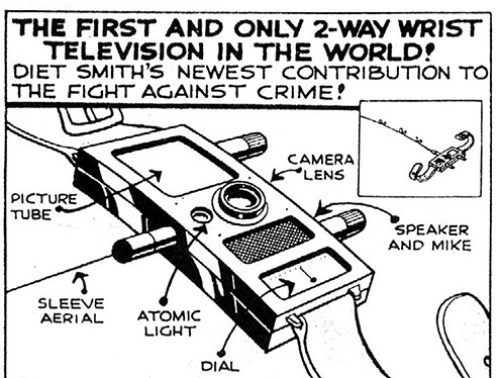
Ubiquitous, wearable computers have been a dream since at least the 1930s. Chester Gould’s comic strip Dick Tracy introduced the 2-Way Radio Watch worn by members of The City police force. At first merely a combination radio and wristwatch, eventually Tracy’s watch added television and other technical capabilities.
This comic strip, in turn, influenced Gene Roddenberry’s communicators on the television series Star Trek, and other images of watch-like communication/computation devices can be found throughout science fiction. The recent announcement of the Apple Watch has renewed interest in computerized wristwatches and revived the idea of a wrist-worn computer that is cool. Of course, the idea is hardly new but it took a long time for the wristwatch computer to reach levels that Dick Tracy achieved.
The earliest combination of the watch form factor with a computational device dates from late 19th century. English company Boucher’s received a patent for a circular slide rule in a pocket watch shape in 1876.
Boucher’s Calculator – circular slide rule
French company Meyrat & Perdrizet made a slide rule chronograph in 1890. The central portion of the device was a standard pocket watch face, with a circular slide rule with an independent hand surrounded it. Two dials at the top of the watch allowed it to perform calculations…

Follow the story– the introduction of wrist instruments in the early 20th century, the advent of electronics– at “It’s About Time: The Computer on Your Wrist.”
* Steve Wozniak
###
As we strap it on, we might send timely birthday greetings to John Harrison; he was born on this date in 1693. A self-educated English carpenter and clockmaker, Harrison invented the marine chronometer, In the absence of a way for ships at sea accurately to ascertain their longitude, sailing was dangerous; cumulative errors in dead reckoning over long voyages led to ship wrecks and loss of life. Indeed, the perceived threat– thus, the desire of a defense– was so great that Parliament offered a Longitude prize of £20,000 (£2.75 million) for a solution. Harrison’s approach, which won that prize, was to create a clock so accurate that it could eliminate those errors. His “chronometers” were accurate to within seconds over long periods; his winning clock was off only 39.2 seconds over a voyage of 47 days… and helped create the conditions in which the Age of Sail flourished. (More detail on the longitude problem and Harrison’s answer here.)

You must be logged in to post a comment.