Archive for April 2024
“I’m having a magenta day. Not just red, but magenta!”*…

Your correspondent is still on the road; regular service resumes on or around May 6. Meantime, a colorful update…
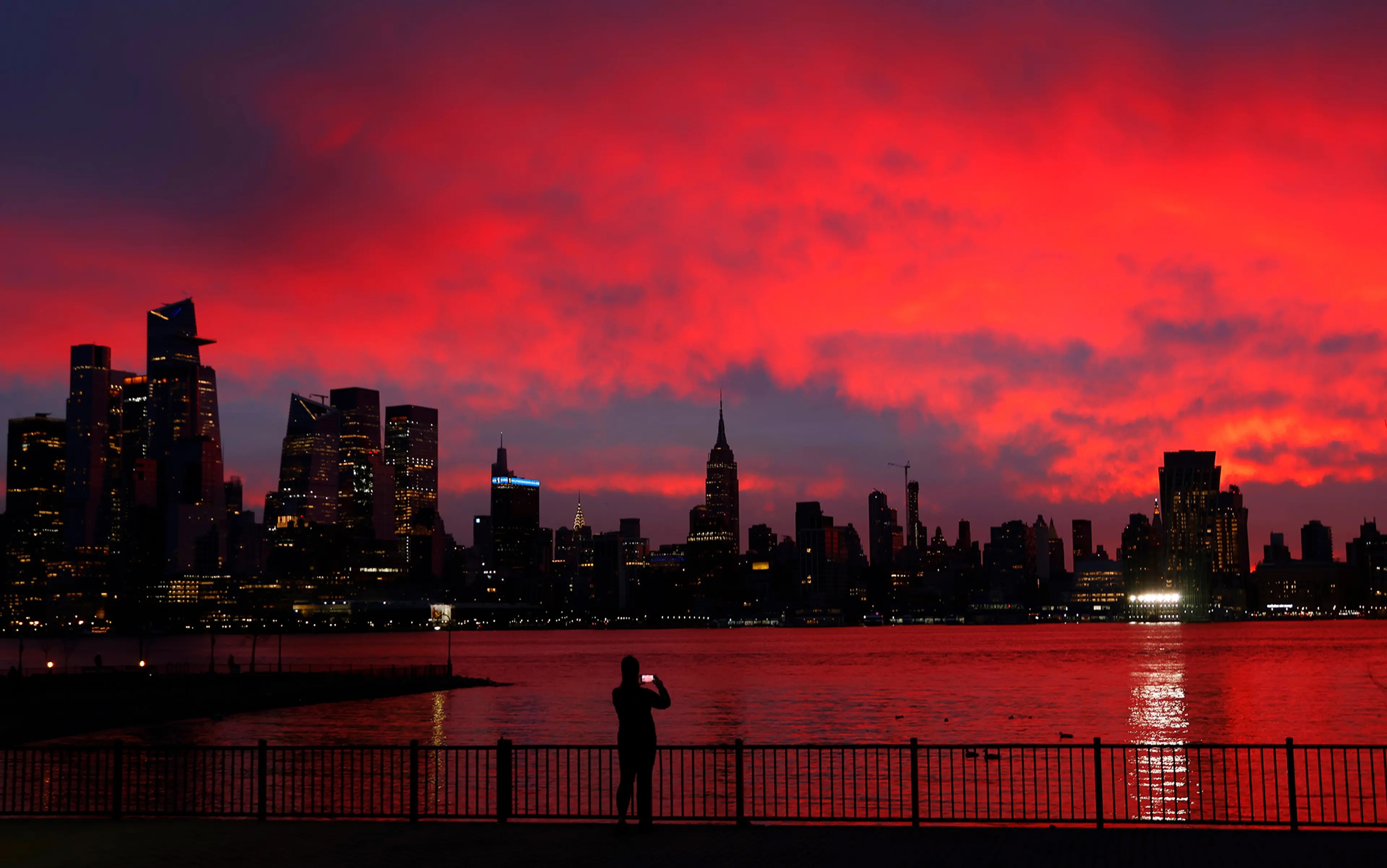
Forget about red hot. A new color-coded heat warning system relies on magenta to alert Americans to the most dangerous conditions they may see this summer.
The National Weather Service and the Centers for Disease Control and Prevention on Monday — Earth Day — presented a new online heat risk system that combines meteorological and medical risk factors with a seven-day forecast that’s simplified and color-coded for a warming world of worsening heat waves.
“For the first time we’ll be able to know how hot is too hot for health and not just for today but for coming weeks,” Dr. Ari Bernstein, director of the National Center for Environmental Health, said at a joint news conference by government health and weather agencies.
Magenta is the worst and deadliest of five heat threat categories, hitting everybody with what the agencies are calling “rare and/or long-duration extreme heat with little to no overnight relief.” It’s a step higher than red, considered a major risk, which hurts anyone without adequate cooling and hydration and has impacts reverberating through the health care system and some industries. Red is used when a day falls within the top 5% hottest in a particular location for a particular date; when other factors come into play, the alert level may bump even higher to magenta, weather service officials said.
On the other hand, pale green is little to no risk. Yellow is minor risk, mostly to the very young, old, sick and pregnant. Orange is moderate risk, mostly hurting people who are sensitive to heat, especially those without cooling, such as the homeless.
“When red-hot isn’t enough: New government heat risk tool sets magenta as most dangerous level,” from @AP.
* Stephen King, Needful Things
###
As we reassess risk, we might recall that it was on this date in 1986 that Russia announced the Chernobyl nuclear disaster, two days after it happened.

“If the world’s 223 international undersea cable systems were to suddenly disappear, only a minuscule amount of this traffic would be backed up by satellite, and the Internet would effectively be split between continents”*…

Your correspondent is hitting the road, so (Roughly) Daily will be a good bit more roughly than daily for a bit. Regular service should resume on or around May 6. Meantime, a fascinating– and meaty– piece to hold you…
Josh Dzieza goes deep on an undersung technology and the folks who keep it functioning…
The world’s emails, TikToks, classified memos, bank transfers, satellite surveillance, and FaceTime calls travel on cables that are about as thin as a garden hose. There are about 800,000 miles of these skinny tubes crisscrossing the Earth’s oceans, representing nearly 600 different systems, according to the industry tracking organization TeleGeography. The cables are buried near shore, but for the vast majority of their length, they just sit amid the gray ooze and alien creatures of the ocean floor, the hair-thin strands of glass at their center glowing with lasers encoding the world’s data.
If, hypothetically, all these cables were to simultaneously break, modern civilization would cease to function. The financial system would immediately freeze. Currency trading would stop; stock exchanges would close. Banks and governments would be unable to move funds between countries because the Swift and US interbank systems both rely on submarine cables to settle over $10 trillion in transactions each day. In large swaths of the world, people would discover their credit cards no longer worked and ATMs would dispense no cash. As US Federal Reserve staff director Steve Malphrus said at a 2009 cable security conference, “When communications networks go down, the financial services sector does not grind to a halt. It snaps to a halt.”
Corporations would lose the ability to coordinate overseas manufacturing and logistics. Seemingly local institutions would be paralyzed as outsourced accounting, personnel, and customer service departments went dark. Governments, which rely on the same cables as everyone else for the vast majority of their communications, would be largely cut off from their overseas outposts and each other. Satellites would not be able to pick up even half a percent of the traffic. Contemplating the prospect of a mass cable cut to the UK, then-MP Rishi Sunak concluded, “Short of nuclear or biological warfare, it is difficult to think of a threat that could be more justifiably described as existential.”
Fortunately, there is enough redundancy in the world’s cables to make it nearly impossible for a well-connected country to be cut off, but cable breaks do happen. On average, they happen every other day, about 200 times a year. The reason websites continue to load, bank transfers go through, and civilization persists is because of the thousand or so people living aboard 20-some ships stationed around the world, who race to fix each cable as soon as it breaks…
The internet cables that knit the world together and the people that keep them working: “The Cloud Under the Sea,” from @joshdzieza in @verge. Eminently worth reading in full.
* Nicole Starosielski, The Undersea Network
###
As we dive deep, we might send effectively-transmitted birthday greetings to a pioneer of telecommunications, Granville Woods; he was born on this date in 1856. An inventor, he held more than 50 patents, for innovations that ranged from a locomotive steam boiler to an egg incubator. But he is probably best remembered for his Synchronous Multiplex Railway Telegraph, a variation of the induction telegraph that relied on ambient static electricity from existing telegraph lines, allowing railroads to send messages between train stations and moving trains.
He is often referred to as the first African American mechanical and electrical engineer after the Civil War and as “the Black Edison” (sic).

“Men have become the tools of their tools”*…
Visionary philosopher Bernard Stiegler argued that it’s not our technology that makes humans special; rather, it’s our relationship with that technology. Bryan Norton explains…
It has become almost impossible to separate the effects of digital technologies from our everyday experiences. Reality is parsed through glowing screens, unending data feeds, biometric feedback loops, digital protheses and expanding networks that link our virtual selves to satellite arrays in geostationary orbit. Wristwatches interpret our physical condition by counting steps and heartbeats. Phones track how we spend our time online, map the geographic location of the places we visit and record our histories in digital archives. Social media platforms forge alliances and create new political possibilities. And vast wireless networks – connecting satellites, drones and ‘smart’ weapons – determine how the wars of our era are being waged. Our experiences of the world are soaked with digital technologies.
But for the French philosopher Bernard Stiegler, one of the earliest and foremost theorists of our digital age, understanding the world requires us to move beyond the standard view of technology. Stiegler believed that technology is not just about the effects of digital tools and the ways that they impact our lives. It is not just about how devices are created and wielded by powerful organisations, nation-states or individuals. Our relationship with technology is about something deeper and more fundamental. It is about technics.
According to Stiegler, technics – the making and use of technology, in the broadest sense – is what makes us human. Our unique way of existing in the world, as distinct from other species, is defined by the experiences and knowledge our tools make possible, whether that is a state-of-the-art brain-computer interface such as Neuralink, or a prehistoric flint axe used to clear a forest. But don’t be mistaken: ‘technics’ is not simply another word for ‘technology’. As Martin Heidegger wrote in his essay ‘The Question Concerning Technology’ (1954), which used the German term Technik instead of Technologie in the original title: the ‘essence of technology is by no means anything technological.’ This aligns with the history of the word: the etymology of ‘technics’ leads us back to something like the ancient Greek term for art – technē. The essence of technology, then, is not found in a device, such as the one you are using to read this essay. It is an open-ended creative process, a relationship with our tools and the world.
This is Stiegler’s legacy. Throughout his life, he took this idea of technics, first explored while he was imprisoned for armed robbery, further than anyone else. But his ideas have often been overlooked and misunderstood, even before he died in 2020. Today, they are more necessary than ever. How else can we learn to disentangle the effects of digital technologies from our everyday experiences? How else can we begin to grasp the history of our strange reality?…
[Norton unspools Stiegler’s remarkable life and the development of his thought…]
… Technology, for better or worse, affects every aspect of our lives. Our very sense of who we are is shaped and reshaped by the tools we have at our disposal. The problem, for Stiegler, is that when we pay too much attention to our tools, rather than how they are developed and deployed, we fail to understand our reality. We become trapped, merely describing the technological world on its own terms and making it even harder to untangle the effects of digital technologies and our everyday experiences. By encouraging us to pay closer attention to this world-making capacity, with its potential to harm and heal, Stiegler is showing us what else is possible. There are other ways of living, of being, of evolving. It is technics, not technology, that will give the future its new face…
Eminently worth reading in full: “Our tools shape our selves,” from @br_norton in @aeonmag.
Compare and contrast: Kevin Kelly‘s What Technology Wants
* Henry David Thoreau
###
As we own up, we might send phenomenological birthday greetings to Immanuel Kant; he was born on this date in 1724. One of the central figures of modern philosophy, Kant is remembered primarily for his efforts to unite reason with experience (e.g., Critique of Pure Reason [Kritik der reinen Vernunft], 1781), and for his work on ethics (e.g., Metaphysics of Morals [Die Metaphysik der Sitten], 1797) and aesthetics (e.g., Critique of Judgment [Kritik der Urteilskraft], 1790).
But Kant made important contributions to mathematics and astronomy. For example: his argument that mathematical truths are a form of synthetic a priori knowledge was cited by Einstein as an important early influence on his work. And his description of the Milky Way as a lens-shaped collection of stars that represented only one of many “island universes,” was later shown to be accurate by Herschel.
Act so as to treat humanity, whether in your own person or in that of another, at all times also as an end, and not only as a means.

“Engineering is the art of modeling materials we do not wholly understand, into shapes we cannot precisely analyze, so as to withstand forces we cannot properly assess, in such a way that the public has no reason to suspect”*…

… and so, for a very long time, it has been. Consider the case of the inventive Ismail al-Jazarī, a predecessor of Da Vinci…
… Al-Jazarī, who passed away in 1206, served as the chief engineer for the court of the Artuqids in Diyarbakir. His Book of Knowledge of Ingenious Mechanical Devices lives up to its name, detailing lock-like devices for raising water, sophisticated zodiac clocks, avian automata able to produce song, and a showering system for King Salih, who “disliked a servant or slave girl pouring water onto his hands for him”. He invented bloodletting technologies, mischievous fountains, segmental gears, and a chest (sundūq) that featured a security system with four combination dials — presumably a safe for storing valued possessions — and has been subsequently dubbed “the father of robotics”, due to his creation of a life-like butler who could offer guests a hand towel after their ablutions. Al-Jazarī’s contemporaries already recognized his eminence as an engineer, referring to him as unique and unrivaled, learned and worthy. He stood on the shoulders of Persian, Greek, Indian, and Chinese precursors, while Renaissance inventors, in turn, stood on his.
The Book of Knowledge of Ingenious Mechanical Devices contains some fifty mechanical devices divided into six categories: clocks; vessels and figures for drinking sessions; pitchers, basins, and other washing devices; fountains and perpetual flutes; machines for raising water; and a miscellaneous category, where we find a self-closing door. The second category is perhaps the most intriguing, and grants some insight into the extravagant concerns of al-Jazarī’s courtly patrons. One machine — “a standing slave holding a fish and a goblet from which he serves wine to the king” — is programmed to dispense clarified wine every eighth of an hour for a certain period. Numerous similar devices follow: robots that drink from goblets, which are filled from the recycled contents of their stomachs; automaton shaykhs that serve each other wine that each consumes in turn; a boat full of mechanical slave girls that play instruments during drinking parties. Not unlike our “AI assistants”, al-Jazarī’s inventions are never allowed to transcend the category of indentured laborer, reproducing the inequalities of social relations across the human-machine divide.
The illustrations from the Berlin manuscript are notably different than some of its sister specimens, such as the ornate pair of manuscripts held in Leiden. Here the images are mainly in-line illustrations and seem more focused on technical details and inner workings than other versions, which tend to lean toward aesthetic exteriors. Red and yellow predominate, offset by the occasional body of water in indigo blue. Gears and levers are rich in tone, while humanoid figures get left as simple, colorless sketches. To the contemporary viewer, the illustrations invert the power dynamic that is so present in al-Jazarī’s text. Machines come to the foreground; humans are incidental figures, almost irrelevant…
Putting material to work. More– and many more illustrations: “Ismail al-Jazarī’s Ingenious Mechanical Devices,” from @PublicDomainRev.
More of (and on) al-Jazarī’s creations here.
###
As we imagine machines, we might spare a thought for Henry Christopher Mance; he died on this date in 1926. An electrical engineer and inventor, he was instrumental in laying the earliest underwater telecom cables (under the Persian Gulf) and developed the Mance method of detecting and locating the positions of defects in submarine cables. But he is better remembered as the inventor of the Mance heliograph (a wireless solar telegraph that signals by flashes of sunlight using Morse code reflected by a mirror), which found wide military, survey, and forest protection application and for which he was knighted.


“Hollywood will rot on the windmills of Eternity”*…

… or possibly, Daniel Bessner argues, sooner…
… Thanks to decades of deregulation and a gush of speculative cash that first hit the industry in the late Aughts, while prestige TV was climbing the rungs of the culture, massive entertainment and media corporations had been swallowing what few smaller companies remained, and financial firms had been infiltrating the business, moving to reduce risk and maximize efficiency at all costs, exhausting writers in evermore unstable conditions.
“The industry is in a deep and existential crisis,” the head of a midsize studio told me in early August. We were in the lounge of the Soho House in West Hollywood. “It is probably the deepest and most existential crisis it’s ever been in. The writers are losing out. The middle layer of craftsmen are losing out. The top end of the talent are making more money than they ever have, but the nuts-and-bolts people who make the industry go round are losing out dramatically.”
Hollywood had become a winner-takes-all economy. As of 2021, CEOs at the majority of the largest companies and conglomerates in the industry drew salaries between two hundred and three thousand times greater than those of median employees. And while writer-producer royalty such as Shonda Rhimes and Ryan Murphy had in recent years signed deals reportedly worth hundreds of millions of dollars, and a slightly larger group of A-list writers, such as Smith, had carved out comfortable or middle-class lives, many more were working in bare-bones, short-term writers’ rooms, often between stints in the service industry, without much hope for more steady work. As of early 2023, among those lucky enough to be employed, the median TV writer-producer was making 23 percent less a week, in real dollars, than their peers a decade before. Total earnings for feature-film writers had dropped nearly 20 percent between 2019 and 2021.
Writers had been squeezed by the studios many times in the past, but never this far. And when the WGA went on strike last spring, they were historically unified: more guild members than ever before turned out for the vote to authorize, and 97.9 percent voted in favor. After five months, the writers were said to have won: they gained a new residuals model for streaming, new minimum lengths of employment for TV, and more guaranteed paid work on feature-film screenplays, among other protections.
But the business of Hollywood had undergone a foundational change. The new effective bosses of the industry—colossal conglomerates, asset-management companies, and private-equity firms—had not been simply pushing workers too hard and grabbing more than their fair share of the profits. They had been stripping value from the production system like copper pipes from a house—threatening the sustainability of the studios themselves. Today’s business side does not have a necessary vested interest in “the business”—in the health of what we think of as Hollywood, a place and system in which creativity is exchanged for capital. The union wins did not begin to address this fundamental problem.
Currently, the machine is sputtering, running on fumes. According to research by Bloomberg, in 2013 the largest companies in film and television were more than $20 billion in the black; by 2022, that number had fallen by roughly half. From 2021 to 2022, revenue growth for the industry dropped by almost 50 percent. At U.S. box offices, by the end of last year, revenue was down 22 percent from 2019. Experts estimate that cable-television revenue has fallen 40 percent since 2015. Streaming has rarely been profitable at all. Until very recently, Netflix was the sole platform to make money; among the other companies with streaming services, only Warner Bros. Discovery’s platforms may have eked out a profit last year. And now the streaming gold rush—the era that made Dickinson—is over. In the spring of 2022, the Federal Reserve began raising interest rates after years of nearly free credit, and at roughly the same time, Wall Street began calling in the streamers’ bets. The stock prices of nearly all the major companies with streaming platforms took precipitous falls, and none have rebounded to their prior valuation.
The industry as a whole is now facing a broad contraction. Between August 2022 and the end of last year, employment fell by 26 percent—more than one job gone in every four. Layoffs hit Warner Bros. Discovery, Netflix, Paramount Global, Roku, and others in 2022. In 2023, firings swept through the representation giants United Talent Agency and Creative Artists Agency; Netflix, Paramount Global, and Roku again; plus Hulu, NBCUniversal, and Lionsgate. In early 2024, it was announced that Amazon was cutting hundreds of jobs from its Prime Video and Amazon MGM Studios divisions. In February, Paramount Global laid off roughly eight hundred people. It’s unclear which streamers will survive. As James Dolan, the interim executive chair of AMC Networks, told employees in late 2022 as he delivered news of massive layoffs—roughly 1,700 people (20 percent of U.S. staff) would lose their jobs—“the mechanisms for the monetization of content are in disarray.”
Profit will of course find a way; there will always be shit to watch. But without radical intervention, whether by the government or the workers, the industry will become unrecognizable. And the writing trade—the kind where one actually earns a living—will be obliterated…
Film and television writers face an existential threat; viewers, a drab future: “The Life and Death of Hollywood,” from @dbessner in @Harpers. A bracing piece, eminently worth reading in full.
* Allen Ginsberg
###
As we study streaming, we might recall that it was on this date in 1964 that AT&T connected the first Picturephone call (between Disneyland in California and the World’s Fair in New York). The device consisted of a telephone handset and a small, matching TV, which allowed telephone users to see each other in fuzzy video images as they carried on a conversation. It was commercially-released shortly thereafter (prices ranged from $16 to $27 for a three-minute call between special booths AT&T set up in New York, Washington, and Chicago), but didn’t catch on… though, of course, it augured the “future” in which now we live.

You must be logged in to post a comment.