Archive for March 2024
“Every living thing is made of cells, and everything a living thing does is done by the cells that make it up”*…
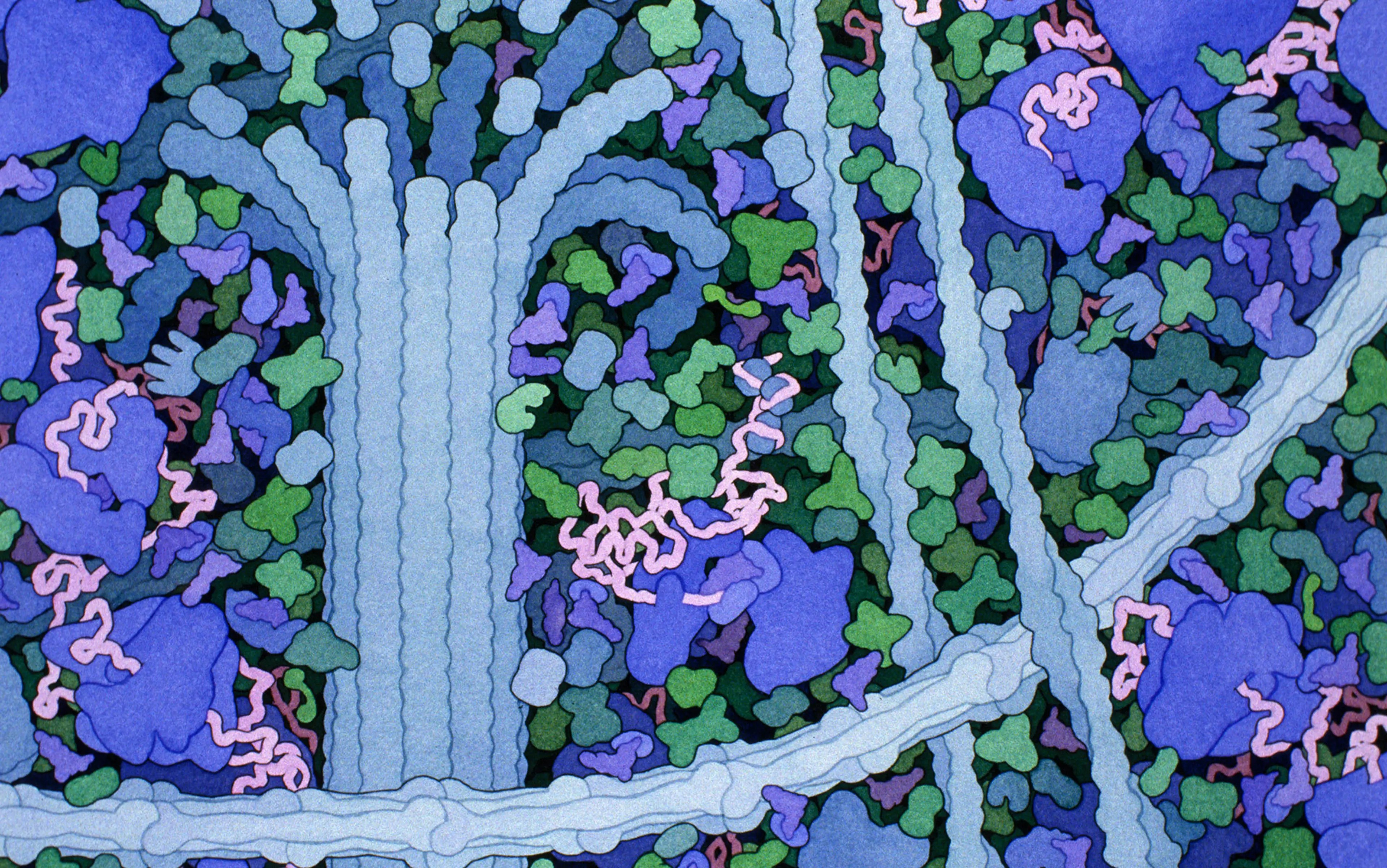
And so, as Charudatta Navare explains, we need to be thoughtful about how we talk about them, as prevailing scientific narratives project human social hierarchies onto nature in misleading ways…
When you think about it, it is amazing that something as tiny as a living cell is capable of behaviour so complex. Consider the single-cell creature, the amoeba. It can sense its environment, move around, obtain its food, maintain its structure, and multiply. How does a cell know how to do all of this? Biology textbooks will tell you that each eukaryotic cell, which constitutes a range of organisms from humans to amoeba, contains a control centre within a structure called the nucleus. Genes present in the nucleus hold the ‘information’ necessary for the cell to function. And the nucleus, in turn, resides in a jelly-like fluid called the cytoplasm. Cytoplasm contains the cellular organelles, the ‘little organs’ in the cell; and these organelles, the narrative goes, carry out specific tasks based on instructions provided by the genes.
In short, the textbooks paint a picture of a cellular ‘assembly line’ where genes issue instructions for the manufacture of proteins that do the work of the body from day to day. This textbook description of the cell matches, almost word for word, a social institution. The picture of the cytoplasm and its organelles performing the work of ‘manufacturing’, ‘packaging’ and ‘shipping’ molecules according to ‘instructions’ from the genes eerily evokes the social hierarchy of executives ordering the manual labour of toiling masses. The only problem is that the cell is not a ‘factory’. It does not have a ‘control centre’. As the feminist scholar Emily Martin observes, the assumption of centralised control distorts our understanding of the cell.
A wealth of research in biology suggests that ‘control’ and ‘information’ are not restricted at the ‘top’ but present throughout the cell. The cellular organelles do not just form a linear ‘assembly line’ but interact with each other in complex ways. Nor is the cell obsessed with the economically significant work of ‘manufacturing’ that the metaphor of ‘factory’ would have us believe. Instead, much of the work that the cell does can be thought of as maintaining itself and taking ‘care’ of other cells.
Why, then, do the standard textbooks continue to portray the cell as a hierarchy? Why do they invoke a centralised authority to explain how each cell functions? And why is the imagery so industrially loaded?…
We need better metaphors to describe cellular life: “The cell is not a factory,” from @charudatta_n in @aeonmag.
* cytologist and author L.L. Larison Cudmore
###
As we avoid anthropomorphism, we might recall that it was on this date in 1981 that the first patent for a life form (U.S. No. 4,259,444) was issued to Ananda Chakrabarty (who had done his research at GE). Chakrabarty had developed Pseudomonas bacterium (now called Burkholderia cepacia) which can be used to clean up toxic spills (as it can break down crude oil into simpler substances that can even become food for aquatic life)– an ability possessed by no naturally occurring bacteria.
The application had been originally denied by the patent office, on the grounds that under patent law at that time, living things were generally understood to not be patentable subject matter under 35 U.S.C. § 101.
Chakrabarty (and GE) appealed (to the Board of Patent Appeals and Interferences), lost, and appealed again ( the United States Court of Customs and Patent Appeals) and prevailed…. At which point, the Patent Office (led by director Sydney Diamond) appealed in civil court.
Ultimately, the Supreme Court ruled (5-4, Diamond v. Chakrabarty) in Chakrabarty’s favor. As Chief Justice Warren Burger wrote for the majority, life can be patented if they are the outcome of “human ingenuity and research” and not “nature’s handiwork”– a ruling that cleared the way for patents to be issued on genetically-engineered mice and other animals, seeds, and more.

“The list could surely go on, and there is nothing more wonderful than a list, instrument of wondrous hypotyposis”*…
Kanya Kanchana‘s panegyric to lists in literature, to the literature of lists, and to the authors who make them…
… We all make lists, if only to buy bread and milk. But we tend to forget how mythic and subversive (as we have just seen), joyful and maddening, enchanting and sobering, and utterly chilling lists can be—and what they can do. To love a list is to partake in letter and word, form and change. To make lists is to join a long line of list makers, to indulge in a timeless art, to break down the artificial wall that separates thinking and doing, thinkers and doers…
From Borges and the Bhagavad-Gītā to Georges Perec and Atul Gawande: “One Thing After Another: A Reading List for Lovers & Makers of Lists,” from @Longreads.
* Umberto Eco (one of the authors on the list)
###
As we check it off, we might note that today is National I Am In Control Day… an annual celebration of two disparate things: it is meant to encourage people to take control of their lives. At the same time, it marks the occasion of an assassination attempt on President Ronald Reagan (on this date in 1981) immediately after which then-Secretary of State Alexander Haig, in a press briefing, uttered the famous words, “I am in control“… which wasn’t factually correct and contributed to his resignation not too long after.
“You may delay, but time will not”*…
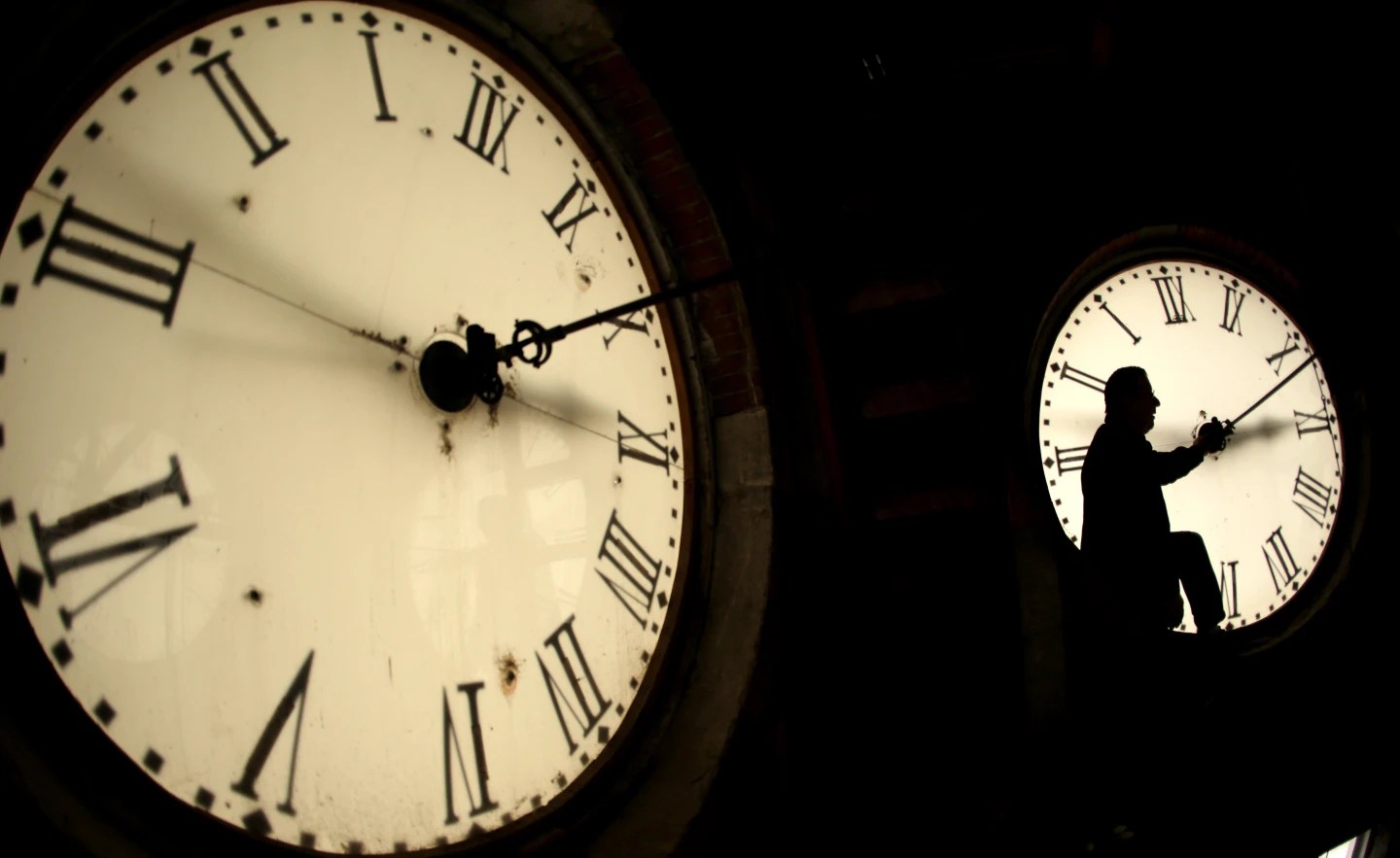
It turns out that our feeling that things are speeding up has some basis in science…
Earth’s changing spin is threatening to toy with our sense of time, clocks and computerized society in an unprecedented way — but only for a second.
For the first time in history, world timekeepers may have to consider subtracting a second from our clocks in a few years because the planet is rotating a tad faster than it used to. Clocks may have to skip a second — called a “negative leap second” — around 2029, a study in the journal Nature said Wednesday.
“This is an unprecedented situation and a big deal,” said study lead author Duncan Agnew, a geophysicist at the Scripps Institution of Oceanography at the University of California, San Diego. “It’s not a huge change in the Earth’s rotation that’s going to lead to some catastrophe or anything, but it is something notable. It’s yet another indication that we’re in a very unusual time.”
Ice melting at both of Earth’s poles has been counteracting the planet’s burst of speed and is likely to have delayed this global second of reckoning by about three years, Agnew said.
“We are headed toward a negative leap second,” said Dennis McCarthy, retired director of time for the U.S. Naval Observatory who wasn’t part of the study. “It’s a matter of when.”…
The full story: “A faster spinning Earth may cause timekeepers to subtract a second from world clocks,” from @AP.
For (even) more on leap seconds on their history, see “Will We Have a Negative Leap Second?“, by Demetrios Matsakis (also a retired director of time for the U.S. Naval Observatory).
See also: “Climate change is altering Earth’s rotation enough to mess with our clocks” (gift article): “in that one second, the Earth rotated about four football fields”
* Benjamin Franklin
###
As we muse on measurement, we might send carefully-observed birthday greetings to Sir Harold Spencer Jones; he was born on this date in 1890. An astronomer (indeed, for 23 years the tenth Astronomer Royal), he specialized in positional astronomy, particularly the motion and orientation of the Earth in space… a focus that helped him contribute to knowledge of the Earth’s rotation and improved timekeeping– efforts that led to Spencer Jones’ election (in 1947) as the first President of the Royal Institute of Navigation (which, In 1951, named its highest award, the Gold Medal, in his honor).

“Great minds discuss ideas; average minds discuss events; small minds discuss people”*…

In his invaluable newsletter, Garbage Day, Ryan Broderick unpacks the full– and forlorn— story of the online travails of Kate Middleton (AKA Catherine, the Princess of Wales) and considers its implications…
… As Charlie Warzel wrote, “It was always going to end this way. The truth about Kate Middleton’s absence is far less funny, whimsical, or salacious than the endless memes and conspiracy theories suggested.” But this also wasn’t a simple case of the unruly masses being Bad Online.
Yes, the #WhereIsKate hashtag was initially spread by the Sussex Squad, a royal fandom subculture that hates Prince William and believes Kate is, at best, sort of racist. And a lot of the early gossip was motivated by an impulse to give Kate a taste of what Meghan Markle is still experiencing at the hands of the UK media. But if you’re looking for someone to blame all of this on, it’s clearly Kate’s press team and, by extension, everyone in her life that supposedly cares about her. There were countless moments where her press team could have squashed all this, but they didn’t. Instead, they let a woman who had just discovered she has cancer become a global laughing stock and, at one point, made her apologize for it! Absolute sicko shit.
But this is also just how our various institutions work — or more accurately do not work — now. Over the last 25 years we have slowly uploaded every part of our lives to a system of platforms run by algorithms that make money off our worst impulses. Well, the ones brands are comfortable advertising around. And for years we have wondered what the world might look like when we crossed the threshold into a fully online world. Well, we did. We crossed it. This is what it looks like. And it is already too vast and complicated and all-encompassing to blame any one individual for how it functions. If we want something new, we’d have to smash the whole thing and I don’t think that’s going to happen. So let’s hope PR people, at the very least, can figure out how to deal with it going forward…
Those of us in post-colonial North America, might ponder the implications of this sad tale for matters closer to home– public health, meme stocks, and perhaps especially our looming elections…
The saga of #WhereIsKate: “How we got here,” from @broderick.
* Eleanor Roosevelt
###
As we lean back and think, we might recall that it was on this date in 1881 that a celebrated hoaxster took on partners: “P.T. Barnum’s Grand Traveling Museum, Menagerie, Caravan, and Circus: The Greatest Show on Earth” joined forces with James Bailey and James Hutchinson. By 1887, the re-branded circus went by the name “The Barnum & Bailey Greatest Show on Earth.”

“Words are sacred. They deserve respect. If you get the right ones, in the right order, you can nudge the world a little.”*…

And as Gail Sherman observes, that principle operates at a pretty basic level…
There is a Royal Order of Adjectives, and you follow it without knowing what it is—a particular sequence to use when more than one adjective precedes a noun. There are exceptions, of course, because English is three languages in a trenchcoat. According to the Cambridge Dictionary, in general, the proper order is:
Opinion
Size
Physical quality
Shape
Age
Color
Origin
Material
Type
PurposeMost people couldn’t tell you this rule, but everyone follows it. If you use the wrong order, it just sounds weird. If you have a fancy new blue metal lunchbox but call it a metal new fancy blue lunchbox, people might be worried you are having a stroke…
“There is a Royal Order of Adjectives, and you follow it without knowing what it is,” from @CambridgeWords via @BoingBoing.
* Tom Stoppard
###
As we parse, we might send powerfully-phrased birthday greetings to a spare but graceful user of adjectives, Seymour Wilson “Budd” Schulberg; he was born on this date in 1914. A screenwriter, television producer, novelist, and sportswriter, Schulberg is best remembered for his novels What Makes Sammy Run? (1941) and The Harder They Fall (1947), as well as his screenplays for On the Waterfront (1954, for which he received an Academy Award) and A Face in the Crowd (1957).
As a sportswriter, Schulberg was most famously chief boxing correspondent for Sports Illustrated. He wrote some well-received books on boxing, including Sparring with Hemingway and was inducted into the International Boxing Hall of Fame (in 2002).
The son of B. P. Schulberg, head of Paramount Studios in its golden age, Budd wrote Moving Pictures: Memoirs of a Hollywood Prince, an autobiography covering his youth in Hollywood, growing up in the 1920s and 1930s among the famous.

You must be logged in to post a comment.