Archive for March 2024
“My spirit will arise from my grave”*…
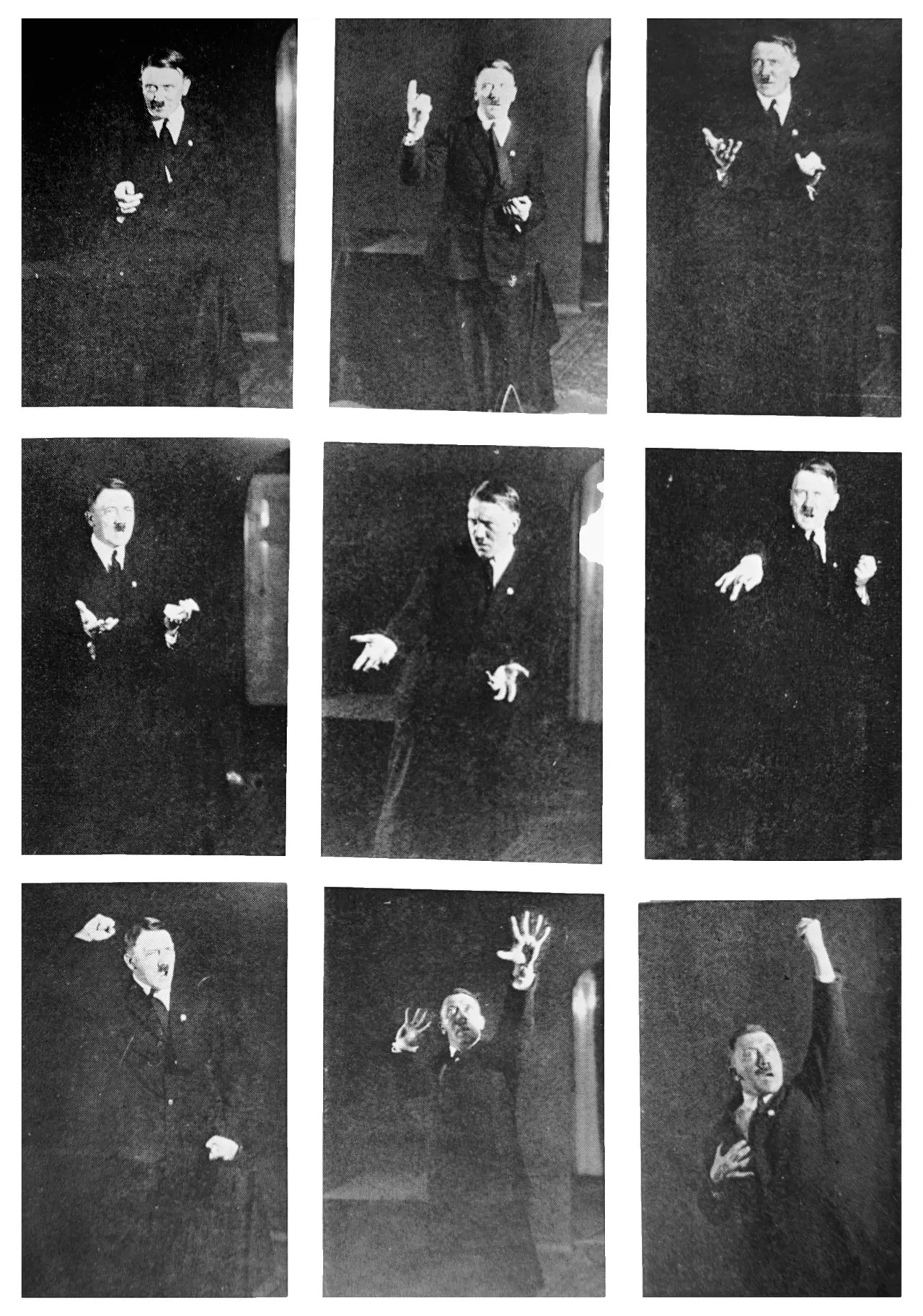
Hitler didn’t seize power; he was given it. As Adam Gopnik reports in a review of Tim Ryback‘s important new book, media lords thought that they could control him; political schemers thought that they could outwit him. The mainstream left had become a gerontocracy. And all of them failed to recognize his immunity to shame…
Hitler is so fully imagined a subject—so obsessively present on our televisions and in our bookstores—that to reimagine him seems pointless. As with the Hollywood fascination with Charles Manson, speculative curiosity gives retrospective glamour to evil. Hitler created a world in which women were transported with their children for days in closed train cars and then had to watch those children die alongside them, naked, gasping for breath in a gas chamber. To ask whether the man responsible for this was motivated by reading Oswald Spengler or merely by meeting him seems to attribute too much complexity of purpose to him, not to mention posthumous dignity. Yet allowing the specifics of his ascent to be clouded by disdain is not much better than allowing his memory to be ennobled by mystery.
So the historian Timothy W. Ryback’s choice to make his new book, “Takeover: Hitler’s Final Rise to Power” (Knopf), an aggressively specific chronicle of a single year, 1932, seems a wise, even an inspired one. Ryback details, week by week, day by day, and sometimes hour by hour, how a country with a functional, if flawed, democratic machinery handed absolute power over to someone who could never claim a majority in an actual election and whom the entire conservative political class regarded as a chaotic clown with a violent following. Ryback shows how major players thought they could find some ulterior advantage in managing him. Each was sure that, after the passing of a brief storm cloud, so obviously overloaded that it had to expend itself, they would emerge in possession of power. The corporate bosses thought that, if you looked past the strutting and the performative antisemitism, you had someone who would protect your money. Communist ideologues thought that, if you peered deeply enough into the strutting and the performative antisemitism, you could spy the pattern of a popular revolution. The decent right thought that he was too obviously deranged to remain in power long, and the decent left, tempered by earlier fights against different enemies, thought that, if they forcibly stuck to the rule of law, then the law would somehow by itself entrap a lawless leader. In a now familiar paradox, the rational forces stuck to magical thinking, while the irrational ones were more logical, parsing the brute equations of power. And so the storm never passed. In a way, it still has not…
Both the review and the book on which it focuses are eminently worth reading in full: “The Forgotten History of Hitler’s Establishment Enablers” (possible paywall; in which case, archived copy here), from @adamgopnik in @NewYorker.
* Hitler, as quoted in a letter from von Ribbentrop (to Churchill and Atlee) sent just before von Ribbentrop was captured at the end of the war
###
As we hear the echo, we might spare a thought for Ludwig van Beethoven; he died on this date in 1827. A crucial figure in the transition between the Classical and Romantic eras in Western music, he remains one of the most famous and influential of all composers. His best-known compositions include 9 symphonies, 5 concertos for piano, 32 piano sonatas, and 16 string quartets. He also composed other chamber music, choral works (including the celebrated Missa Solemnis), a single opera (Fidelio), and numerous songs.
Relevantly to the piece above…
Beethoven admired the ideals of the French Revolution, so he dedicated his third symphony to Napoleon Bonaparte… until Napoleon declared himself emperor. Beethoven then sprung into a rage, ripped the front page from his manuscript and scrubbed out Napoleon’s name. Some modern reproductions of the original title page have scrubbed out Napoleon’s name to create a hole for authenticity’s sake!
Beethoven’s temper and Symphony No. 3 ‘Eroica’
But, of course, it was too late…

“Everything we care about lies somewhere in the middle, where pattern and randomness interlace”*…

… A French mathematician has just won the Abel Prize for his decades of work developing a set of tools now widely used for taming random processes…
Random processes take place all around us. It rains one day but not the next; stocks and bonds gain and lose value; traffic jams coalesce and disappear. Because they’re governed by numerous factors that interact with one another in complicated ways, it’s impossible to predict the exact behavior of such systems. Instead, we think about them in terms of probabilities, characterizing outcomes as likely or rare…
… the French probability theorist Michel Talagrand was awarded the Abel Prize, one of the highest honors in mathematics, for developing a deep and sophisticated understanding of such processes. The prize, presented by the king of Norway, is modeled on the Nobel and comes with 7.5 million Norwegian kroner (about $700,000). When he was told he had won, “my mind went blank,” Talagrand said. “The type of mathematics I do was not fashionable at all when I started. It was considered inferior mathematics. The fact that I was given this award is absolute proof this is not the case.”
Other mathematicians agree. Talagrand’s work “changed the way I view the world,” said Assaf Naor of Princeton University. Today, added Helge Holden, the chair of the Abel prize committee, “it is becoming very popular to describe and model real-world events by random processes. Talagrand’s toolbox comes up immediately.”
…
A random process is a collection of events whose outcomes vary according to chance in a way that can be modeled — like a sequence of coin flips, or the trajectories of atoms in a gas, or daily rainfall totals. Mathematicians want to understand the relationship between individual outcomes and aggregate behavior. How many times do you have to flip a coin to figure out whether it’s fair? Will a river overflow its banks?
Talagrand focused on processes whose outcomes are distributed according to a bell-shaped curve called a Gaussian. Such distributions are common in nature and have a number of desirable mathematical properties. He wanted to know what can be said with certainty about extreme outcomes in these situations. So he proved a set of inequalities that put tight upper and lower bounds on possible outcomes. “To obtain a good inequality is a piece of art,” Holden said. That art is useful: Talagrand’s methods can give an optimal estimate of, say, the highest level a river might rise to in the next 10 years, or the magnitude of the strongest potential earthquake…
Say you want to assess the risk of a river flooding — which will depend on factors like rainfall, wind and temperature. You can model the river’s height as a random process. Talagrand spent 15 years developing a technique called generic chaining that allowed him to create a high-dimensional geometric space related to such a random process. His method “gives you a way to read the maximum from the geometry,” Naor said.
The technique is very general and therefore widely applicable. Say you want to analyze a massive, high-dimensional data set that depends on thousands of parameters. To draw a meaningful conclusion, you want to preserve the data set’s most important features while characterizing it in terms of just a few parameters. (For example, this is one way to analyze and compare the complicated structures of different proteins.) Many state-of-the-art methods achieve this simplification by applying a random operation that maps the high-dimensional data to a lower-dimensional space. Mathematicians can use Talagrand’s generic chaining method to determine the maximal amount of error that this process introduces — allowing them to determine the chances that some important feature isn’t preserved in the simplified data set.
Talagrand’s work wasn’t just limited to analyzing the best and worst possible outcomes of a random process. He also studied what happens in the average case.
In many processes, random individual events can, in aggregate, lead to highly deterministic outcomes. If measurements are independent, then the totals become very predictable, even if each individual event is impossible to predict. For instance, flip a fair coin. You can’t say anything in advance about what will happen. Flip it 10 times, and you’ll get four, five or six heads — close to the expected value of five heads — about 66% of the time. But flip the coin 1,000 times, and you’ll get between 450 and 550 heads 99.7% of the time, a result that’s even more concentrated around the expected value of 500. “It is exceptionally sharp around the mean,” Holden said.
“Even though something has so much randomness, the randomness cancels itself out,” Naor said. “What initially seemed like a horrible mess is actually organized.”…
“Michel Talagrand Wins Abel Prize for Work Wrangling Randomness,” from @QuantaMagazine.
* James Gleick, The Information
###
As we comprehend the constructs in chance, we might spare a thought for Caspar Wessel; he died on this date in 1818. A mathematician, he the first person to describe the geometrical interpretation of complex numbers as points in the complex plane and vectors.
Not coincidentally, Wessel was also a surveyor and cartographer, who contributed to the Royal Danish Academy of Sciences and Letters‘ topographical survey of Denmark.

“He’s like the ghost in the machine”*…

Sasha Kay on Clyde Stubblefield’s 20-second drum break that became one of the most sampled beats in music…
On November 20 1969, musical history was being made in a red-brick end-of-terrace in Cincinnati, Ohio. The sounds of cymbals and snares leaking out from under a garage roller door included a beat you’ve probably heard hundreds of times — perhaps without even knowing it.
At King Records’ low-key studio, drummer Clyde Stubblefield was improvising a 20-second breakbeat during a James Brown jam session which became known as “Funky Drummer”, a track that dramatically changed the course of music sampling and moulded the hip-hop genre which would be born a few years later.
Brown stresses Stubblefield’s genius in the song’s title and in various flamboyant asides stippled throughout the break — “Ain’t it funky” — but Mr Funky Drummer himself never received a penny from the track’s royalties. As was typical for the time, Stubblefield was on a work-for-hire contract, meaning his performance was legally attributed to Brown. Despite cooing “I wanna give the drummer some” over Stubblefield’s snares, Brown never gave Stubblefield a dime.
“Funky Drummer” fell short of the top 50 chart when it was released as a single in March 1970, but the record had a remarkable afterlife…
[Kay recounts the extraordinary life of the break as a sample in other musicians’ (especially Hip Hop artists’) works. See here for as complete a list as one’s likely to find– over 1,860 songs.]
… At the end of Stubblefield’s life, Prince paid around $80,000 of his medical bills — perhaps the singer’s personal reparation for mislaid royalties after sampling the beat in his “Gangster Glam” (1991).
Although “Funky Drummer” is a strong contender for the world’s most sampled beat, most wouldn’t recognise it in another tune, and much less know the drummer’s name. Stubblefield often said he was influenced by the sounds of factories and railways he grew up around — and no doubt many young instrumentalists have unknowingly been shaped by a music culture framed by his rhythm…
“Funky Drummer — pop history was made when James Brown hollered ‘Hit it!’,” from @FT.
For an appreciation of Stubblefield by Ahmir Thompson (AKA Questlove), see here.
* Questlove on Clyde Stubblefield
###
As we beatify the beat, we might spare a thought for another undersung hero of percussion, Uriel Jones; he died on this date in 2009. The drummer in Motown‘s in-house studio band, the Funk Brothers, during the 1960s and early 1970s, he can be heard on dozens of recordings, including classics like “I Heard It Through the Grapevine” by Marvin Gaye, “Cloud Nine” by the Temptations, “The Tracks of my Tears” and “I Second That Emotion” by Smokey Robinson & the Miracles, “For Once In My Life” by Stevie Wonder, and both versions of “Ain’t No Mountain High Enough” (Marvin Gaye & Tammi Terrell in 1967 and the 1970 remake by Diana Ross).

“This is not your average, everyday darkness. This is… ADVANCED darkness.”*…

As Rob Beschizza explains, Pere Rosselló, an astrophysics student at Universidad de La Laguna in Tenerife, Spain, has created an animation depicting the gravitational collapse of Spongebob…
Beschizza muses…
Just imagine being part of a civilization on the cusp of attaining a decent model of the universe’s origins—somewhere between Halley and Lemaître, and you start plotting backwards from where we are and where the Big Bang should be you find Spongebob instead. Running the numbers again and again. Such a universe has no need of Lovecraft, cosmic horror would be right there in the maths.
Rosselló [also] solved a three-body problem: the one of animating three bodies to look really cool…
“N-body simulation of the gravitational collapse of Spongebob Squarepants,” by @PeRossello via @Beschizza in @BoingBoing.
* SpongeBob, “Rock Bottom“
###
As we deconstruct deconstruction, we might recall that it was on this date (in an unspecified year) that SpongeBob met the green seahorse Mystery.
“A greenback, greenback dollar bill / Just a little piece of paper, coated with chlorophyll”*…

Americans are increasingly going cashless. Still, as Marcus Lu illustrates, there’s rather a lot of currency in circulation– almost $2.3 Trillion (of which about a third, an estimated $950 Billion [and here] is outside the U.S.)…
Every year, the U.S. Federal Reserve submits a print order for U.S. currency to the Treasury Department’s Bureau of Engraving and Printing (BEP). The BEP will then print billions of notes in various denominations, from $1 bills to $100 bills.
In this graphic, we’ve used the latest Federal Reserve data to visualize the approximate number of bills for each denomination globally, as of Dec. 31, 2022…
“Visualizing All of the U.S. Currency in Circulation” from @VisualCap.
* Ray Charles, “Greenbacks”
###
As we concede that cash is still king, we might send penurious birthday greetings to Kenneth Rogoff; he was born on this date in 1953. An economist who teaches at Harvard and has served as the Chief Economist of the International Monetary Fund, he has been a vocal champion of austerity… thus in conflict with Nobel Laueate and former chief economist of the World Bank Joseph Stiglitz (and radically less consequentially, with your correspondent).
While Rogoff completed his education (at Princeton and MIT), he dropped out of high school at 16 to concentrate on chess (at which time he met Bobby Fischer, who was impressed by Rogoff’s “self-assured style and his knowing exactly what he wanted over the chessboard”). Two years later he returned to school but continued to play competitively. Indeed, In 2012 he drew a blitz game with the world’s highest rated player Magnus Carlsen.

You must be logged in to post a comment.