Archive for October 2023
“Cyberspace undeniably reflects some form of geography”*…

Your correspondent in stepping again into the rapids, so (Roughly) Daily is going into a short hiatus. Regular service should resume on or around Nov 4. Here, something to enjoy in the meantime…
Our old friend Neal Agarwal has created an interactive museum of sorts, a stroll through the history of the internet, as manifest in the artifacts of important “firsts”– the first smiley, the first MP3, the first “LOL.” the first live-steamed concert, and so, so much more…
Browse through Internet Artifacts, from @nealagarwal.
* Sandra Day O’Connor
###
As we touch the exhibits, we might send imperial birthday greetings to William Henry Gates III; he was born on this date in 1955. Gates is, of course, best known for co-founding the technology giant Microsoft, along with his childhood friend Paul Allen. He led the company from its packaged software beginnings onto the internet. After leaving the company in 2008, he founded several other companies, including BEN, Cascade Investment, TerraPower, bgC3, and Breakthrough Energy; but he has increasingly turned his attention to philanthropy.

“Your silence will not protect you”*…

Characterized today by the noise of banging, buzzers, and the cries of inmates, solitary confinement was originally developed from Quaker ideas about the redemptive power of silence, envisioned as a humane alternative to the punitive violence of late-18th century jails. Revisiting Pennsylvania’s Eastern State Penitentiary, Jane Brox discovers the spiritual origins and reformist ambitions of solitary’s early advocates, and sees their supposedly progressive desires come to ruin by the 20th century…
On any given day in the United States, of the more than one million men and women incarcerated in jails and prisons, over 120,000 are locked in solitary confinement. None have been sentenced by a court to their isolation. They are serving a punishment within punishment, having been placed in solitary by prison officials for a variety of reasons: violent crime, petty theft, speaking out, gang involvement, political activism. Some are in protective custody; others have mental health issues and are considered too difficult to control. A disproportionate percentage are people of color. Their sentence might last weeks or months and is subject to extension. More than a few spend years, even decades in cells whose dimensions are commonly compared to the size of a parking space, but which are often smaller — six-by-nine feet, or eight-by-ten. Reading material is sparse. Confined prisoners don’t participate in educational or rehabilitation programs. Other than meals — which are often more meager than those provided to the general prison population — and an hour of exercise a day, little exists to distract them from the heaviness of time, and nothing at all suggests that the historic roots of such punishment can be traced to the concept of redemption.
The idea of the solitary cell as an integral part of the American prison system arose during the Early Republic, the specific vision of Philadelphia physician and Founding Father Benjamin Rush, who advocated for time in solitude and silence — the active, searching silence of Quakerism — as an alternative to the bodily pain, injury, and humiliation of public hangings and whippings. He saw it as a means not only of punishment but of reformation for housebreakers, forgers, highway robbers, horse thieves, and even murderers, and his vision of justice eventually led to the construction of the world’s first penitentiary, Eastern State, designed by architect John Haviland, and raised on the grounds of an old cherry orchard three miles outside of Philadelphia’s city limits.
When Cherry Hill — as it was sometimes called — admitted its first prisoners in 1829, it stood in stark contrast to traditional jails, where debtors and those awaiting trial were housed in filthy, noisy, and disorderly common rooms. In the penitentiary, not only were the confined to remain in their individual cells for the duration of their sentence, according to the board of inspectors for Philadelphia’s prisons, there was to be “such an entire seclusion of convicts from society and from one another, as that during the period of their confinement, no one shall see or hear, or be seen or heard by any human being, except the jailer, the inspectors, or such other persons, as for highly urgent reasons may be permitted to enter the walls of the prison.”…
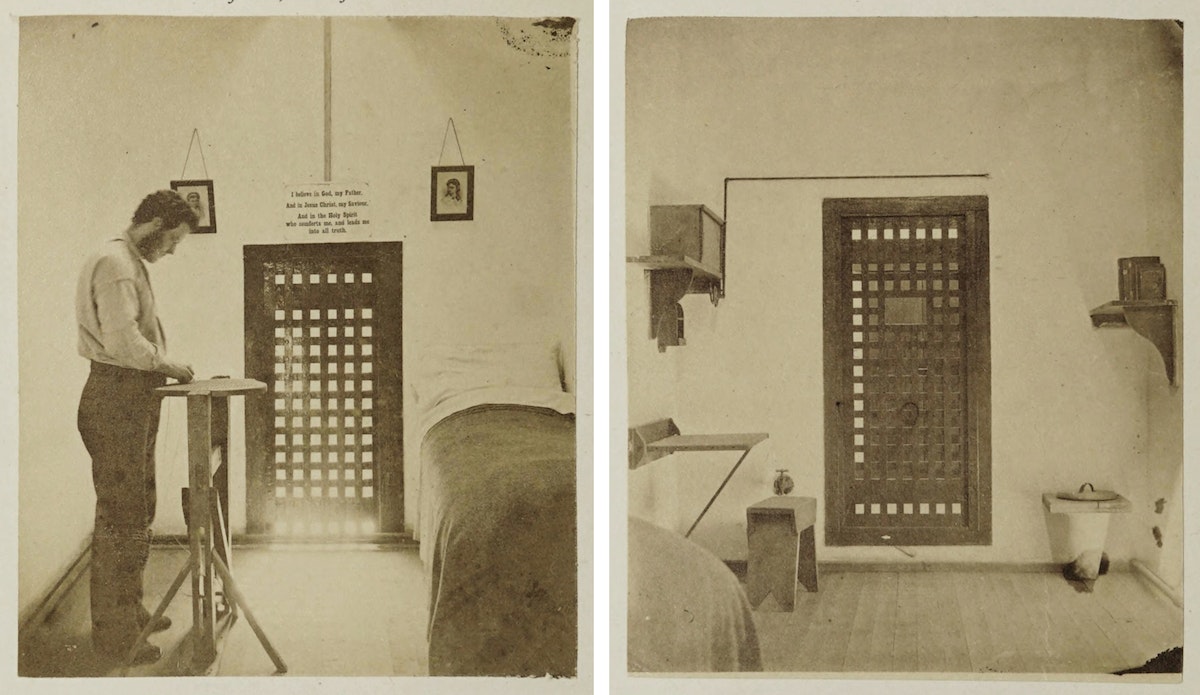
How a Quaker’s good intentions went awry: “The Silent Treatment- Solitary Confinement’s Unlikely Origins,” in @PublicDomainRev.
* Audre Lorde
###
As we ponder penitentiaries, we might send reformist birthday greetings to Roscoe Pound; he was born on this date in 1870. A lawyer and law school professor and Dean, he was one of the most cited legal scholars of the 20th century.
While serving as Dean of Harvard Law School, Pound founded the movement for “sociological jurisprudence” and was one of the early leaders of the movement for American Legal Realism, which argued for a more pragmatic and public-interested interpretation of law and a focus on how the legal process actually occurred, as opposed to (in his view) the arid legal formalism which prevailed in American jurisprudence at the time. In Pound’s view, these jurisprudential movements advocated “the adjustment of principles and doctrines to the human conditions they are to govern rather than to assumed first principles.” While Pound was dean, law school registration almost doubled, but his standards were so rigorous that one-third of those matriculated did not receive degrees. Among those that did were many of the great political innovators of the New Deal years.
Pound also had a PhD in botany, and before turning to the law, served as director of the Nebraska state botanical survey (1892-1903), during which time he discovered a rare fungus, subsequently named Roscopoundia.

“The world is a globe — the farther you sail, the closer to home you are”*…

A good globe is a thing of beauty and a source of wonder, perhaps none more than those made by Peter Bellerby, founder of artisan globemakers Bellerby & Co. Globemakers, one of only two handmade globemaking companies in the world. In an excerpt from his book, The Globemakers: The Curious Story of an Ancient Craft, he explains how it’s done…
The simplest way to make a globe is to construct a sphere and paint it. The earliest globes would have been made of wood or metal, with the celestial or terrestrial map painted directly on by hand. Later, in the sixteenth century, hollow globes were made of thin sheets of metal which were then hand-painted. Mapping doesn’t lend itself to painting and lettering by hand, and cartography was in its infancy, so early painted globes were necessarily very inaccurate.
Later makers pasted blank gores onto the sphere to create a more forgiving canvas for the hand-painted map and lettering. These are called manuscript globes. The invention of the printing press meant that maps could be printed as gores. A silversmith or skilled engraver would etch a reverse map on copper plates before printing using a process known as intaglio, from the Italian word for ‘carving.’ In intaglio printing the etched plate is coated with ink, then wiped to leave ink only in the incised depressions, before being run through an etching press, in which dampened paper picks up the ink to create the printed image. Copper is a soft metal, so the plates lose their clarity relatively quickly; smaller print runs were therefore common. The effect, though, is very satisfying, with an intense character to the image. The globemaker then pasted the printed gores onto the globe and finally the painter would add color.
It was at this point that the globemaking craft became assimilated with the printing and publishing industry. Globes were after all now printed just like books, and since this time each edition has been referred to as a ‘publication.’ And as in book publishing, copying the map from a rival’s globe is plagiarism.
The golden age of the printed and then hand-painted globe coincided with the age of European expansion, reaching its peak at the beginning of the seventeenth century. In this period, as astronomical, geographical and cartographical knowledge developed apace, globemakers too were inspired to experiment and refine their art. In turn, the proliferation of printing presses made it possible over time to produce more globes at a less than exorbitant cost so they became more affordable to a greater number of people.
Nevertheless, the acquisition or commission of a globe was still the preserve of the aristocracy and the affluent merchant class. Because of the delicate and time-consuming nature of the work, a budding globemaker probably would have required considerable financial backing. Globes therefore were prized symbols of status and prestige.
Studying these venerable antique globes, it was striking to see how little the methods of manufacture had changed from the mid-sixteenth century until the twentieth century, albeit there is always a mystery about the exact construction and methods because so much is hidden under the surface – it was only in the last century that the rot set in. I knew that I had high aspirations but did not want to simply reproduce some sort of cheap faux-antique facsimile. Instead, my ambition was to produce a handmade globe that felt classic yet at the same time unusual, relevant and contemporary…
Read on for a fascinating unpacking of the ingenuity and skill involved: “On the Artisanal Craft of Making a Globe,” from @globemakers in @lithub.
* Terry Pratchett
###
As we spin the sphere, we might send cartographical birthday greetings to Dimitrie Cantemir; he was born on this date in 1673. A Moldavian prince, statesman, and man of letters, he led a storied life as a statesman (twice serving as voivode of Moldavia), but also distinguished himself as a philosopher, historian, composer, musicologist, linguist, ethnographer, and geographer.
To that lattermost distinction, Cantemir’s c. 1714 manuscript map of Moldova (as the region which Moldavia centered was also known) was the first real map of the country, containing geographical detail as well as administrative information. Printed in 1737 in the Netherlands, it formed the basis of most European maps of the country for decades.

“The gods do not visit you to remind you what you know already”*…

Or do they? As the estimable Emily Watson explains, one woman– Edith Hamilton— had a great deal to do with our acquaintance with the mythology of ancient Greece and Rome, and in a way that had as much to do with the present as the past…
The discipline of “classical” literature has long been associated with social gatekeeping. The mastery of Latin and ancient Greek—or at least enough of an acquaintance to be able to trot out a well-worn tag from Horace and prompt knowing chuckles over the brandy—has often provided a useful qualification for passing as a gentleman and keeping out the plebs (Latin for “common people”) or hoi polloi (ancient Greek for “the many”). It is understandable that George Eliot’s Maggie Tulliver eagerly whizzes through the Latin textbooks neglected by her idle brother Tom, or that Thomas Hardy’s Jude, hoping in vain to escape the obscurity of provincial poverty, slogs through his Greek dictionary until late into the night. For these fictional characters, like many of their real-life equivalents, ancient languages and literature provided the most visible bar against entry into a “higher” social class.
Even in the 20th and 21st centuries, the subject has maintained a close association with systems of exclusion based on income, education, race, and gender…
Over the past century, there have been numerous attempts to provide wider access to the supposed treasures of Greek and Roman antiquity to those once excluded from its riches. In the early 20th century, translations of ancient texts became more widely available, ranging from Gilbert Murray’s wonderfully ornate and virtuosic renditions of Euripides to Hilda Doolittle’s much starker modernist free verse. The Loeb Classical Library was founded in 1911 and featured fairly inexpensive editions of these ancient texts in their original languages, with an English translation on the facing page. These translations heralded a new age in which once-inaccessible works of classical literature became more accessible to a far wider range of people. As Virginia Woolf noted in 1917, it was the Loeb Library editions that helped make it “respectable” for the “amateur” (including female ones) to muddle through Aeschylus.
After the First World War, an ever-larger number of colleges and universities in the United States began to offer classes on ancient texts studied in translation, with no expectation that students would be able to read even a little of the originals. By the early 20th century, the study of ancient literature and history was often considered a prerequisite for understanding contemporary issues in Europe and the United States—regions that were now often lumped together under the term “the West.” The Columbia Core, the first such course in the United States, was developed in 1919 with the explicit goal of showing students the “unique features of the western world,” a world that apparently had begun in ancient Greece and that had now reached its apex in the American present.
The goal of connecting US citizens to a long, largely fabricated notion of “Western civilization” seemed increasingly urgent in the aftermath of a war that had torn the nations of Europe apart. The fantasy of a common “Western” heritage shared by white Europeans and North Americans appeared as a prophylactic against future wars, at least between those who could qualify as “Westerners.” But it also did something else. By excluding the numerous surviving ancient texts and cultural artifacts from the rest of the world, these new courses on “Western civilization” suggested that premodern “civilization” was the exclusive property of the “West”—enabling a kind of mythical/historical justification for continued domination of those peoples deemed to have come from outside this exclusive group, whether it was Black and Asian Americans in the United States or the millions still living under imperial and colonial rule in Asia and Africa.
By the 1920s, a sizable market for popular classics books and translations had emerged in the United States. A new publishing firm, W.W. Norton, decided to seize on it and signed up a recently retired Latin teacher and private school headmistress named Edith Hamilton to translate a trio of Greek tragedies and write two surveys of ancient literature, The Greek Way and The Roman Way. Published in quick succession in the 1930s, these volumes proved to be an immediate success. Along with Mythology, her retelling of the Greco-Roman legends, the books made Hamilton a household name. Mythology has never been out of print since then and has remained an extraordinary commercial success, enriching her heirs and publishers to this day. Probably no other single person has had such an impact in shaping the perceptions of classical literature and mythology in the United States for almost a century.
How did a retired Latin schoolteacher (Hamilton was 62 when The Greek Way was published), with limited formal education and almost no scholarly credentials, come to be one of the most influential “classicists” of the 20th century? Victoria Houseman’s annalistic new biography, American Classicist, does not quite see this question as the puzzle it is, in part because Houseman has so much admiration for her subject that Hamilton’s successes are largely taken for granted. But the book still makes for gripping reading, as we trace the trajectory of Hamilton’s life from her activist youth (she was a member of the Baltimore Equal Suffrage League), through her various travels in Europe and Asia, her health troubles (she was a breast cancer survivor), her fascinating romantic partnerships with other women, to her second career as a popularizer of the ancient world and as a public intellectual who became closely associated with wealthy and powerful conservative groups in the US…
Read on for more of Hamilton’s remarkable– and cautionary– story: “Ancient Worlds,” from @EmilyRCWilson (@emilyrcwilson.bsky.social) in @thenation.
###
As we contemplate classics, we might send aquatic birthday greetings to Squidward Tentacles; today is his (fictional) birthday. A main characters of the SpongeBob SquarePants franchise, he is SpongeBob’s and Patrick’s grumpy neighbor and the former’s coworker at the Krusty Krab who lives in an Easter Island head. He is a mostly unpleasant artist and musician, and his favorite hobbies are painting self-portraits and playing the clarinet.
Though Squidward’s name contains the word “squid,” he is an octopus.

“No one ever went broke underestimating the taste of the American public”*…

… and now two beverage giants are turning their attention to Europe:
Coca-Cola and Pernod Ricard plan to debut Absolut Vodka & Sprite as a ready-to-drink pre-mixed cocktail in early 2024, the companies said in a statement.
The pre-mixed cocktail will be available in versions with Sprite and Sprite Zero Sugar, with the initial launch planned for select European countries, including the U.K., the Netherlands, Spain and Germany.
Coca-Cola has brought several of its most popular brands into the alcohol space during the last two years through partnerships with booze companies such as Molson Coors and Brown-Forman…
FoodDive
The inimitable Walt Hickey reacts…
Coca-Cola and Pernod Ricard have cut a deal to produce a ready-to-drink mixed cocktail that is literally just Absolut vodka and Sprite. Legendary adwoman Peggy Olson once quipped that “You need three ingredients for a cocktail. Mountain Dew and vodka is an emergency,” and that wisdom certainly holds here. The idea that a company could charge a premium to mix together Absolut and Sprite is an insult; as we all know, cheap vodka mixed with Sprite is an innovation of desperation, the mixture one creates when all other options have been exhausted, the kind of drink that you have when you’re 17 and new to the whole thing. This is the kind of beverage that is exclusively made at 2:45 in the morning in a college dorm because the bars closed and we can’t get mixers at Wawa because the line was too long. An Absolut and Sprite is the official drink of a CYO party. An Absolut and Sprite makes a Jack and Coke look like a Sazerac. That it is being combined in a ready-to-drink offering is an insult to the aluminum that went into that can. Given that the ready-to-drink category is projected to grow by $11.6 billion from 2022 to 2026 alone, I can almost guarantee it’s going to be amazingly successful and I already hate it.
Numlock
[Image above: source]
* H. L. Mencken
###
As we ponder progress, we might recall that today is observed (by some) as World Tripe Day— a celebration of the culinary delicacy known as tripe (the edible lining from the stomach of various farm animals, such as cattle, sheep, and goats).

You must be logged in to post a comment.