Posts Tagged ‘prisons’
“Your silence will not protect you”*…

Characterized today by the noise of banging, buzzers, and the cries of inmates, solitary confinement was originally developed from Quaker ideas about the redemptive power of silence, envisioned as a humane alternative to the punitive violence of late-18th century jails. Revisiting Pennsylvania’s Eastern State Penitentiary, Jane Brox discovers the spiritual origins and reformist ambitions of solitary’s early advocates, and sees their supposedly progressive desires come to ruin by the 20th century…
On any given day in the United States, of the more than one million men and women incarcerated in jails and prisons, over 120,000 are locked in solitary confinement. None have been sentenced by a court to their isolation. They are serving a punishment within punishment, having been placed in solitary by prison officials for a variety of reasons: violent crime, petty theft, speaking out, gang involvement, political activism. Some are in protective custody; others have mental health issues and are considered too difficult to control. A disproportionate percentage are people of color. Their sentence might last weeks or months and is subject to extension. More than a few spend years, even decades in cells whose dimensions are commonly compared to the size of a parking space, but which are often smaller — six-by-nine feet, or eight-by-ten. Reading material is sparse. Confined prisoners don’t participate in educational or rehabilitation programs. Other than meals — which are often more meager than those provided to the general prison population — and an hour of exercise a day, little exists to distract them from the heaviness of time, and nothing at all suggests that the historic roots of such punishment can be traced to the concept of redemption.
The idea of the solitary cell as an integral part of the American prison system arose during the Early Republic, the specific vision of Philadelphia physician and Founding Father Benjamin Rush, who advocated for time in solitude and silence — the active, searching silence of Quakerism — as an alternative to the bodily pain, injury, and humiliation of public hangings and whippings. He saw it as a means not only of punishment but of reformation for housebreakers, forgers, highway robbers, horse thieves, and even murderers, and his vision of justice eventually led to the construction of the world’s first penitentiary, Eastern State, designed by architect John Haviland, and raised on the grounds of an old cherry orchard three miles outside of Philadelphia’s city limits.
When Cherry Hill — as it was sometimes called — admitted its first prisoners in 1829, it stood in stark contrast to traditional jails, where debtors and those awaiting trial were housed in filthy, noisy, and disorderly common rooms. In the penitentiary, not only were the confined to remain in their individual cells for the duration of their sentence, according to the board of inspectors for Philadelphia’s prisons, there was to be “such an entire seclusion of convicts from society and from one another, as that during the period of their confinement, no one shall see or hear, or be seen or heard by any human being, except the jailer, the inspectors, or such other persons, as for highly urgent reasons may be permitted to enter the walls of the prison.”…
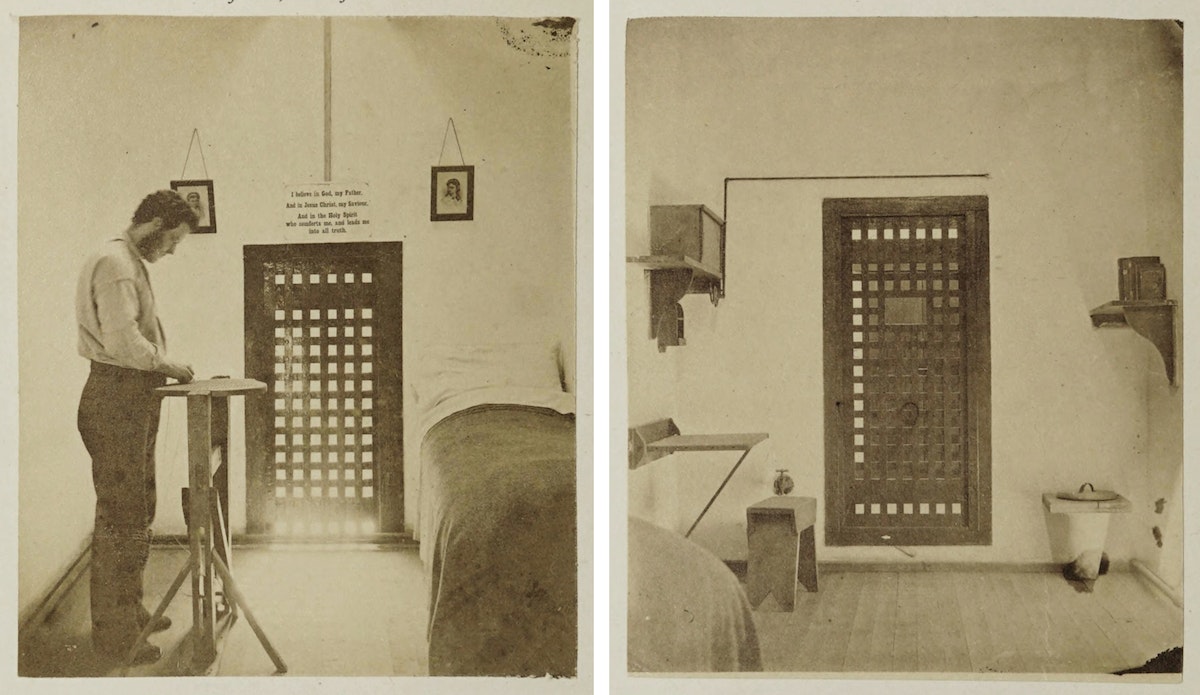
How a Quaker’s good intentions went awry: “The Silent Treatment- Solitary Confinement’s Unlikely Origins,” in @PublicDomainRev.
* Audre Lorde
###
As we ponder penitentiaries, we might send reformist birthday greetings to Roscoe Pound; he was born on this date in 1870. A lawyer and law school professor and Dean, he was one of the most cited legal scholars of the 20th century.
While serving as Dean of Harvard Law School, Pound founded the movement for “sociological jurisprudence” and was one of the early leaders of the movement for American Legal Realism, which argued for a more pragmatic and public-interested interpretation of law and a focus on how the legal process actually occurred, as opposed to (in his view) the arid legal formalism which prevailed in American jurisprudence at the time. In Pound’s view, these jurisprudential movements advocated “the adjustment of principles and doctrines to the human conditions they are to govern rather than to assumed first principles.” While Pound was dean, law school registration almost doubled, but his standards were so rigorous that one-third of those matriculated did not receive degrees. Among those that did were many of the great political innovators of the New Deal years.
Pound also had a PhD in botany, and before turning to the law, served as director of the Nebraska state botanical survey (1892-1903), during which time he discovered a rare fungus, subsequently named Roscopoundia.

Orange Is The New Black (Ink)…

This year Sweden closed four prisons and a detention center… there simply aren’t enough prisoners to justify them. Sweden has one of the lowest incarceration rates in the world. And they seem to mean to do even better: though the crime rate is rising, the government is investing in prevention, not detention.
Conversely, the U.S. has the world’s highest incarceration rate (not counting North Korea, on which data is not available– though the Committee on Human Rights estimates that the rate is roughly equal to America’s). And though there are a few states (like Pennsylvania) in which prison populations are falling, it’s not looking to shrink overall.
Among the reasons: private prisons. Virtually nonexistent until the 1980s, private jails have spread across the nation, as for-profit corporations have built new facilities and bought older ones from cash-strapped states, operating them on contract. Lately, these companies have prevailed on their customers– the states– to agree to minimum guarantees. Some examples: Arizona has three private prison contracts requiring 100 percent occupancy; Oklahoma has three contracts at 98 percent occupancy; Louisiana and Virginia have occupancy rate minimums at 96 and 95 respectively.
As In the Public Interest (ITPI) reports
These contract clauses incentivize keeping prison beds filled, which runs counter to many states’ public policy goals of reducing the prison population and increasing efforts for inmate rehabilitation… some worried the terms would encourage criminal justice officials to seek harsher sentences to maintain the occupancy rates required by a contract…
Bed guarantee provisions are also costly for state and local governments. As examples in the report show, these clauses can force corrections departments to pay thousands, sometimes millions, for unused beds — a “low-crime tax” that penalizes taxpayers when they achieve what should be a desired goal of lower incarceration rates. The private prison industry often claims that prison privatization saves states money. Numerous studies and audits have shown these claims of cost savings to be illusory, and bed occupancy requirements are one way that private prison companies lock in inflated costs after the contract is signed…
Read ITPI’s full report (pdf), “How Lockup Quotas and ‘Low-Crime Taxes’ Guarantee Profits Guarantee Profits.”
###
As we rattle our chains, we might recall that it was on this date in 1916 that Margaret Sanger, fresh back from a stint in the Raymond Street jail, reopened the Brownsville Clinic in Brooklyn, NY– the first birth control clinic in the U.S. Sanger had been shut down and arrested before for obscenity (she offered a booklet called “What Every Young Woman Should Know,” explaining the female reproductive system and several contraceptive methods). This time, the police leaned on her landlord to evict her, and the clinic closed almost as soon as it reopened.

Sanger (center) at the Brownsville Clinic
Go directly to jail…

The U.S. has under 5% of the world’s population– but jails over 25% of the world’s imprisoned. We have (by far) the highest rate of incarceration in the world; and with the encouragement of the the private prison industry, it’s growing.
Josh Begley, a master’s student in the Interactive Telecommunications program at NYU, wanted to represent what all of this means, to communicate not just the sheer quantity of prisons in America, but their footprint, their volume on our landscape. The result: Prison Map, not really a map so much as an extraordinary collection of Google earth photos of “correctional institutions” across the country.
Read more at Atlantic Cities, and visit Prison Map.
***
As we ponder the perils of profligate privatization, we might take a moment to meditate on Timothy Francis Leary; he died on this date in 1996. As a Harvard psychology professor in the early 60s, Leary was among the first researchers into the therapeutic applications of psychedelic drugs (when those drugs were legal, and widely considered promising). His early experiments, conducted “in the clear” and according to accepted research protocols, were contemporaneous with covert CIA tests. But while Leary’s work produced encouraging results, his project was closed, and he was fired from his post. Leary spent the next three decades advocating the use of psychedelics– and influencing a broad swath of the counter-culture.
In his final moments, Leary said “why not?” to his son Zachary Leary repeatedly, in different intonations– as a question, as a statement, softly, loudly, thoughtfully, ruefully, and confidently. His last word, according to Zachary, was “beautiful.”
“Turn on, tune in, drop out”
“Think for yourself and question authority”

Rejoice, for that which was lost has been found…
 “I found this camera on Mount Vesuvius (Italy), July 22nd, 2010. I think the owner is Brazilian because the first pics are from Sao Paulo. Anyway, I’m sending a sample of the photos, may be you’ll recognize the owner.”
Reuniting photographers and their missing equipment, IFoundYourCamera.net has created an online Lost & Found…
Recognize Anyone?
New sets of orphan pictures are posted on Mondays, Wednesdays and Saturdays.
If you see yourself, or someone you know, please email us to help return these lost camera and orphan pictures home.
Visit our contact page for more details.
Find A Lost Camera?
Email at least four photos from your found camera.
Include any other details, time, location, school, etc.
Share your lost camera stories and thoughts about the blog.
Check back every Monday, Wednesday and Saturday for new updates.
In the same spirit as the afore-featured Is This Your Luggage?, IFoundYourCamera.net reunites travellers with the memories they’ve accidentally left behind…
 “I found a memory card on the ground in a Metro parking lot in suburban Virginia possibly in the late winter/spring of 2009. Family with three girls and a baby. You visited DC and took photos in front of the Michigan pillar at the World War II memorial. You visited Sesame Street’s Forest of Fun in Busch Gardens.
If you can describe Emily’s birthday cake, I’ll know it’s you.
It breaks my heart to see pictures of a lovely vacation without their rightful owners. I hope I find you!”
As we abet in the Remembrance of Things Past, we might recall that it was on this date in 1994 that the Justice Department announced that the prison population in the U.S. had risen above 1 million for the first time in history. Since then, the number of prisoners has more than doubled.
The U.S. has has the highest documented incarceration rate and the highest total documented prison and jail population in the world. Most recent estimates (for 2008) suggest that there are 754 inmates per 100,000 U.S. residents, or 0.75%. According to the U.S. Bureau of Justice Statistics, “in 2008, over 7.3 million people were on probation, in jail or prison, or on parole at year-end– 3.2% of all U.S. adult residents or 1 in every 31 adults.”

You must be logged in to post a comment.