Posts Tagged ‘Universe’
“This is not your average, everyday darkness. This is… ADVANCED darkness.”*…
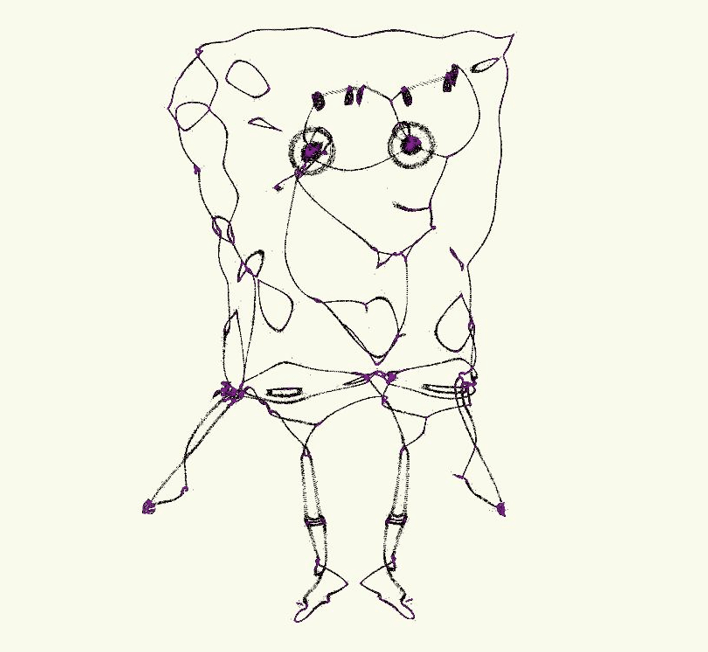
As Rob Beschizza explains, Pere Rosselló, an astrophysics student at Universidad de La Laguna in Tenerife, Spain, has created an animation depicting the gravitational collapse of Spongebob…
Beschizza muses…
Just imagine being part of a civilization on the cusp of attaining a decent model of the universe’s origins—somewhere between Halley and Lemaître, and you start plotting backwards from where we are and where the Big Bang should be you find Spongebob instead. Running the numbers again and again. Such a universe has no need of Lovecraft, cosmic horror would be right there in the maths.
Rosselló [also] solved a three-body problem: the one of animating three bodies to look really cool…
“N-body simulation of the gravitational collapse of Spongebob Squarepants,” by @PeRossello via @Beschizza in @BoingBoing.
* SpongeBob, “Rock Bottom“
###
As we deconstruct deconstruction, we might recall that it was on this date (in an unspecified year) that SpongeBob met the green seahorse Mystery.
“A cosmic mystery of immense proportions, once seemingly on the verge of solution, has deepened and left astronomers and astrophysicists more baffled than ever. The crux … is that the vast majority of the mass of the universe seems to be missing”*…
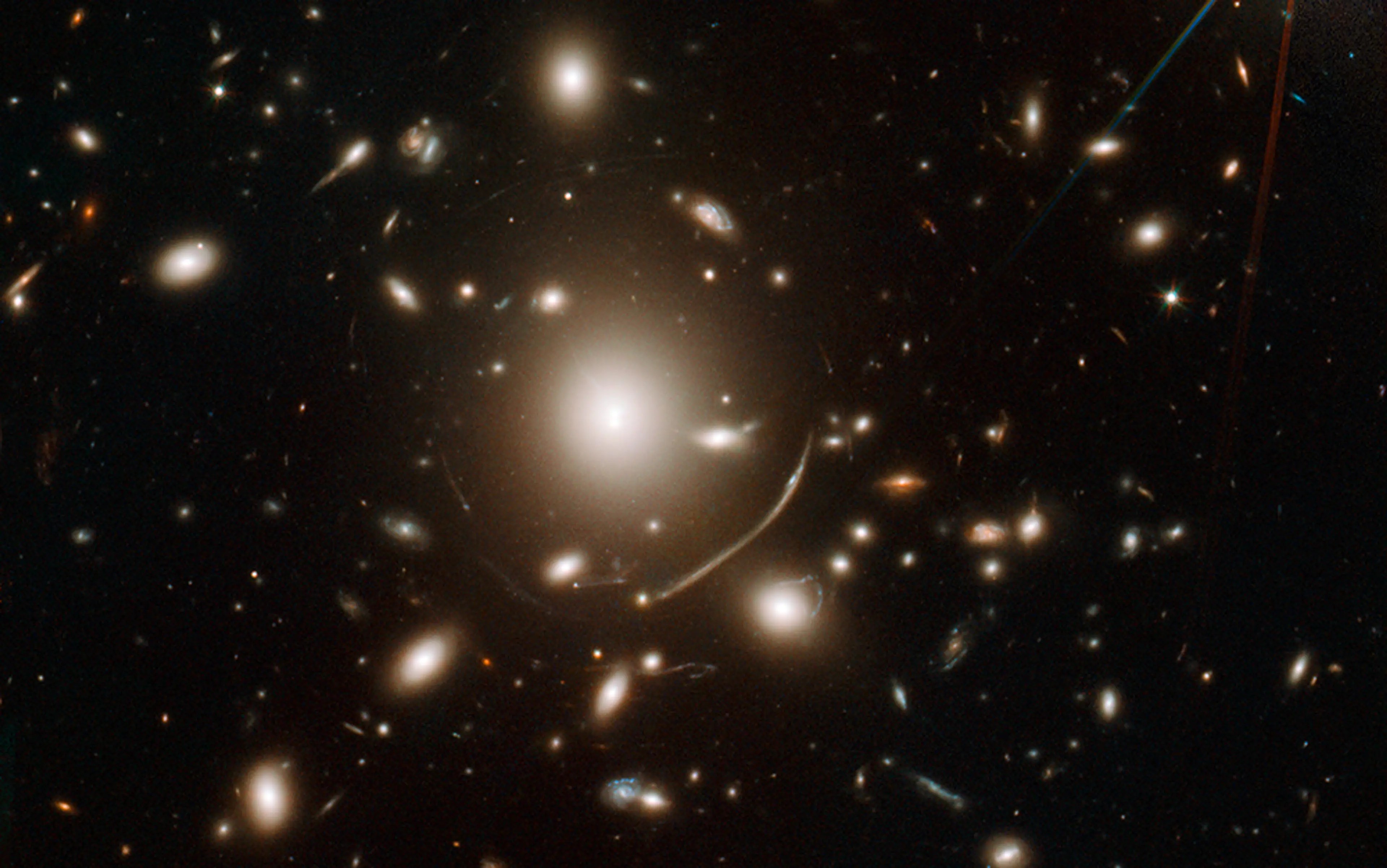
Quantum effects may not be just subatomic, Sabine Hossenfelder suggests; they might be expressed across galaxies, and solve the puzzle of dark matter…
Most of the matter in the Universe is invisible, composed of some substance that leaves no mark as it breezes through us – and through all of the detectors the scientists have created to catch it. But this dark matter might not consist of unseen particle clouds, as most theorists have assumed. Instead, it might be something even stranger: a superfluid that condensed to puddles billions of years ago, seeding the galaxies we observe today.
This new proposal has vast implications for cosmology and physics. Superfluid dark matter overcomes many of the theoretical problems with the particle clouds. It explains the long-running, increasingly frustrating failure to identify the individual constituents within these clouds. And it offers a concrete scientific path forward, yielding specific predictions that could soon be testable.
Superfluid dark matter has important conceptual implications as well. It suggests that the common picture of the Universe as a mass of individual particles bound together by forces – almost like a tinker toy model – misses much of the richness of nature. Most of the matter in the Universe might be utterly unlike the matter in your body: not composed of atoms, and not even built of particles as we normally understand them, but instead a coherent whole of vast extension…
Is dark matter composed of particles? Is it a fluid? Or is it both? Read On: “The superfluid Universe,” from @skdh in @aeonmag.
###
As we deconstruct the dark, we might spare a thought for Richard Philips Feynman; he died on this date in 1988. A theoretical physicist, Feynman was probably the most brilliant, influential, and iconoclastic figure in his field in the post-WW II era.
Richard Feynman was a once-in-a-generation intellectual. He had no shortage of brains. (Relevantly to the piece above, in 1965 he won the Nobel Prize in Physics for his work on quantum electrodynamics.) He had charisma. (Witness this outtake [below] from his 1964 Cornell physics lectures [available in full here].) He knew how to make science and academic thought available, even entertaining, to a broader public. (See, for example, these two public TV programs hosted by Feynman here and here.) And he knew how to have fun.
– From Open Culture (where one can also find Feynman’s elegant and accessible 1.5 minute explanation of “The Key to Science.”)
“I failed in some subjects in exams, but my friend passed in all. Now he is an engineer in Microsoft and I am the owner of Microsoft.”*…

And that, Yasheng Huang argues, is not something likely to happen in China, for a reason that dates back to the 6th century…
On 7 and 8 June 2023, close to 13 million high-school students in China sat for the world’s most gruelling college entrance exam. ‘Imagine,’ wrote a Singapore journalist, ‘the SAT, ACT, and all of your AP tests rolled into two days. That’s Gao Kao, or “higher education exam”.’ In 2023, almost 2.6 million applied to sit China’s civil service exam to compete for only 37,100 slots.
Gao Kao and China’s civil service exam trace their origin to, and are modelled on, an ancient Chinese institution, Keju, the imperial civil service exam established by the Sui Dynasty (581-618). It can be translated as ‘subject recommendation.’ Toward the end of its reign, the Qing dynasty (1644-1911) abolished it in 1905 as part of its effort to reform and modernize the Chinese system. Until then, Keju had been the principal recruitment route for imperial bureaucracy. Keju reached its apex during the Ming dynasty (1368-1644). All the prime ministers but one came through the Keju route and many of them were ranked at the very top in their exam cohort…
Much of the academic literature focuses on the meritocracy of Keju. The path-breaking book in this genre is Ping-ti Ho’s The Ladder of Success in Imperial China (1962). One of his observations is eye catching: more than half of those who obtained the Juren degree were first generation: ie, none of their ancestors had ever attained a Juren status. (Juren was, at the time, the first degree granted in the three-tiered hierarchy of Keju.) More recent literature demonstrates the political effects of Keju. In 1905, the Qing dynasty abolished Keju, dashing the aspirations of millions and sparking regional rebellions that eventually toppled China’s last imperial regime in 1911.
The political dimension of Keju goes far beyond its meritocracy and its connection to the 1911 republican revolution. For an institution that had such deep penetration, both cross-sectionally in society and across time in history, Keju was all encompassing, laying claims to the time, effort and cognitive investment of a significant swathe of the male Chinese population. It was a state institution designed to augment the state’s own power and capabilities. Directly, the state monopolised the very best human capital; indirectly, the state deprived society of access to talent and pre-empted organised religion, commerce and the intelligentsia. Keju anchored Chinese autocracy.
The impact of Keju is still felt today, not only in the form and practice of Gao Kao and the civil service exam but also because Keju incubated values and work ethics. Today, Chinese minds still bear its imprint. For one, Keju elevated the value of education and we see this effect today. A 2020 study shows that, for every doubling of successful Keju candidates per 10,000 of the population in the Ming-Qing period, there was a 6.9 per cent increase in years of schooling in 2010. The Keju exams loom as part of China’s human capital formation today, but they also cultivated and imposed the values of deference to authority and collectivism that the Chinese Communist Party has reaped richly for its rule and legitimacy…
An ultimate autocracy is one that reigns without society. Society shackles the state in many ways. One is ex ante: it checks and balances the actions of the state. The other is ex post. A strong society provides an outside option to those inside the state. Sometimes, this is derisively described as ‘a revolving door’, but it may also have the positive function of checking the power of the state. State functionaries can object to state actions by voting with their feet, as many US civil servants did during the Donald Trump administration, and thereby drain the state of the valuable human capital it needs to function and operate. A strong society raises the opportunity costs for the state to recruit human capital but such a receptor function of society has never existed at scale in imperial China nor today, thanks – in large part, I would argue – to Keju.
Keju was so precocious that it pre-empted and displaced an emergent society. Meritocracy empowered the Chinese state at a time when society was still at an embryonic stage. Massive resources and administrative manpower were poured into Keju such that it completely eclipsed all other channels of upward mobility that could have emerged. In that sense, the celebration by many of Keju’s meritocracy misses the bigger picture of Chinese history. It is a view of a tree rather than of a forest…
…Its impressive bureaucratic mobility demolished all other mobility channels and possibilities. Keju was an anti-mobility mobility channel. It packed all the upward mobility within one channel – that of the state. Society was crowded out, and over time, due to its deficient access to quality human capital, it atrophied. This is the root of the power of Chinese autocracy and, I would argue, it is a historical development that is unique to China and explains the awesome power of Chinese autocracy…
…
There was, however, a massive operational advantage to the Neo-Confucianist curriculum: it standardised everything. Standardisation abhors nuance and the evaluations became more straightforward as the baseline comparison was more clearly delineated. There was objectivity, even if the objectivity was a manufactured artefact. The Chinese invented the modern state and meritocracy, but above all the Chinese invented specialised standardised testing – the memorisation, cognitive inclination and frame of references of an exceedingly narrow ideology.
Ming standardised Keju further: it enforced a highly scripted essay format, known as the ‘eight-legged essay’, or baguwen in Chinese (八股文), to which every Keju candidate had to adhere. A ‘leg’ here refers to each section of an essay, with a Keju essay requiring eight sections: 1) breaking open the topic; 2) receiving the topic; 3) beginning the discussion; 4) the initial leg; 5) the transition leg; 6) the middle leg; 7) the later leg; and 8) conclusion. The eight-legged essay fixed more than the aggregate structure of exposition. The specifications were granular and detailed. For example, the number of phrases was specified in each of the sections and the entire essay required expressions in paired sentences – a minimum of six paired sentences, up to a maximum of 12. The key contribution of the eight-legged essay is that it packed information into a pre-set presentational format.
Standardisation was designed to scale the Keju system and it succeeded brilliantly in that regard, but it had a devastating effect on expositional freedom and human creativity. All elements of subjectivity and judgment were taken out. In his book Traditional Government in Imperial China (1982), the historian Ch’ien Mu describes the ‘eight-legged essay’ as ‘the greatest destroyer of human talent.’…
In his book The WEIRDest People in the World (2020), Joseph Henrich posited that the West prospered because of its early lead in literacy. Yet the substantial Keju literacy produced none of the liberalising effects on Chinese ideas, economy or society. The literacy that Henrich had in mind was a particular kind of literacy – Protestant literacy – and the contrast with Keju literacy could not have been sharper. Keju literacy was drilled and practised in classical and highly stratified Chinese, the language of the imperial court rather than the language of the masses, in sharp contrast to Protestant literacy. Protestant literacy empowered personal agency by embracing and spreading vernaculars of the masses. Henrich’s liberalising ‘WEIRD’ effect – Western, educated, industrialised, rich and democratic – was a byproduct of Protestant literacy. It is no accident that Keju literacy produced an opposite effect…
Not everyone sees the Western/WEIRD definition of creativity and innovation as the only important one (c.f., here and here), nor that China is as lacking in what Westerners call creativity and innovation (c.f., here— possible soft paywall, and here). Still, Huang’s essay on Keju, China’s incredibly difficult civil service test, and how it strengthened the state at the cost of freedom and creativity, is eminently worthy of reading full: “The exam that broke society,” from @YashengHuang in @aeonmag.
And for the amazing (and amusing) story of how the Keju was instrumental in the introduction of Catholicism into China, see Jonathan Spence’s wonderful The Memory Palace of Matteo Ricci.
* Bill Gates
###
As we study, we might recall that it was on this date in 4004 BCE that the Universe was created… as per calculations by Archbishop James Ussher in the mid-17th century.
When Clarence Darrow prepared his famous examination of William Jennings Bryan in the Scopes trial [see here], he chose to focus primarily on a chronology of Biblical events prepared by a seventeenth-century Irish bishop, James Ussher. American fundamentalists in 1925 found—and generally accepted as accurate—Ussher’s careful calculation of dates, going all the way back to Creation, in the margins of their family Bibles. (In fact, until the 1970s, the Bibles placed in nearly every hotel room by the Gideon Society carried his chronology.) The King James Version of the Bible introduced into evidence by the prosecution in Dayton contained Ussher’s famous chronology, and Bryan more than once would be forced to resort to the bishop’s dates as he tried to respond to Darrow’s questions.
“Bishop James Ussher Sets the Date for Creation”

“The structure of the universe- I mean, of the heavens and the earth and the whole world- was arranged by one harmony through the blending of the most opposite principles”*…
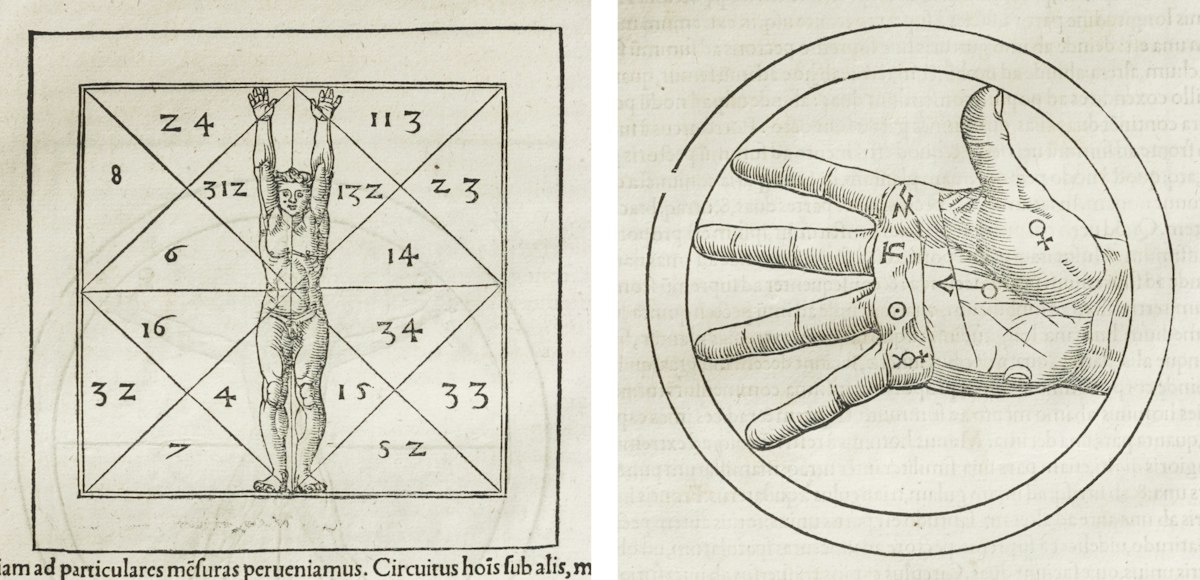
… And as we undertake to understand that structure, we use the lens– the mental models and language– that we have. The redoubtable Anthony Grafton considers and early 16th century attempt: Heinrich Cornelius Agrippa‘s De Occulta Philosophia libri III, Agrippa’s encyclopedic study of magic that was, at the same time, an attempt to describe the structure of the universe, sketching a path that leads both upward and downward: up toward complete knowledge of God, and down into every order of being on earth…
Heinrich Cornelius Agrippa’s manual of learned magic, De occulta philosophia (1533), explicated the ways in which magicians understood and manipulated the cosmos more systematically than any of his predecessors. It was here that he mapped the entire network of forces that passed from angels and demons, stars and planets, downward into the world of matter. Agrippa laid his work out in three books, on the elementary, astrological, and celestial worlds. But he saw all of them as connected, weaving complex spider webs of influence that passed from high to low and low to high. With the zeal and learning of an encyclopedist imagined by Borges, Agrippa catalogued the parts of the soul and body, animals, minerals, and plants that came under the influence of any given planet or daemon. He then offered his readers a plethora of ways for averting evil influences and enhancing good ones. Some of these were originally simple remedies, many of them passed down from Roman times in the great encyclopedic work of Pliny the Younger and less respectable sources, and lacked any deep connection to learned magic.
[Grafton describes the many dimensions of Agrippa’s compilation of the then-current state of magic…]
But few of the dozens of manuscript compilations that transmitted magic through the Middle Ages reflected any effort to impose a system on the whole range of magical practices, as Agrippa’s book did. He made clear that each of the separate arts of magic, from the simplest form of herbal remedy to the highest forms of communication with angels, fitted into a single, lucid structure with three levels: the elementary or terrestrial realm, ruled by medicine and natural magic; the celestial realm, ruled by astrology; and the intellectual realm, ruled by angelic magic. Long tendrils of celestial and magical influence stitched these disparate realms into something like a single great being…
Agrippa offered, in other words, both a grand, schematic plan of the cosmos, rather like that of the London Underground, which laid out its structure as a whole, and a clutch of minutely detailed local Ordinance Survey maps, which made it possible to navigate through any specific part of the cosmos. Readers rapidly saw what Agrippa had to offer. The owner of a copy of On Occult Philosophy, now in Munich, made clear in his only annotation that he appreciated Agrippa’s systematic presentation of a universe in which physical forms revealed the natures of beings and their relations to one another: “Physiognomy, metoposcopy [the interpretation of faces], and chiromancy, and the arts of divination from the appearance and gestures of the human body work through signs.” Agrippa’s book not only became the manual of magical practice, but it also made the formal claim that magic was a kind of philosophy in its own right…
A 16th century attempt to understand the structure of the universe: “Marked by Stars- Agrippa’s Occult Philosophy,” from @scaliger in @PublicDomainRev.
* Aristotle
###
As we take in the totality, we might send more modern birthday greetings to a rough contemporary of Agrippa’s, Evangelista Torricelli; he was born on this date in 1608. Even as Agrippa was trying to understand the world via magic, Torricelli, a student of Galileo, was using observation and reason to fuel the same quest. A physicist and mathematician, he is best known for his invention of the barometer, but is also known for his advances in optics, his work on the method of indivisibles, and “Torricelli’s Trumpet.” The torr, a unit of pressure, is named after him.

“Nothing can better cure the anthropocentrism that is the author of all our ills than to cast ourselves into the physics of the infinitely large (or the infinitely small)”*…

And very eye-opening it can be. Jason Kottke reports on an article in the most recent issue of the American Journal of Physics with the understated title of “All objects and some questions.”
You just have to admire a chart that casually purports to show every single thing in the Universe in one simple 2D plot. [As the article’s author explain:]
In Fig. 2 [above], we plot all the composite objects in the Universe: protons, atoms, life forms, asteroids, moons, planets, stars, galaxies, galaxy clusters, giant voids, and the Universe itself. Humans are represented by a mass of 70 kg and a radius of 50 cm (we assume sphericity), while whales are represented by a mass of 10^5 kg and a radius of 7 m.
The “sub-Planckian unknown” and “forbidden by gravity” sections of the chart makes the “quantum uncertainty” section seem downright normal — the paper collectively calls these “unphysical regions.” Lovely turns of phrase all.
But what does it all mean? My physics is too rusty to say, but I thought one of the authors’ conjectures was particularly intriguing: “Our plot of all objects also seems to suggest that the Universe is a black hole.”…
Is the universe a black hole? (and other provocative propositions): @kottke on a recent scientific paper: “The Plot of All Objects in the Universe.”
* Julio Cortázar, Around the Day in Eighty Worlds
###
As we size up scale, we might recall that it was on this date in 451 that a different kind of attempt to reconcile the finite and the infinite began: the first session of the Council of Chalcedon (in modern-day Turkey) was opened. The fourth ecumenical council of the Christian church, it was attended by over 520 bishops or their representatives (making it the largest and best documented of the first seven ecumenical councils). It was convened by the Roman emperor Marcian to re-assert the teachings of the ecumenical Council of Ephesus against the heresies of Eutyches and Nestorius— whose teachings attempted to dismantle and separate Christ’s divine nature from his humanity (Nestorianism) and further, to limit Christ as solely divine in nature (Monophysitism).
The Council succeeded in that task. As Jaroslav Pelikan characterized their findings:
We all teach harmoniously [that he is] the same perfect in godhead, the same perfect in manhood, truly God and truly man, the same of a reasonable soul and body; homoousios with the Father in godhead, and the same homoousios with us in manhood … acknowledged in two natures without confusion, without change, without division, without separation.
… which marked a turning point in the Christological debates. But it also generated heated disagreements between the council and the Oriental Orthodox Church, which saw things differently– a contention that informed the separation of the Oriental Orthodox Churches from the rest of Christianity… and led to the Council being remembered as “Chalcedon, the Ominous.”

You must be logged in to post a comment.