Posts Tagged ‘quantum effects’
“A cosmic mystery of immense proportions, once seemingly on the verge of solution, has deepened and left astronomers and astrophysicists more baffled than ever. The crux … is that the vast majority of the mass of the universe seems to be missing”*…
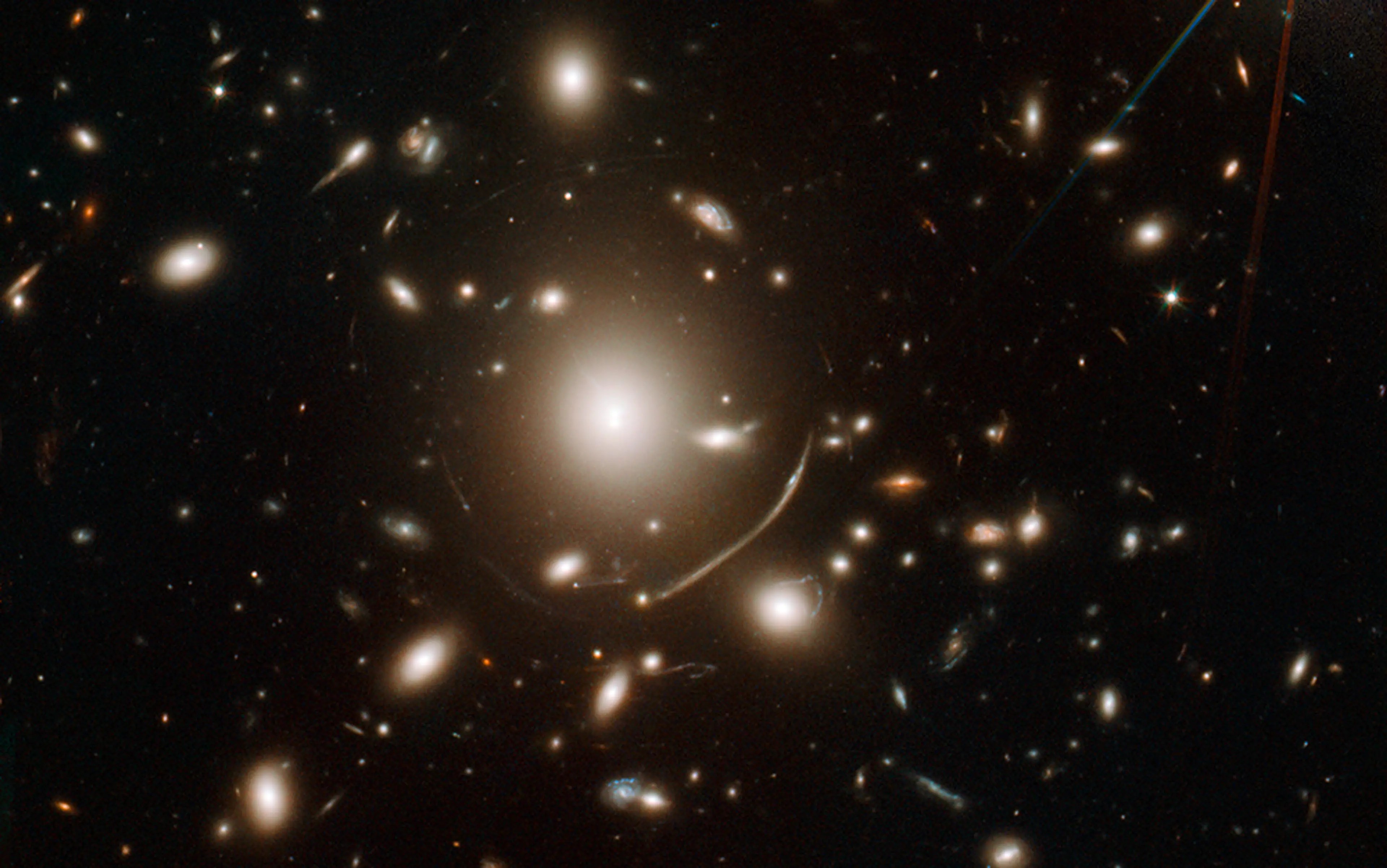
Quantum effects may not be just subatomic, Sabine Hossenfelder suggests; they might be expressed across galaxies, and solve the puzzle of dark matter…
Most of the matter in the Universe is invisible, composed of some substance that leaves no mark as it breezes through us – and through all of the detectors the scientists have created to catch it. But this dark matter might not consist of unseen particle clouds, as most theorists have assumed. Instead, it might be something even stranger: a superfluid that condensed to puddles billions of years ago, seeding the galaxies we observe today.
This new proposal has vast implications for cosmology and physics. Superfluid dark matter overcomes many of the theoretical problems with the particle clouds. It explains the long-running, increasingly frustrating failure to identify the individual constituents within these clouds. And it offers a concrete scientific path forward, yielding specific predictions that could soon be testable.
Superfluid dark matter has important conceptual implications as well. It suggests that the common picture of the Universe as a mass of individual particles bound together by forces – almost like a tinker toy model – misses much of the richness of nature. Most of the matter in the Universe might be utterly unlike the matter in your body: not composed of atoms, and not even built of particles as we normally understand them, but instead a coherent whole of vast extension…
Is dark matter composed of particles? Is it a fluid? Or is it both? Read On: “The superfluid Universe,” from @skdh in @aeonmag.
###
As we deconstruct the dark, we might spare a thought for Richard Philips Feynman; he died on this date in 1988. A theoretical physicist, Feynman was probably the most brilliant, influential, and iconoclastic figure in his field in the post-WW II era.
Richard Feynman was a once-in-a-generation intellectual. He had no shortage of brains. (Relevantly to the piece above, in 1965 he won the Nobel Prize in Physics for his work on quantum electrodynamics.) He had charisma. (Witness this outtake [below] from his 1964 Cornell physics lectures [available in full here].) He knew how to make science and academic thought available, even entertaining, to a broader public. (See, for example, these two public TV programs hosted by Feynman here and here.) And he knew how to have fun.
– From Open Culture (where one can also find Feynman’s elegant and accessible 1.5 minute explanation of “The Key to Science.”)
“Aside from velcro, time is the most mysterious substance in the universe”*…

Detail from Salvador Dali’s Persistence of Memory
In normal life, you open the car door before getting into the car. Operation A happens before operation B. That’s the causal order of things. But a new quantum switch weirdly enables two operations to happen simultaneously. From Science News:
The device, known as a quantum switch, works by putting particles of light through a series of two operations — labeled A and B — that alter the shape of the light. These photons can travel along two separate paths to A and B. Along one path, A happens before B, and on the other, B happens before A.
Which path the photon takes is determined by its polarization, the direction in which its electromagnetic waves wiggle — up and down or side to side. Photons that have horizontal polarization experience operation A first, and those with vertical polarization experience B first.
But, thanks to the counterintuitive quantum property of superposition, the photon can be both horizontally and vertically polarized at once. In that case, the light experiences both A before B, and B before A, Romero and colleagues report.
While this is deeply weird and amazing, it unfortunately doesn’t occur at the human scale but rather in the quantum realm where measurements are in the nanometers. Still, quantum switches do have clear applications in future communications and computation systems.
“Indefinite Causal Order in a Quantum Switch” (Physical Review Letters)
From the ever-illuminating David Pescovitz at Boing Boing: “Weird time-jumbling quantum device defies ‘before’ and ‘after’.”
* Dave Barry
###
As we check our watches, we might send timely birthday greetings to Louis Essen; he was born on this date in 1908. A physicist, he drew on his World War II work on radar to develop the first generally-accepted scientific measurement of the speed of light (one that has held up well as measurement techniques have advanced.).
But Essen is probably better remembered as the father of the atomic clock: in 1955, in collaboration with Jack Parry, he developed the first practical atomic clock by integrating the caesium atomic standard with conventional quartz crystal oscillators to allow calibration of existing time-keeping.

Louis Essen (right) and Jack Parry (left) standing next to the world’s first caesium-133 atomic clock
You must be logged in to post a comment.