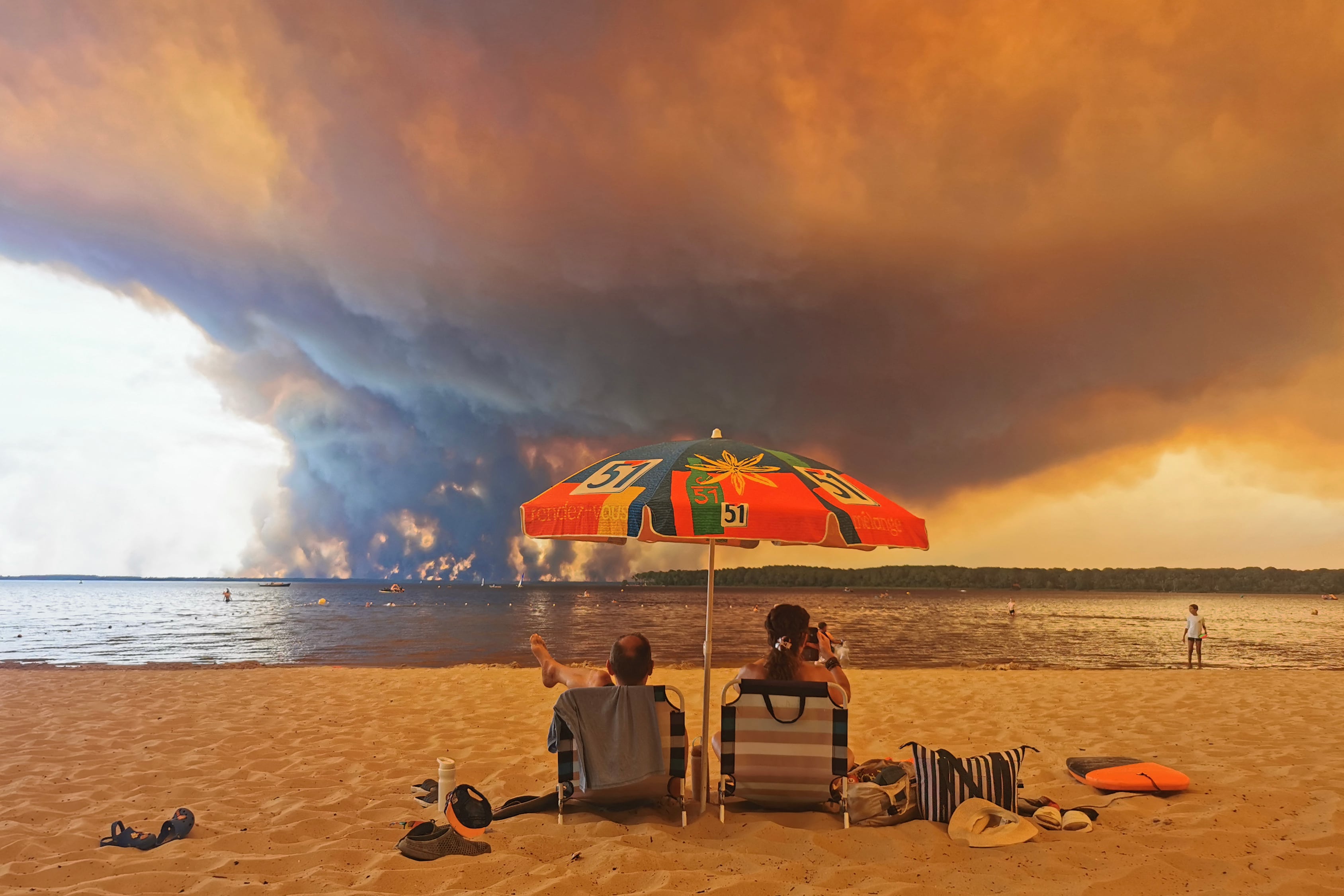
Beachgoers rest on the beach of Moutchic on the shore of Lake Lacanau in Lacanau, southwestern France on July 24, 2026, as clouds of smoke rise into the sky from the Gironde wildfire
A bracing essay from Adam McKay (director of Don’t Look Up, Vice, and The Big Short, among many other films), arguing that our acceptance of assurances that we have time left to address climate change, or that “Net Zero by 2050” will save us, is driving us toward full social collapse in ways that become more obvious with every new broken temperature record…
Lies are a lot like gourds. They come in hundreds of different varieties, sizes, and bulbous, twisty shapes. Some are off-puttingly spiked and prickly, while others remind us of fall childhood memories.
Some lies, if prepared correctly like squash or pumpkin, can appear delicious and irresistible, concealing a dark reality: “I can’t believe you’re not a model! For five thousand dollars I can photograph you so you have a portfolio.” The central aim of most lies is to avoid consequences. When an untruth is especially desperate and self-serving, it can be unintentionally hilarious: “Yes I tried marijuana… but I did not inhale.”
Embezzling money or murdering someone for the insurance pay-out are part of a phylum of lies that cross into serious criminality. These deceptions’ sphere of influence often stays fairly localized. But sometimes covering up the initial lie can spawn lots of other lies that spread and spread, like with Watergate or Bernie Madoff. What started as a little decorative Thanksgiving-gourd-sized lie suddenly becomes larger and quite ugly. This family of lies strives to not only avoid consequences, but to gain status and resources, another common end game of many deceptions.
And then there are the large society-wide lies: hulking distortions and misrepresentations watered and tended to by leaders, mass media, culture, and industry.
This particular sub-genus of grifts, half-truths and strategic omissions have led throughout modern history to wars, mass death, societal collapse, and the theft of humanity’s great treasures. “Manifest Destiny.” “Aryan superiority.” “The divine right of kings.” “The domino theory.” “Israel has a right to defend itself.” “Oxycontin isn’t addictive because it’s time-released.” These county-fair, blue ribbon-winning prevarications tend to be driven by a myriad of short-term incentives, irrational manipulated fears, unexamined assumptions, convenient blind spots, and of course… the desire to avoid consequences and expand status and resources.
“People always pay their mortgages” became the half-true rallying cry used by Wall Street, news media, and politicians to collapse the world economy in 2007. Turns out when you change lending rules to feed an unregulated derivatives market by giving mortgages to people who can’t pay them… they don’t. “Saddam Hussein has weapons of mass destruction” (along with the subvariations on the central lie—“We want to bring democracy,” “If you don’t support the troops, you support the terrorists,” “Saddam orchestrated 9/11,” etc) killed a million people, devastated the entire nation of Iraq, and in many ways also gutted the United States, all while enriching oil companies, weapons manufacturers, big banks, juicing TV ratings, and expanding the power of the Bush/Cheney presidency.
However, there is one type of rare, gargantuan, towering lie that makes all the other mass lies throughout human history seem like frightened, scurrying, little adorable fibs.
It is a lie told worldwide by hundreds of thousands of institutions, elected officials, many universities, legacy news, some large non-profits and eventually—as the deception entered mainstream culture—even by ourselves, to ourselves, every single moment of every day. It is a constantly growing gourd that even as a baby back in the 1970s was the size of three aircraft carriers. These days it is so massive it is almost easier to refer to what isn’t part of it (Disneyland, a BLT, that green croc by the side of the highway) than what is.
This massive lie can best be summed up as “when it comes to climate change… we have more time.”
To be clear, we are not talking about the kind of total climate denial one would find on the extremist, lunatic fringe inhabited by the likes of Alex Jones or the current U.S. President. And we’re not referring to cartoonish hucksters and “climate skeptics” like Joe Rogan or Jordan Peterson.
Polling shows only 14.8 percent of Americans deny the basic sixth grade science behind global warming. To put that in perspective, as much as 10 percent of the population still believes the Earth is flat.
No, the monstrous, misshapen garden colossus lie we’re referring to is subscribed to by most of the U.S., has stopped and slowed climate action far more than outright denial, and keeps growing and growing. Every day this deception whispers seductively in the ears of mankind: “global warming is real but not urgent… Keep doing what you’re doing.”
Less embarrassing than “climate change is a Chinese hoax,” but every bit as unscientific and ridiculous, it is the preferred lie of the ruling class, mainstream news media, and corporations.
Sir David King—former science advisor to the United Kingdom, professor at Oxford and then Cambridge, winner of too many awards to list and as establishment as they come—was quoted as saying that what we do over the next three to four years will determine the fate of humankind.
He said this… in 2021…
[McKay unpacks a chilling variety of examples of “the lie” in action, contrasting government/media/corporate messages with the reality to which the )ostensibly) refer…]
… Still have doubts? If you do, I don’t blame you. We live in a consumer culture hammering us daily with triggering political proclamations, sales pitches, and clickbait designed to spike engagement responses in the brain. “Immigrants are coming for your way of life!” “This new SUV is the best ever!” “Great White Shark Eats Porn Star!” Most of it is misleading, in one way or another, so there’s a natural tendency to assume that “Planet about to boil!” might be too.
But Big Oil and its PR agencies know this, and they’ve weaponized the healthy skepticism we’ve developed as a survival mechanism against those voices speaking the truth about the urgent state of the climate.
After all, who are you going to believe? The New York Times, an outlet famous for downplaying climate urgency, or some weird scientist saying crazy things? Even when a profession famous for dead-eyed, bottom-line risk assessment like insurance actuaries releases a statement about how serious the situation is, corporate news media turns it into what people used to call a “below the fold story,” framing it as just another minor environmental item—not headline news.
In service of the Great Lie, the government of the United Kingdom even tried to bury a climate report from its own intelligence agency before it was leaked. To my knowledge there aren’t many spies being called tree huggers, unless they’re undercover of course. But the MI5 and MI6 are clear-eyed about the danger that’s coming. The report warned that “global ecosystem degradation and collapse threaten UK national security and prosperity.”
No one wants to eat a raw pumpkin. It looks like a Dr. Seuss character’s brain, is full of seeds, and has no real taste. But like with any good lie, when the right sugar, spices, a buttery crust, and time in the oven is added, pumpkin pie becomes a cherished classic.
The same thing happens with the climate lie. The financial markets, massive oil companies, the banks that finance them, the travel industry, car companies, your career and job security, the people you’re having dinner with who don’t want to be bummed out, all of these incentives and forces don’t want you to know you are eating a big, weird gourd.
And as long as we go with their mendacious flow, hundreds of millions, and then billions will die well before “Net Zero by 2050” or “our great grandkids’ future” arrive. Because we are out of time. And we need to get to work immediately. There are a million things to do…
As Pope John Paul II said, “An excuse is worse and more terrible than a lie, for an excuse is a lie guarded.”
As we face up, we might spare a thought for Blaise Pascal; he died on this date in 1662. A French mathematician, physicist, theologian, and inventor (e.g., the first digital calculator, the barometer, the hydraulic press, and the syringe), his commitment to empiricism (“experiments are the true teachers which one must follow in physics”) pitted him against his contemporary René “cogito, ergo sum” Descartes– and was foundational in the acceleration of the scientific/rationalist commitment to measurement (and the conclusions/actions they dictated).
Relevantly to McKay’s piece, Pascal also advanced the philosphical argument we know as “Pascal’s Wager.” While he posed the exercise as a life-defining gamble regarding the belief in the existence of God, we can easily transpose it to apply to climate change action:
Pascal contends that a rational person should adopt a lifestyle consistent with the existence of God and should strive to believe in God. The reasoning for this stance involves the potential outcomes: if God does not exist, the believer incurs only finite losses, potentially sacrificing certain pleasures and luxuries; if God does exist, the believer stands to gain immeasurably, as represented for example by an eternity in Heaven in Abrahamic tradition, while simultaneously avoiding boundless losses associated with an eternity in Hell. –source
If the threat of climate change is, as “the lies” suggest, real but distant, then immediate action only costs us some short-term sacrifice. But if that threat is imminent, immediate action could preserve our way of life and the prospect of an improving future for us and our children and their children… while inaction is likely to end in utter disaster.
First, internet search, then AI– we live in an age of ever-easier answers. But, of course, that bounty comes with two issues; most obviously, can we trust the answers we get? But as important as that is, it’s secondary to the other issue: what do we lose when we “outsource” the research? As Ben Franklin is reputed to have said (though it seems likelier to be a quote from he Xunzi, the works of Xun Kuang, a Chinese Confucian philosopher who lived the 4th century BC), “Tell me and I forget. Teach me and I remember. Involve me and I learn.”
Librarian Hana Lee Goldin is here to help, with an approach to building a map of where knowledge lives, and advice on how to find our way through it…
Suppose we want to understand why a freeway was built through a particular neighborhood and what happened to the people who lived there afterward. A search engine can surface articles about the project, while a chatbot can summarize those articles into one response. Neither interface necessarily reveals the full range of places where information about that history may exist. City planning records may explain how officials chose the route, while census tables can show how the neighborhood changed. A local archive may preserve residents’ letters or photographs from before construction, while later scholarship can connect that history to broader patterns of transportation policy and displacement.
Finding those materials involves more than searching for the right words because different kinds of information are organized and made discoverable in different ways. A library catalog contains structured records for books, journals, media, digital resources, and other materials, and it may also link to or include records for archival collections. An archive may organize thousands of records according to the person or institution that created or accumulated them, then describe groups of records rather than every individual document. A government data portal organizes measurements according to categories such as geography or reporting period, while a scholarly database helps us find research distributed across many publications. Each system is designed around different kinds of information and discovery, which means we may need to search each one differently.
That difference becomes easy to miss when many of these systems can be reached through the same general interfaces. A search engine can return a library record next to a government report, while an AI tool can synthesize information drawn from several kinds of sources into a single response. The access feels flattened even though the underlying information is still organized according to very different rules. When a search produces weak results, we may keep changing the keywords even though the larger problem is that we’re looking in the wrong place.
Before deciding what to search, then, we need to know what we’re trying to find. If we want to understand how the freeway route was approved, we need records of the decision-making process. If we want to know how the neighborhood’s population changed, we need measurements that allow us to compare the neighborhood before and after construction. Once we know what kind of information could answer each part of the question, we can ask who would have created or preserved that information and which research system is designed to help us find it.
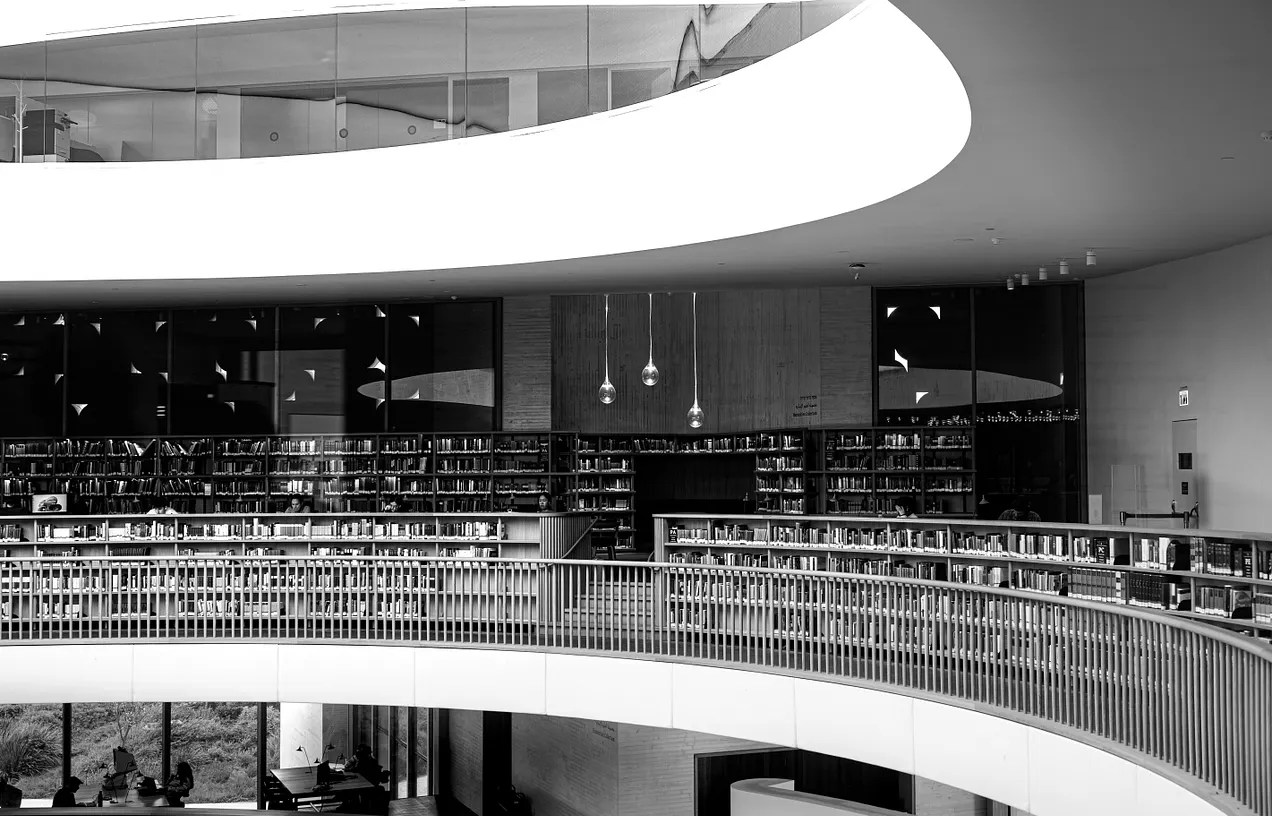
What we need, then, is a way to see that larger research environment as a whole: the different kinds of places it contains, the roles those places play, and the paths that can carry a question from one to another. An atlas offers a model for doing that. An atlas can bring together different maps of the same territory, allowing us to see features and relationships that no single map can represent on its own.
From that model comes the Atlas of Learning, a framework for mapping the research environment itself. Instead of geographic territory, it maps where different kinds of information can be found, how those places and systems organize what they contain, and how we can move among them as a question develops. One part of the Atlas might show where original records are preserved, while another shows the systems through which published research can be discovered. Other parts can include places for structured learning or people whose expertise helps us find our way through systems we don’t yet know.
The routes among those parts are part of the Atlas too. A planning document may give us the formal name of an agency, while a scholarly article may give us a citation to an earlier source. An archival record may introduce the name of an organization whose records are preserved somewhere else. Those names, citations, institutions, and other clues allow one source to generate the next search.
The framework isn’t meant to contain every research resource that exists. It gives us a way to recognize different kinds of resources, understand what each can help us find, and see how one can lead toward another. As we discover new places and learn how to navigate them, we can add those destinations and routes to the Atlas ourselves.
Before so much of research converged onto a common screen, the form and setting of a resource often revealed what kind of knowledge we were entering: a card catalog described and located materials, a statistical yearbook gathered institutional measurements, and an archival collection placed us among the records of a person or organization. Those distinctions can become harder to see when a government report, library record, and generated response arrive through the same interface. Many parts of the research world can now be reached from the same screen, but that ease of access can make those parts look more interchangeable than they are.
The Atlas restores that larger view. Instead of presenting every resource as another result arriving through the same interface, it makes the different parts of the research environment visible in relation to one another. We can see which places are built for which kinds of questions and how a discovery in one part of the Atlas can open a route into another. As more of our information environment is encountered through common interfaces or generated responses, that layered view gives us back a sense of the terrain we’re moving through…
[Goldin unpacks the Atlas; explains how to find “routes” within it (and what to “pack” for the different “terrains” we will traverse); and offers a strategy for those occasions on which one finds oneself “stuck.” She concludes by explaining that, in fact, there is no one “master,” but rather a multiplicity of use-specific atlases…]
… An Atlas of Learning can begin whenever there is something we want to understand beyond a quick factual lookup. Each inquiry creates its own terrain because the places we need to visit depend on the question. A health question may take us through medical literature and public health agencies, while a historical question may lead toward archives, newspapers, or census records. The Atlas gives that particular inquiry a visible research environment of its own.
Because the Atlas is organized around a question, that question becomes the compass. It gives the research direction as new possibilities appear, helping us decide whether a newly discovered resource is relevant to what we’re trying to understand and what it might contribute to an answer. And it becomes the point we return to whenever the terrain grows more complicated, helping us recover our bearing and decide what to pursue next.
The working Atlas can be extremely lightweight. A spreadsheet, Notion page, mind map, document, or another information-management tool can all serve the same purpose. At minimum, we need the question, the research destinations that become relevant to answering it, and a brief note about what each can contribute. The form matters less than being able to look at the Atlas and see, at a glance, where this particular inquiry can go.
The Atlas represents the research terrain for a single question. It keeps the destinations connected to that question visible together, giving us a way to see the terrain as it develops and maintain our orientation within it. Something becomes part of the Atlas when it materially advances the inquiry, either by helping us answer the question or by opening a direction we may need to follow next. The result is a record of the sources and destinations that have become consequential to the research, rather than everything we happened to encounter along the way.
Building an Atlas gives us practice locating a question within a larger information environment and recognizing how different parts of that environment can help answer it. We also learn to follow connections as new territory appears and to find our bearings when the direction becomes uncertain. Taken together, those abilities form a kind of information literacy we can apply when we enter subjects we have never explored before.
With that practice, entering an unfamiliar subject becomes an act of orientation as much as discovery. We may begin with little sense of how knowledge about that subject is organized or where its records, research, and expertise reside, but we know that those structures are there to be found. As they come into view, the subject begins to acquire a geography of its own, one that we can learn to read even though we have never traveled through it before.
The Atlas of Learning is something we draw as each question opens a new research terrain around us. The destinations will change from one subject to the next, and the route will develop differently each time. What remains is the ability to look beyond the interface in front of us and see a larger world of places we can learn to navigate…
As we do the work, we might take caution from the story of Paul Kammerer; he was born on this date in 1880. A biologist, he claimed to have produced experimental evidence that acquired traits could be inherited. Almost all of Kammerer’s experiments involved forcing various amphibians to breed in environments that were radically different from their native habitat to demonstrate Lamarkian inheritance. (This is the idea that learning one acquires during one’s lifetime is passed on to that person’s offspring: e,g, if you play guitar, your children will have nimble fingers; each generation builds upon the past and continues to improve.)
Several scientists tried– and failed– to replicate the results of his most famous (and striking) findings, from his experiments with the mid-wife toad; and Kammerer was accused of fraud. Suffering depression at the time, he shot himself. Arthur Koestler’s 1971 book The Case of the Midwife Toad, argued that while Kammerer’s results were incorrect, he had been the victim of Nazi sympathizers at the University of Vienna, who’d tampered with his results. But most biologists believe that Kammerer was a fraud and even the others, that he misinterpreted the results of his experiments.
Further, in a fashion, to yesterday’s post… J. F. Martel explores why art matters, arguing that when early humans first painted cave walls, they began to find out who they really were: our minds emerged from our images…
In 1940, rumours of secret passageways to an old manor lured four teenage boys into a hole in the ground near the village of Montignac in southwestern France. Instead of a tunnel laden with gold, they found a series of natural chambers bejewelled with exquisite paintings: horses and elk, ibex and bulls, almost perfectly preserved on the limestone walls. Experts examining the Lascaux caves in subsequent years using radiocarbon dating estimated that the paintings had been made some 19,000 years ago. [See here.] Today, the images are believed to be around 20,000 years old. But Lascaux is far from the oldest example of human art. Since 1940, many other caves have been found in Europe, Australia, Indonesia and Africa containing art no less astounding. Some of it is more than twice the age of the Lascaux murals.
Cave paintings at Lascaux, France. Courtesy Wikimedia
These discoveries have turned the questions of when and why humans invented art into central problems of the human sciences. As fair and poignant as such questions may be, they leave unaddressed the deeper mystery of what art is in the first place, where it comes from in the human soul, and what it might reveal to us about the nature of reality.
Popular legend holds that when Pablo Picasso visited the Lascaux cave a few years after its discovery, he emerged exclaiming: ‘We have invented nothing’ – art had appeared full-grown from its earliest instance. The common interpretation is that Picasso was humbly attributing the invention of art to our prehistoric ancestors rather than claiming it for himself and his contemporaries, or any human of the modern age. But perhaps this apocryphal story conveys a weirder truth, namely that no one really invented art. Instead, it was the other way around: art invented humanity…
[Martel develops his case (fascinatingly). He concludes…]
… The idea, then, that human beings invented art, that art ‘belongs’ to humanity, is true only after the fact. In a more primordial sense, art invented humanity by giving humans access to the process through which it brings forth a world, along with everything else.
What I mean here is that art did not serve to express a humanity that already existed. Rather, it acted as the mirror we needed to catch sight of our own image in the flux of nature. The question of when humans invented art leads us to imagine early humans much like ourselves, deciding one day to express themselves through symbols and figures. The assumption hidden in the question is that they already had minds like ours and simply chose, out of all the things they might have done on a frigid day in the Ice Age, to pick up ochre and make animal pictures. But the evidence, it seems to me, points the other way: it was the practice of making images, repeated over hundreds of generations, that occasioned the emergence of those minds we take for granted. We are putting the cart before the horse when we understand ourselves as the source of sense and meaning. In reality, we are participants in something that exceeds us, and the aesthetic, poetic dimension of great art reconnects us with that excess as a matter of course.
But again, we are led back to two kinds of art. Artifice is art that imitates nature: an attempt to represent the world on human terms, resulting either in imperfect reflections (according to Plato) or in perfected abstractions (according to Aristotle). Real art, by contrast, enacts natura naturans – that is, creation as such. If we can speak of imitation here at all, it is not in the sense of mechanical copying but of what the Christian mystics call imitatio Christi: the imitation that becomes instead of merely aping, a creative event transcending all the ways in which the intellect reduces things-in-the-making to things made.
Art alone puts us in touch with certain kinds of truth and beauty. And in that way, art restores us to reality. For it to succeed, however, it must be left to its own devices (or lack thereof). It must be free to eschew the logic of utility and to embody the freedom we stifle under the pressures of means-and-ends thinking.
‘All art,’ quipped Oscar Wilde in the preface to The Picture of Dorian Gray (1890), ‘is quite useless.’ For Wilde, art necessarily and essentially serves no purpose – and artists ought to know better than to wish it otherwise. At the same time, he elsewhere argued with equal conviction that if it weren’t for the efforts of the Impressionist painters, the London fog would not exist. It was they, he claimed in ‘The Decay of Lying’ (1891), who brought forth this aspect of the world, which had gone unseen until then:
Where, if not from the Impressionists, do we get those wonderful brown fogs that come creeping down our streets, blurring the gas-lamps and changing the houses into monstrous shadows? … The extraordinary change that has taken place in the climate of London during the last 10 years is entirely due to this particular school of Art … One does not see anything until one sees its beauty. Then, and then only, does it come into existence … There may have been fogs for centuries in London. I dare say there were. But no one saw them, and so we do not know anything about them. They did not exist till Art had invented them.
Claude Monet and his circle did not represent what was already present; they made present what had hitherto been absent. This power to make us see, for Wilde, is what makes art invaluable.
Is there a contradiction here? How can art be both invaluable and ‘quite useless’? It depends on how we define that last term. One might argue that if nobody paid attention to the fogs that crept through Victorian London until then, it was because there was no use in doing so. By attending to what no one cared to notice, the Impressionists drew from the invisible background of the human world a new entity that then became impossible to ignore. If art is useless for Wilde, it is only in the sense that it explores those regions of reality for which our present intellect has found no use – at least not yet. By making visible that which we could not see, to paraphrase Paul Klee, art expands our perception of the world. It thus fulfils a function precisely analogous to that of science; but whereas science is driven by an ideal of utility, art seeks what has not yet appeared on our radars. Artists alert us to what we do not yet know we do not know. Through their work, new realities, new ideas and new emotions become available.
Indeed, science begins – and can only begin – in the world that art has made. Ultimately, what we call art is the fruit of the human imagination’s capacity to go beyond immediate perception, to dream what lies around this corner, outside the human world. From this point of view, the hypothetical stage of the scientific method is nothing less than art: an exercise through which we step out of the mundanities of the actual to explore the possible as such, testing our dreams and extending our reach into the more-than-human.
This is why the French philosopher Gilles Deleuze in 1968 described aesthetics as a ‘science of the sensible’. Art, for him, makes the world that science later measures, but the world it makes is ultimately beyond all measurement because it is the world that exists before we divide it into lengths, magnitudes and quantities. Bergson, a major influence on Deleuze, had called this a ‘qualitative multiplicity’, closer in nature to a continuous melody than to a series of discrete, static things that can be isolated from one another. It is what comes first, because it is the Real itself.
Paradoxically, art is useful only if it is allowed to remain entirely useless – that is, entirely free to go where it will. Wilde finds an ally here in Baudelaire, who followed his observation of the strangeness of the beautiful with a sharp rebuke to those who would subordinate artistic beauty to a utilitarian logic. Baudelaire asks:
How could this necessary, irreducible, and infinitely varied strangeness … ever be controlled, amended, and corrected by Utopian rules conceived in some little scientific temple or other on this planet, without mortal danger to art itself?
The privileging of utility over uselessness, of work over play, is the death of art – and the death of the given world in which our utilitarian spirit must be grounded if it is to have purpose and meaning.
Today, art is pressed upon by forces that would subordinate it to all-too-human ends. Some say that it should educate and elevate impressionable minds, training them to behave in accordance with a preexisting moral code. Others claim that it should play a therapeutic role, either as an instrument of medicine or as a means of escape by which workers might regain their strength before the next working day. Still others insist that art ought to serve the needs of the state or the market, upholding the preconceived ideas of a polity that mistakes its limited view of reality for the whole of reality. The rise of artificial intelligence has only intensified this levelling of art into non-art. By definition, artificial intelligence is capable only of artifice, since it inhabits a virtual universe of things made (data) rather than things-in-the-making. To fail to distinguish between the artifice it generates and the true art it imitates is to mistake representation for creation, and so to blind ourselves to the very source of what makes both art and humanity possible.
Art must remain useless (or become it again), and it must do so in the name of truth as well as beauty. At the beginning of this essay, I distinguished two forms of each of these ideals: one that merely confirms what we think we know, and another that reminds us of the mystery that underlies all our partial knowledge and imperfect beliefs. Above all, art confronts us with that radical mystery, without which our problem-solving and utilitarianism would be pointless. This mystery is not a theory but a truth, the very ground of that truth whose splendour Plato called beauty, Herzog called ecstasy, and Keats, speaking to his urn, declared to be one with truth itself. It is ecstatic because it takes us outside ourselves, connecting us with the wonder that burns at the heart of the world, and which, out of every search for answers, calls forth new questions – and, with them, new reasons to live…
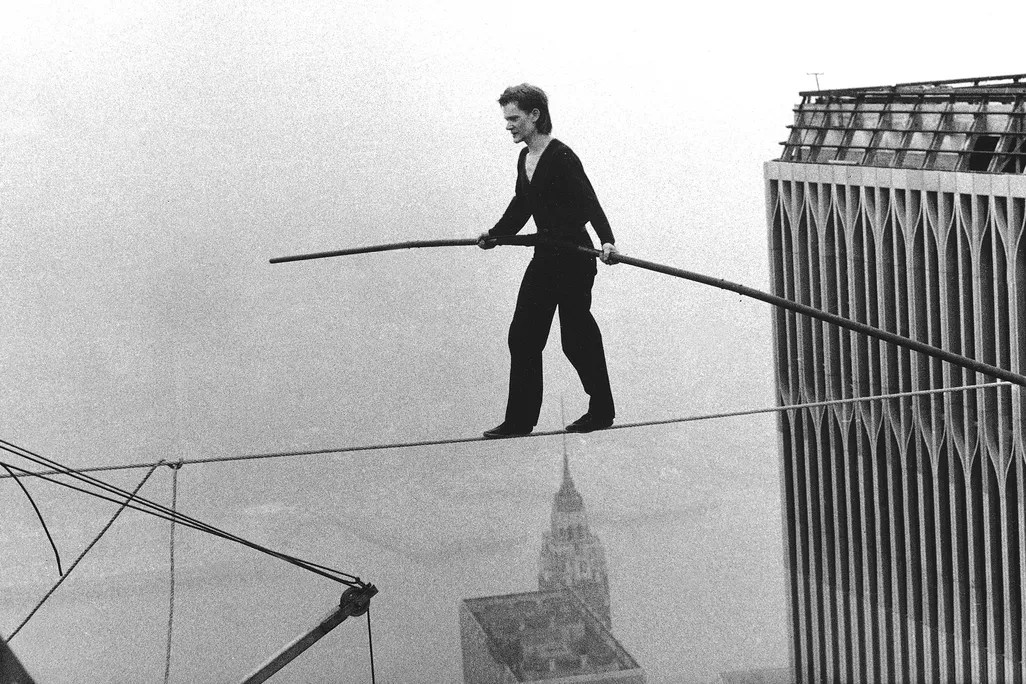
As we muse on the mystery of musing, we might recall that it was on this date in 1974 that French highwire artist Philippe Petit committed the “artistic crime of the century,” traversing a 200-foot steel cable across the 138-foot gap between the twin towers of the World Trade Center in New York City. 1,312 feet above the ground, he performed for 45 minutes, making eight passes along the wire, during which he walked, danced, lay down on the wire, and saluted observers from a kneeling position. Office workers, construction crews, and policemen cheered him on. The unpermitted/illegal performance took Petit six years of planning.
The sharing of experimental results and the underlying data is critical to the advance of science. Indeed, when I had the chance to do a scenario planning exercise with a collection of the leading research university librarians in the U.S. a couple of decades ago, the biggest threat/fear they surfaced was the concern that the free and open exchange of ideas and data, as manifest formally in scientific publication and informally in the collegial cooperation among scientists, would be occluded by an increasing proprietary embrace of knowledge.
73% of geneticists surveyed in an article in the 23/30 January 2002 issue of the Journal of the American Medical Association agreed that although keeping data private may help the individual researcher, data hoarding is detrimental to the progress of science Still, sadly, that threathasgrown since the turn of the millennium.
By way of current (and dramatic) example: as Celina Zhao reports, more than half of AI “unicorns” have never published a paper or preprint…
Today’s biggest artificial intelligence (AI) startups make no shortage of bold promises. Their technologies, some boast, will revolutionize software development, drug discovery, and scientific research.
Yet a new preprint posted on 16 July on bioRxiv suggests many of these firms barely participate in one of science’s most fundamental practices: publicly documenting discoveries in scientific literature so other researchers can evaluate and build on them. More than half of AI unicorns—private companies valued at more than $1 billion—have never played a leading role in publishing a scientific paper or preprint, according to the new analysis. Collectively, they accounted for just one in every 1000 AI papers published in 2025.
“For a field that is supposedly reshaping science and is so advanced in terms of scientific potential, not having any scientific documentation seems like a very weird paradox,” says paper co-author John Ioannidis, a metascientist at Stanford University [see here]. “How can you judge that what they say is real, validated, and reproducible?” The scarcity of publications, others say, also makes it harder to assess AI’s social impacts, including energy use and safety.
But University of Alberta AI ethicist Mohamed Abdalla says the findings reflect the incentives facing commercial AI developers, rather than solely a failure to uphold scientific norms. “It’s not the company’s job to advance science, right?” he says. “The company’s job is to advance money.”
Ioannidis has long studied how unicorns, particularly in biotech, engage with the scientific literature. (In 2015, he was the first to publicly scrutinize the lack of peer-reviewed studies produced by Theranos, the blood testing startup that proved to be based on fraudulent data.) He wondered whether AI unicorns would show similar patterns.
To find out, he and his team first identified all 317 unicorn AI companies that have existed from 1998 to 2025. Then, they searched for publications affiliated with these startups—including journal articles, conference papers, reviews, and preprints. They selected those where a company researcher played a leading role as a first or last author, indicating the startup had made a substantial contribution to the work. The final data set included 2077 final publications, comprising 1389 peer-reviewed papers and 688 preprints.
More than half of the startups had never produced a single qualifying paper, the analysis revealed. Scientific influence proved even more concentrated, with the top 5% of firms accounting for greater than 90% of all citations. OpenAI alone was responsible for nearly 40% of all citations in the data set, followed by the Chinese computer vision company Megvii and the platform Hugging Face. And even at the most prolific companies, much of the output came from the same small group of repeat authors. For example, despite OpenAI employing roughly 4500 people, only eight researchers had authored five or more qualifying papers.
The findings are unsurprising to some AI researchers given how the industry is structured. For example, unlike the pharmaceutical industry, where published discoveries can be protected by patents, AI companies have learned they often gain little from publicly disclosing technical advances, says Nur Ahmed, an AI researcher at the University of Arkansas. Google’s landmark 2017 paper on the transformer—the architecture that underpins today’s large language models—has become a classic cautionary example, Abdalla adds. Although Google patented aspects of the technology, “I don’t think anybody’s paying Google for that,” he says.
Startups also operate on much faster timelines than academia, where peer review can lumber on for months or even years. That’s why many AI companies have embraced what Avijit Ghosh, an AI policy researcher at Hugging Face, calls the “blogification” of research: announcing new models and releasing code or data sets through blog posts and technical reports rather than scientific journals. The new analysis didn’t track those outputs, he points out.
For Ghosh, the debate shouldn’t center on publishing in journals versus blogs. What matters is whether companies are releasing enough code, data sets, or model weights (the numbers that determine how a model interprets and responds to a prompt) for others to independently verify and build on their work, he says.
The preprint also found that firms based in China consistently published more papers than their counterparts based in the United States. Whereas leading U.S. frontier labs have increasingly kept the details of their most capable models secret or “closed sourced,” leading Chinese companies have embraced “open-source” models. Moonshot AI, one of the Chinese startups included in the study, recently unveiled Kimi K3—one of the strongest open models to date—and publicly released its model weights through Hugging Face today.
But whether models are open or closed, the rapid pace toward increasingly powerful generalist AI worries Emma Pierson, a computer scientist at the University of California, Berkeley. She argues AI research—whether published freely or kept secret—risks accelerating models that pose serious societal and safety concerns, including supercharging cyberattacks. “If we were racing forward on cancer-curing AI, I would be like, ’Fantastic, full steam ahead,’” she says. “But that’s not what we’re racing toward, right?”…
By way of example? In order to have a broader footprint in AI for (default proprietary) scientific discovery, Google moves away from a successful AI effort (that did publish): “Google DeepMind dismantles Nobel-winning AlphaFold team in strategy shift” (gift article from the FT). Onewonders: when these LLMs run out of published papers on which to train, where (and how) will they source the knowledge they need to stay useful?
* Neil deGrasse Tyson
###
As we share and share alike, we might recall that it was on this date in 1887 that Chester A. Hodge of Beloit, Wisconsin received patent No. 367,398 for ‘spur rowel’ barbed wire (consisting of spur shaped wheels with 8 or 10 points mounted between 2 wires). It was one of many patents for barbed wire (e.g., here), which spread across the American West rapidly (thanks, in no small measure to the guy featured in the almanac entry here)– and (by protecting farmers from foraging free-ranging cattle) paved the way for the expansion of wheat (and other kinds of) farming… even as it spelled the doom of a commons– the open range.
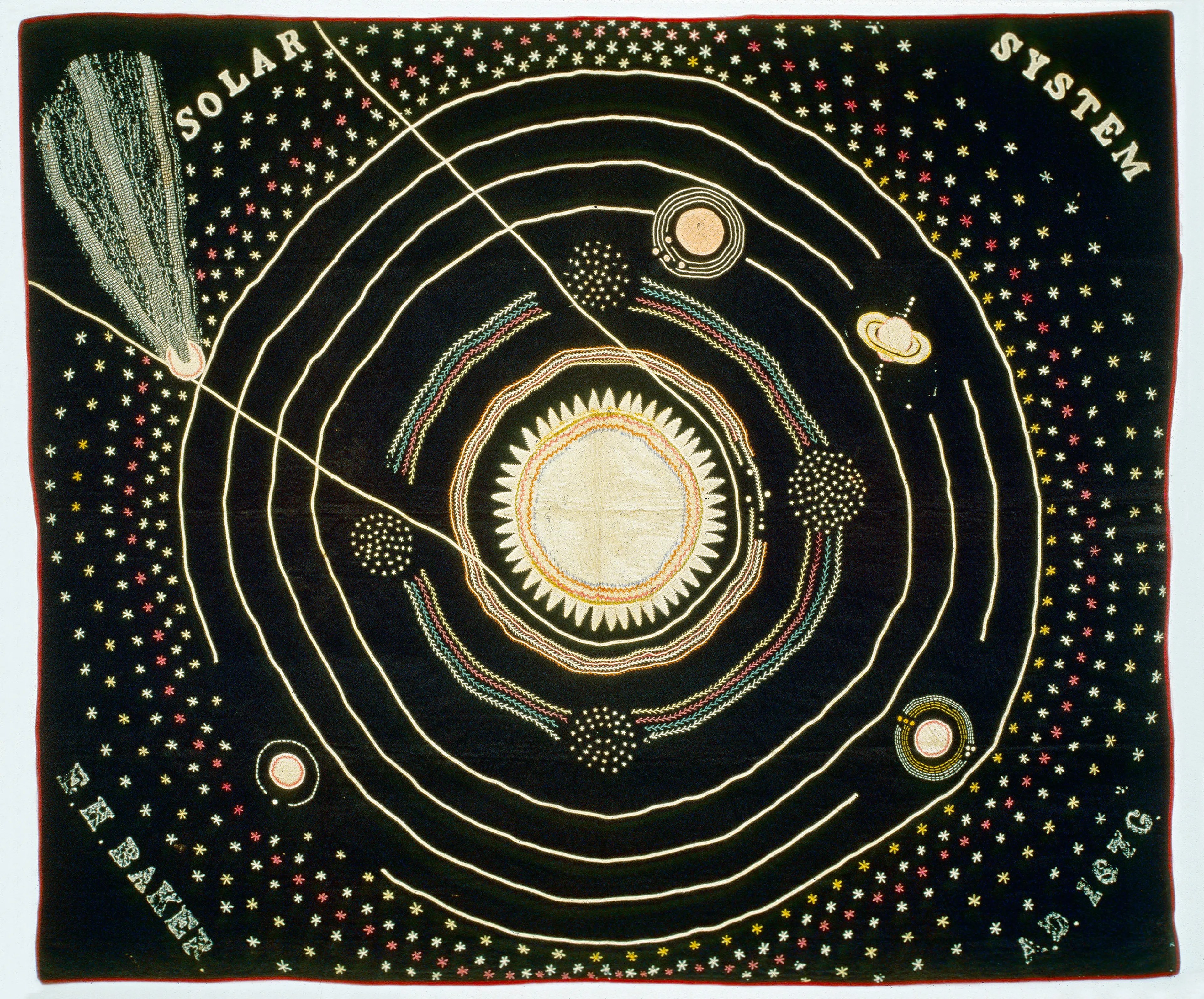
Two figures related to the art of astronomy from a manuscript of the Ars notoria (NLI Ms. Yah. Var. 34), ca. 1550–1600. Each contains subordinate figures to be contemplated — while reciting accompanying prayers (orations) — in a prescribed sequence over time and with respect to the cardinal directions — Source.
As Anne Lawrence-Mathers explains, centuries before Neo instantly mastered Kung Fu in The Matrix, and AI emerged promising quick command of any subject to any of us, medieval scholars found a shortcut to years of difficult study: a magical manuscript that promised to fast-track advanced learning. Anne Lawrence-Mathers investigates the Ars notoria, its supposed powers, and the demonic influence it had upon some users…
Mastering the full range of subjects taught in medieval universities normally required many years of hard and expensive study. From the thirteenth century on, however, an anonymous work known as the Ars notoria promised, through diagrams, incantations, and arcane rituals, to rapidly transmit to scholars the total knowledge of anything they might need. Condemned by church authorities, the fifty-six extant manuscripts nevertheless testify to the seductiveness of that offer.
Its complex diagrams were at the center of its appeal. Unlike diagrams in other magical texts, those in Ars notoria do not illustrate what the text is seeking to communicate. Nor do they act as models to be replicated in three-dimensional form as pieces of magical equipment. Instead, they supposedly work almost in the same way as religious icons. That is, faithful possession and use of them can offer direct contact with powerful and benign supernatural forces — and ultimately even with God. The diagrams themselves are the route to magic and consist of arrangements of symbolic and geometric forms, patterns, and symbols, interspersed with “words”, which are frequently unintelligible combinations of letters.3 Practitioners who opened their minds to receive and imprint these labyrinthine images, while reciting complex verbal formulae and strings of mysterious, almost unpronounceable words and names, are engaging in a significant act of trust.
Several factors made the Ars notoria fundamentally different from other magical texts. First, this is not a text in conflict with the church. In fact, the rituals framing and shaping usage of the images are presented as extremely pious, and the texts to be recited are identified as prayers. The alien words, names, and characters are explained as coming from ancient languages such as Greek, Hebrew, and “Chaldean”, and are claimed to preserve both the names of angels and words used to communicate with them. Second, the advantages offered are relatively virtuous: contact with spiritual beings and full knowledge of the subjects taught in medieval universities. Such claims cut little ice with thirteenth-century theologians, however, who saw clear links to things condemned as superstitious and demonic by St Augustine, despite the text’s assertion that it contains wisdom revealed to King Solomon.
St Thomas Aquinas was worried enough by the Ars notoria to name and condemn it specifically in his Summa theologiae — one of the most authoritative summaries of Christian teaching. He dealt with the very serious issue of superstition in Book Two, Part 2 — Question 96 is effectively devoted to the Ars notoria. Aquinas’ conclusion is wholly negative: the “art” is both “unlawful and futile”. It is futile because it cannot deliver what it promises. Still more seriously, its “signs” are neither understood by humans (like ordinary words and letters) nor sent by God (as sacraments are), and thus are precisely the type of thing that lures humans into contact and compact with demons.
That may seem a conclusive case for the rejection of the Ars notoria, especially as Aquinas’ objections were echoed by other major theologians. However, the number of surviving medieval copies of the work, and the fact that it was copied and owned in religious institutions until the end of the medieval period, show that the church ultimately had neither the interest nor ability to stamp it out. Moreover, it was translated in the early modern period and also went into print, demonstrating an ongoing — and more widespread — interest…
[Professor Lawrence-Mathers explains how the Ars notoria was used…]
… For some users, the rituals were so powerful that they seemed demonic. One of these was Brother John, an early fourteenth-century monk of the abbey of Morigny, near Étampes. John’s account of his introduction to the text, his powerful attraction to it, and the terrifying experiences he underwent while using it, was given in several chapters of John’s own, visionary work, the early fourteenth century Liber florum celestis doctrine.6
The great attraction of the Ars notoria for John was its promise of quick access to advanced scholarly knowledge. He recounts his continuing wish to study, and how he was lent a copy of a book of necromancy by “a certain cleric”. He copied much of it and wanted more. This led to an encounter with a “medical expert” from Lombardy, who informed John that what he needed was the Ars notoria, and that a copy of it was to be found within the walls of the school (at Orléans) where John had been sent. These details provide important evidence of the liminal status of works of ritual magic. They were recognised as dangerous, and were far from being officially approved, and yet were well known, owned and recommended by educated individuals, including monks and clerics.
For John, the Ars notoria was dangerous not in some abstract way, but very directly. He confesses that it struck him at first as beautiful and holy, and seemed to offer miraculous gifts rather than demonic temptations. It became apparent, however, that the book was utterly deceptive, a work of the Devil, a “sick pleasure” that was actually fatally poisonous to the soul, not only to the body…
As we do the work, we might recall that it was on this date in 1965 that Frank Herbert’s Dune was published.
Herbert published a three-part serial Dune World in the monthly Analog, from December 1963 to February 1964. The serial was accompanied by several illustrations that were not published again. After an interval of a year, he published the much slower-paced five-part The Prophet of Dune in the January–May 1965 issues. The first serial became “Book One: Dune” in the final published Dune novel, and the second serial was divided into “Book Two: Muad’dib” and “Book Three: The Prophet”. The serialized version was expanded, reworked, and submitted to more than twenty publishers, each of whom rejected it. The novel, Dune, was finally accepted and published in August 1965 by Chilton Books, a printing house better known for publishing auto repair manuals. Sterling Lanier, an editor at Chilton, had seen Herbert’s manuscript and had urged his company to take a risk in publishing the book. However, the first printing, priced at $5.95 (equivalent to $60.79 in 2025), did not sell well and was poorly received by critics as being atypical of science fiction at the time. Chilton considered the publication of Dune a write-off and Lanier was fired. Over the course of time, the book gained critical acclaim, and its popularity spread by word-of-mouth to allow Herbert to start working full time on developing the sequels to Dune, elements of which were already written alongside Dune.
Herbert died in 1986; his son Brian Herbert and author Kevin J. Anderson continued the series in over a dozen additional novels since 1999. Among them was Dune: The Butlerian Jihad, a prequel which chronicles the fictional Butlerian Jihad, a crusade by the last free humans in the universe against the thinking machines, a violent and dominating force led by the sentient computer Omnius.





You must be logged in to post a comment.