Posts Tagged ‘Science’
“All progress is experimental”*…

An excerpt from Stuart Firestein‘s new book, It Could Be Otherwise- Science in the Age of Uncertainty…
Progress is a precursor to, perhaps even a prerequisite for, optimism. Not the psychological optimism of cheery moods, but the scientific optimism that is the main subject of this book. Psychological optimism, as I have suggested, is more like resignation—making the best of what you have, finding silver linings. Scientific optimism is forward-looking, even obsessed with a future of possibilities.
Progress, too, is future-oriented. While that may sound trivial to modern ears—of course, progress requires a future—it has not always been so. Even today, progress is a controversial subject. We’re all quite happy to have anesthesia. Less happy for sure about The Bomb. Both are the result of scientific progress.
How do we parse this and many other examples of technologies that are used for good or ill, or many times both? Scientific progress is littered with genies we might rather not have let out of the bottle. Nonetheless, I think that most people would agree that the benefits are undeniable and, by most measures, outweigh the harms. Arguments over progress fill books and journals and podcasts and many other media, most of which rely themselves on some technological progress. Progress is a fraught subject.
Let us try avoiding this complicated morass by separating the idea of progress from the products of progress. This is not just a semantic trick, but a way to see aspects of progress that have shaped human society and attitudes, no matter how you feel about the particular results of that progress. It’s not that I think discussions about the values of progress are not important, but for our purposes here, it is not any particular progress that matters. It is the idea of progress and having that idea as a regular part of our mental lives—as a shared outlook, as an expectation, as commonplace—that have so radically changed us and our social constitution in the last few centuries.
This idea of progress is something that gets much less attention than the products and values of progress, perhaps because it has become so habitual in our thinking that we are all sure we know what it means. Not so. There are many layers of meaning and many aspects to the concept that are worth examining, especially in light of our attempts to redefine optimism, which depends in many ways, and in many not-so-obvious ways, on the idea of progress. So, let’s complicate the idea of progress. That will require us to let go of some familiar associations attached to the word and consider some perhaps unexpected ones.
First, we should disabuse ourselves of the notion that progress as an idea is something innate to human beings, that it has been around since people were painting pictures on cave walls. There is no strong evidence that Paleolithic cave artists were expressing an explicit optimism for the future in the way we think of that sentiment today. Most scholars interpret early cave art as tied to immediate concerns—rituals, communication, or sympathetic magic—rather than a conscious projection of hope into an abstract future. There is a lack of explicit progress iconography—of a past or present, a before and after, or a change over time. Indeed, the paintings may just as easily have been a depiction of a recently successful hunt, with no thought of the future.
Several things are required for an idea such as progress to gain a footing, and it was not until the Scientific Revolution that all of those were met. This is not to say that some notion of change did not exist before the late sixteenth century, but with very few exceptions, it seems that change was either not highly regarded or simply occurred so slowly as to go largely unnoticed.
It may seem remarkable, but the Athenian Greeks, so admired for providing the foundations of philosophy and democratic ideals of governance and even an early devotion to something we could sort of call science, had no single word for progress. There were words that could loosely be translated as progress but they were more like “change” or “increase” or some vague property that we might now associate with progress. To the extent that progress was considered, it was typically thought to be undesirable. Progress and the change associated with it were a source of dissolution and decay, a further loss of the innocence of the Golden Age of the ancestors. They were the opposite of stability and dependability. Consider the mythic fates of Icarus, Prometheus, Hercules—all were punished rather severely for trying to expand knowledge, to make progress.
The Platonic ideal of transcendent forms that exist in eternity is another block to progress, because, strictly speaking, there is no open future and no such thing as invention. As E.R. Dodds put it in his famous essay, “The Ancient Concept of Progress,” “What the ancients call invention is but recollection of a reality which is already there—nothing entirely new can ever come into being.” There is nothing new under the sun, only perhaps approaches to more perfect versions that already exist in some transcendent place.
Yes, the Greeks made remarkable advances in mathematics, but mostly in geometry, which is about solid, stable objects and uses a strict hierarchy of axioms, rules, and procedures—very Platonic. I doubt the Greeks could have imagined calculus, the mathematics of change. Indeed, no one would until nearly two thousand years after Euclid. What progress was made in some technological areas—navigation, shipbuilding—was seen as the pinnacle of achievement. There was little motivation to go further.
There were exceptions, but they were outliers. Archimedes wrote, “I apprehend that some either of my contemporaries or of my successors will be enabled to discover other theorems in addition, which have not as yet occurred to me.” In the second century BCE, the astronomer Hipparchus compiled a list of the fixed stars so that future astronomers might compare his observations to their own and discover what might have changed.
But these ideas, it seems, did not percolate into the society of philosophers, politicians, and the average man, and were not taken up by the Roman civilization that supplanted the Athenian and Alexandrian Greeks. Roman science consisted mainly of improving technologies in civil engineering (water and road systems) and warfare, compiling medical knowledge, and developing tools for specialized uses. There was little of discovery and interest beyond this sort of technology development.
Progress fared only slightly better in the long period from the fall of Rome (c. 475 CE) to the Renaissance (in the fourteenth century)—one thousand years during which change was so slow that for nearly forty generations, most people saw little or no change in technology during their lifetimes (except perhaps in warfare). You would likely do what your parents did and your children would do as you did. Options were limited. It’s not that there was no progress, but that within a single generation, so little changed as to be imperceptible.
Think of the stirrup, sometimes credited as being one of the three most important inventions in the course of history. (The plow and gunpowder are the other two, or the printing press, depending on your perspective.) The stirrup probably originated in the Far East in the first century CE and was introduced in Europe around the seventh century. It remained of critical importance from then until about one hundred years ago, when horsemanship quite suddenly was no longer a required skill. That’s thirteen hundred years of the same individual transportation technology. Julius Caesar and Thomas Jefferson both traveled around their lands by horse.
Robert Merton, the renowned sociologist of science, has made the case that in spite of the occasional bright star or beacon of discovery in the earlier periods (e.g., Leonardo da Vinci, Robert Grosseteste, Roger Bacon), they were not enough to support a scientific infrastructure, or the social requirements of a scientific community. To remain viable, science must be widespread and continuous, able to spread and connect with other ideas and other minds.
The Renaissance brings a spark of life to more worldly intellectual pursuits, and the very beginnings of science can be seen toward the end of that period and the start of what may be termed the early modern period (the mid-sixteenth to mid-seventeenth centuries). The Renaissance, as the name implies, was a rebirth of interest in classical (i.e., Greek and Roman) culture, and so was a look back as much as forward. Nonetheless, the Renaissance provided a kind of onramp to the Scientific Revolution and the much speedier pace of progress associated with it.
This faster pace was a key element that allowed progress to become an idea, a viewpoint, a mental and social state. For that to happen, progress must be experienced within a generation, within a single lifetime. That means it must be rapid. I would go a step further and propose that for the idea of progress to become manifest, it must not only be rapid, but it must also accelerate. It is not enough for progress to be fast; the very rate of progress must increase. Then, and only then, will the idea, as much as its products, take hold of a society. It is a kind of cognitive bias that results from the way our sensory systems interact with the world that we are more aware of acceleration than of speed. Like flying in a plane, you don’t really notice the speed when it is constant, only when there is acceleration.
Four critical prerequisites are necessary for the idea of progress to develop and become a driving force in society. Each of these arose separately over the course of time from Athenian Greece, but they came together in the Scientific Revolution and its immediate aftermath. They are what produced the idea of progress.
First is a transition from a circular to a linear view of time and history. Circular philosophies of recurrence, common in many cultures and religious systems, are not as susceptible to progress, since they conceive of the world as repeating history in an endless cycle. For the Greeks, the circle was the perfect shape because this reflected their worldview of recurrence. Most ancient calendars are in the form of a circle, based on recurring astronomical events and repeating seasons.
Even today, astrological calendars supposedly reflecting ancient views arrange the zodiacal months in a circle. The linear calendar we live and work with now is effectively infinite; you just keep adding days. (On the Calendar app provided with my Apple computer, I was able to scroll one hundred years into the future to 2125, and there seemed to be no end in sight.) This calendar takes for granted that time will proceed without end and therefore that unending progress is also possible. Although the short biblical history and prophecy of a coming apocalypse truncate the literal religious timescale, it was the Judeo-Christian adoption of a linear calendar that provided, if unintentionally, the ground for an open-ended view of continued progress. As J. B. Bury put it in his book The Idea of Progress, “You have not got the idea of progress until you go on to conceive that it is destined to advance indefinitely into the future.”
A considerable body of scholarship exists on the shift from circular to linear time and its effects on philosophy, society, and culture. Much of it is also wrapped up in the invention of mechanical clocks, in particular the mechanical clocks of medieval Europe. that progressed indefinitely—the second, the minute, and the hour. Today, we argue about the merits of daylight saving time, but until the advent of clocks, hours were simply split into equal portions of day and night. During the summer, daytime hours were longer—twelve of them needed to cover the day. Likewise, nighttime hours were shorter since there had to be twelve of them packed into the shorter night. In the winter, this was reversed. Time was thus malleable and very local.
Keeping time in constant units allowed advances in navigation and in communication and collaboration over distances—time units were now the same everywhere. Time could be parceled into measurable packets, but it was also continuous and unending. There was now a distinct past, present, and future. Calendars possessed an infinite timeline. Once a future existed, there could be progress…
Technology, science, time– and the fraught subject of progress: “What Does ‘Progress’ Mean, Anyway?” via @literaryhub.bsky.social.
###
As we parse progression, we might spare a thought for Peter Cooper Hewitt; he died on this date in 1921. An electrical engineer, he studied the production of light using electrical discharges (while Thomas Edison was still developing incandescent filaments) and, in 1901, invented the first mercury-vapor lamp, an important forerunner of fluorescent lamps.
Hewitt also developed the mercury arc rectifier, the first rectifier that could convert alternating current power to direct current without mechanical means. It was widely used in electric railways, industry, electroplating, and high-voltage direct current (HVDC) power transmission. Although it was largely replaced by power semiconductor devices in the 1970s and 1980s, it is still used in some high power applications.

“Every river seems to come with a purpose”*…

The Yukon Delta in Alaska formed where the Yukon River flows into the Bering Sea
A simple scaling law brings order to the chaos of flowing water, rock, and sediment. As Natalie Wolchover reports, new findings have extended the law even further…
A river has my heart. It’s not the austere, black Thames winding through London, where I was born, but a lazy green one 5,000 miles away, where I spent my adolescence: the Blanco River in Texas. My maternal ancestors have dipped into its waters for generations, as I have on countless summer days.
The Blanco is a tributary of the San Marcos, which flows into the Guadalupe, and on into the Gulf of Mexico. You can probably picture how this looks on a map because all river networks look similar, creeping through the landscape, merging into ever wider and longer channels, downhill to the sea. The pattern resembles twigs on branches that connect to trunks of trees (and the branching of their root systems, too), and it likewise resembles the veins of plant leaves, our own systems of blood vessels, and train and highway networks that feed into cities.
There’s something appealing about this ubiquitous pattern, so appealing to me personally that I have it tattooed on my forearm: the silhouette of a tree, with leafless branches reaching upward and roots burrowing downward, almost in mirror image. “The shapes of rivers and leaf vasculature and so on — branching networks — you can just about grasp the pattern, but it’s still chaotic, so there’s something fascinating with that,” said Chris Paola, a river scientist at the University of Minnesota.
Systems that branch in this way are “transport networks”: They transport some fluid substance (water, blood, traffic) from every place to a single place (the sea, a heart, a city center). Of the various examples, rivers are especially revealing, I think, since they arise from neither biological evolution nor urban planning, but rather chaotic Earth processes. Yet they obey simple, universal laws…
…
… In 1957, a U.S. Geological Survey scientist named John Hack discovered the most important law of river networks. In rivers and streams in Virginia and Maryland, Hack measured the length of each stream and the area of the land that slopes toward that stream and therefore drains into it, called its basin or drainage area. What he discovered is now known as Hack’s law: Any stream, from the littlest brook to the mightiest river, has a length that’s proportional to its drainage area raised to the power of 0.6. (In symbolic form: L ~ A0.6.) There’s a bit of variance around that 0.6 value — Earth is, after all, a complicated place — but “the general regularity of the relation is nevertheless remarkable,” Hack wrote. “Stream lengths tend to increase proportionally to the 0.6 power of the drainage area, regardless of the geological or structural characteristics of the area.”
As more and better data has accrued, especially from satellite imagery, Hack’s law has held worldwide. Why this is the case is the essential mystery geomorphologists have grappled with ever since. “Hack’s law is still the big question,” said Hansjörg Seybold, a geomorphologist at the Institute for Interdisciplinary Mountain Research at the Austrian Academy of Sciences.
It’s not so surprising that the bigger the land area of the basin, the longer the stream that drains it. But in a purely mathematical sense, one might expect that stream length would follow a slightly different power law. Imagine a square patch of land. You might guess that regardless of slope or size, in idealized form, the land would drain into a stream that’s the length of one of its sides — a vertical line down the middle, for example. That length is the square root of the area — or A to the power of 0.5.
Under that circumstance, big river basins would have the same proportions as the small river basins that feed the tributaries within them. Their structure would be the same, regardless of size. But that’s not what Hack’s law reveals.
Instead, as a drainage areas get larger, the length of their streams increases faster. “A nice way to phrase it would be that small basins are short and squat, and large basins are long and thin,” said Daniel Rothman, a geophysicist at the Massachusetts Institute of Technology. We unknowingly pick up on this pattern when we look at a network of tributaries on a map; a perfectly self-similar, fractal river network wouldn’t look quite right. Basins and streams become elongated at larger scales, so that river networks have an inherent directionality that stretches toward the sea. One result of that elongation is that neighboring river networks must lie closer together than they would with a 0.5 power law…
…
… Rivers do shift their layouts all the time. In the 1990s, in parallel with the work on optimal channel networks, geomorphologists developed powerful landscape evolution models to capture this constant adjustment and show the mechanism by which Hack’s law etches itself on the landscape. These computer simulations start with water flowing downhill, eroding rock as it goes. Tiny, random irregularities in the topography cause some channels to capture more runoff than others. Those channels in turn erode faster and deepen, which causes them to attract still more water. One streambed might grow toward its neighbor, and thereby intercept some of its runoff. The victorious stream grows longer and carries more water, while the losing stream shrinks or disappears. These sorts of local adjustments like these route water along ever more efficient paths. As the entire drainage network gradually reorganizes over thousands of years or more, it attains and then continues to tweak a configuration that transports water downhill with minimal energy dissipation.
Gravity and friction are the driving forces of this process. Gravity supplies potential energy to flowing water. Friction, the cause of erosion, dissipates that energy. A channel configuration that wastes energy by forcing water along inefficient routes tends to erode rapidly and change. A configuration that routes water more effectively is stabler and therefore more persistent. The network becomes optimal through this dynamic evolution, eventually arriving at a form that adheres to Hack’s law.
That explanation of river network geometry hangs together for me, though geomorphologists still have many questions. Some study rivers that deviate from Hack’s law. Others organize transport networks that follow Hack’s law into one class of optimal transport networks, among a whole family of them. Trees, which branch in three dimensions instead of two, would be in a different class from rivers and follow different optimal scaling laws, for instance.
Now, geomorphologists have a new finding to explain. In April 2026, Tian Dong of the University of Texas, Rio Grande Valley and co-authors made the cover of Science for discovering that Hack’s law holds not only for rivers’ tributary networks, but also for their deltas, the fanlike structures that form where a river meets the sea.
Rivers essentially hit a brick wall when they reach the (nonflowing) ocean. The sudden deceleration of the water causes it to drop the sediments it carries. These pile up to form new land. In the process, the river’s water splits into a different kind of network of channels, which shift locations constantly as sediments build up and wash away.
Scientists told me that they’ve long wondered about the organization of channels in river deltas, but they are hard to study. Unlike the upstream river network, where slope and elevation differences make it easy to calculate the area of land that drains into any given tributary, deltas are flat and especially dynamic. But through a sophisticated analysis of satellite data that allowed them to distinguish land from water, Dong and his collaborators determined that the length of a channel in a river delta scales with the size of its nourishment area — the area that it supplies with sediments — raised to the power of 0.6. Rivers’ tributary networks and distributary networks are opposites — sediments are transported away from one end and deposited at the other — yet they abide by the same math. Geomorphologists are now considering why Hack’s law should apply in this inverse context.
Reflecting on my own question, I think it’s the coexistence of simplicity and determinism with chaos and randomness that makes the optimal structure of rivers so captivating. Natural efficiency is, perhaps, innately appealing to us…
The order in seeming chaos: “Why Are Rivers So Mathematical?” from @nattyover.bsky.social in @quantamagazine.org.
* Haruki Murakami, Kafka on the Shore
###
As we go with the flow, we might send carefully-calculated birthday greetings to Moritz Cantor; he was born on this date in 1829. A historian of mathematics, he is best remembered for the four volume work Vorlesungen über Geschichte der Mathematik (“Lectures on the History of Mathematics”) which traces the history of mathematics up to 1799, the year of Gauss‘s doctoral thesis. Modern historians credit Moritz with introducing a new discipline to a field, the history of mathematics, that had hitherto lacked the sound, conscientious, and critical methods of other fields of history.

“We often take for granted the very things that most deserve our gratitude”*…

In a lovely meditation on the things that we take for granted, Jordan Dworkin walks us through a modern apartment, pausing to see items through the eyes of people who were around when they were invented…
All the items in this room were once out of reach; some not yet invented, others too rare or costly for the vast majority of people. Today, most of us lucky enough to live with them walk past without a second thought.
It is to humanity’s credit that we remain restless in the midst of all of this progress. We continue to look forward, pushing the frontier further with new treatments, new tools, and new institutions that will help future generations in ways we can’t even picture yet.
But our lives today are a gallery of past generations’ heroic efforts to do the same. It serves us, and honors them, to recapture whenever possible the old sense of awe at these wonders that have long since become commonplace…


Things we take for granted that once inspired awe: “Ordinary Abundance,” from @jdworkin.bsky.social.
###
As we appreciate our ancestors, we might send innovative birthday greetings to George Joseph Herriman III; he was born on this date in 1880. A cartoonist best remembered for Krazy Kat, which ran from 1913 until his death in 1944, he was never a commercial success; his strip survived via the admiration (and support) of his publisher, William Randolph Hearst. But Herriman was enormously influential, a primary influence on cartoonists like Will Eisner, Charles M. Schulz, Robert Crumb, Art Spiegelman, Bill Watterson, and Chris Ware.


“Of all the forms of inequality, injustice in health care is the most shocking and inhuman”*…

Why are health care costs so high in the U.S.? Harvard public health scholar John McDonough chalks it up to a “wrong turn” in 1980, and the consequences that have ensued…
“What happened in 1980?” John McDonough wondered every time he looked at the numbers.
After 1980, U.S. healthcare became far more expensive than care in peer nations such as France and Germany. In 1980, the U.S. was at the top of a tight pack of industrialized democracies. After that, the cost of American healthcare soared. By 2024, U.S. spending as a percentage of GDP was about 50 percent higher than that of peer nations.
“In the early 1980s, we can see a significant upsurge,” McDonough, professor of the practice of public health at the Harvard T.H. Chan School of Public Health, said in an interview. “All of a sudden, we jumped from the rest of the crowd and were now in a category by ourselves. Over the following 40, 45 years, the distance kept growing.”
McDonough knew what he could rule out: Any suggestion that Americans get more for their money. On the contrary, millions of U.S. citizens are uninsured; out-of-pocket costs and medical debt are high; and even people with insurance have trouble getting appointments. Meanwhile, physician satisfaction is low, leading to early retirements and migration to nontraditional models like concierge care.
When the pandemic hit, McDonough had time for a deep dive into the issue. This month, after a five-year “labor of love,” he’s presenting his answer in a new book, America’s Wrong Turn: US Health Care in the Neoliberal Era [here]. In it, McDonough links increases in healthcare costs to a new political and economic era dominated by a belief in an unfettered free market, tax cuts, deregulation, privatization, smaller government, increased immigration, and free trade.
This trend in U.S. policy — “Reaganomics” before it became “neoliberalism” — included tax, spending, and regulatory overhauls instituted during President Ronald Reagan’s eight years in the White House. But McDonough, a Democrat who served 13 years in the Massachusetts House of Representatives, isn’t just interested in Reagan. Over the next 40 years, some presidents adhered to neoliberalism’s tenets but even those who didn’t were influenced by its deep penetration into the nation’s political and economic ecosystem, he says.
McDonough found a guide in the writings of Yale University political scientist Stephen Skowronek, who suggests that presidents should be measured by the durability and influence of their ideas and values well beyond their terms in office. Skowronek identified only five singular and decades-long eras in U.S. history, those of Thomas Jefferson, Andrew Jackson, Abraham Lincoln, Franklin Delano Roosevelt, and Ronald Reagan.
While Reagan was the first president to espouse neoliberal political and economic philosophy, the core ideas date back decades, fostered by Nobel Prize-winning economist Milton Friedman, who became a key economic adviser to Reagan.
“There was a New Deal-FDR era between 1933 and 1980,” McDonough said. “The neoliberal era that Reagan kicked off saw itself as the corrective to the pro-government prior era. Important dynamic consistencies persisted among Ronald Reagan and Bill Clinton, George W. Bush, and even Barack Obama. There were sets of beliefs with a Republican conservative flavor and with a Democratic flavor that were surprisingly consistent.”
When describing the U.S. healthcare system under neoliberalism, McDonough, who worked with U.S. senators on the Affordable Care Act, cites several major effects, chief among them a permissiveness toward corporate mergers and consolidations that reduces competition, and an unleashing of private equity.
Since the 1980s, U.S. healthcare has become increasingly consolidated, dominated by fewer and larger organizations. The two largest dialysis centers have 92 percent of the U.S. market, for example, while the two largest providers of intravenous solutions control 75 percent of the market. The two largest syringe manufacturers have a 69 percent market share.
Consolidation extends to physician and hospital markets, with 90 percent of hospital markets, 65 percent of physician specialist markets, and 74 percent of health insurance markets considered highly concentrated, McDonough writes.
One argument for larger organizations is the potential for cost saving through both efficiencies and a greater ability to negotiate savings, but the cost-saving record of larger organizations in healthcare is poor, McDonough says. He cites a 2022 RAND study that indicates that price increases of between 3 percent and 65 percent accompany hospital mergers.
Private equity’s focus on generating profits to maximize shareholder value conflicts with improving patient care, McDonough argues. When private equity firms target businesses, enhance their operations, and quickly resell them at a profit, critics say the value extraction from the deals creates harmful operating cuts and dismantling rather than business improvement.
McDonough reviews other key forces in the evolution of U.S. healthcare in recent decades, including fragmentation leading to high administrative costs, low spending on public health and preventive care, unequal access and uneven quality of care, and cost shifts onto consumers via copays, coinsurance and other cost-sharing mechanisms, which result in high levels of medical debt.
McDonough offers prescriptions, but recognizes that change will require political buy-in for things such as strengthened antitrust action to break up megacompanies and stronger regulation of prescription drug pricing, both difficult in an era of sharply divided politics. Government, along with industry, needs to reaffirm a commitment to patient care as the center of its efforts, he says, while also foregrounding equity, access, affordability, and population health.
“The damage to U.S. health and medical care from the 40-year neoliberal era has left considerable harm for patients and consumers, for medical workers at all levels, and for public/population health,” McDonough said. “It will take radical action to reinvigorate the values and principles of our health system that have been lost and eroded. An essential way to do this is to understand how we got to this position in the first place.”…
How we got here and how to respond: “How to fix U.S. healthcare? ‘Radical action’,” from @harvardmagazine.bsky.social.
For a case in point, see David Oks‘ “Why American ambulance rides are so expensive” (source of the image at the top).
And for a more straightforward, but somewhat more “radical” prescription than McDonough’s, see: “Universal Health Coverage Could Save $1 Trillion and 114,000 Lives Every Year, Yale Study Projects,” from the Yale School of Public Health: “A single-payer universal health care system could cover every American, save more than 100,000 lives a year, and still cost $1 trillion less than the system it would replace…”
Finally: this is the third (R)D in a row that focuses on (some of) the consequences of the unholy infection of government by business, largely in the U.S. (though, of course, we can see the phenomenon all over the world). The focus shifts with tomorrow’s post. But before we go, Dylan Riley‘s pithy diagnosis of “the chaotic obscenity of our current moment”: “The Thesis of Political Capitalism.”
* Dr. Martin Luther King, Jr.
###
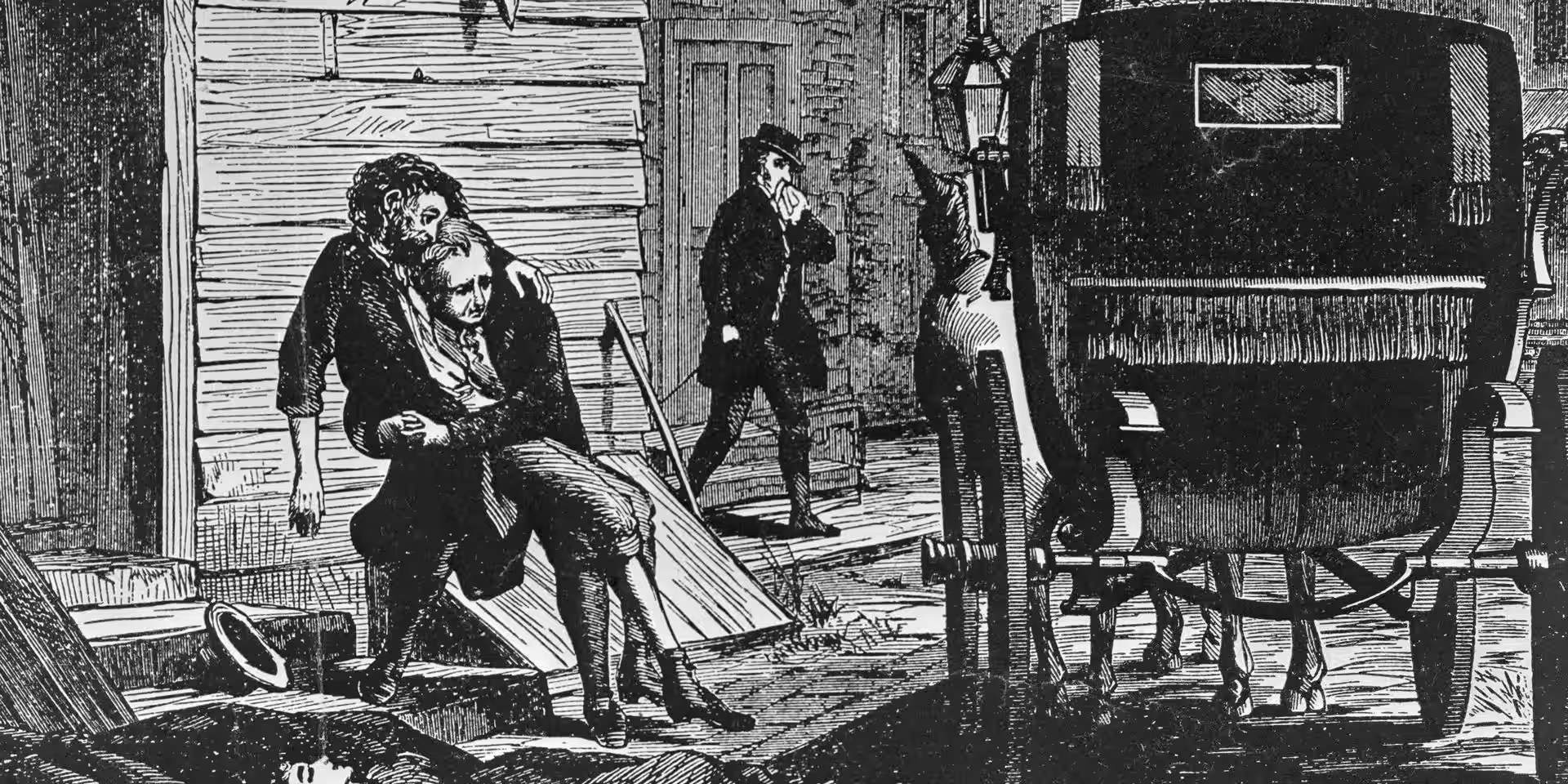
As we actually make America healthy again, we might recall that it was on this date in 1793 that prominent Philadelphia physician (and Declaration of Independence signatory) Benjamin Rush alerted the city’s mayor that an epidemic of mosquito-borne yellow fever was fast emerging.
In the summer of that year, refugees from a yellow fever epidemic in the Caribbean fled to Philadelphia. Within weeks, people throughout the city were experiencing symptoms. By the middle of October, around 100 people were dying from the virus daily. Caring for the victims so strained public services that the local city government collapsed. Philadelphia was also the seat of the United States government at the time, but federal authorities simply evacuated the city in the face of the raging epidemic. Eventually, a cold front eliminated Philadelphia’s mosquito population, and the death toll fell to 20 per day by late October. By the time the epidemic ended, roughly 5,000 people had died.
Today, a vaccine prevents yellow fever in much of the world, though thousands of unvaccinated people still die every year from the disease.
“The lie has become not just a moral category but a pillar of the State”*…

A bracing essay from Adam McKay (director of Don’t Look Up, Vice, and The Big Short, among many other films), arguing that our acceptance of assurances that we have time left to address climate change, or that “Net Zero by 2050” will save us, is driving us toward full social collapse in ways that become more obvious with every new broken temperature record…
Lies are a lot like gourds. They come in hundreds of different varieties, sizes, and bulbous, twisty shapes. Some are off-puttingly spiked and prickly, while others remind us of fall childhood memories.
Some lies, if prepared correctly like squash or pumpkin, can appear delicious and irresistible, concealing a dark reality: “I can’t believe you’re not a model! For five thousand dollars I can photograph you so you have a portfolio.” The central aim of most lies is to avoid consequences. When an untruth is especially desperate and self-serving, it can be unintentionally hilarious: “Yes I tried marijuana… but I did not inhale.”
Embezzling money or murdering someone for the insurance pay-out are part of a phylum of lies that cross into serious criminality. These deceptions’ sphere of influence often stays fairly localized. But sometimes covering up the initial lie can spawn lots of other lies that spread and spread, like with Watergate or Bernie Madoff. What started as a little decorative Thanksgiving-gourd-sized lie suddenly becomes larger and quite ugly. This family of lies strives to not only avoid consequences, but to gain status and resources, another common end game of many deceptions.
And then there are the large society-wide lies: hulking distortions and misrepresentations watered and tended to by leaders, mass media, culture, and industry.
This particular sub-genus of grifts, half-truths and strategic omissions have led throughout modern history to wars, mass death, societal collapse, and the theft of humanity’s great treasures. “Manifest Destiny.” “Aryan superiority.” “The divine right of kings.” “The domino theory.” “Israel has a right to defend itself.” “Oxycontin isn’t addictive because it’s time-released.” These county-fair, blue ribbon-winning prevarications tend to be driven by a myriad of short-term incentives, irrational manipulated fears, unexamined assumptions, convenient blind spots, and of course… the desire to avoid consequences and expand status and resources.
“People always pay their mortgages” became the half-true rallying cry used by Wall Street, news media, and politicians to collapse the world economy in 2007. Turns out when you change lending rules to feed an unregulated derivatives market by giving mortgages to people who can’t pay them… they don’t. “Saddam Hussein has weapons of mass destruction” (along with the subvariations on the central lie—“We want to bring democracy,” “If you don’t support the troops, you support the terrorists,” “Saddam orchestrated 9/11,” etc) killed a million people, devastated the entire nation of Iraq, and in many ways also gutted the United States, all while enriching oil companies, weapons manufacturers, big banks, juicing TV ratings, and expanding the power of the Bush/Cheney presidency.
However, there is one type of rare, gargantuan, towering lie that makes all the other mass lies throughout human history seem like frightened, scurrying, little adorable fibs.
It is a lie told worldwide by hundreds of thousands of institutions, elected officials, many universities, legacy news, some large non-profits and eventually—as the deception entered mainstream culture—even by ourselves, to ourselves, every single moment of every day. It is a constantly growing gourd that even as a baby back in the 1970s was the size of three aircraft carriers. These days it is so massive it is almost easier to refer to what isn’t part of it (Disneyland, a BLT, that green croc by the side of the highway) than what is.
This massive lie can best be summed up as “when it comes to climate change… we have more time.”
To be clear, we are not talking about the kind of total climate denial one would find on the extremist, lunatic fringe inhabited by the likes of Alex Jones or the current U.S. President. And we’re not referring to cartoonish hucksters and “climate skeptics” like Joe Rogan or Jordan Peterson.
Polling shows only 14.8 percent of Americans deny the basic sixth grade science behind global warming. To put that in perspective, as much as 10 percent of the population still believes the Earth is flat.
No, the monstrous, misshapen garden colossus lie we’re referring to is subscribed to by most of the U.S., has stopped and slowed climate action far more than outright denial, and keeps growing and growing. Every day this deception whispers seductively in the ears of mankind: “global warming is real but not urgent… Keep doing what you’re doing.”
Less embarrassing than “climate change is a Chinese hoax,” but every bit as unscientific and ridiculous, it is the preferred lie of the ruling class, mainstream news media, and corporations.
Sir David King—former science advisor to the United Kingdom, professor at Oxford and then Cambridge, winner of too many awards to list and as establishment as they come—was quoted as saying that what we do over the next three to four years will determine the fate of humankind.
He said this… in 2021…
[McKay unpacks a chilling variety of examples of “the lie” in action, contrasting government/media/corporate messages with the reality to which the )ostensibly) refer…]
… Still have doubts? If you do, I don’t blame you. We live in a consumer culture hammering us daily with triggering political proclamations, sales pitches, and clickbait designed to spike engagement responses in the brain. “Immigrants are coming for your way of life!” “This new SUV is the best ever!” “Great White Shark Eats Porn Star!” Most of it is misleading, in one way or another, so there’s a natural tendency to assume that “Planet about to boil!” might be too.
But Big Oil and its PR agencies know this, and they’ve weaponized the healthy skepticism we’ve developed as a survival mechanism against those voices speaking the truth about the urgent state of the climate.
After all, who are you going to believe? The New York Times, an outlet famous for downplaying climate urgency, or some weird scientist saying crazy things? Even when a profession famous for dead-eyed, bottom-line risk assessment like insurance actuaries releases a statement about how serious the situation is, corporate news media turns it into what people used to call a “below the fold story,” framing it as just another minor environmental item—not headline news.
In service of the Great Lie, the government of the United Kingdom even tried to bury a climate report from its own intelligence agency before it was leaked. To my knowledge there aren’t many spies being called tree huggers, unless they’re undercover of course. But the MI5 and MI6 are clear-eyed about the danger that’s coming. The report warned that “global ecosystem degradation and collapse threaten UK national security and prosperity.”
No one wants to eat a raw pumpkin. It looks like a Dr. Seuss character’s brain, is full of seeds, and has no real taste. But like with any good lie, when the right sugar, spices, a buttery crust, and time in the oven is added, pumpkin pie becomes a cherished classic.
The same thing happens with the climate lie. The financial markets, massive oil companies, the banks that finance them, the travel industry, car companies, your career and job security, the people you’re having dinner with who don’t want to be bummed out, all of these incentives and forces don’t want you to know you are eating a big, weird gourd.
And as long as we go with their mendacious flow, hundreds of millions, and then billions will die well before “Net Zero by 2050” or “our great grandkids’ future” arrive. Because we are out of time. And we need to get to work immediately. There are a million things to do…
As Pope John Paul II said, “An excuse is worse and more terrible than a lie, for an excuse is a lie guarded.”
Eminently worth reading in full: “The Gargantuan Lie That is Collapsing The World’s Climate,” from @ghostpanther.bsky.social in @currentaffairs.bsky.social.
Oh, and meantime: “U.S. Declared An Energy Emergency, Then Paid $4 Billion For Less Energy.”
* Aleksandr Solzhenitsyn
###
As we face up, we might spare a thought for Blaise Pascal; he died on this date in 1662. A French mathematician, physicist, theologian, and inventor (e.g., the first digital calculator, the barometer, the hydraulic press, and the syringe), his commitment to empiricism (“experiments are the true teachers which one must follow in physics”) pitted him against his contemporary René “cogito, ergo sum” Descartes– and was foundational in the acceleration of the scientific/rationalist commitment to measurement (and the conclusions/actions they dictated).
Relevantly to McKay’s piece, Pascal also advanced the philosphical argument we know as “Pascal’s Wager.” While he posed the exercise as a life-defining gamble regarding the belief in the existence of God, we can easily transpose it to apply to climate change action:
Pascal contends that a rational person should adopt a lifestyle consistent with the existence of God and should strive to believe in God. The reasoning for this stance involves the potential outcomes: if God does not exist, the believer incurs only finite losses, potentially sacrificing certain pleasures and luxuries; if God does exist, the believer stands to gain immeasurably, as represented for example by an eternity in Heaven in Abrahamic tradition, while simultaneously avoiding boundless losses associated with an eternity in Hell. –source
If the threat of climate change is, as “the lies” suggest, real but distant, then immediate action only costs us some short-term sacrifice. But if that threat is imminent, immediate action could preserve our way of life and the prospect of an improving future for us and our children and their children… while inaction is likely to end in utter disaster.

You must be logged in to post a comment.