Posts Tagged ‘single payer’
“Of all the forms of inequality, injustice in health care is the most shocking and inhuman”*…

Why are health care costs so high in the U.S.? Harvard public health scholar John McDonough chalks it up to a “wrong turn” in 1980, and the consequences that have ensued…
“What happened in 1980?” John McDonough wondered every time he looked at the numbers.
After 1980, U.S. healthcare became far more expensive than care in peer nations such as France and Germany. In 1980, the U.S. was at the top of a tight pack of industrialized democracies. After that, the cost of American healthcare soared. By 2024, U.S. spending as a percentage of GDP was about 50 percent higher than that of peer nations.
“In the early 1980s, we can see a significant upsurge,” McDonough, professor of the practice of public health at the Harvard T.H. Chan School of Public Health, said in an interview. “All of a sudden, we jumped from the rest of the crowd and were now in a category by ourselves. Over the following 40, 45 years, the distance kept growing.”
McDonough knew what he could rule out: Any suggestion that Americans get more for their money. On the contrary, millions of U.S. citizens are uninsured; out-of-pocket costs and medical debt are high; and even people with insurance have trouble getting appointments. Meanwhile, physician satisfaction is low, leading to early retirements and migration to nontraditional models like concierge care.
When the pandemic hit, McDonough had time for a deep dive into the issue. This month, after a five-year “labor of love,” he’s presenting his answer in a new book, America’s Wrong Turn: US Health Care in the Neoliberal Era [here]. In it, McDonough links increases in healthcare costs to a new political and economic era dominated by a belief in an unfettered free market, tax cuts, deregulation, privatization, smaller government, increased immigration, and free trade.
This trend in U.S. policy — “Reaganomics” before it became “neoliberalism” — included tax, spending, and regulatory overhauls instituted during President Ronald Reagan’s eight years in the White House. But McDonough, a Democrat who served 13 years in the Massachusetts House of Representatives, isn’t just interested in Reagan. Over the next 40 years, some presidents adhered to neoliberalism’s tenets but even those who didn’t were influenced by its deep penetration into the nation’s political and economic ecosystem, he says.
McDonough found a guide in the writings of Yale University political scientist Stephen Skowronek, who suggests that presidents should be measured by the durability and influence of their ideas and values well beyond their terms in office. Skowronek identified only five singular and decades-long eras in U.S. history, those of Thomas Jefferson, Andrew Jackson, Abraham Lincoln, Franklin Delano Roosevelt, and Ronald Reagan.
While Reagan was the first president to espouse neoliberal political and economic philosophy, the core ideas date back decades, fostered by Nobel Prize-winning economist Milton Friedman, who became a key economic adviser to Reagan.
“There was a New Deal-FDR era between 1933 and 1980,” McDonough said. “The neoliberal era that Reagan kicked off saw itself as the corrective to the pro-government prior era. Important dynamic consistencies persisted among Ronald Reagan and Bill Clinton, George W. Bush, and even Barack Obama. There were sets of beliefs with a Republican conservative flavor and with a Democratic flavor that were surprisingly consistent.”
When describing the U.S. healthcare system under neoliberalism, McDonough, who worked with U.S. senators on the Affordable Care Act, cites several major effects, chief among them a permissiveness toward corporate mergers and consolidations that reduces competition, and an unleashing of private equity.
Since the 1980s, U.S. healthcare has become increasingly consolidated, dominated by fewer and larger organizations. The two largest dialysis centers have 92 percent of the U.S. market, for example, while the two largest providers of intravenous solutions control 75 percent of the market. The two largest syringe manufacturers have a 69 percent market share.
Consolidation extends to physician and hospital markets, with 90 percent of hospital markets, 65 percent of physician specialist markets, and 74 percent of health insurance markets considered highly concentrated, McDonough writes.
One argument for larger organizations is the potential for cost saving through both efficiencies and a greater ability to negotiate savings, but the cost-saving record of larger organizations in healthcare is poor, McDonough says. He cites a 2022 RAND study that indicates that price increases of between 3 percent and 65 percent accompany hospital mergers.
Private equity’s focus on generating profits to maximize shareholder value conflicts with improving patient care, McDonough argues. When private equity firms target businesses, enhance their operations, and quickly resell them at a profit, critics say the value extraction from the deals creates harmful operating cuts and dismantling rather than business improvement.
McDonough reviews other key forces in the evolution of U.S. healthcare in recent decades, including fragmentation leading to high administrative costs, low spending on public health and preventive care, unequal access and uneven quality of care, and cost shifts onto consumers via copays, coinsurance and other cost-sharing mechanisms, which result in high levels of medical debt.
McDonough offers prescriptions, but recognizes that change will require political buy-in for things such as strengthened antitrust action to break up megacompanies and stronger regulation of prescription drug pricing, both difficult in an era of sharply divided politics. Government, along with industry, needs to reaffirm a commitment to patient care as the center of its efforts, he says, while also foregrounding equity, access, affordability, and population health.
“The damage to U.S. health and medical care from the 40-year neoliberal era has left considerable harm for patients and consumers, for medical workers at all levels, and for public/population health,” McDonough said. “It will take radical action to reinvigorate the values and principles of our health system that have been lost and eroded. An essential way to do this is to understand how we got to this position in the first place.”…
How we got here and how to respond: “How to fix U.S. healthcare? ‘Radical action’,” from @harvardmagazine.bsky.social.
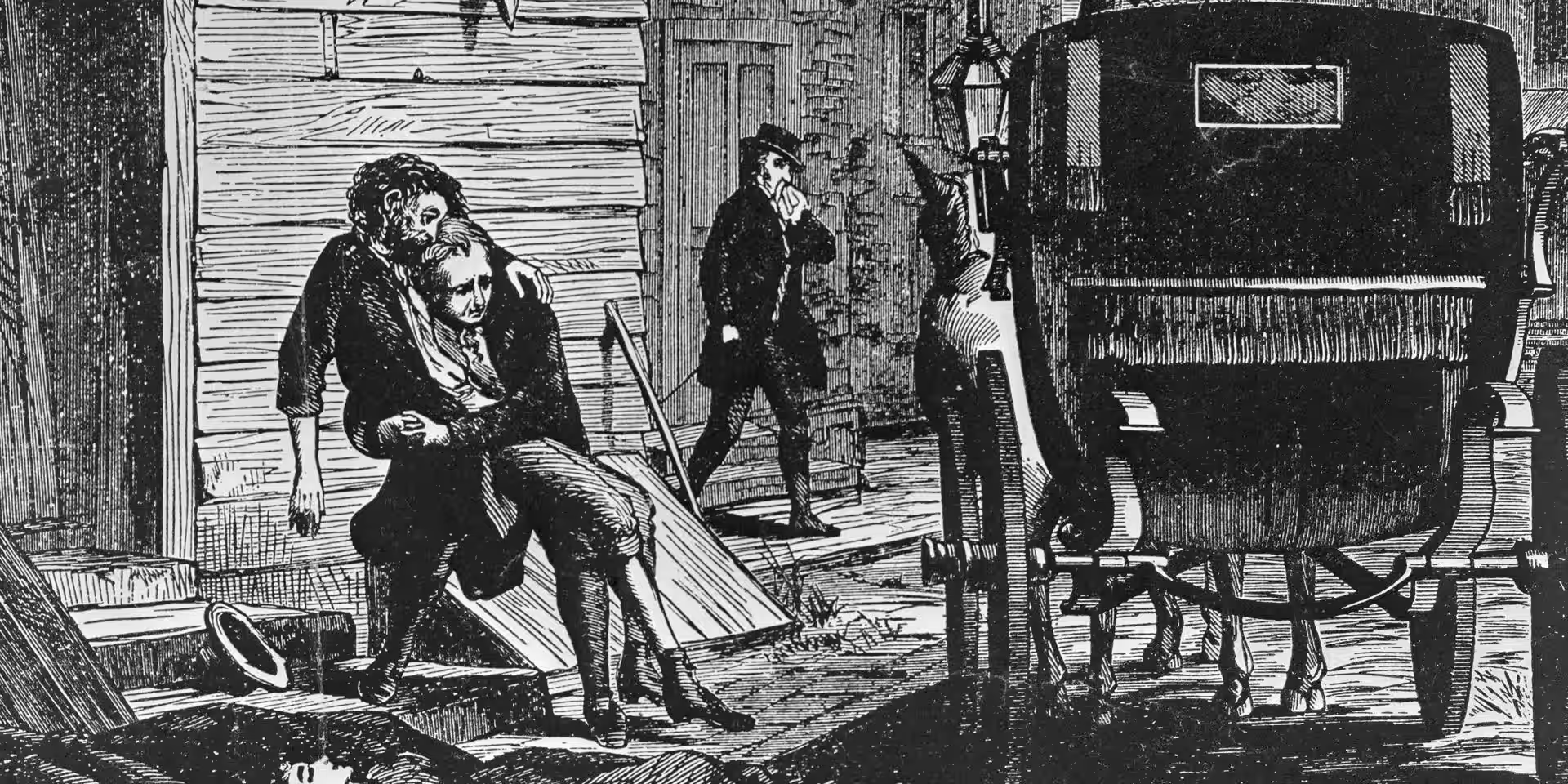
For a case in point, see David Oks‘ “Why American ambulance rides are so expensive” (source of the image at the top).
And for a more straightforward, but somewhat more “radical” prescription than McDonough’s, see: “Universal Health Coverage Could Save $1 Trillion and 114,000 Lives Every Year, Yale Study Projects,” from the Yale School of Public Health: “A single-payer universal health care system could cover every American, save more than 100,000 lives a year, and still cost $1 trillion less than the system it would replace…”
Finally: this is the third (R)D in a row that focuses on (some of) the consequences of the unholy infection of government by business, largely in the U.S. (though, of course, we can see the phenomenon all over the world). The focus shifts with tomorrow’s post. But before we go, Dylan Riley‘s pithy diagnosis of “the chaotic obscenity of our current moment”: “The Thesis of Political Capitalism.”
* Dr. Martin Luther King, Jr.
###
As we actually make America healthy again, we might recall that it was on this date in 1793 that prominent Philadelphia physician (and Declaration of Independence signatory) Benjamin Rush alerted the city’s mayor that an epidemic of mosquito-borne yellow fever was fast emerging.
In the summer of that year, refugees from a yellow fever epidemic in the Caribbean fled to Philadelphia. Within weeks, people throughout the city were experiencing symptoms. By the middle of October, around 100 people were dying from the virus daily. Caring for the victims so strained public services that the local city government collapsed. Philadelphia was also the seat of the United States government at the time, but federal authorities simply evacuated the city in the face of the raging epidemic. Eventually, a cold front eliminated Philadelphia’s mosquito population, and the death toll fell to 20 per day by late October. By the time the epidemic ended, roughly 5,000 people had died.
Today, a vaccine prevents yellow fever in much of the world, though thousands of unvaccinated people still die every year from the disease.
You must be logged in to post a comment.