Posts Tagged ‘Science’
“Every happiness is the child of a separation it did not think it could survive”*…

A third and final (for awhile:) post on AI and what it might mean… Sunday’s post was a consideration of what we might lose if AI becomes central to our lives, a modern echo of Socrates’ lament on the spread of writing. Indeed, we are in a moment of high dudgeon over AI: its potential impact on the environment, on jobs. on the economy more broadly, and in the wake of recent statements from foundational model companies, on their governability(“rogue AI,” though do also see here), and thus on the prospect of our very existence (though do also see here).
Yesterday’s post was an example of thinking that starts from the implicit assumption that AI is coming, then asks how we might govern it. It’s worth noting that even if there is an AI Bubble about to burst, AI could still loom large in our longer-term future. Investors hobbled in many earlier bubbles (e.g., railroads, telecom, the dot.com crash, et al.) were directionally absolutely right about the longer-term promise of the technologies that excited them, just wrong to believe that the early entrants (and their specific offers) in which they were investing were the vehicles to realize that promise.
Today, we stick with the assumption that AI will continue to develop and to change the world around it. Some suggest that AI and its impact are moving us from literacy back to orality (the loss of which so concerned Socrates). But others suggest that AI (and the advances that it enables) could usher in a new Axial Age, a time of huge and ultimately positive transformation, on the other side of which we– humanity– will be… different, as different from the people we were in, say 1999, as Shakespeare was from Socrates.
But what might that be like? It’s relatively easy to imagine disasters that amount to the things we know collapsing; it’s much harder to envisage positive futures filled with altogether new things, futures the contents of which are, essentially by definition, things we’ve not imagined, much less experienced.
Following, from Vinkatesh Rao, one of the most thoughtful approaches I’ve yet come across. He starts with mathematics– with the recent successes of AIs in that field– locates that work in the history of math (in particular axiomatics), then suggests a way of understanding AI’s “success”:
… A theorem prover does not search the space of all possible sequences of logical symbols. It plays inside a world humans have painstakingly designed.
This makes recent achievements in AI mathematics look slightly different.
Perhaps we have been too quick to interpret them as evidence that AI has acquired access to the wild source of mathematical intuition. A significant part of the achievement may instead be that humans spent a century converting increasingly large regions of mathematical wilderness into exceptionally good game boards: semi-closed environments in which the relevant state can be represented, legitimate moves can be made, accumulated technique can be reused, and success can be verified…
Rao then explains how similar trajectories have accrued in the application of AI to programming and to physics, concluding…
Across mathematics, programming and physics, the same pattern keeps appearing. First there is clever performance. Then somebody finds a representation that captures what the clever performers are doing. Then general machinery accumulates around the representation. Then the machinery becomes architecture. Eventually much of the play becomes mechanical.
The creativity has not disappeared. It has moved.
There is an obvious objection to this story.
Perhaps what I am describing as progress is merely legibility.
James C. Scott famously described [and here] the tendency of modern states to simplify complicated social and natural realities into representations that administrators can see and manipulate: cadastral maps, standardized names, scientific forests, censuses, planned cities.
The representation is useful precisely because it throws things away. A forest seen by a forester interested in timber yield is not the forest experienced by the people, animals, fungi and plants living in it. The administrative forest has become extraordinarily legible along a narrow set of dimensions by becoming blind along others.
Every game performs a similar operation. Before you can play, you must decide what the pieces are. You must decide what constitutes the state of the game, what counts as a move, what consequences follow from moves, and what counts as winning. Everything else becomes environment.
A rigid body in a mechanical simulation is not actually rigid. A point mass is not a point. A frictionless surface does not exist. A program described by its types still runs on processors with caches and memory hierarchies. A theorem encoded in Lean does not contain the diagram that gave somebody the idea for it.
Formalization is compression.
In physics this is explicit. Reality becomes a model, the model becomes mathematics, and the mathematics becomes a numerical representation. Information is discarded at every step.
The miracle is not that nothing is lost. The miracle is how often we can throw almost everything away and still retain what matters…
…
… This suggests an important asymmetry. A productive mathematical ecology wants porous epistemic boundaries and impermeable verification boundaries. On the way in, metaphor, hallucination and category mistakes can be useful. On the way out, they are forbidden.
A poem can inspire the theorem. The poem cannot prove it…
… A domain becomes playable when enough of its phenomenological complexity can be compressed into something like a state; when there is some reasonably stable repertoire of actions; when interactions can be repeated; when outcomes provide feedback about better and worse play; and when the environment is stationary enough that lessons learned yesterday remain useful tomorrow.
None of these conditions needs to be perfect. Poker contains hidden information. Markets change their own rules. Hunting happens in an uncontrolled environment. Conversation does not have an explicit score.
Playability is a matter of degree.
Nor is playability the same as formalizability.
Children learn social games without writing axioms. Hunters learn landscapes. Merchants learn markets. Political operators learn institutions. Formalization is merely one unusually powerful technology for increasing playability.
So are money, measurement, domestication, standardization, simulation, bureaucracy and digitization. They do related things. They compress states. They stabilize interactions. They make outcomes comparable. They create memory. They allow experience to accumulate.
This suggests a hypothesis:
Far more of reality than we might reasonably have expected can be carved into semi-closed environments in which experience accumulates, performance improves through repeated play, and success eventually becomes sufficiently legible to automate.
Call this the Curiously Playable Universe hypothesis…
…
… If playability were merely a property of AI-friendly digital environments, none of this would be particularly interesting.
But the pattern is ancient. Consider agriculture.
Hunting and gathering takes place in a relatively wild learning environment. Animals move. Weather changes. Useful plants appear where they appear. The training distribution is supplied by nature.
Agriculture does something profound to the learning problem: It changes the environment.
Fields stabilize locations. Planting stabilizes cycles. Domestication alters organisms. Irrigation alters water availability. Storage alters time. Property regimes and markets stabilize incentives.
Humans did not merely become better at learning nature. They made nature easier to learn.
The wild game becomes domesticated.
Eventually industrial agriculture pushes large portions of the process toward automaticity: standardized breeds, standardized feed, controlled environments, mechanized planting and harvesting, precisely measured yields.
Then the game moves upward.
Instead of merely optimizing how an organism is cultivated, we begin optimizing the organism itself. Selective breeding becomes genetics becomes genomic selection and genetic engineering.
The old player becomes a game piece.
It is tempting to map this progression onto contemporary machine-learning terminology. Hunting looks vaguely like reinforcement learning in a difficult environment. Agriculture introduces something like shaped rewards and a controlled training distribution. Factory farming begins to resemble a regime of relentless verification against measurable outputs.
The analogy should not be pushed too literally. Human cultures have always involved teaching, imitation, norms and complicated reward systems.
But structurally the direction is unmistakable: increasing control over the state representation, action space, feedback signal and training distribution.
Commerce underwent another version of the transformation.
Exchange begins embedded in relationships, obligations, reputation, kinship and local knowledge. Credit can be intensely personal. Value is contextual.
Money performs an astonishing act of compression.
Heterogeneous goods and obligations become comparable through a common medium. Markets then stabilize arenas in which repeated exchange produces prices. Accounting makes states more legible. Contracts formalize future obligations.
Eventually finance builds games on top of the game.
A derivative can be a claim on the future value of another asset. Options put prices on possible future prices. Markets become arenas for expectations about expectations.
Play moves upward.
None of this required artificial intelligence. Humans have been turning wildernesses into games for thousands of years.
What AI changes is the cost of achieving playability in a domain.
Historically, making a domain playable was expensive. Somebody had to invent the categories. Somebody had to measure the variables. Somebody had to standardize the procedures. Somebody had to construct the institutions that made interactions repeatable.
And the resulting representation had to be relatively explicit because ordinary software was brittle.
Machine learning relaxes that requirement…
Rao muses on where this effect might accrue…
Coding is perhaps the clearest domain currently passing through the transition.
Programming was unusually playable before generative AI arrived.
Compilers already supplied verifiers. Type systems constrained legal moves. Unit tests supplied rewards. Version control recorded trajectories. Continuous integration repeatedly evaluated outcomes. Package ecosystems created enormous libraries of reusable moves.
Generative coding systems arrived in a landscape generations of programmers had inadvertently prepared for them.
As implementation becomes cheaper, the game moves upward toward specifications, architectures, product decisions and the increasingly important question of what software should exist in the first place.
Robotics is a more difficult frontier.
The physical world is phenomenologically unruly. Objects deform. Friction varies. Things break. Lighting changes. People walk into rooms. Drawers stick.
Simulation, cheap sensors, multimodal models and increasingly capable world models are gradually making physical environments more playable, but reality continually leaks through the representation.
This is why robotics may be one of the most important tests of the Curiously Playable Universe hypothesis.
Can enough of ordinary physical reality be compressed into stable learned representations to permit the same cycle of domestication and automation?
Science will probably fragment according to playability rather than according to our traditional rankings of intellectual difficulty.
Protein structure turned out to be unusually playable.
Drug discovery is less so because chemical promise must survive biology, organisms, clinical trials and human heterogeneity. Materials discovery may become increasingly playable through the combination of simulation and automated laboratories. Ecology may remain stubbornly wild because every useful abstraction excludes interactions operating at another scale.
Medicine contains both extremes. Image interpretation and molecular design can be made relatively game-like. Caring for an elderly person with five interacting conditions, family constraints and changing preferences is another matter.
Governance may become a particularly strange frontier.
States have spent centuries making populations legible through names, addresses, laws, property records, taxes, censuses, bureaucratic categories and standardized procedures. In that sense the modern administrative state is already a vast game-making machine.
AI will make more of its internal operations automatic.
But political systems contain an unusual source of wilderness: the pieces know they are pieces.
People respond strategically to measurements, categories and incentives. A rule changes the behavior it was intended to regulate. A metric becomes a target and stops being a good metric (Goodhart’s Law). Political actors learn to play the machinery designed to make them legible.
This may push governance upward toward new games involving states themselves: transnational protocols, financial systems, supply chains, standards regimes, platform governance and other structures that do not fit comfortably inside the old nation-state game board.
Some domains may resist for much longer.
Child-rearing is difficult to make playable because the objective changes as the child changes. Friendship has no stable score. Diplomacy involves adversaries whose models include models of your model of them. Entrepreneurship often consists precisely of discovering a game nobody realized existed.
Frontier science operates where we do not yet know which measurements matter. Cultural creation is evaluated by audiences who change partly because of the works being evaluated. Political legitimacy is altered by attempts to measure and optimize it.
These are not necessarily domains AI cannot enter. They are domains in which the wilderness fights back…
He continues…
… We keep asking what it means that machines can now play chess, write programs, fold proteins, prove theorems, steer robots and discover molecules. The question presumes that the remarkable new object is the machine—that some mysterious substance called intelligence has finally become “general” enough to flow from one human province into another.
But perhaps the stranger discovery concerns the provinces: Wildernesses can be reliably turned into game boards. We domesticate the territory, become skilled at its game, build machinery that plays it better than we can, and move outward to construct another game around the first, domesticating a larger scope.
This happened to fields and livestock long before it happened to chess. It happened to trade before it happened to programming. It happened to mechanics before it happened to mathematical proof.
Artificial intelligence did not invent this strange property of reality. It is merely making it difficult not to notice.
The deepest surprise of the AI era may turn out not to be that intelligence was easier to manufacture than we thought. It may be that the universe is far more playable than we imagined…

And he concludes with a consideration of writing…
… Writing sits somewhere awkwardly in the middle of the playability spectrum. It is obviously more playable than friendship or political legitimacy. There are stable artifacts, accumulated techniques, recognizable genres, repeatable operations and abundant feedback. Sentences can be revised. Arguments can be tested for consistency. Stories can be checked for continuity. Editors can compare two versions and usually say something useful about why one works better.
But writing lacks the feature that makes Lean such an extraordinarily good game board: a verifier. There is no kernel that accepts Middlemarch and rejects a bad novel. The relevant state is incompletely represented, the available moves are effectively unlimited, and the reward function wanders around outside the text in readers, institutions, historical circumstances and cultures that change partly in response to what gets written. Recent attempts to extend verifiable-reward techniques to writing therefore have to manufacture approximate evaluators out of principles and pairwise judgments rather than simply checking an answer. Writing is playable, but imperfectly and unevenly so.
The unevenness is becoming easier to see because AI is revealing which kinds of writing were already more game-like than we realized. A corporate memo, SEO article, product description, technical explanation or conventional news report has relatively strong constraints: purpose, audience, format, facts, length, house style, perhaps measurable outcomes. Formulaic genre fiction has a looser but still recognizable game board of beats, tropes, pacing, character functions and reader expectations. Even fiction once assumed to depend heavily on irreducible human voice is proving surprisingly susceptible to systematic generation and variation. Writing is not one game but a family of wilderness activities at very different stages of domestication.
At the other end lies writing whose purpose is partly to alter the terms by which it will be judged. As Walter Benjamin observed, “all great works of literature establish a genre or dissolve one.”
A genuinely new literary form, a strange essay, a foundational work of philosophy, or a piece of criticism that gives its readers a concept they did not previously possess cannot simply optimize against an existing reward function. Its success may consist in creating a new one. This is writing at its most wilderness-like, and perhaps why arguments about AI writing become confused when “writing” is treated as a single capability. Producing competent prose, satisfying a genre contract, developing an argument and inventing a form are different games with different degrees of playability…
… The meta-game emerging above writing may therefore involve constructing—and strategically revealing—the game boards on which execution takes place. If competent prose becomes cheap, more resources can be directed toward finding the question, assembling unlikely source domains, inventing the useful distinction, designing sequences of inquiry, recognizing when an analogy is productive, deciding what belongs together, and establishing the criteria by which a finished object ought to succeed. The writer becomes somewhat less like a person manufacturing sentences and somewhat more like an architect and player of generative constraints.
That does not mean prose becomes irrelevant. A game board badly realized is still a bad essay, just as a brilliant architectural plan does not eliminate the need for a building. Nor does it mean the higher-level activity is permanently reserved for humans. AI systems may themselves become increasingly capable of inventing representations, designing probes, discovering genres and constructing new games. The point is only that automaticity at one level does not end the activity. It displaces its frontier.
Writing may therefore be undergoing the same transition described throughout this essay, only messier and in public. Some of its old games are becoming startlingly playable. Some are approaching automaticity. New games are forming above them. And beyond those remains the poorly mapped territory from which the next game board might emerge…
Eminently worth reading in full: “The Curiously Playable Universe,” from @vgr.bsky.social.
And further: “Our Eukaryotic Moment,” in which Rao urges us to keep our minds open– to resist “premature ontological closure in conceptualizing AI.” A taste:
… About two billion years ago, life underwent a change in architecture. Until then, the planet was ruled by relatively simple prokaryotic cells: bacteria and archaea, tiny packets of chemistry bounded by membranes, carrying their genetic material directly in the same cellular space where much of the business of life took place.
Then something happened, or rather, several things happened in an order that remains uncertain. At some point, an ancestral archaeon cell entered into a permanent symbiosis with a bacterium capable of unusually powerful energy metabolism.
That bacterium eventually became the mitochondrion.
Somewhere in the same long evolutionary transition, genetic material became enclosed within a nucleus, separating the storage and regulation of hereditary information from much of the cell’s everyday chemistry. Internal membranes proliferated, cytoskeletons became more elaborate, and a new kind of cell emerged: the eukaryote….
… Eukaryotic cells became larger, more internally differentiated and capable of forms of organization unavailable to their ancestors. Much later, and independently in several lineages, some evolved multicellularity. Cells themselves became components of larger entities, differentiating and cooperating in increasingly elaborate ways. From the eukaryotic architecture eventually came forests, mushrooms, octopuses, hummingbirds, whales and us.
Eukaryotes were more than just “better bacteria.” They represented a different organization of life, capable of sustaining far more complex structures..
We may be living through an analogous transition now. The emergence of AI, in the particular form that it has appeared (deep learning), is arguably the eukaryotic moment in human cultural evolution, understood in memetic terms, with humans playing the role of mitochondria, and AI the role of the nucleus…
Meantime: “After We Stop Grieving AI: Cyborgs, Centaurs and Cyberpunks” (via Patrick Tanguay) See also: “Diving Deeper Into Digital Transformation” from John Hagel (source of the image above).
As the estimable Tim O’Reilly suggests, we’d probably be wise to take a breath, to treat AI as a “normal technology”: “Technology doesn’t force us… it merely opens the door.”
* Rainer Maria Rilke, Sonnets to Orpheus, Part Two, XII
###
As we crane to conceive what’s beyond our cocoon, we might recall that it was on this date in 1947 that the Association for Computing Machinery (or ACM) was founded. In one sense, computer science dates back to the 17th century and the mechanical calculators of Wilhelm Schickard and Gottfried Leibniz; in another, to the Difference and Analytical Engines of Charles Babbage (and the “programming” of Ada Lovelace). But the ACM can claim to be at least a key stone in the foundation of the field we now knw as “Computer Science”– the first modern “learned society” devoted to the emerging field. (Computer Science began to be established as a distinct academic discipline in the 1950s and early 1960s. The world’s first computer science degree program, the Cambridge Diploma in Computer Science, began at the University of Cambridge Computer Laboratory in 1953. The first computer science department in the United States was formed at Purdue University in 1962.)

“It is entirely possible that you get unpredictable behavior out of predictable rules”*…
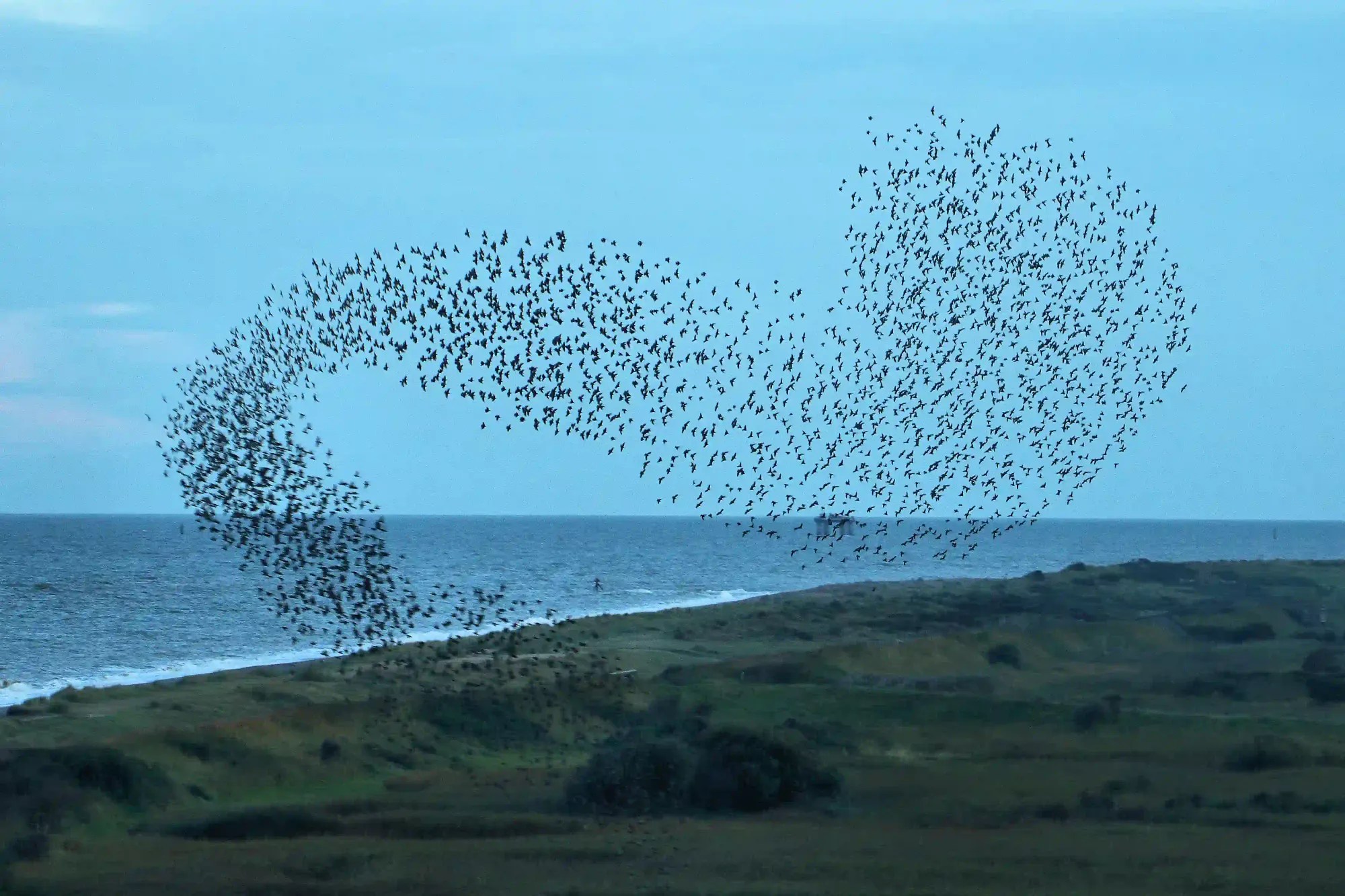
For centuries, the hypnotic winter flights of starlings were thought to be telepathy. Today, science reveals a much darker reality. Behind one of nature’s most breathtaking visual displays lies a mathematical masterpiece built entirely on fear. From The Great Planet…
During the autumn and winter months, if you look to the skies over Europe and North America about an hour before sunset, you might witness one of nature’s most breathtaking visual spectacles. These massive black clouds of tens of thousands of European starlings (Sturnus vulgaris)—constantly shifting into spheres, planes, and waves—are known in the scientific community as a “murmuration.” Named after the deep, resonant sound produced by thousands of wings beating in unison, the phenomenon looks from afar like a colossal calligraphy brushstroke across the sky or a ball of fire flickering in the wind. Yet, beyond this aesthetic illusion lies a ruthless and flawless algorithm for survival.
For centuries, researchers were baffled by how tens of thousands of birds could fly at speeds of around 45 kilometers per hour without a single collision. This coordination was so inconceivable that in 1931, prominent ornithologist Edmund Selous described it as “a madness in the sky.” To Selous, there was only one logical explanation for this complex behavior: telepathy. “They must think collectively, all at the same time,” he wrote.
Like many others, Selous assumed that complex behavior must stem from equally complex origins. However, groundbreaking observations made in 2005 by the married physicists Andrea Cavagna and Irene Giardina from the rooftop of the Palazzo Massimo in Rome revealed a truth far more striking than telepathy. Over three years of chilly evenings, the team used pairs of cameras to reconstruct the 3D positions of more than 4,000 birds in a single flock, proving that there is no overarching plan and no leader. Each starling in the flock interacts exclusively with its seven closest neighbors—a number researchers suggest might be the maximum capacity their brains can handle. The starlings do not keep track of these constantly changing alliances; they simply align their flight path with whichever seven birds are nearest, remaining close, but never too close.
The birds do not need to engage in complex communication to navigate their massive trajectories. When Charlotte Hemelrijk of the University of Groningen in the Netherlands plugged just three simple rules—avoidance, alignment, and attraction—along with basic aerodynamics into a computer model, the resulting virtual murmuration perfectly matched the real-world data gathered in Rome.
Physicists explain this vast web of interaction through the concept of “scale-free correlation.” When a starling turns, this new alignment influences its neighbors, who in turn influence theirs. Yet, unlike a children’s game of telephone, this transfer of information does not degrade with errors; instead, the errors are entirely washed away in the movement. No matter how large the flock becomes, the information arrives at the furthest edge completely uncorrupted. Even though each bird only pays attention to seven neighbors, its senses effectively extend across the entire murmuration, allowing it to instantly react to a movement hundreds of birds away. The reason the flock looks like a single entity from the outside is that, physically, it truly behaves like one.
Why do starlings expend such an immense amount of energy to constantly shift shape in the sky? For a long time, the scientific consensus leaned toward the “warmer together” hypothesis, assuming the displays served to advertise a roosting site and gather more birds for thermal benefits on cold nights. However, an analysis of over 3,000 murmurations across 23 countries, gathered through citizen science, revealed only a weak negative correlation between temperature and flock duration. The true determining factor was the “safer together” principle: defense against predators.
In approximately 30% of the recorded murmurations, birds of prey such as hawks, falcons, or harriers were present. As predators approached or actively engaged the flock, both the duration and the size of the murmuration increased…
… Millions of years of evolution have granted starlings this colossal collective intelligence, allowing them to outmaneuver even nature’s most apex aerial predators. Yet, the primary threat they face today comes not from the sky, but from human activity on the ground. While European starlings are omnivorous, they rely heavily on insect larvae, such as leatherjackets, that live in the soil beneath grasslands; as these grassy areas vanish, so does their food supply. Their habitats are rapidly shrinking due to urbanization and changing farming practices, such as moving livestock feed indoors…
… For a species to merely exist within an ecosystem, narrowly avoiding physical extinction, does not mean it has truly been saved. Earth’s most beautiful phenomena only emerge when living things can act together in great, thriving numbers. You can evolve a flawless biological algorithm based on scale-free correlation to outwit nature’s most ruthless predators, but when your habitat is suddenly paved over with concrete, evolution affords you no time to design a new defense mechanism. The fact that we have finally decoded the mathematical secret of the starling murmuration just as we are on the verge of losing it forever remains one of the most haunting questions suspended in our skies—a stark reflection of modern human hubris and our destructive relationship with the planet…
A flawless algorithm is fading from our skies: “The Mathematics of Fear: Why Starlings Murmurate.”
See also: “The brain has corridors surpassing / Material place.”
* Frank Heppner (an ornihologist who helped create the first computer simulations of bird flocks in flight)
###
As we fly, we might send beautifully-plumed birthday greetings to Elliott Coues; he was born on this date in 1842. An army surgeon, historian, writer, and geographer, he led surveys of the Arizona Territory, first in his army posting there and later as secretary of the United States Geological and Geographical Survey of the Territories.
But we remember him here for his lifelong pursuit of his boyhood passion for birds. As a teen, he met many naturalists at the Smithsonian Institution and published his first ornithological paper in 1859, at age 19. As his army assignments took him to various locations throughout the West, he continued studying the bird life in each new area, and found new species. His Key to North American Birds (1872) was the first work of its kind to present a taxonomic classification of birds according to an artificial key and promoted the systematic study of wild fowl in North America. He founded the American Ornithological Union in 1883, and was editor of its publication, The Auk.

“Reality is a very subjective affair”*…

As Nathan Gardels reports, the Berggruen Institute recently gathered religious scholars, philosophers, quantum physicists, AI technologists, neuroscientists and science fiction novelists at Casa dei Tre Oci in Venice to ponder the nature of consciousness. Noting that “it is fascinating to see how their ideas correspond to the long-ago musings of Medieval mystics and even the “pagan masters” of antiquity'” Gardels observes that “the great question then, as now, and probably forever, is whether there is a metaphysical gap between the body and the soul, or if they are made of the same substance, symbiotic aspects of a singular reality that entail each other.” He concludes…
…The quantum physicist Carlo Rovelli argues that the much-discussed metaphysical gap between body and soul, subjective and objective, doesn’t exist.
As he has written in Noema, “We, subjects of knowledge and understanding, are not outside the world. We are part of it. Our theories and knowledge are embodied tools to help us navigate the real world, not disembodied views on reality from the outside. They are themselves aspects of the very world they describe. Our understanding, like our feelings, perceptions and experience, is a natural phenomenon.”
For Rovelli, the notion of a metaphysical gap “contradicts everything we have learned about nature in the last centuries. The mind is the behavior of the brain, properly described in a high-level language. Neither my own experience of myself nor an external experience of me is primary: They are two distinct perspectives on the same events. We do not need to assume that the circle between epistemology (how we get knowledge) and ontology (what exists) requires a starting point. There is nothing wrong with its circularity: The world I access is the information I have about it, and I am part of that world.
“Nor do we need to require that there is any ultimate or fundamental account of reality. Any account is approximate, has blind spots and is realized within reality, so it is embodied in a part of that same reality.
“If we do not fall into the error of dualism upfront, we can safely speak of soul and emotions just as we speak of a kitchen table, even if the table is also a collection of atoms. It is time to give up the pernicious dualism introduced by the debate on consciousness and embrace the reality that our soul, or our spiritual life, is consistent with our fundamental physics.
“Earth is not metaphysically different from the heavens, living beings are not metaphysically different from inanimate matter, humans are not metaphysically different from other animals. The soul is not metaphysically different from the body. We are all parts of nature.”
Rovelli’s scientific case that we humans are not outside the world of reality, but constitutive participants in it and constructors of it, tracks with the intuition of Medieval thinkers like the 14th-century Christian mystic Meister Eckhart.
For Eckhart, consciousness was being aware we are not apart from, but both inhabit and are inhabited by, the mind of God — that is, “objective reality.”
As stated in the New Testament’s Gospel of John, “In the beginning was the Word, and the Word was with God.” In biblical terms, the Word, or Logos, is divine reason. Eckhart interpreted this passage as meaning that the incarnation of the divine in man was not a one-time event of Christ’s birth in Bethlehem, but takes place through continuous human participation in the unfolding Logos of the Word, making us part of and conjoining with the mind of God; co-essences, so to speak.” If God is the pure thought of divine reason, then, as Sloterdijk has put it, ‘To think is to give birth to God.’”
That Medieval insight is another way of saying, in Rovelli’s words, that “objectivity without a subject is an abstract construct, of little relevance — it is the illusion of a science now belonging to the past.”
Consciousness, then, can be said to be the perspective of the aware self in a world where there is no outside. The “I” is not detached from some order of objective reality, but in all the diversity of personal experience, part of what makes it “everywhere whole.” Not only is “the universe disclosed by a knowing subject;” the knowing subject is its co-creator from within…
Eminently worth reading in full.
Striving to understand the nature of consciousness: “Subjective Perspective Makes Objective Reality ‘Everywhere Whole’,” from @noemamag.com.
Pair with: “Everything is not itself.”
* Vladimir Nabokov, Pale Fire
###
As we muse on our minds, we might spare a thought for a man who wrestled with these same issues, Auguste Comte; he died on this date in 1857. A philosopher (and mathematician), he is remembered as the father of the doctrine of positivism. He developed the Law of Three Stages to describe the historical evolution of human thought and consciousness, arguing that the human mind, in its search for understanding, progresses through three distinct intellectual phases (the theological, the metaphysical, and the positive (or scientific), each with a different method of explaining reality.
Comte is widely regarded as the first “philosopher of science” in the modern sense, and as the forebearer of sociology (the name of which he coined, as he did the word “altruism”). He had a major impact on 19th-century thought, influencing the work of social thinkers like John Stuart Mill and George Eliot. His concepts of “sociology” and social evolutionism set the tone for early social theorists and anthropologists including Harriet Martineau and Herbert Spencer, evolving into modern academic sociology (a la Émile Durkheim) as practical and objective social research.
“I wisely started with a map”*…

From Daniel O’Donohue, 29 print-ready folding globe templates (the one above is “Earth Today”; there are also globes of the sun, the moon, the planets, and lots of different “views” of Earth) — every one free to download, print, and fold, and every one customizable into other shapes or create your own, with your own pinned places. via the custom globe builder…
… This project started with a simple observation: we look at maps on screens all day, but almost nobody gets to hold a planet. A paper globe is the cheapest possible spacecraft — print a sheet, cut along the lines, fold, glue, and you are turning the actual shape of the world over in your hands.
Nothing here is decoration. Every globe is built from openly licensed scientific data — NASA satellite imagery, USGS planetary mosaics, Natural Earth cartography, NOAA ocean data, the Smithsonian’s volcano inventory — rendered through real map projections into print-quality PDFs. Each globe credits its source, and the source is always one click away.
The fold shapes are the classics of mathematical cartography: icosahedra, dodecahedra, gores like a 17th-century globemaker would cut, even the Airocean projection that unfolds the world onto twenty triangles with barely any distortion.
The curated globes are free — print as many as you like. When you want a globe that is yours alone — your places pinned, your countries highlighted, your choice of shape — the builder is where it happens…
Getting our minds– and out hands– around the places we are: “Folding Globes.”
Harmonic: “24 Times,” from Gysin-Vanetti: “A collection of twentyfour variations on the theme “clock” created for HeK… Each of these clocks shows time in a distinct form. The result is a sequence of numbers, letters or punctuation marks animated in different ways….”
* J. R. R. Tolkien
###
As we orient ourselves, we might spare a thought for William John McGee (or “WJ McGee, without the periods, as he referred to himself); he died on this date in 1912. An inventor, geologist, anthropologist, and ethnologist, he is remembered for his pioneering studies documenting the occurrence of waves of invasions and recessions of ice sheets in North America (thus establishing the complexity of the Great Ice Age). But he worked in a number of governmental and organizational capacities that contributed to teh development of geography as a discipline: e.g., as a director in the U.S. Geological Survey, and as a founder and president of the National Geographic Society. While on the staff of the Bureau of Soils, in 1918, he organized the landmark Conference of Governors on Conservation of Natural Resources, for whihc he has been called the “chief theorist of the conservation movement.”

“The ice was here, the ice was there, The ice was all around”*…

Your correspondent will on the road for the next several days, so (R)D will be on hiatus until on or around September 3. Meantime, a seasonally-appropriate post…
Writing for Texas Monthly, Lauren Larson visits Reddy Ice, the largest producer of packaged ice in North America and it’s CEO, Lonny Warner, to explore a billion-dollar industry that’s essential to us all, but that few of us stop to ponder…
… Warner joins a long procession of icemen who have bemoaned the lack of interest in their trade. “We are so familiar with water in its liquid and its solid form, that we seldom think of it as a mineral, and still less as a mineral product of any considerable industrial importance,” wrote W. P. Blake, an American geologist and mining consultant, in an 1883 report on the country’s ice trade. And yet, he wrote, “the industry is peculiarly American, and in no other country has the business of cutting and storing ice been so well systematized and perfected.”
By the time of Blake’s findings, people had been experimenting with making and keeping ice for centuries. In India, possibly as early as three thousand years ago, people used clay pots to cool water: The water’s evaporation through the clay removed heat, leaving chilled water or even ice under the right conditions. The technique is still used, especially as the country experiences record heat waves.
Americans in the nineteenth century, the dawn of the modern ice industry, had it easier. “The natural supply of ice in the United States is almost beyond calculation,” wrote a U.S. census agent named Henry Hall in a report submitted in 1883. Since at least 1805 so-called natural ice had been harvested from northern lakes, rivers, and ponds in a process accurately and musically depicted in the opening scene of Frozen, a rare cinematic nod to the ice industry. (In Eugene O’Neill’s 1946 play, The Iceman Cometh, a salesman has told his alcoholic friends that his wife is at home with the iceman. The iceman in question is meant to evoke death—the woman has been killed—but anxieties around swole deliverymen entering homes and seducing wives seem to have been prevalent in the twentieth century.) Using long handsaws and a variety of improvised plows, Northerners would cut grids in the ice and remove blocks, which were then stored or sent to warmer locales by ship or rail in insulated containers.
Thanks to a man named Frederic Tudor, some of these destinations were quite far-flung. Tudor was a merchant from Boston, more mutton chop than man in his later years. He would ship natural ice from Thoreau’s Walden Pond, which is startlingly Whole Foods–y branding for the nineteenth century.
Tudor envisioned a global ice industry. Perhaps he was motivated by the limited market for his Gläce-priced ice blocks in the U.S. or by the prevalence elsewhere of tropical fevers such as yellow fever, as the symptoms of these were often soothed by cold water. (In 1851 a doctor named John Gorrie experimented with creating a cold sickroom for malaria patients’ high fevers, effectively inventing air-conditioning.) In 1806, Tudor attempted to ship blocks of ice to the island of Martinique, a speculation that is detailed by Jonathan Rees, a history professor at Colorado State University Pueblo, in Refrigeration Nation, one of three books he’s written about refrigeration. First, the owner of a boat Tudor had chartered got cold feet, convinced, as many shipowners were, that the ice would melt and sink the ship. Tudor chartered another ship and successfully delivered his wares to the island, but Martinique had no icehouse in which to store it, and it began to melt, as ice does. Customers also had no idea how to transport it from his hold to their homes or keep it cold once they did; Tudor advised them to wrap their purchases in cloth. “He still got complaints, since it melted anyway,” writes Rees.
Tudor could very well have gone down in history as the father of the modern Potemkin start-up rather than the father of the modern ice industry, but he persevered. He saw that in order to create the worldwide ice trade he envisioned, he would have to build a global network of icehouses. Eventually his empire grew vast, and historians call Tudor by the absolutely sick moniker the Ice King…
… By the mid to late nineteenth century, artificial ice makers were being invented across the globe. Texans—perhaps shaken by the Civil War, which hindered the shipment of ice, and also likely motivated by the state’s growing beef industry—were aggressive in the ice race. By 1867, notes Rees, when the United States had only eight ice plants, three existed in San Antonio. Some early refrigeration machines used compressed ammonia, which is still widely used as a coolant. In the coming decades, ice plants bloomed across the state like frost on a window.
In the late 1920s, Southland Ice Company had eight plants and 21 retail locations in Texas, from which it provided ice for the iceboxes of residents in surrounding areas. (Widespread adoption of refrigerators was still several decades away and was driven, Rees tells me, by the lure of ice in the home. “The argument was always, ‘Get rid of the iceman. Buy a refrigerator.’ ”) Southland eventually became Southland Ice Corporation, and its icehouses, which had grown into convenience stores called Tote’ms, were rechristened 7-Elevens. In 1972, as 7-Eleven was growing into the brand that would stain the lips of countless middle schoolers with its neon Slurpees, Southland rebranded its large ice operation, calling it Reddy Ice Division.
Reddy was not yet the acquisitive ice empire it is today. For most of the twentieth century, regional producers thrived. But then, in the early nineties, the packaged-ice industry encountered an innovation: the in-store bagger. Refrigerator ice makers already existed but were not a particularly virile threat, as it would take a long time for a refrigerator-door ice maker to fill a cooler. In-store ice baggers were a different story.
The machines had been perfected by a young man named Jim Stuart, a former accountant who had consulted for a company called Automatic Ice Machine, or A.I.M. Inspired by that work, he began selling what he called the Ice Factory, a machine that automatically made and packaged ice at grocery stores and other retailers that had previously bought their ice from local businesses. Stuart began acquiring these flailing producers. His Houston-based company, Packaged Ice, quickly achieved ice supremacy, and in 1998, Stuart bought Reddy. (It still makes the Ice Factory.) A 2001 New Yorker profile christened Stuart the Emperor of Ice…
[Larson reviews the uses to which we put ice– the social (American’s prefer their beverages chilled), but also the more industral: ice is critical to everything from construction (e.g., in high temps it’s used to keep concrete from setting too quickly and becoming brittle) to medical treatment and research…]
… Not far from Reddy’s headquarters is a storage facility with twelve thousand pounds of ice that’s kept on reserve—kept on ice!—for emergencies. When natural disasters level our critical systems, as ritually occurs in Texas, ice is suddenly even more crucial. “When a hurricane hits and power goes out, we’re a lifeline,” Warner says. “It’s not for drinks at that point. It’s ‘how do I keep my food cold?’ ” In the event of a crisis, Reddy works with H-E-B, Walmart, and the Federal Emergency Management Agency to distribute ice, often thousands of pounds of it. He vividly remembers when Hurricane Beryl tore through Houston soon after the Fourth of July in 2024. Celebrations had cleared out Reddy and its distributors’ reserves, leading them to scramble to get ice from across the country to Houston. “We had H-E-B calling us for ice, and we were just trying to get it anywhere we could,” Horton, of Polar Ice, recalls.
The moments when ice is needed but unavailable are as irritating and unsettling to us as the breakdown of any utility, even in much lower-stakes contexts than a hurricane’s aftermath. “Ice is actually a very high-passion business,” says Juan Estrada, who directs Reddy plants in the Metroplex and across the state. Customers might stop at a convenience store on the way to a party, gather some snacks, and then ask for a bag of ice at the checkout. If there is no ice available, Estrada says, they’ll likely abandon all their other purchases and walk out. For most of us, these small but searing disappointments are the only times we think about the role of ice in our lives.
But for many Texans, ice can be the only thing keeping us from succumbing to our surroundings. In 2024, Harris County Public Health reported that heat-related illnesses had increased by 329 percent between 2019 and 2023. Texans who are exposed to heat as part of their work in industries including agriculture, construction, and delivery—as is the case for more than 35 percent of Americans—are disproportionately vulnerable, as are older adults and children.
Those of us outside those groups are not immune. As early as March of this year, a ranger at Big Bend National Park tells me, she and her colleagues were responding to between four and six heat-related incidents each week. Rangers bring ice on almost every medical response; it’s crucial for stabilizing patients during what can be an hours-long journey from the park to a hospital. In the summer, says San Antonio Fire Department medic Ashley Long, everyone is vulnerable to the heat, even those who have been hydrating all day. Much like the ice distributors, Long responds to ten times as many emergencies when it’s hot. “The hospitals are just slammed. Every single bed is taken,” she says. “Every disease and debilitation that people have is magnified by the heat.”
Perhaps we don’t think much about ice because doing so requires us to consider how implausible it is that we’re able to live comfortably in such heat. How lucky we are to enjoy a snow cone on a one-hundred-degree day.
An invisible essential: “Inside the Billion-Dollar Industry That’s Keeping Your Beer Cold—and Saving Lives,” from @lonlozzin.bsky.social in @texasmonthly.bsky.social.
For a look at the even larger, even more infrastructurally-central, but equally opaque– ‘cold chain’: “Food is simply sunlight in cold storage.”
* Samuel Taylor Coleridge, The Rime of the Ancient Mariner
###
As we stay cool, we might note that there’s still time to check in on World Water Week; today is its final day. While its in-person events are happening in Stockholm, much of the program is available online.
Why we should care (UK-centered, but all-too-relevant across the globe).

You must be logged in to post a comment.