Posts Tagged ‘preservation’
“All that mankind has done, thought or been: it is lying as in magic preservation in the pages of books”*…

… But books (and their predecessors) are fragile, and need special archival care if they are to survive. That’s even truer, as Adrienne Bernhard explains in The Long Now Foundation‘s newsletter, of digital data and documents…
The Dead Sea scrolls, made of parchment and papyrus, are still readable nearly two millennia after their creation — yet the expected shelf life of a DVD is about 100 years. Several of Andy Warhol’s doodles, created and stored on a Commodore Amiga computer in the 01980s, were forever stranded there in an obsolete format. During a data-migration in 02019, millions of songs, videos and photos were lost when MySpace — once the Internet’s leading social network — fell prey to an irreversible data loss.
A false sense of security persists surrounding digitized documents: because an infinite number of identical copies can be made of any original, most of us believe that our electronic files have an indefinite shelf life and unlimited retrieval opportunities. In fact, preserving the world’s online content is an increasing concern, particularly as file formats (and the hardware and software used to run them) become scarce, inaccessible, or antiquated, technologies evolve, and data decays. Without constant maintenance and management, most digital information will be lost in just a few decades. Our modern records are far from permanent.
Obstacles to data preservation are generally divided into three broad categories: hardware longevity (e.g., a hard drive that degrades and eventually fails); format accessibility (a 5 ¼ inch floppy disk formatted with a filesystem that can’t be read by a new laptop); and comprehensibility (a document with a long-abandoned file type that can’t be interpreted by any modern machine). The problem is compounded by encryption (data designed to be inaccessible) and abundance (deciding what among the vast human archive of stored data is actually worth preserving).
The looming threat of the so-called “Digital Dark Age”, accelerated by the extraordinary growth of an invisible commodity — data — suggests we have fallen from a golden age of preservation in which everything of value was saved. In fact, countless records of previous historical eras have all but disappeared. The first Dark Ages, shorthand for the period beginning with the fall of the Roman Empire and stretching into the Middle Ages (00500-01000 CE), weren’t actually characterized by intellectual and cultural emptiness but rather by a dearth of historical documentation produced during that era.
Even institutions built for the express purpose of information preservation have succumbed to the ravages of time, natural disaster or human conquest. The famous library of Alexandria, one of the most important repositories of knowledge in the ancient world, eventually faded into obscurity. Built in the fourth century B.C., the library flourished for some six centuries, an unparalleled center of intellectual pursuit. Alexandria’s archive was said to contain half a million papyrus scrolls — the largest collection of manuscripts in the ancient world — including works by Plato, Aristotle, Homer and Herodotus. By the fifth century A.D., however, the majority of its collections had been stolen or destroyed, and the library fell into disrepair.
Digital archives are no different. The durability of the web is far from guaranteed. Link rot, in which outdated links lead readers to dead content (or a cheeky dinosaur icon), sets in like a pestilence. Corporate data sets are often abandoned when a company folds, left to sit in proprietary formats that no one without the right combination of hardware, software, and encryption keys can access. Scientific data is a particularly thorny problem: unless it’s saved to a public repository accessible to other researchers, technical information essentially becomes unusable or lost. Beyond switching to analog alternatives, which have their own drawbacks, how might we secure our digital information so that it survives for generations? How can individuals, private corporations and public entities coordinate efforts to ensure that their data is saved in more resilient formats?…
Without maintenance, most digital information will be lost in just a few decades. How might we secure our data so that it survives for generations? “Shining a Light on the Digital Dark Age,” from @AdrienneEve and @longnow. Eminently worth reading in full.
C.F. also: “Very Long-Term Backup” by Kevin Kelly (@kevin2kelly).
* Thomas Carlyle
###
As we ponder preservation, we might recall that the #1 song in the U.S. and the U.K. (among other territories) was the Beatles’ “Help!” (their fourth of six #1 singles in a row on the American charts).


“If you want to understand today you have to search yesterday”*…
The redoubtable Brewster Kahle on the dangerous ephemerality of civil discourse in our digital times…
Many have now seen how, when someone deletes their Twitter account, their profile, their tweets, even their direct messages, disappear. According to the MIT Technology Review, around a million people have left so far, and all of this information has left the platform along with them. The mass exodus from Twitter and the accompanying loss of information, while concerning in its own right, shows something fundamental about the construction of our digital information ecosystem: Information that was once readily available to you—that even seemed to belong to you—can disappear in a moment.
Losing access to information of private importance is surely concerning, but the situation is more worrying when we consider the role that digital networks play in our world today. Governments make official pronouncements online. Politicians campaign online. Writers and artists find audiences for their work and a place for their voice. Protest movements find traction and fellow travelers. And, of course, Twitter was a primary publishing platform of a certain U.S. president.
If Twitter were to fail entirely, all of this information could disappear from their site in an instant. This is an important part of our history. Shouldn’t we be trying to preserve it?
I’ve been working on these kinds of questions, and building solutions to some of them, for a long time. That’s part of why, over 25 years ago, I founded the Internet Archive. You may have heard of our “Wayback Machine,” a free service anyone can use to view archived web pages from the mid-1990’s to the present. This archive of the web has been built in collaboration with over a thousand libraries around the world, and it holds hundreds of billions of archived webpages today–including those presidential tweets (and many others). In addition, we’ve been preserving all kinds of important cultural artifacts in digital form: books, television news, government records, early sound and film collections, and much more.
The scale and scope of the Internet Archive can give it the appearance of something unique, but we are simply doing the work that libraries and archives have always done: Preserving and providing access to knowledge and cultural heritage…
While we have had many successes, it has not been easy… companies close, and change hands, and their commercial interests can cut against preservation and other important public benefits. Traditionally, libraries and archives filled this gap. But in the digital world, law and technology make their job increasingly difficult. For example, while a library could always simply buy a physical book on the open market in order to preserve it on their shelves, many publishers and platforms try to stop libraries from preserving information digitally. They may even use technical and legal measures to prevent libraries from doing so. While we strongly believe that fair use law enables libraries to perform traditional functions like preservation and lending in the digital environment, many publishers disagree, going so far as to sue libraries to stop them from doing so.
We should not accept this state of affairs. Free societies need access to history, unaltered by changing corporate or political interests. This is the role that libraries have played and need to keep playing…
A important plea, eminently worth reading in full: “Our Digital History Is at Risk,” from @brewster_kahle @internetarchive.
* Pearl S. Buck
###
As we prioritize preservation, we might recall that it was on this date in 1940 that MGM released the first in what would be a long series of Tom and Jerry cartoons (though neither character was named in this inaugural outing, and one of the animators referred to them as Jasper and Jinx… Tom and Jerry were their monikers from the second cartoon, on). The basic premise was the one that would become familiar to audiences: “cat stalks and chases mouse in a frenzy of mayhem and slapstick violence.” Though studio executives were unimpressed, audiences loved the film, and it was nominated for an Academy Award.
Find Tom and Jerry at The Internet Archive.
“For some of us, books are as important as almost anything else on earth”*…
Preserving precious publications…
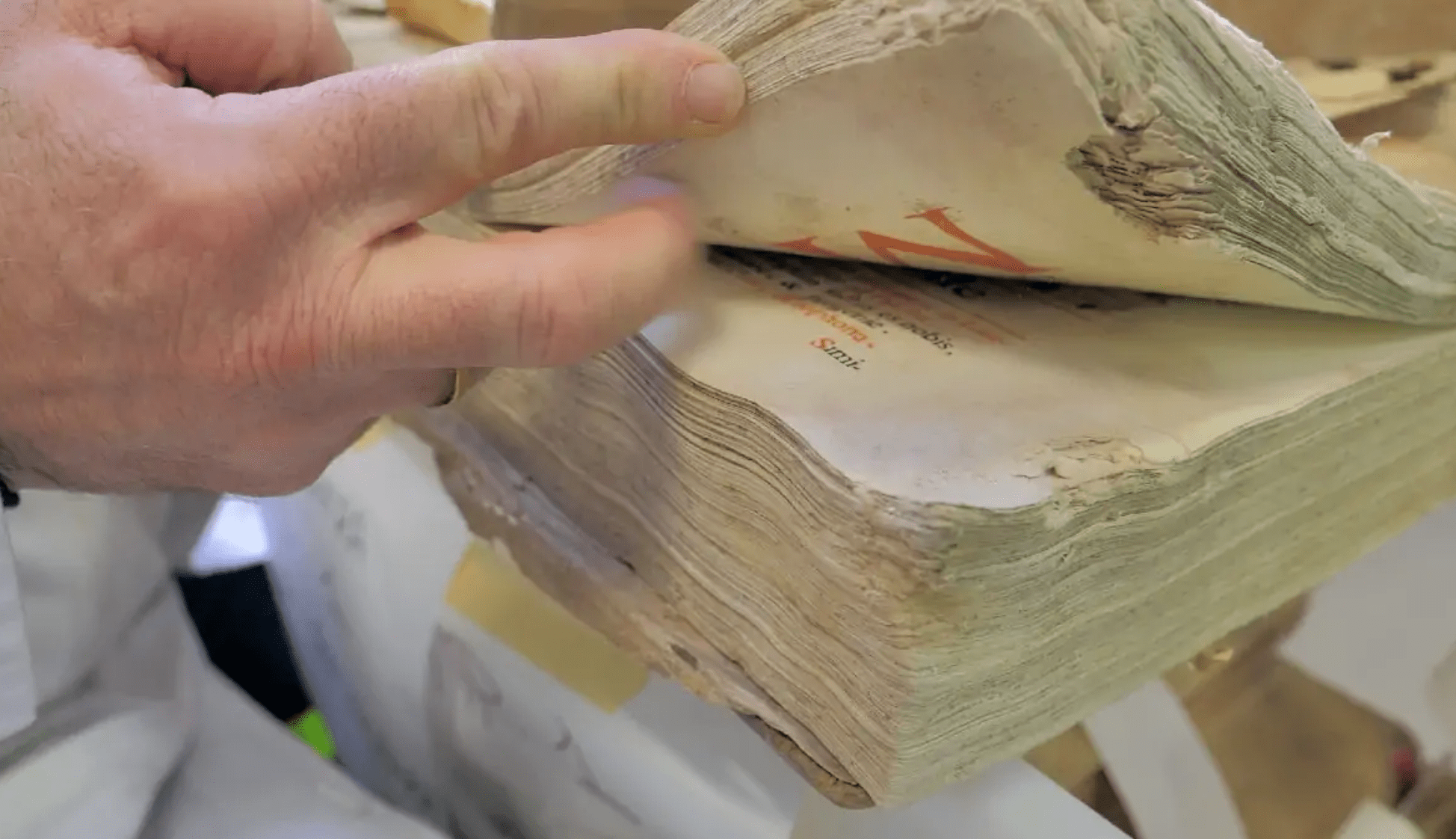
It all started in 1994. The flooding of the Po river and its tributaries had just swept away entire villages in the Piedmont region of northern Italy, leaving behind only death and debris. The whole of Italy was shocked. Of all the damage broadcast on television, one caused a particular sensation: In the village Santo Stefano Belbo, the historical archive of Cesare Pavese, one of the most famous and beloved Italian writers, was buried in mud.
The debacle particularly impressed a man named Pietro Livi, president of Frati & Livi in Bologna, a company that had been restoring and conserving ancient texts for nearly 20 years. At that time, however, no one in Italy was equipped for this kind of rescue. In the past, flooded and muddy documents were entrusted to companies that used basic restoration methods that proved both invasive and ineffective: The books were simply placed in ovens or air-dried in large rooms, which often left the texts unusable and made mold only proliferate.
So Livi decided to find out if anyone in Europe had found a more effective way to save these invaluable records of human achievement. Finally, in Austria, Livi found a freeze dryer that held some promise, but it was too big and costly for a small artisanal company like his. Then, in 2000, the Po river overflowed again. In the city of Turin, entire archives belonging to distinguished institutes and libraries ended up underwater.
At a loss for what to do, Italy’s Archival Superintendency of the Ministry of Cultural Heritage summoned Livi. By this time, Livi had established a solid reputation as a master restorer, having studied the art of book restoration with Benedictine friars. But he realized that for a project of this scope, his expertise was no longer enough; he needed a kind of Renaissance workshop, where he could collaborate with professionals from a variety of disciplines. Livi believed that the time had come where the world of artisan knowledge and the world of technology, too often considered as opposites, had to talk to each other—for the benefit of one another…
Then, on November 12, 2019, the city of Venice, one of the world’s most mythical and most admired locales, suffered its worst flood in 53 years. The swollen lagoon soaked roughly 25,000 valuable texts, including the last surviving original of one of Vivaldi’s musical scores. Frati & Livi was quickly called to the scene…
In the city of Bologna, home to the western world’s oldest university, Pietro Livi developed an unusual machine shop—part artisanal and part high-tech—built to restore damaged ancient texts to their former glory. And then came Venice’s historic floods of 2019: “Italy’s Book Doctor,” from @CraftsmanshipQ.
* “For some of us, books are as important as almost anything else on earth. What a miracle it is that out of these small, flat, rigid squares of paper unfolds world after world after world, worlds that sing to you, comfort and quiet or excite you. Books help us understand who we are and how we are to behave. They show us what community and friendship mean; they show us how to live and die.” – Anne Lamott
###
As we celebrate craft, we might we spare a thought for publishing pioneer Condé Montrose Nast; he died on this date in 1942. After serving as Advertising Director at Colliers, then a brief stint in book publishing, Nast bought a small New York society magazine called Vogue— which he proceeded to turn into the nation’s, then the world’s leading fashion magazine. While other periodical publishers simply sought higher and higher circulation, Nast introduced the “lifestyle” title, targeted to a group of readers by income level or common interest. By the time of his death, his stable of monthlies also included House & Garden, British, French, and Argentine editions of Vogue, Jardins des Modes, (the original) Vanity Fair, and Glamour; subsequently, the group added such resonant lifestyle books as Gourmet, New Yorker, and Wired.

“Now I luxuriously thrust for noble pickle”*…

The delicacy that delights…
Amerigo Vespucci didn’t discover the Americas, contrary to what the map-makers who named the continents believed, but his given name did end up lending itself to the so-called “new world.” And Ralph Waldo Emerson once called Vespucci “the pickle-dealer at Seville,” a derisive label that may have stretched the truth a bit, but pointed towards a very real part of the itinerant Italian’s biography.
Before traveling to the New World himself, Vespucci worked as a ship chandler—someone who sold supplies to seafaring merchants and explorers. These supplies included foods like meat, fish, and vegetables that had been pickled, which meant they would stay preserved beneath a ship’s deck for months. Without pickling, expeditions had to rely on dried foods and ingredients with naturally long shelf lives for sustenance. Much of the time, this limited diet wasn’t enough to provide crewmembers the nutrition they needed for the journey ahead. This made pickle sellers like Vespucci indispensable during the golden age of exploration. Vespucci even supplied Christopher Columbus’s later voyages across the Atlantic with his briny goods. So while he wasn’t the world’s most important explorer, Vespucci’s pickles may have changed history by preventing untold bouts of scurvy.
And pickles weren’t just enjoyed by 15th century sailors. From ancient Mesopotamia to New York deli counters, they’ve played a vital role in the global culinary scene. But where do pickles come from? How did the cucumber become the standard-issue pickling vegetable in the States? And what exactly is a pickle, anyway?…
The story of a humble but crucial comestible: “A Brief History of Pickles.”
* Martial
###
As we dig in, we might spare a thought for Sylvester Graham; he died on this date in 1851. A Presbyterian minister, he preached primarily of the benefits of vegetarianism (and temperance). He urged the use only of whole, coarse grains– inspiring a host of graham flour, graham bread, and graham cracker products.

“Doing research on the Web is like using a library assembled piecemeal by pack rats and vandalized nightly”*…
But surely, argues Jonathan Zittrain, it shouldn’t be that way…
Sixty years ago the futurist Arthur C. Clarke observed that any sufficiently advanced technology is indistinguishable from magic. The internet—how we both communicate with one another and together preserve the intellectual products of human civilization—fits Clarke’s observation well. In Steve Jobs’s words, “it just works,” as readily as clicking, tapping, or speaking. And every bit as much aligned with the vicissitudes of magic, when the internet doesn’t work, the reasons are typically so arcane that explanations for it are about as useful as trying to pick apart a failed spell.
Underpinning our vast and simple-seeming digital networks are technologies that, if they hadn’t already been invented, probably wouldn’t unfold the same way again. They are artifacts of a very particular circumstance, and it’s unlikely that in an alternate timeline they would have been designed the same way.
The internet’s distinct architecture arose from a distinct constraint and a distinct freedom: First, its academically minded designers didn’t have or expect to raise massive amounts of capital to build the network; and second, they didn’t want or expect to make money from their invention.
The internet’s framers thus had no money to simply roll out a uniform centralized network the way that, for example, FedEx metabolized a capital outlay of tens of millions of dollars to deploy liveried planes, trucks, people, and drop-off boxes, creating a single point-to-point delivery system. Instead, they settled on the equivalent of rules for how to bolt existing networks together.
Rather than a single centralized network modeled after the legacy telephone system, operated by a government or a few massive utilities, the internet was designed to allow any device anywhere to interoperate with any other device, allowing any provider able to bring whatever networking capacity it had to the growing party. And because the network’s creators did not mean to monetize, much less monopolize, any of it, the key was for desirable content to be provided naturally by the network’s users, some of whom would act as content producers or hosts, setting up watering holes for others to frequent.
Unlike the briefly ascendant proprietary networks such as CompuServe, AOL, and Prodigy, content and network would be separated. Indeed, the internet had and has no main menu, no CEO, no public stock offering, no formal organization at all. There are only engineers who meet every so often to refine its suggested communications protocols that hardware and software makers, and network builders, are then free to take up as they please.
So the internet was a recipe for mortar, with an invitation for anyone, and everyone, to bring their own bricks. Tim Berners-Lee took up the invite and invented the protocols for the World Wide Web, an application to run on the internet. If your computer spoke “web” by running a browser, then it could speak with servers that also spoke web, naturally enough known as websites. Pages on sites could contain links to all sorts of things that would, by definition, be but a click away, and might in practice be found at servers anywhere else in the world, hosted by people or organizations not only not affiliated with the linking webpage, but entirely unaware of its existence. And webpages themselves might be assembled from multiple sources before they displayed as a single unit, facilitating the rise of ad networks that could be called on by websites to insert surveillance beacons and ads on the fly, as pages were pulled together at the moment someone sought to view them.
And like the internet’s own designers, Berners-Lee gave away his protocols to the world for free—enabling a design that omitted any form of centralized management or control, since there was no usage to track by a World Wide Web, Inc., for the purposes of billing. The web, like the internet, is a collective hallucination, a set of independent efforts united by common technological protocols to appear as a seamless, magical whole.
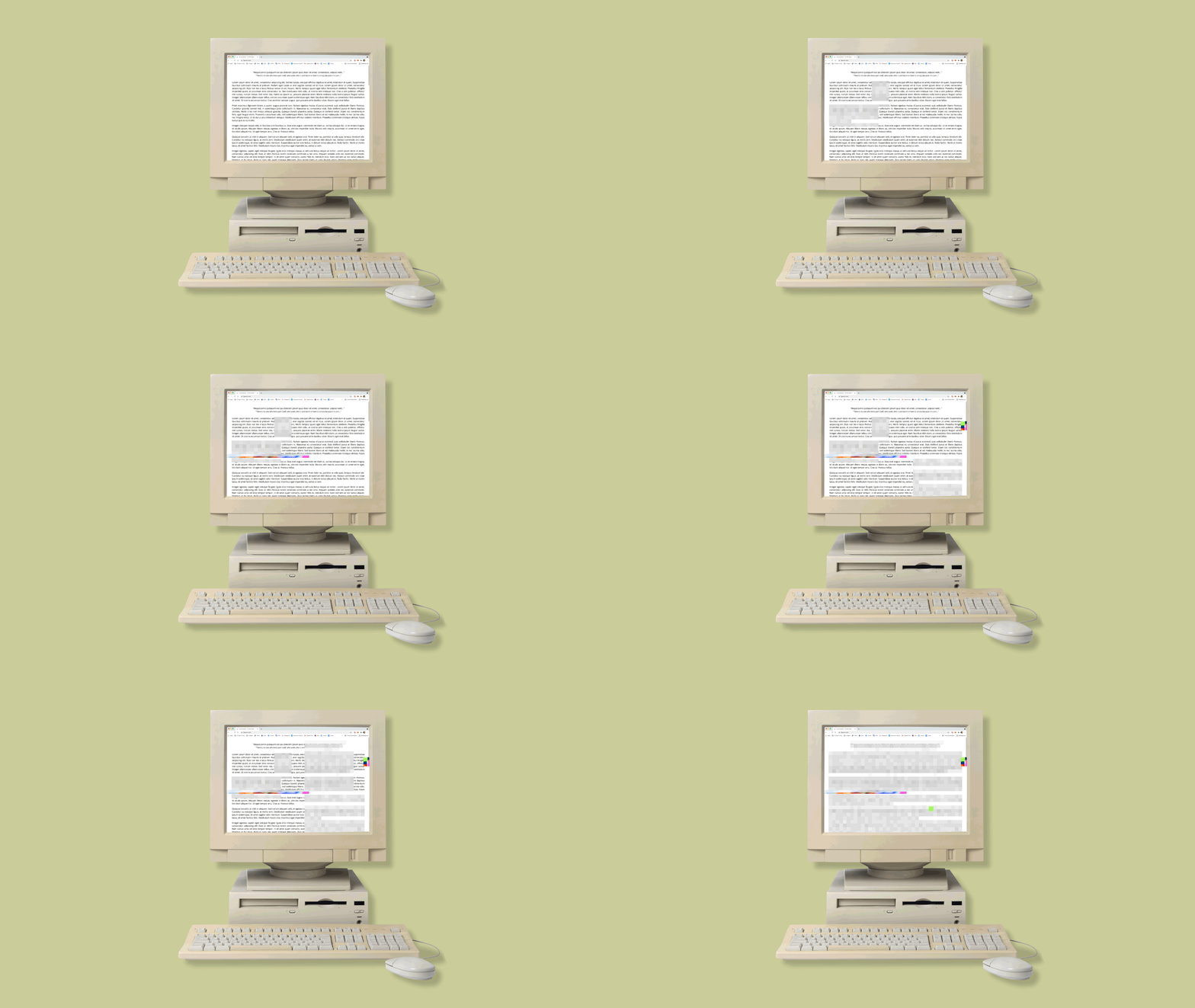
This absence of central control, or even easy central monitoring, has long been celebrated as an instrument of grassroots democracy and freedom. It’s not trivial to censor a network as organic and decentralized as the internet. But more recently, these features have been understood to facilitate vectors for individual harassment and societal destabilization, with no easy gating points through which to remove or label malicious work not under the umbrellas of the major social-media platforms, or to quickly identify their sources. While both assessments have power to them, they each gloss over a key feature of the distributed web and internet: Their designs naturally create gaps of responsibility for maintaining valuable content that others rely on. Links work seamlessly until they don’t. And as tangible counterparts to online work fade, these gaps represent actual holes in humanity’s knowledge…
The glue that holds humanity’s knowledge together is coming undone: “The Internet Is Rotting.” @zittrain explains what we can do to heal it.
(Your correspondent seconds his call to support the critically-important work of The Internet Archive and the Harvard Library Innovation Lab, along with the other initiatives he outlines.)
* Roger Ebert
###
As we protect our past for the future, we might recall that it was on this date in 1937 that Hormel introduced Spam. It was the company’s attempt to increase sales of pork shoulder, not at the time a very popular cut. While there are numerous speculations as to the “meaning of the name” (from a contraction of “spiced ham” to “Scientifically Processed Animal Matter”), its true genesis is known to only a small circle of former Hormel Foods executives.
As a result of the difficulty of delivering fresh meat to the front during World War II, Spam became a ubiquitous part of the U.S. soldier’s diet. It became variously referred to as “ham that didn’t pass its physical,” “meatloaf without basic training,” and “Special Army Meat.” Over 150 million pounds of Spam were purchased by the military before the war’s end. During the war and the occupations that followed, Spam was introduced into Guam, Hawaii, Okinawa, the Philippines, and other islands in the Pacific. Immediately absorbed into native diets, it has become a unique part of the history and effects of U.S. influence in the Pacific islands.

You must be logged in to post a comment.