Posts Tagged ‘maps’
“Every picture tells a story”*…

The world’s populations is unevenly spread across the globe. But, plotted by latitude (as per this visualization from Engaging Data), it’s a little more concentrated…

… which is interesting (perhaps better said, “bracing”) to consider aside this illustration from NOAA…

Global warming is coming for most of us: “World Population Distribution by Latitude and Longitude,” from @engagingdata.bsky.social and @climate.noaa.gov.
See also: “The world is heating up. How much can our bodies handle?” from @gristnews.bsky.social and “Understanding Climate Migration,” from RAND.
* traditional saying
###
As we feel the heat, we might spare a thought for John Graunt; he died on this date in 1674. A haberdasher turned statistician, he is considered by many to be the father of demography (the statistical study of human populations).
A charter member of The Royal Society, Graunt distributed a 90-page book, Natural and Political Observations Mentioned in a Following Index, and Made upon the Bills of Mortality at the February, 1662 Society meeting. He described his work as having “reduced several great confused volumes” of parish records into a few easily to understood tables, and “abridged such Observations… into a few succinct Paragraphs.” He initiated “life tables” of life expectancy. His use of demographics was further pioneered by his friend Sir William Petty and Edmond Halley, the Astronomer Royal.
Graunt’s work also gives him some claim to having been the first epidemiologist.

“What is it about maps? I could look at them all day”*…
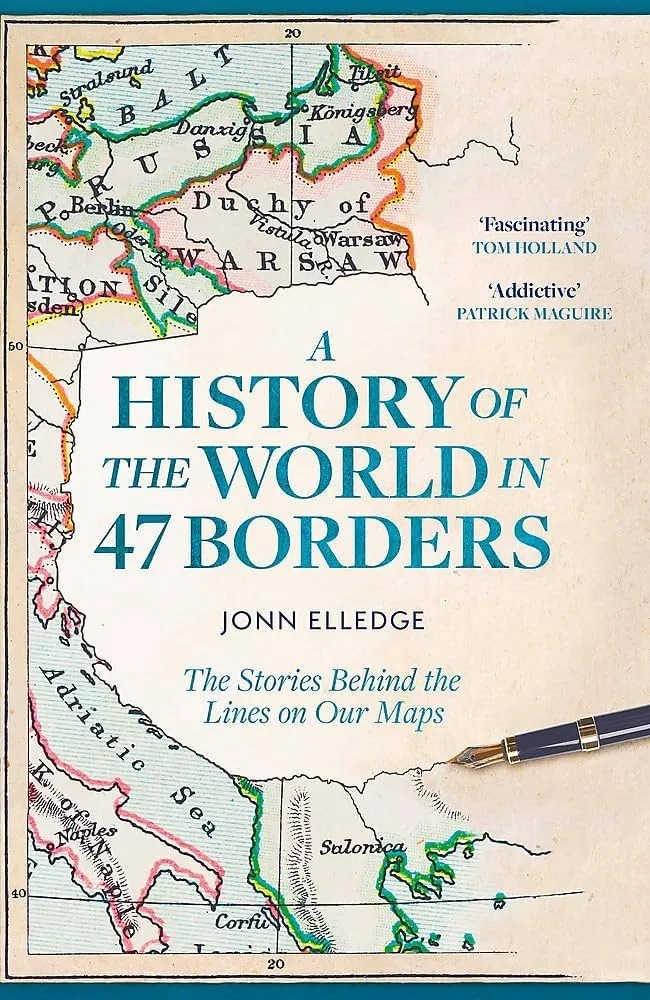
Jonn Elledge devotes the current issue of his nifty newsletter to a series of fascinating facts from his wonderful book, A Brief History of the World in 47 Borders (as it’s known in its U.S. edition, as compared to the less qualified title of the U.K. original pictured above)…
… Back in May, the good people at the UK’s leading maps and travel specialist bookshop Stanfords were kind enough to select my new book A History of the World in 47 Borders as their book of the month. And to promote it, they asked me to make a quick video, talking about it…
My initial thought was to list a single fact from each of the book’s 47 chapters, but that, I soon realised, would go on forever and take an absurd number of takes to get right. So in the end I decided on a top 10: that took an absurd number of takes to get right too, and also features me the wrong way round, for some reason, but at least it’s only three minutes long…
… as a special Christmas treat, not to mention shameless attempt to get more of you to buy the book for yourself or a loved one, here are all 47 of the facts I originally chose…
You’ll find tidbits like these:
The oldest known international border was the one between what today we call Upper Egypt and Lower Egypt. We know about it today because, sometime around 3100BCE, someone abolished it.
The Great Wall is not really one wall, but many. And the first Chinese emperor used to kidnap young men to make them build them.
The Open Borders Policies of Genghis Khan basically created the modern world.
In 1884, the great powers agreed to divide up the entire map of Africa without ever visiting. No Africans were in attendance, and one who’d asked for an invite, the Sultan of Zanzibar, was openly laughed at.
There’s a piece of Africa which two countries, Egypt and Sudan, both aggressively claim belongs to the other.
There’s an opera house in which the US/Canada border divides audience from stage.
There’s a coral atoll a thousand miles from Japan which is technically classed as a suburb of Tokyo.
Air traffic control zones cover the entire planet except the Galapagos Islands and the bit of the Arctic where Santa lives.
So much more at “47 Facts from A History of the World in 47 Borders,” from @jonnelledge.bsky.social
* Bill Bryson
###
As we muse on maps, we might send acutely observant birthday greetings to an astute student of the human animal, anthropologist Margaret Mead; she was born on this date in 1901. Best-known for her studies of the nonliterate peoples of Oceania, she was 23 when she first traveled to the South Pacific to conduct research for her doctoral dissertation. The book that resulted, Coming of Age in Samoa, was– and remains– a best-seller.

“Unlimited tolerance must lead to the disappearance of tolerance”*…

In 1945, in The Open Society and Its Enemies, Karl Popper described “the paradox of tolerance“…
The so-called paradox of freedom is the argument that freedom in the sense of absence of any constraining control must lead to very great restraint, since it makes the bully free to enslave the meek. The idea is, in a slightly different form, and with very different tendency, clearly expressed in Plato.
Less well known is the paradox of tolerance: Unlimited tolerance must lead to the disappearance of tolerance. If we extend unlimited tolerance even to those who are intolerant, if we are not prepared to defend a tolerant society against the onslaught of the intolerant, then the tolerant will be destroyed, and tolerance with them. — In this formulation, I do not imply, for instance, that we should always suppress the utterance of intolerant philosophies; as long as we can counter them by rational argument and keep them in check by public opinion, suppression would certainly be unwise. But we should claim the right to suppress them if necessary even by force; for it may easily turn out that they are not prepared to meet us on the level of rational argument, but begin by denouncing all argument; they may forbid their followers to listen to rational argument, because it is deceptive, and teach them to answer arguments by the use of their fists or pistols. We should therefore claim, in the name of tolerance, the right not to tolerate the intolerant. We should claim that any movement preaching intolerance places itself outside the law, and we should consider incitement to intolerance and persecution as criminal, in the same way as we should consider incitement to murder, or to kidnapping, or to the revival of the slave trade, as criminal…
Mark Manson offers a critique…
… Popper proposed the Paradox of Tolerance to explain why a German public full of otherwise good people allowed Hitler to come to power and commit so many atrocities. Since then, the Paradox of Tolerance has survived and has occasionally become a talking point in discussions about social justice. The idea is that it’s okay to be a piece of shit to someone because they, too, are a piece of shit.
But the problem is that, most of the time, it’s not crystal clear what defines “tolerance” and “intolerance.”… Like most thought experiments inspired by Hitler, it doesn’t really work when you don’t have someone who is so obviously evil to unite against. As a result, the definition of an intolerant person has become so muddied and loose to the point where it might as well mean, “someone who believes things that make me feel bad.”…
The problem with Popper’s reasoning is that it quickly devolves into a cascade of dickish, self-righteous behavior.
Let’s say Person B decides that Person A’s behavior is intolerant and a threat to society. Person B then decides that it is morally correct to be intolerant of Person A and treat her like crap.
But then, Person C strolls by and notices Person B being a totally intolerant assface to Person A. Person C then decides that it’s morally correct to be actively intolerant of Person B. But then Person D strolls by, and notices Person C being horribly intolerant towards Person B…
You can see where this is going. And if you ever doubt the realism of this scenario, I invite you to spend a few hours on Twitter some time.
The irony is that in order to practice tolerance, you must be willing to sit with things that upset you or make you uncomfortable.
Yet, if your adopted ethic is that no one should ever be upset or uncomfortable, then you make any sort of tolerance impossible…
– source
I imagine that Popper might respond first that, of course, Manson is right that the definition of intolerance is slippery and that most varieties of unshared disapproval are best tolerated– indeed, that’s the essence of an open society.
But I suspect that he’d further argue that it is possible, well shy of Hitlerian extremes, to identify the intent (beyond disapproving) to debar– to abridge the fundamental rights of others. Even then, of course, it’s tricky– especially in social/cultural periods in which xenophobia and othering are in the ascendant, when difference isn’t perceived to be simply difference or disagreement, but a threat.
Still (presuming again to channel Popper), if one values an open society, one must practice the art (which is to say that it’s not a science) of protecting against this extreme, imperious intolerance– lest it squelch all alternatives to itself. This was the challenge taken up by the Founding Fathers in crafting the U.S. Constitution. And as they observed (but we tend to forget) it’s an on-going challenge. They imagined that the Constitution would be continually revised, both to reflect “learning” (what worked and what didn’t– practical learning) and to reflect changing circumstances and culture (the social and cultural learning/development on which, as Humanists, they were counting).
It’s hard… but then, as my old man used to say, that’s why they call it a paradox…
* Karl Popper
With apologies, another “hiatus notice”: I’m headed into three days of very intense meetings, so (R)D will be off until Friday…
###
As we deal with dichotomies, we might spare a cartographically-constructive thought for one of history’s most impactful scientific artists: Gerardus Mercator; he died on this date in 1594. The most renown cartographer of his time, he created a world map based on a new projection– the Mercator Projection— on which parallels and meridians are rendered as straight lines spaced so as to produce at any point an accurate ratio of latitude to longitude and sailing courses of constant bearing are represented as straight lines, an approach still employed in nautical charts used for navigation. He also introduced the term “atlas” for a collection of maps.
While he is most esteemed as the foremost geographer of his day, Mercator was also an accomplished engraver, calligrapher and maker of globes and scientific instruments. And he studied theology, philosophy, history, mathematics, and magnetism.

“The path to paradise begins in hell”*…

It’s been over 700 years since Dante Aligheri found himself, midway along the journey of his life, within a dark forest. His terza rima epic, The Divine Comedy, rivets us still…. and as Hunter Dukes recounts, raises questions…
Ever since the publication of Dante’s Divine Comedy, scholars and artists have tried to map the Inferno’s architecture, survey Purgatory, and measure their way across the spheres of Paradise. The first cosmographer of Dante’s universe was the Florentine polymath Antonio Manetti, whose unpublished research — which mathematically concluded that hell was 3246 miles wide and 408 miles deep — inspired the woodcuts used for a landmark 1506 edition of the poem. In 1588, a young Galileo weighed in, deriving Lucifer’s height and armlength (1200 and 340 meters respectively) and suggesting that the Inferno’s vaulted ceiling was supported by the same physical principles as Brunellesci’s dome. The scholarly tradition continued for centuries, culminating with the works of Michelangelo Caetani, who designed a series of maps and charts. These were published as The Divine Comedy of Dante Alighieri Described in Six Plates and appeared in two editions, an 1855 edition featuring hand-colored lithographs and an 1872 edition printed using an early form of chromolithography, deployed by an order of monks at Monte Cassino near Rome…
Learn more about Caetani and his approach, and see more of his work: “Diagramming Dante: Michelangelo Caetani’s Maps of the Divina Commedia,” from @hunterdukes in @PublicDomainRev.
* Dante Alighieri
###
As we chart cosmology, we might recall that it was on this date in 1971 that Michael Hart launched the source of the link to The Divine Comedy embedded above, Project Gutenberg, and effectively invented ebooks. It debuted on ARPANET.
An online library of free ebooks, it currently has over 70,000 items available (in plain text as well as other formats, such as HTML, PDF, EPUB, MOBI, and Plucker wherever possible).

“We say the cows laid out Boston. Well, there are worse surveyors.”*…

On plotting the relationships of things in space…
Written by Leonhard Zubler, a Swiss goldsmith and instrument maker who is credited with popularizing the use of the plane table as a tool for surveying, Novum instrumentum geometricum illuminates the shared history of land-surveying and militaristic range-finding technologies. The text is intercut with elaborate copperplate engravings that showcase the might of trigonometry and triangulation in the immediacy of conflict. Bombardiers pack canons that are aimed with advanced precision at distant towers; the construction of ornate fortifications are planned with ease thanks to geometric instruments; and seemingly insurmountable crags are brought down to earth through the surveyor’s sightline. Readers are promised that they will learn how to measure the width of a moat or the height of wall in order to breach them more efficiently.
Novum instrumentum geometricum mainly features images related to an early modern instrument known as the triquetrum or Dreistab, a three-armed ruler, with two pivot points, used for charting angles in the heavens and on earth. Zubler most often showcases a two-armed variation known as the Zweistab, which includes a “finely divided scale and micrometer slide for exact settings”, writes Uta Lindgren. As if to show the versatility of this technology, the instrument is wielded on the masts of ships, balconies, and by a man perched atop the stump of a felled tree — even comically enlarged to depict its arms stretching out to touch the objects of their reconnaissance. Frequently two instruments are employed in parallel, by a pair of figures a fixed distance apart, which would allow the surveyors to estimate the distance to a faraway point using trigonometry.
Little is known about Leonhard Zubler (b. 1565), aside from his divorce in 1604, and probable death by plague circa 1611. He once created an extensive plan for modernizing the cityscape of Zurich, which was subsequently lost. During his lifetime, Zubler’s instruments were so desired that he was able to open a commercial outlet in Frankfurt am Main in 1608…


More mesmerizing illustrations: “Angles of Reconnaissance: Novum Instrumentum Geometricum (1607)” from @PublicDomainRev.
* Ralph Waldo Emerson
###
As we triangulate, we might recall that it was on this date in 1667, about a year after the Great Fire of London, that Robert Hooke, a physicist (“natural philosopher”), astronomer, geologist, meteorologist, and architect was sub-contracted by friend and fellow architect Christopher Wren to conduct a survey of the fire-damaged area to establish ownership and facilitate reconstruction. As Lisa Jardine observed, “in the four weeks from the 4th of October, [Hooke] helped map the fire-damaged area, began compiling a Land Information System for London, and drew up building regulations for an Act of Parliament to govern the rebuilding.” Hooke also designed some of the buildings that made up the “new” London, among them: the Monument to the Great Fire of London (1672), Montagu House in Bloomsbury )1674 and Bethlem Royal Hospital (1674), which became known as “Bedlam.”
In 1670, Hooke was appointed Surveyor of the Royal Works. Together with Scottish cartographer and printer John Ogilby, he made precise and detailed surveys that led to the production in 1677 of a large-scale map of London, the first-known to be of a specific scale (1:1200).

You must be logged in to post a comment.