Posts Tagged ‘British Museum’
“I am told there are people who do not care for maps, and I find it hard to believe”*…

A marvelous account of the oldest surviving map in the world…
Taking a first glance at the Babylonian Map of the World, few of us could recognize it for what it is. But then again, few of us are anything like the British Museum Middle East department curator Irving Finkel, whose vast knowledge (and ability to share it compellingly) have made him a viewer favorite on the institution’s YouTube channel. In the Curator’s Corner video below, he offers an up-close view of the Babylonian Map of the World — or rather, the fragment of the clay tablet from the eighth or seventh century BC that he and other experts have determined contains a piece of the oldest map of the known world in existence.
“If you look carefully, you will see that the flat surface of the clay has a double circle,” Finkel says. Within the circle is cuneiform writing that describes the shape as the “bitter river” that surrounds the known world: ancient Mesopotamia, or modern-day Iraq.
Inside the circle lie representations of both the Euphrates River and the mighty city of Babylon; outside it lie a series of what scholars have determined were originally eight triangles. “Sometimes people say they are islands, sometimes people say they are districts, but in point of fact, they are almost certainly mountains,” which stand “far beyond the known world” and represent, to the ancient Babylonians, “places full of magic, and full of mystery.”
Coming up with a coherent explanation of the map itself hinged on the discovery, in the nineteen-nineties, of one of those triangles originally thought to have been lost. This owes to the enthusiasm of a non-professional, a student in Finkel’s cuneiform night classes named Edith Horsley. During one of her once-a-week volunteer shifts at the British Museum, she set aside a particularly intriguing clay fragment. As soon as Finkel saw it, he knew just the artifact to which it belonged. After the piece’s reattachment, much fell into place, not least that the map purported to show the distant location of the beached (or rather, mountained) ark built by “the Babylonian version of Noah” [Utnapishtim in the Epic of Gilgamesh, himself likely based on the earlier Mesopotamian flood navigator Ziusudra] — the search for which continues these nine or so millennia later…
“An Introduction to The Babylonian Map of the World–the Oldest Known Map of the World,” from @openculture.
Sort of apposite– and very amusing: “The Many Lives of Null Island.”
* Robert Louis Stevenson
###
As we contemplate cartography, we might send exploratory birthday greetings to Samuel de Champlain; he was born (baptismal records suggest) on this date in 1567. An explorer, navigator, cartographer, draftsman, soldier, geographer, ethnologist, diplomat, and chronicler, he made between 21 and 29 trips across the Atlantic Ocean and founded Quebec City, the territory of New France, and a number of colonial settlements in what we now know as Canada– of which Champlain created the first accurate coastal map during his explorations.

“History is not the past but a map of the past, drawn from a particular point of view”*…

To that point, The Economist reviews Josephine Quinn’s new book, How the World Made the West, a re-examination of what we think we know about civilizations…
Asked what he thought of Western civilisation, Mahatma Gandhi is said to have quipped that such a thing “would be a good idea”. (The West, he suggested, was not so enlightened.) But as Josephine Quinn makes clear in her new book, Western civilisation has always been a bad idea, or at any rate a wrong-headed one. To compartmentalise history into a set of distinct and essentially self-contained civilisations is a misguided quest that has dangerously distorted our understanding of the world, Ms Quinn asserts: “It is not peoples that make history, but people, and the connections that they create with one another.”
Ms Quinn, a historian and archaeologist who teaches at Oxford, does not spend 500-odd pages trashing what generations of schoolchildren have been taught to take pride in as European achievements. Instead, she demolishes the underlying concept of what she calls “civilisational thinking”. Her argument is simple, persuasive and deserving of attention.
The idea of civilisation, Ms Quinn points out, is relatively recent. The word was first used only in the mid-18th century and did not take hold of Western imaginations until the late 19th century. In that imperialist age, historians found that Greek, Roman and Christian civilisations made nice building blocks that could be stacked into a grand-looking construct, which they labelled “Western” or “European” civilisation. To this they attributed a host of inherited “classical” virtues: vigour, rationality, justice, democracy and courage to experiment and explore. Other civilisations, by contrast, were regarded as inferior.
It does not take much unpacking by Ms Quinn to expose the folly of this approach. Behold, for instance, John Stuart Mill, a philosopher in the 19th century, claiming that the Battle of Marathon, Persia’s first invasion of Greece in 490BC, was more important to English history than William the Conqueror’s triumph at Hastings in 1066. (Without an Athenian victory, the logic goes, the magical seed of Greek civilisation might never have grown into Western civilisation.) Or consider “The Clash of Civilisations” (1996) by Samuel Huntington, an American historian, who declared it impossible to understand history without classifying humanity into mutually hostile civilisations between which, “during most of human existence”, contact has been “intermittent or non-existent”.
What is non-existent is any truth to that notion. Ms. Quinn’s brisk, scholarly romp across the arc of European history shows that, far from being rare, contact across and between cultures, often over surprisingly long distances, has been the main motor of human advancement in every age. Rather than being prickly and inward-looking, most societies have proved receptive to ideas, fashions and technologies from their neighbours…
As The Economist observes, “anyone who thought history was passé could not be more wrong”: “The history of the West is not quite what you learned in school” (gift link)– @TheEconomist on @josephinequinn.
###
As we ponder the past’s presence in our present, we might send civilized birthday greetings to a man who contributed mightily to the paradigms that Quinn questions, Bernard Ashmole; he was born on this date in 1894. A historian, archaeologist, and art historian, he taught at both the University of London and Oxford and served as Keeper of Greek and Roman Antiquities at the British Museum from 1939 to 1956.

“The Greek temple is the creation, par excellence, of mind and spirit in equilibrium”*…
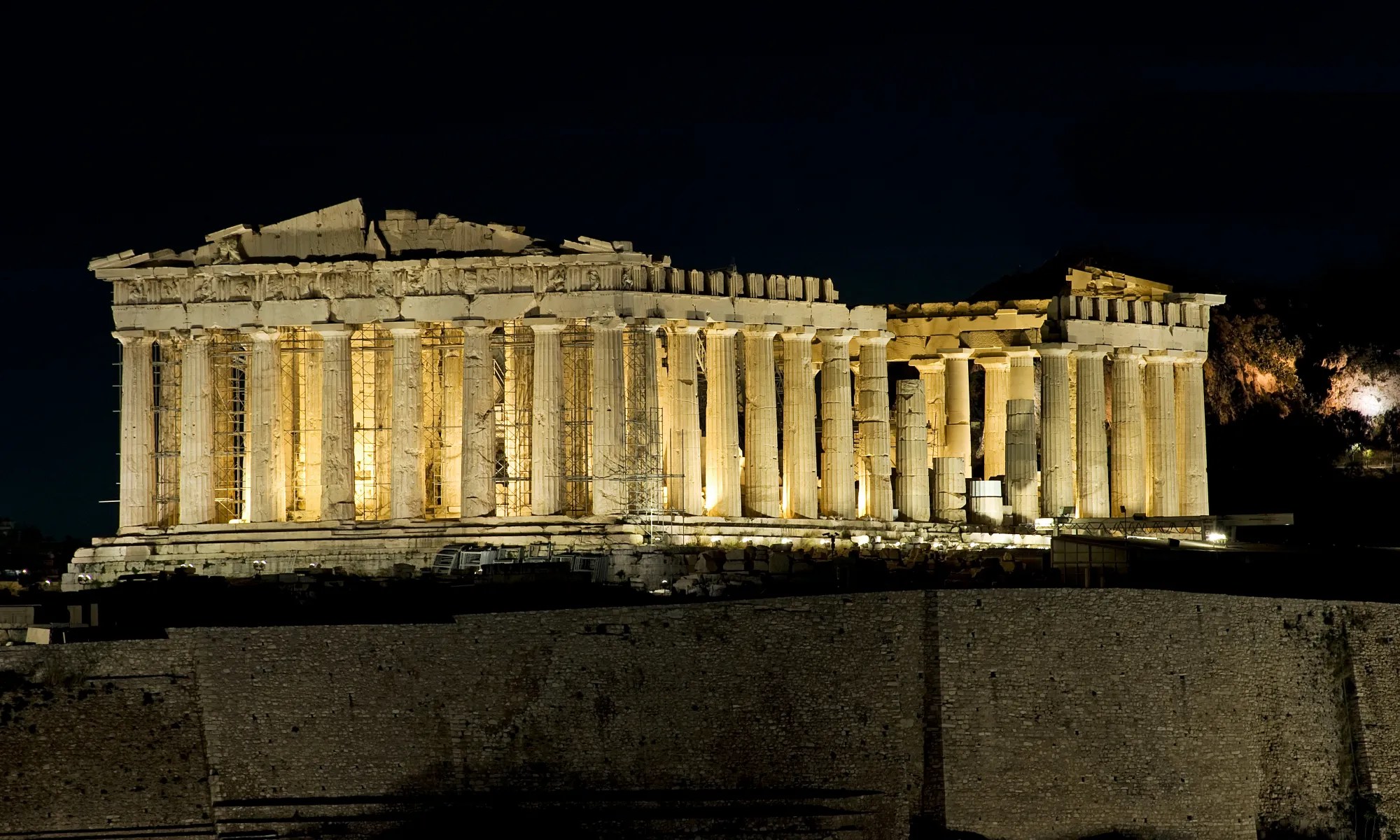
Edmund Stewart outlines the requirements for building a Greek temple…
If, like me, you have ever wondered what goes into building a Greek temple, then fear not: I here present a list of everything you will need. Admittedly, when compared with the wonders made possible by Roman concrete or a mediaeval gothic arch, the hundreds of temples scattered across the Greek world may perhaps look a bit small. Yet they are certainly elegant, sometimes with a slender beauty typical of the Ionic order, or else the sturdy grandeur of the Doric. And, when examined closely, the process of building one may quickly become worryingly complex…
Indeed, as The Browser observes, it’s a challenge…
In brief: [one would need] quite a lot. An architect, obviously, though architects were relatively cheap in ancient Greece; ships to bring in the marble; a hundred slaves for heavy lifting; a dozen carpenters; six craftsmen per column to dress the facade; sculptors and painters for the ornamentation; a door-maker; and do be sure to order your floor-tiles well ahead of time, they may take two years to arrive..
A fascinating and entertaining read: “What You Need to Build a Greek Temple,” in @AntigoneJournal, via @TheBrowser.
* Edith Hamilton
###
As we contemplate construction, we might send carefully-excavated birthday greetings to Charles Thomas Newton; he was born on this date in 1816. An archaeologist, he excavated sites in southwestern Turkey and disinterred the remains of one of the seven wonders of the ancient world, the Mausoleum of Halicarnassus (at present-day Bodrum, Turkey). Newton joined staff of British Museum in 1840, where he helped to establish systematic methods for archaeology and ultimately became its first keeper (curator) of Greek and Roman antiquities.

“If you could say it in words, there would be no reason to paint”*…

One of the world’s most important collections of art has re-emerged after having been lost for more than 70 years.
The corpus – 103 original drawings by the non-Western world’s most famous artist, the 19th century Japanese painter, Hokusai – came to light in Paris and has now been bought by the British Museum.
The newly discovered artworks appear to have formed part of one of the most ambitious publishing projects ever conceived – a Japanese plan to create a huge pictorial encyclopaedia.
Known as the Great Picture Book of Everything, it was conceived by Hokusai (best known for his most famous work – The Great Wave) – but was never completed.

The project was abandoned in the 1830s – either because of cost or possibly because Hokusai insisted on reproduction standards that were difficult to attain.
The Great Picture Book of Everything was to have been a comprehensive way for the Japanese to have access to images of people, cultures and nature around the world – at a time when virtually no Japanese people had been allowed out of Japan for some two centuries – and virtually no foreigners had been allowed into 99 per cent of the country.
In that ultra-restrictive atmosphere, the project was to have given people an opportunity to explore a highly stylised printed version of the outside world as well as Japan itself…
The full story (and more examples of the work) at “Hokusai: More than 100 lost works by non-western world’s most famous artist rediscovered“– the artist’s abandoned attempt to create Great Picture Book of Everything.
* Edward Hopper
###
As we picture that, we might send challenging birthday greetings to Hans Peter Wilhelm Arp; he was born on this date in 1886. A sculptor, painter, and poet (who also worked in other media such as torn and pasted paper), Arp was a friend and associate of Hugo Ball and a regular at the Cafe Voltaire, where he helped create the Dada Movement; at the same time he was associated with the Surrealists. But he broke with those movements to found Abstraction-Création, working with the Paris-based group Abstraction-Création and the periodical, Transition. Beginning in the 1930s, he expanded his efforts from collage and bas-relief to include bronze and stone sculptures, and to write and publish essays and poetry. Examples of his work are here.

No man’s land…

Lake Superior contains a phantom island. After the American Revolution, the Treaty of Paris established the boundary between the United States and Canada as running “through Lake Superior northward of the Isles Royal and Phelipeaux to the Long Lake,” following an inaccurate map created by John Mitchell. In the 1820s surveyors discovered that Phelipeaux does not exist, and the boundary had to be negotiated anew.
Around the same time, the dramatically named Mountains of Kong appeared on maps of West Africa, apparently placed there originally by English cartographer James Rennell. It wasn’t until the 1880s that French explorer Louis Gustave Binger discovered that they don’t exist either. They persisted in Goode’s World Atlas until 1995.

One of the wonders at The Futility Closet– “an idler’s miscellany of compendious amusements.”
###
As we remember that the map is not the territory, we might recall that it was on this date in 1759 that the the first exhibition galleries and the reading room of the British Museum opened. The institution had been established in 1753 by King George II and Parliament– the first of a new kind of museum: belonging to neither church nor king, freely open to the public, and aiming to collect everything. With the subsequent acquisition of of Montagu House in Bloomsbury, and the inclusion of several “foundation collections” (including the Lindisfarne Gospels, the sole surviving copy of Beowulf, and many others of the most treasured books now in the British Library), the museum moved toward reality. (The Trustees had rejected Buckingham House, on the site now occupied by Buckingham Palace.)
Among the earliest treasures on display in 1759 were a starved cat, a rat, a tree trunk gnawed by a beaver, and a mummified thumb found beneath the St. James’s Coffee House. This emphasis on books, manuscripts, and “natural history” (perhaps better said, “cabinet of curiosities”) began to shift when in 1772 the Museum acquired for £8,400 its first significant antiquities: Sir William Hamilton’s “first” collection of Greek vases.

Montagu House, Bloomsbury, London (later the British Museum) from the north by James Simon, c.1715
You must be logged in to post a comment.