Posts Tagged ‘Canada’
“Soft as the earth is mankind and both need to be altered”…
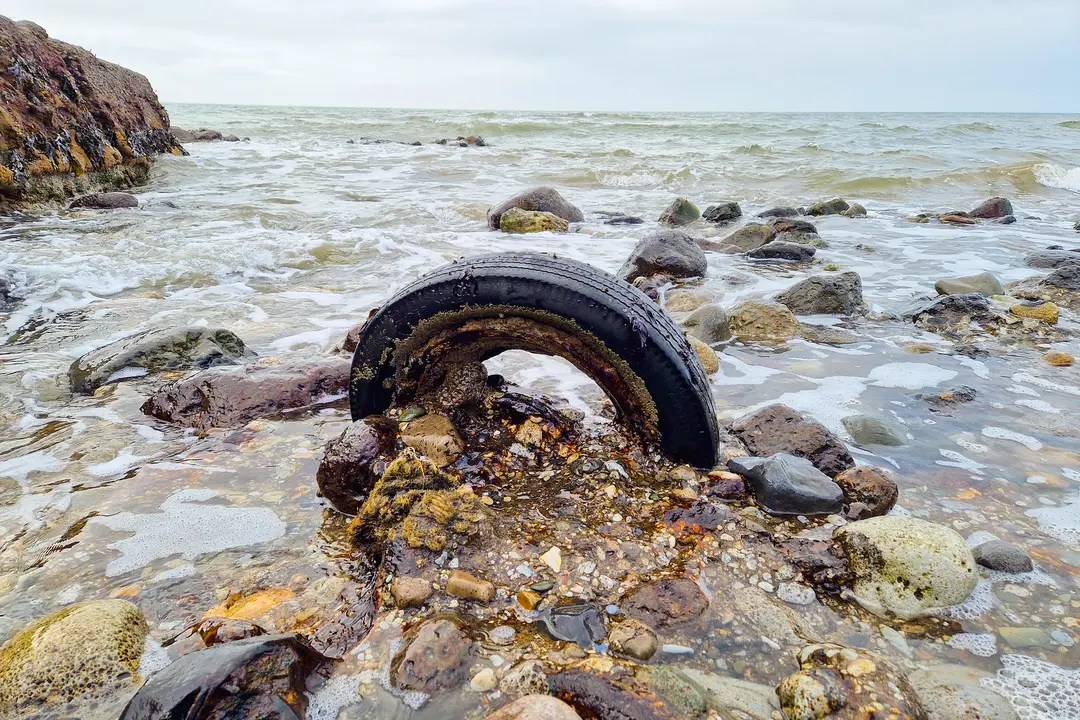
Indeed, especially over the last 150 years or so, both have been. And as a consequence, John MacDonald reports, the Anthropocene is presenting a challenge to geologists:
I’m standing on a beach at Workington, on the western edge of the Lake District in England [pictured above and throughout the article linked below]. Here I find myself contemplating a very unnatural object, while pondering a pretty fundamental question: what, exactly, is a rock? For a geologist like me, this should be easy to answer, but what I’m looking at has made me think otherwise.
At Workington, all seems natural – the sounds of the waves lapping the shore, the call of seabirds, the smell of the ocean, the sight of the stony beach and high cliffs. At first glance, the beach is made largely of a rock platform, which is not a particularly unusual phenomenon – many coastal areas are ‘rock coasts’ made of sandstone, basalt or granite. These rocks are ancient in human years – often millions or even billions of years old – and have been sculpted into their current cliff or platform shapes over hundreds to thousands of years.
Yet among the waves is an object that shouldn’t be there: a wheel and tyre, embedded in the rock that makes up the shore. It’s not stuck in a crevice – the rock has actually formed around it. How can this have happened? The wheel and tyre are of a mid-20th century style, but rocks are ancient, often millions of years old. Aren’t they?
Closer inspection of this hard rock platform shows it is what geologists call conglomerate: a sedimentary rock made of rounded pebbles and cobbles deposited on the Earth surface. Over thousands to millions of years, this material is buried and heated causing minerals to form and fill in the gaps between the pebbles and cobbles, fusing them together into a hard rock mass. At Workington though, this can’t have happened: as well as the tyre, my colleagues and I found several other human-made objects, under 100 years old. The pebbles and cobbles in the conglomerate aren’t natural either: they are all made of slag, a solid by-product of the iron- and steel-making process.
As a geologist, I have studied various types of natural rocks, but recently I have become interested in ‘anthropogenic geomaterials’ – things like industrial slag – and how they become entwined in geological and environmental processes. I came to Workington originally to look at the slag, because I was interested in its potential to scrub-capture carbon dioxide out of the atmosphere. However, when encountering the rock platform with the wheel in it, I was drawn by its incongruity. After studying the geomaterials of Workington more closely with my colleagues Amanda Owen and David Brown, we believe that this little-known section of the English coastline represents a tangible and potentially long-lasting signature of the impact humans are having on the planet.
Unlike many industrial landscapes, nature here has mostly returned, so it would be easy to miss that the beach is composed of human materials. Here a process that normally takes millennia or aeons has happened in a matter of decades. And it’s not the only example: new forms of anthropogenic geology are emerging around the world. These new materials are blurring the borderline between the natural and unnatural. They are also raising a rather fundamental question for geology: what actually is a rock?…
And what becomes of geology as its tasks come to resemble archaeology and anthropogy? Read on for the backstory and the answers.
Not natural, not quite unnatural, the strange new rocks of the Anthropocene stretch the boundaries of geology: “What is this rock?” from @aeon.co.
* W. H. Auden, “In Praise of Limestone“
###
As we ruminate on rocks, we might spare a thought for William Logan; he died on this date in 1875. Born in Montreal in 1798, he was sent to Edinburgh for an education, after which, he lingered in Britain to work in Wales at his uncle’s coal and copper-smelting business. Logan made geologic maps of coal fields in Wales, in attempt to understand the sources of coal and ores. He noted the relationship between the underlying clay layers and fossil tree roots with local coal beds– which helped substantiate the theory that coal beds are formed in place.
On returning to Canada in 1842, he became the founding director of the Geological Survey of Canada. At the time, the country’s geology was virtually unknown; but as a product of two decades of his research, the CGS published the monumental Report on the Geology of Canada in 1863. Known as “the father of Canadian geology,” Logan was knighted by Queen Victoria; and after his death Mount Logan, Canada’s highest mountain, was named in his honor.

“I am told there are people who do not care for maps, and I find it hard to believe”*…

A marvelous account of the oldest surviving map in the world…
Taking a first glance at the Babylonian Map of the World, few of us could recognize it for what it is. But then again, few of us are anything like the British Museum Middle East department curator Irving Finkel, whose vast knowledge (and ability to share it compellingly) have made him a viewer favorite on the institution’s YouTube channel. In the Curator’s Corner video below, he offers an up-close view of the Babylonian Map of the World — or rather, the fragment of the clay tablet from the eighth or seventh century BC that he and other experts have determined contains a piece of the oldest map of the known world in existence.
“If you look carefully, you will see that the flat surface of the clay has a double circle,” Finkel says. Within the circle is cuneiform writing that describes the shape as the “bitter river” that surrounds the known world: ancient Mesopotamia, or modern-day Iraq.
Inside the circle lie representations of both the Euphrates River and the mighty city of Babylon; outside it lie a series of what scholars have determined were originally eight triangles. “Sometimes people say they are islands, sometimes people say they are districts, but in point of fact, they are almost certainly mountains,” which stand “far beyond the known world” and represent, to the ancient Babylonians, “places full of magic, and full of mystery.”
Coming up with a coherent explanation of the map itself hinged on the discovery, in the nineteen-nineties, of one of those triangles originally thought to have been lost. This owes to the enthusiasm of a non-professional, a student in Finkel’s cuneiform night classes named Edith Horsley. During one of her once-a-week volunteer shifts at the British Museum, she set aside a particularly intriguing clay fragment. As soon as Finkel saw it, he knew just the artifact to which it belonged. After the piece’s reattachment, much fell into place, not least that the map purported to show the distant location of the beached (or rather, mountained) ark built by “the Babylonian version of Noah” [Utnapishtim in the Epic of Gilgamesh, himself likely based on the earlier Mesopotamian flood navigator Ziusudra] — the search for which continues these nine or so millennia later…
“An Introduction to The Babylonian Map of the World–the Oldest Known Map of the World,” from @openculture.
Sort of apposite– and very amusing: “The Many Lives of Null Island.”
* Robert Louis Stevenson
###
As we contemplate cartography, we might send exploratory birthday greetings to Samuel de Champlain; he was born (baptismal records suggest) on this date in 1567. An explorer, navigator, cartographer, draftsman, soldier, geographer, ethnologist, diplomat, and chronicler, he made between 21 and 29 trips across the Atlantic Ocean and founded Quebec City, the territory of New France, and a number of colonial settlements in what we now know as Canada– of which Champlain created the first accurate coastal map during his explorations.

“Life is like riding a bicycle. To keep your balance, you must keep moving.”*…

As Dylan Matthews explains, 80 percent of young Americans still live within 100 miles of where they spent their teenage years…
A new paper by Harvard’s Ben Sprung-Keyser and Nathaniel Hendren, and the Census Bureau’s Sonya Porter, takes an in-depth look at young adults leaving home. The big takeaway is … they do not.
At age 26, the authors find, 30 percent of Americans live in the census tract they lived in at 16. Fifty-eight percent live less than 10 miles away;80 percent live less than 100 miles away; 90 percent live less than 500 miles away. Census tracts are tiny, hyper-local designations, with populations between 1,200 and 8,000 each; mine is only 0.2 square miles in area. The small town where I grew up has three tracts within it. Staying within your tract is an extreme level of residential stasis, but 30 percent of young adults do just that…
As the demographers and sociologists reading this are likely to point out, the finding that people mostly stay put is not new. Indeed, residential mobility inside the US has been cratering for years, and kept falling even during the pandemic, despite narratives about city residents fleeing…
How race and class play into this trend, how distant job opportunities don’t, and what might be done to change the pattern: “The great millennial migration that wasn’t,” from @dylanmatt at @voxdotcom.
* Albert Einstein
###
As we get moving, we might recall that it was on this date in 1610 that explorer and navigator, Henry Hudson and his crew sailed into (what we now know as) Hudson Bay in (what we now know as) Canada. While Hudson is rightly remembered for this and his other explorations and chartings of the northern reaches of North America, it was at the time a disappointment: Hudson initially believed that he had finally found the Northwest Passage through the continent. Months of further exploration and mapping, of course, proven him wrong.

“When in doubt, go to the library”*…

Two great champions of reading for pleasure remind us that it really is an important thing to do – and that libraries create literate citizens: “Neil Gaiman and Chris Riddell on why we need libraries – an essay in pictures.”
* J. K. Rowling
###
As we browse in bliss, we might recall that it was on this date in 1779 that Sir Frederick Haldimand, Governor of Quebec, asked British dramatist Richard Cumberland to select books for the first subscription (public) library in Canada.

The library of the Literary and Historical Society of Quebec, which incorporated the collection of Haldimand’s library in the mid-19th century.
“The best blood will at some time get into a fool or a mosquito”*…

Woman dressed as a mosquito at the Russian Mosquito Festival
Nine year old Irina Ilyukhina earned the title of “tastiest girl” last month at the Russian Mosquito Festival, an annual event held in Berezniki, a town in the Ural Mountains. She and other contestants stood in shorts and vests for 20 minutes in a bug-infested wood; Irina’s winning total was 43 bites.
In 2013, the winner collected more than 100 mosquito bites; but unusually hot and dry weather in Berezniki diminished the insect population this year. Most years, attendees can participate in a mosquito hunt that rewards whomever can collect the most bugs in a glass jar; this year’s festival had to forgo the event.
More at “9-year-old wins ‘tastiest girl’ competition at annual Russian Mosquito Festival.” C.f. also, The Great Texas Mosquito Festival, held annually in Clute, Texas. (One notes that, Russia has confirmed just five cases of travel-related Zika in recent months, Texas has reported 125, and the United States as a whole, over 2,500.)
* Benito Mussolini
###
As we slather on the DEET, we might spare a thought for Fredrick Kenneth Hare, CC OOnt FRSC; he died on this date in 2002. One of Canada’s leading climatologists and environmentalists, he led both academic and political efforts to measure and stem the rise of atmospheric carbon dioxide, to mitigate climate change, and to prevent drought.

You must be logged in to post a comment.