Posts Tagged ‘history’
“You can’t judge a book by its cover”*…

… Fair enough. But you can sometimes get a pretty good feel from the first several pages. And there’s a website available to help…
Read an endless stream of free book samples. Reveal and save the ones you like.
Judge a book by its writing: “Uncovered Ink.”
* Common idiom
###
As we browse, we might send engrossing birthday greetings to a writer whose first pages are highly likely to compel you, David Mitchell; he was born on this date in 1969. A novelist, screenwriter, and translator, he has authored nine novels, two of which (number9dream and Cloud Atlas) were short-listed for the Booker Prize; one of which (The Bone Clocks) was long-listed for the Booker and won the World Fantasy Award. His 2016 work, From Me Flows What You Call Time, was the second contribution to the Future Library project (to be published in 2114).

“This was not that the subject was simple enough to be explained without mathematics, but rather that it was much too involved to be fully accessible to mathematics.”*…
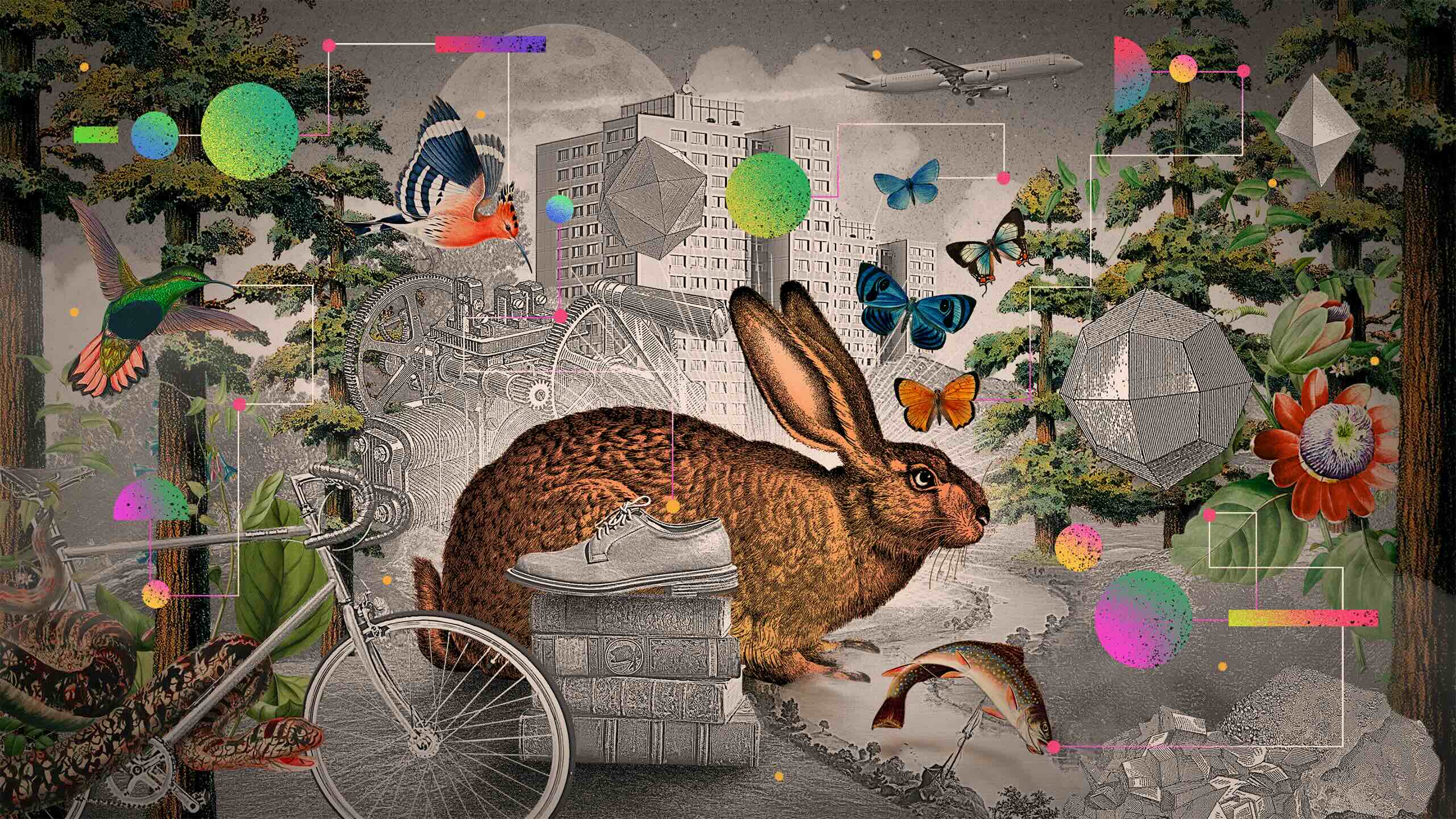
The idea of ‘biological agency’ — that life devises its own goals and behaves accordingly — complicates our understanding of what it means to be alive. But, Philip Ball asks, does it serve a scientific purpose?…
In 1993, a team led by the planetary scientist Carl Sagan tentatively concluded that there is life on Earth. Not much of a deduction, you might think — except that the researchers confined their evidence to observations made by the Galileo spacecraft, which had flown past our planet three years earlier on a looping journey to Jupiter. So great is the transformative power of life that its presence can be detected just from the light and radio waves our planet emits or reflects into space. Today we scan the cosmos for some of these telltale signatures light-years away.
Life leaves a mark, yet even now there’s no scientific consensus about what makes living things so different from inorganic substances like the rocks, gases, and oceans that are the sole components of dead worlds. Many scientists cite properties such as replication or metabolism. Others speak in more abstract terms about the way life is out of thermodynamic equilibrium with its surroundings. But some give another kind of answer. Living organisms are different because they do stuff for reasons.
It’s not enough to say that life is a nonequilibrium organized state through which there’s a constant flux of matter and energy. That description applies to hurricanes, too. But hurricanes just are. Only living entities have goals: to find food, to reproduce, to survive, sometimes simply to experience good things. (Dog owners will recognize that this is not just a human attribute.)
One way to express this idea is to say that living organisms have “agency.” It’s a hotly contested term. Some biologists reject it outright, at least for any organisms except humans, because we decide on our actions with conscious deliberation. (Whether we’re truly the only species to do so is another issue.) Others think that agency is a fundamental attribute of all life. Since there’s no agreed-upon definition of the term, to some extent it can mean whatever you want it to mean. But the debate about biological agency touches on fundamental issues in our understanding of what it means to be alive, because agency evokes a notion that biologists and philosophers have always wrestled with: teleology, the apparent purposiveness of life. If we admit agency into biology, do we open the floodgates to ideas about design, vitalism, or cosmic meaning? Or is it just a recognition of what makes life such a special state of matter?
To me, the notion of agency indeed speaks to our intuitive sense of what makes living things so special: not mere machines pushed around by environment and circumstance. I suspect that aversion to agency betrays a queasiness about confronting life as something more than some kind of genetic program. But there’s danger in the idea, too: It could so easily derail the work of studying the mechanistic explanations of how life works. I’m not looking to either bury or praise agency, but to explore whether it can be a scientifically productive idea…
[Ball unpacks the idea of agency, then reviews both scientific observations and the theories that they have provoked. He concludes…]
… I’m cautiously optimistic about the prospects of uniting such theoretical ideas with biological mechanisms. It seems unlikely to be coincidental, for example, that organisms that seem to show more agency also have molecular pathways that permit more openness to the influence of context and external information.
If we can get a clearer idea of what makes an agent, this could help us to understand how collective goals arise — as they did when multicellular organisms first arose long ago — and how they can break down, as in cancer. What’s more, a proper theory of agency might give us a clearer idea of what’s needed to make genuine artificial agents, not just computers and machines programmed with our own goals, but ones that can formulate their own. We might then also get a clearer idea of the potential benefits and dangers such truly agential machines might bring. But perhaps the most compelling argument for recognizing agency is that it might help us understand what makes life so different — not just humans, but life — that it is able to shape an entire planet in a manner visible from outer space.
Purpose? Goals? On the idea of “biological agency”: “Is Life Just Different?” from @philipcball.bsky.social in @quantamagazine.bsky.social.
* Erwin Schrödinger in What Is Life? (in which he wrestled, in his way, with Ball’s question, contending that life feeds on negative entropy) Full text here.
###
As we wonder why, we might send frustrated birthday greetings to Ernő Rubik; he was born on this date in 1944. An architect and inventor, he created the Rubik’s Cube (in 1974), which has become the world’s best-selling puzzle game, with over half a billion sold.
A Rubik’s Cube consists of 26 small cubes that rotate on a central axis; nine colored cube faces, in three rows of three each, form each side of the cube. After the cube arrangement is randomized (the highest level of entropy), the player must restore order (that’s to say, practice “negative entropy”), returning it to the original condition of faces with matching colors on each side — which is one among 43 quintillion possible configurations.

“It’s the economy, stupid”*…

Many Americans take pride in having the largest economy in the world… which, per the chart above, by one measure we do.
But then, if we adjust for population– calculate per capita– the picture changes…

And we note both that, on a PP basis, the U.S. would be lower and, more fundamentally, that the standing of the U.S. is slipping over time.
If we dive more deeply still, the picture complicates further…

This last chart illustrates the wealth inequality in the U.S., which drops from 2nd to 28th when wealth is measured by the median instead of the average… a wealth gap that has been growing since 1985 (and that is combined with an income gap that has been growing since 1980). For more, see World Inequality Database.
* James Carville
###
As we search for the source of that smell, we might recall that it was on this date in 1549 that Robert Kett agreed to head a group of rebels in the English county of Norfolk during the reign of Tudor king Edward VI. The rebels were incensed by enclosure (the fencing off of common lands by wealthy landlords, as a product of which many peasants lost access to grazing, fuel, and small plots they had long used), along with rising rents, inflation, unemployment, and declining wages; as a response, they began destroying fences. One of their early targets was yeoman Robert Kett who, instead of resisting the rebels, agreed to their demands and offered to lead them.
Kett and his forces, joined by recruits from the city of Norwich and the surrounding countryside and numbering some 16,000, stormed Norwich and took the city at the end of July. They were besieged by, then routed, a Royal Army detachment led by the Marquess of Northampton who had been sent by the government to suppress the uprising.
But what became known as “Kett’s Rebellion” ended on August 27, when the rebels were defeated by an army under the leadership of the Earl of Warwick at the Battle of Dussindale. Kett was captured, held in the Tower of London, tried for treason, and hanged from the walls of Norwich Castle on December 7.

“It is fun to have fun”*…

… but it’s getting tougher to manage. As Ben Steverman reports, with fewer places to relax and socialize, and steeper prices for entry, having fun is quantifiably harder than it used to be…
Over the course of the past two decades, the US has lost 2,000 golf courses and 7,000 bars and nightclubs, and Americans now own 1.3 million fewer boats. It’s prohibitively expensive to open a new summer camp and practically impossible to build a beachfront resort or marina. Venue shortages afflict musicians looking for performance spaces, children looking to play in local sports leagues and adults looking to go out dancing. The best time to book a rental for this summer was last summer, and the best time to book for next summer is … well, it may already be too late.
America appears to be suffering from a fun shortage. For the industries supplying recreational amenities, this deficit is a business opportunity. But for everyone not positioned to profit from the trend, it’s a source of stress and frustration that’s been building for a while. It also has broad ramifications for the future of the economy, society and politics. On… the country’s 250th birthday, it’s worth pondering whether the pursuit of happiness has become more difficult.
First, a quick definition: Experts on these matters generally agree that the kinds of fun we should be striving for are enjoyable experiences with others. A live show with friends, a vacation with family or even small talk with a stranger can all make us feel more connected and content.
By those measures, it’s clear that Americans are having less fun than they used to. Since its 2003 inception, the Bureau of Labor Statistics’ American Time Use Survey shows double-digit percentage drops in the hours spent each year on arts and entertainment activities, attending sports or recreational events, and attending or hosting social events. In a 2024 US Census Bureau survey, almost 80% of respondents said they saw friends or relatives fewer than three times a week.
The US, along with Australia, Canada and New Zealand, seems to have grown uniquely unhappy over the past 15 years, according to the annual World Happiness Report, which combines data on more than 140 countries. For good reason, we often blame smartphones and social media for making us feel worse. But most of the world uses these digital tools at least as much as Americans do, and the US still came in 23rd on the global happiness ranking in 2026, down from 13th a decade prior. America’s happiness decline must have another major cause, says report co-editor and University of British Columbia professor emeritus of economics John Helliwell. He points to the “often forgotten” factor of fun. “It’s not just connections” with other people, he says. “It’s how much you’re enjoying the connections.”…
… It keeps getting harder — and more expensive — to have fun. A combination of factors is delivering a summer of higher prices, fewer options, limited vacancies and longer lines.
No matter how enthusiastic Americans are for offline experiences, there’s a limit to how much they can afford, with prices rising at the fastest pace in three years. As the cost of commutes, housing, utilities and other necessities climbs more quickly than wages, people have little choice but to skimp on fun. Meanwhile, the prices of some key categories of fun have been rising even faster than inflation. The price of a ticket to one of the top 100 concert tours in North America averaged $134 last year, trade publication Pollstar estimates, a 42% increase from 2019. Vacation rentals in coastal destinations jumped 38% over the same period, to $413 per night, according to data analyst AirDNA LLC.
Fun isn’t just harder to afford. It’s harder to access. The US has lost a fifth of its movie theaters and almost a third of its bowling alleys since 2001, Bureau of Labor Statistics data show. Camp spots for children fill up quickly, with more than 80% of organizations reporting steady or increasing enrollment last summer, according to the American Camp Association. At US country clubs, the median initiation fee has doubled since 2019, to $51,500, at the same time that waiting lists have also doubled in length, according to data firm Club Benchmarking…
… Parks departments have added thousands of pickleball courts to meet demand, but the new facilities often come at the expense of basketball and tennis, which have also been getting more popular, while the rest of the park gets busier as well. Park space per person declined in 65 of the 100 largest cities from 2016 to 2023, according to the Trust for Public Land. Record crowds are also inundating the National Park Service’s most scenic spots and descending on America’s most popular beach towns. With tours, hotels and beach houses booking up early, planning a vacation has turned into a thankless task of gaming out the distant future. “Availability is becoming a bigger issue than price,” says Laura Mattia, a financial adviser at the firm Wealth Enhancement in Sarasota, Florida. “I see clients booking rentals six to nine months ahead, committing before they have fully thought through the trip, or saying yes to expensive options simply because they are available.”
Rising inequality is making the problem worse, as the superwealthy bid up the costs of fun, whether luxury hotels or the best seats at sporting events. A 2011 study showed lower levels of happiness in areas of Switzerland with more Ferraris and Porsches. “Inequality matters objectively to people, but when it’s thrown in their faces, they like it even less,” Helliwell says…
…
… This fun shortage may be shifting American politics in significant ways. Studies in the UK and continental Europe show voters are more likely to vote for right-wing candidates in the years after local social spaces such as pubs shut down. “When the last gathering place in a town goes, people experience it as a sign of being left behind, of a place emptying out,” says Subtil, the author of a new paper showing France’s far-right National Rally party has benefited from the closure of thousands of bars-tabacs, shops where customers can make a bet, get a coffee or pick up a newspaper.
Replenishing America’s inventory of fun won’t be easy at a time when digital tools are absorbing ever more attention and economic resources. It will take creativity and capital to generate real excitement in real spaces where real people interact. Encouragingly, there are signs of a shift: After New York City repealed century-old rules against dancing in bars in recent years, New York Governor Kathy Hochul announced a similar statewide policy in May. Massachusetts, meanwhile, has loosened rules that capped the number of liquor licenses, which Boston Mayor Michelle Wu argued were starving neighborhoods of local gathering places. The city may add 225 liquor licenses, the vast majority designated for areas far from the tourist sites downtown.
Local governments “really need to think about fun, leisure and entertainment for everyone,” including children and seniors, says Jess Reia, a professor of public policy and data science at the University of Virginia.
In the meantime, Americans are finding cheaper ways to fill their free time. Participation in outdoor activities and team sports has soared in the past five years, reaching record levels, according to a long-running survey by the Physical Activity Council, which estimates the number of “inactive” Americans has dropped by 13.6 million, or 18%, since 2020. Plus there are signs that young people are taking up old-school hobbies, such as crafts and birding, Reia says. “People are trying to find the fun where they can.”
“The Fun Shortage Is Real, and It’s Making America Miserable,” gift article from @bloomberg.com.
See also: “Do you believe that everybody should have fun or that only a few people should have fun?” from @garrettbucks.bsky.social.
* Dr. Seuss, The Cat in the Hat
###
As we recreate revelry, we might note that today is National Swimming Pool Day. While public baths and dedicated coastal swimming areas have a very long history, the first recorded swimming pool in the U.S. was a public pool built in 1887 in Brookline, Massachusetts, a place to socialize and beat the summer heat before the invention of air conditioning. One of the first residential pools was built on the Vanderbilt estate in Asheville, North Carolina in 1895.
As of 2024, there were 10.7 million pools in the U.S., of which 10.4 million are residential (about 8% of homes). While public pools took an early lead in the build-out, these days only 309,000 are public or commercial pools.

“Technology doesn’t force us… it merely opens the door”*…

The estimable Tim O’Reilly reminds us to think deeply about how AI could and should turn out. He suggests that Jeff Ding‘s diffusion theory of the role of technology in great-power competition also applies to AI adoption– and that it suggests that companies obsessed with the frontier might be optimizing for the wrong thing…
In the 1980s, Japan led the world in semiconductors, consumer electronics, and computer hardware, the industries everyone assumed would decide the next phase of economic power. Japan won them and still did not overtake the United States in the information revolution that followed. Jeff Ding, a political scientist at George Washington University, opens his book Technology and the Rise of Great Powers with the history of the first and second industrial revolutions and the third, the information revolution. The explanation he gives for who wins and who loses applies to companies as well as it does to nations, and very much to the current trajectory of AI.
Ding contrasts two theories of how technological revolutions reshape economic power. The conventional one he calls the leading sector model, or LS theory. It goes like this: New technologies create fast-growing new industries like steel and railroads and automobiles and semiconductors, and the country that dominates invention in those sectors captures the monopoly profits and the upstream and downstream economic linkages that come with them. As the story goes, if you win the leading sector, you win the era. Britain won in the first industrial revolution through its mastery of steam power, and then was surpassed by the US in the second through its leadership in electrification, the internal combustion engine, and mass manufacturing. The US kept its lead over Japan in the information systems revolution not by competing in the “leading sector” of electronic hardware but by diffusing “up the stack” via software that took the power of computing into every sector of the economy. (OK, that last bit is my explanation of what happened rather than Ding’s, but it’s consistent with his theory.)
Leading Sector theory is pretty clearly the working hypothesis of today’s AI industry and the national strategy that is forming around that industry. The company and the country with the biggest and best models wins. Everyone else is an also-ran.
Ding offers another explanation, which he calls diffusion theory. He points out that general-purpose technologies, foundational ones like the steam engine, electricity, and the computer, don’t just create massive profits and productivity gains in a single industry but instead spread across the whole economy. National economic leadership comes not from inventing the new sector but from diffusing the general-purpose technology more quickly and more broadly than your rivals. This happens over decades. The win goes to whoever most successfully embeds the technology into a wide range of ordinary productive work. This is how the US kept its lead over Japan rather than being surpassed by it.
This is obviously aligned with the thinking of Arvind Narayanan and Sayash Kapoor in “AI as Normal Technology,” which Ding cites in his book.
A big part of what enables diffusion is what Ding calls skill infrastructure, the education and training systems that widen the pool of people who can actually work with the technology. When the priority is widespread adoption rather than invention, he argues, the institutions that matter are the ones that build engineering skill at scale, standardize good practice, and tie research to industry. He writes:
GPT diffusion theory highlights the importance of GPT [General Purpose Technology] skill infrastructure. Education and training systems that widen the pool of engineering skills and knowledge linked to a GPT. When widespread adoption of GPTs is the priority, it is ordinary engineers, not heroic inventors, who matter.
Music to my ears, as it should be to yours: “It is ordinary engineers, not heroic inventors, who matter.”
That is not how the current AI narrative goes. Everyone is fixated on the labs, the frontier models, and the most famous researchers. And that fixation shapes enterprise strategy. Inside many companies AI strategy is a procurement decision: Which model and which vendor and which flagship tool should we choose? Or it’s a moonshot to stand up a lab and build an impressive demo and hire your own famous developer. Both approaches treat AI as a sector to be won. Ding’s argument is that the breakthrough sector itself is not where the long-term value for national power lives. And I believe that the same applies to corporate success. The value is in how widely and how well the technology gets embedded into the work of the people you already employ. The company that puts AI to work in finance and support and legal and sales and operations, across every unglamorous process, as well as in product and engineering, outperforms its competitors and drives its industry forward.
The reason diffusion takes a long time is that it is an organizational problem and not a technical one…
[Tim elaborates, and specifies the requirements for successful management of what is an “enterprise transformation problem”; he then unpacks the geopolitics of AI. He concludes…]
… Sovereign AI is not just a matter of national power. It is a predictable consequence of diffusion. A technology that diffuses widely will be adapted by different societies, firms, and institutions to suit their own needs, values, and constraints. Sovereign AI is AI designed for diffusion, not just raw increases in capability.
This is one reason the arms-race framing is unhelpful. It encourages us to treat AI as if it were a weapons system or a scarce strategic asset. But if AI is closer to electrification, computing, or the written word, the important thing is how the technology is embedded into the ordinary life of economies and institutions, and whether that embedding happens in ways that increase agency broadly rather than concentrating it in a few hyperpowerful companies.
There are a few additional lessons we can take from the history of electrification. While motors became decentralized, factories stopped generating their own power and bought it from a centralized grid. The unit-drive revolution decentralized application, not generation. This limitation, which we are now working to overcome to some extent with decentralized solar generation, is perhaps ironically showing up most strongly in the strain that AI data centers are placing on the grid. Let’s learn from that misstep. You can diffuse AI into every workflow via API calls to a big centralized model, or it can be diffused by a network of smaller models that turbocharge every part of the economy.
We should design for a future of multiple AIs, not a single universal system. Different countries will want systems shaped by different legal regimes, languages, histories, and cultural assumptions. So will companies. So will professions and communities of practice. The instinct of some frontier labs is to imagine that the right answer is to homogenize the technology, purge it of bias, and offer a single sanitized intelligence layer for the world. But AI is a social and cultural technology. The differences are not a defect to be smoothed away.
We do need to think about standards and interoperability. The historical analogy that comes to mind is railroad gauge. When real world systems are built to incompatible standards, the result is not healthy diversity but decades of friction, kludges, and retrofitting. The same may prove true for AI. If we force the future into a choice between one universal model and a patchwork of disconnected sovereign systems, we will get the worst of both worlds. We need a layer between uniformity and fragmentation, which can come from standardized protocols that allow different models, tools, and institutions to interoperate without requiring them to become identical.
This is also why open source matters, but only if it is properly understood. Open source is not just about licenses. My earliest introduction to the shared development of software that now goes by that name came from the research community that grew up around Bell Labs’ Unix operating system despite AT&T’s proprietary (albeit permissive) licensing. Because of that experience, I became convinced that it was the modular, protocol-centric architecture of Unix that was a key driver of collaborative, internet-enabled software development.
Open source AI depends on far more than open models. It depends on the architecture of participation built into the systems above and around them: the protocols, servers, interfaces, and shared technical conventions that let many different actors build on common foundations. The Open Source AI Gap Map shows just how rich that open source AI ecosystem is becoming. But open source can also coexist with proprietary, de facto standards like the OpenAI and Anthropic APIs. Like the electric grid we are now beginning to rebuild, the AI future will be a mix of centralized and decentralized systems. Cooperation and competition can coexist. Different actors can build different systems, for different purposes, under different forms of governance, while still participating in a shared technical and economic order.
This is how the future can belong not just to the inventors of AI but to the people who make it usable, adaptable, interoperable, and worth adopting.
Eminently worth reading in full. AI for all of us: “Ordinary Engineers, Not Heroic Inventors,” from @timoreilly.bsky.social
Apposite: “How to talk about “AI” without adding to the anthropomorphization“
###
As we amplify access, we might we might spare a thought for someone who launched more than one central technology into braod diffusion: the Serbian-American electrical engineer and inventor Nikola Tesla; he died on this date in 1943. Tesla is probably best remembered for his rivalry with Thomas Edison: Tesla invented and patented the first AC motor and generator (c.f.: Niagara Falls); Edison promoted DC power… and went to great lengths to discredit Tesla and his approach. In the end, of course, Tesla was right.
Tesla patented over 300 inventions worldwide, though he kept many of his creations out of the patent system to protect their confidentiality. His work ranged widely, from technology critical to the development of radio to the first remote control. At the turn of the century, Tesla designed and began planning a “worldwide wireless communications system” that was backed by J.P. Morgan… until Morgan lost confidence and pulled out. “Cyberspace,” as described by the likes of William Gibson and Neal Stephenson, is largely prefigured in Tesla’s plan. On Tesla’s 75th birthday in 1931, Time put him on its cover, captioned “All the world’s his power house.” He received congratulatory letters from Albert Einstein and more than 70 other pioneers in science and engineering. But Tesla’s talent ran far, far ahead of his luck. He died penniless in Room 3327 of the New Yorker Hotel.

You must be logged in to post a comment.