Posts Tagged ‘geopolitics’
“Neoliberalism: An ideology to absolve banks, landlords and monopolists from accusations of predatory behavior”*…

Neoliberalism has undoubtably contributed to remarkable economic growth, but it has also fostered inequality and “enshittification.” In any case, neoliberalism is, to put it politiely, showing strains. What’s next for the structure of the economy in the U.S. and the world? The estimable Branko Milanović…
Why did neoliberalism, in its domestic and international components, fail? I ask this question, in much more detail than I can do it in a short essay here, in my forthcoming The Great Global Transformation: National Market Liberalism in a Multipolar World. I am asking it for personal reasons too: some of my best friends are neoliberal. It was a generational project of Western baby-boomers which later got adopted by others, from Eastern Europe like myself, and Latin American and African elites. When nowadays I meet my aging baby-boomer friends, still displaying an almost undiminished zeal for neoliberalism, they seem like the ideological escapees from a world that has disappeared long time ago. They are not from Venus or Mars; they are from the Titanic.
When I say that neoliberalism was defeated I do not mean than it was intellectually defeated in the sense than there is an alternative ready-made project waiting in the wings to replace it. No: like communism, neoliberalism was defeated by reality. Real world simply refused to behave the way that liberals thought it should.
We need first to acknowledge that the project had many attractive sides. It was ideologically and generationally linked to the rebellious generation of the 1960s, so its pedigree was non-conformist. It promoted racial, gender and sexual equality. By its emphasis on globalization, it has to be credited by helping along the greatest reduction in global poverty ever and for helping many countries find the path to prosperity. Even its much-reviled Washington consensus—while some of its commandments were taken to an extreme length and other ignored—is fundamentally sound and has much to recommend itself. Not least that it provides an easily understandable shortcut to economic policy. It does not require more than an hour to explain it to the most economically ignorant person.
So, to go back to the original question, why did neoliberalism not remain the dominant ideology? I think there are three reasons: its universalism, hubris of its adherents (which always comes with universalism), and mendacity of its governments.
That neoliberalism is universal or cosmopolitan requires, I believe, little convincing. Liberal ideology treats, in principle, every individual and every nation the same. This is an asset: liberalism and neoliberalism can, again in principle, appeal to the most diverse groups, regardless of history, language or religion. But universalism is also its Achilles’ heel. The pretense that it applies to everybody soon comes into conflict with the realization that local conditions are often different. Trying to bend them to correspond to the tenets of neoliberalism fails. Local conditions (and especially so in social matters which are products of history and religion) are refractory to the beliefs founded under very different geographical and historical conditions. So in its encounter with the real world, neoliberalism retreats. The real world takes over.
But all universalists (communists among them too) refuse to accept that defeat. As they must because every defeat is a sign of non-universalism. That’s where the intellectual hubris kicks in. The defeat is seen as due to moral flaws among those who failed to adopt neoliberal values. To its votaries nothing short of its full acceptance qualifies one as a sane and morally righteous person. Whatever new social contract its votaries have determined is valid, were it only a week ago, must unconditionally be applied henceforth. The morality play combined with economic success that many proponents of neoliberalism enjoyed due to their age, geographical location, and education, gave it Victorian or even Calvinist undertones: becoming rich was seen not only as a sign of worldly success but as an indication of moral superiority. As Deng Xiaoping said, “getting rich is glorious”. This moral element implied lack of empathy with those who failed to find their right place within the new order. If one failed, it was because he deserved to fail. Faithful to its universalism, Western upper middle-class neoliberals did not treat co-citizens any differently from foreigners. Local failure was no less merited than the failure in a faraway place. This contributed more than anything else to the neoliberals’ political defeat: they simply ignored the fact that most politics is domestic.
The hubris which comes from success (and which got elevated to unheard-of heights after the defeat of communism) was reinforced by universalism—a feature shared by all ideologies and religions that by their very construct refuse to accept that local conditions and practices matter. Syncretism was not in the neoliberals’ playbook.
Finally, mendacity. The failure to observe, especially in international relations, even the self-defined and self-acclaimed “rules-based global order”, and the tendency to use these rules selectively—that is, to follow the old-fashioned policies of national interest without acknowledging it, created among many the perception of double standards. Western neoliberal governments refused to own to it and kept on repeating their mantras even when such statements were in glaring contradiction with what they were actually doing. In the international arena, they ended in a cul-de-sac, manipulating words, reinventing concepts, fabricating realities, all in the attempt to mask the truth. A part of that mendacity was present domestically too when people were told to shut up and not complain because the statistical data were not giving them reason and thus their subjective views were wrong and had to be ignored.
What next? I discuss that in The Great Global Transformation. I think there is one thing on which most people would agree: that the past fifty years have seen the debacles of two universalist ideologies: communism and neoliberalism. Both were defeated by the real world. The new ideologies will not be universal: they would not claim to apply to the entire world. They will be particularist, limited in scope, both geographically and politically and geared toward the maintenance of hegemony wherever they rule; not fashioning it into universal principles. This is why the talk about global ideologies of authoritarianism is meaningless. These ideologies are local, aiming at the preservation of power and of the status quo. This does not make them averse to the old imperialist temptation. But that temptation can never be extended to the world as a whole nor can various authoritarianisms work together to accomplish that. Moreover, since they lack universal principles, they are likely to clash. The only way for authoritarians not to fight with each other is to accept a very narrow set of principles, essentially those of non-interference in domestic affairs and absence of aggression, and leave it at that. Xi Jinping’s proclamation of five such narrow rules at the recent Shanghai Cooperation Organization meeting may be based on such a calculation…
Neoliberalism in crisis: “Defeated by reality,” from @brankomilan.bsky.social.
For a less certain perspective: “Will Trump Bring Neoliberalism’s Apocalypse, or Merely a New Iteration?” (source of the image above).
And apposite: “Why Neoliberalism Needs Neofascists,” “Has Liberalism’s Very Success in Delivering Human Flourishing Doomed It?,” and “The future of the world economy beyond globalization – or, thinking with soup.”
###
As we rethink, we might recall that it was on this date in 1975 that New York City came within two hours of bankruptcy. The city had payments due of $350 million, but had only a fraction of that available. Washington had refused craft a bailout package. It was estimated by some that 100 banks would fail if the city went bankrupt. A notice had been drafted and signed by the mayor:

But at the last minute, as creditors were lined up at government buildings and teachers were being notified to stay home, the teachers union pension fund came to the rescue, buying city bonds and giving the city the lifeline it needed to avoid default.

More at: “The Night NYC Saved Itself”
“I think it would be a very good idea”*…

As we discuss global culture(s) or geo-politics, we often talk about “The West” (and the rest). In a review of Georgios Varouxakis‘ new book The West: The History of an Idea, Andrew Kaufmann reminds us that it’s important to interrogate that defining concept…
What is the West? Many take the idea for granted, but few can define it. In this meticulously researched, engaging, and sometimes bewildering new book, The West: The History of an Idea, intellectual historian Georgios Varouxakis takes readers on a two-centuries-long tour of the many uses, definitions, and redefinitions of the term. Along the way, readers may find their own long-held assumptions and stereotypes challenged and even undermined.
The book makes a number of arguments, but for the purposes of this review, it’s worth focusing on just a few major ones. The first and most innovative argument of the book is this: The idea of the West as a transnational sociopolitical community distinct from the rest of the world is more recent than we think. This idea received its first sophisticated and coherent articulation in the 1820s from French philosopher Auguste Comte.
While historians and other academics had long looked to past societies like ancient Athens or medieval Europe as representing the “West” against some “other,” Comte was the first to coherently put together a future-oriented political program to be adopted and followed. Most scholars locate the future-focused version of the West’s inauguration in the 1890s, when the idea was used to justify imperial and colonial expansion. By contrast, Varouxakis argues that Comte and his followers wanted to build a West that was anti-imperialist, committed to science and reason, liberated from dogmatic Christianity, and fueled by altruism and sympathy.
As a progressive positivist, Comte saw the “Western Republic” as a via media between a hyper nationalism (of the French variety) and an overly abstract universalism. He imagined a way station that transcended the parochialism of family and nation and would one day be realized and embraced all over the world, even if it would take a full seven centuries from his own writing to come to fruition (that was Comte’s timeline). Neither tied to a particular nation like France (although Paris would be the center of this Republic until Constantinople would replace it), nor embodied by an abstract and universal cosmopolitanism, the Western Republic (or l’Occident) would be set off against its Other—in particular, Russia and the Orient. Still, over time this republic would non-coercively welcome the rest of the world into its fold.
Contrary to a common conception of “the West,” it was not to be a society (or society of societies) committed to democracy, individualism, or liberalism. It was instead a rejection of the hyper-individualism of the modern period, and it was an attempt to recover an older other-centered ethic that had been lost to a prior age.
The second major argument Varouxakis presents is that despite this idea of a transnational West that had its origin in Comte’s work, and despite Comte’s legacy that his disciples clearly carried across continents and centuries, the history of the idea of the West since Comte is complicated and contested. Put another way, while the specter of Comte hovers over the entire narrative, his vision is not always fully realized, nor is the meaning of the term always stable. This complicated history manifests itself in a number of different ways and carries with it some significant implications…
… Many casual users of “Western Civilization” will often identify it as one and the same with liberal democracy. They often find that somehow and at some point Britain came to embrace the West as being just that—liberal and democratic. Varouxakis complicates this picture by showing that while a few liberal voices in Britain were certainly also champions of Western Civilization, the more consistent and coherent users of the term were disciples of Comte and therefore much more illiberal in their thinking…
… Or take the more familiar East vs. West framework we associate with the Cold War, where surely the fault lines of Eastern totalitarianism against Western liberal capitalism are clean and clear. But even here the history is complicated, as the period begins with the acknowledgement that it was indeed Soviet Russia that helped to save “western civilization.” Indeed, it took forty years of gradual evolution for the idea of the “West” to finally crystallize around the shared commitment to economic, religious, and political freedom over and against Soviet planned economies, state-sanctioned atheism, and one-party politics with no free and fair elections…
… Given the winding road of the history of the West, it is instructive that there seems to be something of a settlement on its meaning for today, even if there are differences in its application. This can be seen most clearly in Varouxakis’ penultimate chapter on the dispute between Samuel Huntington and Francis Fukuyama after the end of the Cold War. Fukuyama of course is well known for his view that the West—in its embrace of liberal democracy and capitalism—had now emerged triumphant over the defeated ideas of Marxist totalitarianism, which found its fullest expression in Soviet Russia of the East.
Samuel Huntington’s ideas of what the West embodied were not much different, but he diverged from Fukuyama in his vision of what the world’s future likely entailed. For Huntington, the coming years and decades would see a “clash of civilizations,” a conflict of the most basic sort between the West and the great civilizations of the world as we know it. He saw nothing certain about the global triumph of any particular civilizational expression, including the West. Indeed, Huntington contends that it is only the West that even believes in universal ideals, and that all of the non-Western civilizations—whether Chinese, Islamic, or otherwise—are all partial in their visions. Therefore, we see here in the latest debate about the West a return of the Comtean question: Will the West become a universal civilization, or will it endure as one of many civilizations forever in conflict with each other? While we may have some agreement on what the West stands for, we may have less confidence in its future in the world.
The history is complex, indeed. But Varouxakis also raises the question of whether Western Civilization—however one defines it—is something to defend in the first place. He considers this question several times in the book, but perhaps none more poignantly than in the Great War itself. For example, there were many who noted the hypocrisy of the “Western powers” that suddenly found common cause with the long-excluded Russia in their fight against Germany and the Central Powers. But perhaps more troubling is what it says about a civilization when it produces not the peace and altruism long promised by its founder, but instead destruction on a scale that had never been seen before in human history. One could likewise ask: What kind of civilization deliberately excludes and exploits the weakest members within its borders, such as in the treatment of African Americans in the United States and of those in the furthest regions of the colonial empires of Europe? This crisis of confidence and feeling of decline continued through the interwar years, as Oswald Spengler expresses in his Decline of the West, a fitting rejoinder to the optimism of Comte’s Western utopia.
And so, perhaps the best way to conclude for readers of all sorts—but especially Christians—is to offer two words of caution. The first is to those who would defend the “West” and “Western Civilization” as something either resonant with or even inspired by a Judeo-Christian worldview. And that word is simple: the origins of the idea of the West in one of its most dominant forms (the Comtean one) and in its subsequent historical uses is either non-Christian or even anti-Christian. Indeed, I went into the book expecting a heavy dose of Judeo-Christian connections to the idea of the West, and while the link is not completely absent, I was struck by its muted nature.
Besides the post-Christian progressive vision of Comte himself, consider the voice of Black writer Richard Wright as one representative example to follow in the Frenchman’s footsteps. As someone who identified with the West, he considered “the content of [his] Westernness [residing] fundamentally…in [his] secular outlook upon life.” The progress of the West would be realized the more it emancipated itself from the influence of “mystical powers” or the priests who would speak in their name. Armed with the tools of trial-and-error pragmatism, human life can be sustained without recourse to divine help. A West liberated from divine help is a West worth preserving, at least according to Wright.
Overall, the West as an idea has many champions who are quite open in their antipathy toward the Christian religion, and it would be foolish to ignore those influences on the meaning and use of the term for us today. Still, the second and final note I’d like to offer is a bit more optimistic. In the concluding chapter, Varouxakis urges readers to move from the parochialism of “Western” ideas to adopt a language that is universal in its appeal. What, after all, was so attractive about any of the Western projects that Varouxakis so painstakingly chronicles? It was always their global appeal.
Altruism, sympathy, love for others, freedom, individualism, democracy, capitalism. These are not ideals that belong to just a few but rightfully can be embraced by all of God’s creatures in different places, at different times, and in different ways. Certainly for Christians who embrace a global faith, the least we can do is see the inheritance of the “West,” however defined, as a mixed bag of common grace insights and ideas in rebellion against God, combined with the perspective that none of what is worth keeping in the West should ever be kept from those who would embrace its ideals…
Eminently worth reading in full: “The Idea of the West” from @mereorthodoxy.bsky.social.
For a look at the concept in current context/practice: “The Rest take on the West,” from @noemamag.com.
* Gandhi’s response when asked, “what do you think of western civilization?”
###
As we ponder perplexingly plastic paradigms, we might recall that it was on this date in 1957 that “Whole Lotta Shakin’ Going On” by Jerry Lee Lewis peaked at #3 on the US pop singles charts (though it topped the R&B and country charts shortly after). It was a cover of a 1955 release by Big Maybelle of a song written by Dave “Curlee” Williams (and sometimes also credited to James Faye “Roy” Hall). Lewis, with session drummer Jimmy Van Eaton and guitarist Roland Janes, had recorded the song at Sun Records in just one take.
“What is it about maps? I could look at them all day”*…
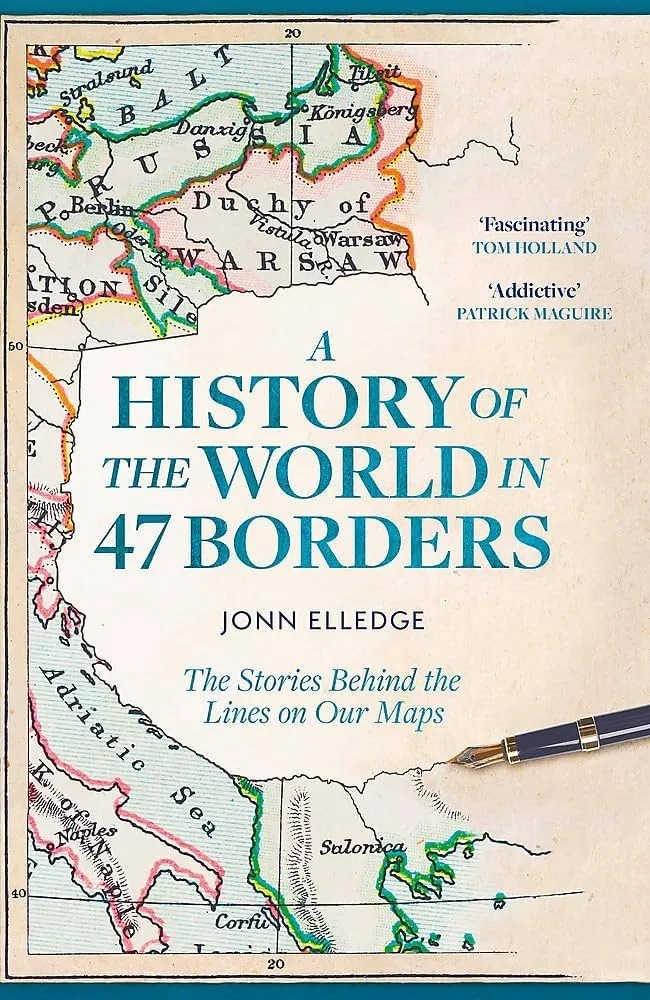
Jonn Elledge devotes the current issue of his nifty newsletter to a series of fascinating facts from his wonderful book, A Brief History of the World in 47 Borders (as it’s known in its U.S. edition, as compared to the less qualified title of the U.K. original pictured above)…
… Back in May, the good people at the UK’s leading maps and travel specialist bookshop Stanfords were kind enough to select my new book A History of the World in 47 Borders as their book of the month. And to promote it, they asked me to make a quick video, talking about it…
My initial thought was to list a single fact from each of the book’s 47 chapters, but that, I soon realised, would go on forever and take an absurd number of takes to get right. So in the end I decided on a top 10: that took an absurd number of takes to get right too, and also features me the wrong way round, for some reason, but at least it’s only three minutes long…
… as a special Christmas treat, not to mention shameless attempt to get more of you to buy the book for yourself or a loved one, here are all 47 of the facts I originally chose…
You’ll find tidbits like these:
The oldest known international border was the one between what today we call Upper Egypt and Lower Egypt. We know about it today because, sometime around 3100BCE, someone abolished it.
The Great Wall is not really one wall, but many. And the first Chinese emperor used to kidnap young men to make them build them.
The Open Borders Policies of Genghis Khan basically created the modern world.
In 1884, the great powers agreed to divide up the entire map of Africa without ever visiting. No Africans were in attendance, and one who’d asked for an invite, the Sultan of Zanzibar, was openly laughed at.
There’s a piece of Africa which two countries, Egypt and Sudan, both aggressively claim belongs to the other.
There’s an opera house in which the US/Canada border divides audience from stage.
There’s a coral atoll a thousand miles from Japan which is technically classed as a suburb of Tokyo.
Air traffic control zones cover the entire planet except the Galapagos Islands and the bit of the Arctic where Santa lives.
So much more at “47 Facts from A History of the World in 47 Borders,” from @jonnelledge.bsky.social
* Bill Bryson
###
As we muse on maps, we might send acutely observant birthday greetings to an astute student of the human animal, anthropologist Margaret Mead; she was born on this date in 1901. Best-known for her studies of the nonliterate peoples of Oceania, she was 23 when she first traveled to the South Pacific to conduct research for her doctoral dissertation. The book that resulted, Coming of Age in Samoa, was– and remains– a best-seller.

“The last act is the greatest treason: To do the right deed for the wrong reason”*…

Climate change is wreaking an increasing amount of havoc in the U.S. and around the world. Many are worried that the political turn to right in so much of the world will aggravate the situation. But Nathan Gardels suggests that, while the current political temper is out of sync with the planetary imperative, it may still present a path forward.
He begins by recounting his Berggruen Institute colleague Nils Gilman‘s call for a planetary response, then …
… [In sum] What is needed, says Gilman, “is a radical rethink of the very architecture of planetary governance in light of this condition of planetarity.” Or, as I put it… what is now called for is not the old “realpolitik” that seeks to secure the interests of nation-states against each other but a “Gaiapolitik” that aims at securing a livable biosphere for all.As logically compelling as this case may be, the paradigm shift underway is going in the opposite direction. Instead of the global interconnectivity forged in recent decades maturing into a planetary perspective, it is breaking up into a renewed nationalism more emphatic than before the advent of globalization.
In short… the present political temper across the world is out of sync with the planetary imperative.
All of this makes the politics of what can be called “planetary realism” a vexing endeavor. It entails both a recognition of the interdependence of the planetary condition as well as a realistic grasp of what it will take to navigate through what remains a world of nation-states.
This is where such alternative notions as decision-division allocated among appropriate scales of governance, sub-national as well as non-state networks of the willing, and a “partnership of rivals” come in.
For example, when President-elect Donald Trump formally pulled the U.S. out of the Paris climate accord during his last administration, then-California Governor Jerry Brown intensified the state’s cooperation with China’s provinces on de-carbonization strategies, including efforts, among others, to align the metrics of their carbon-trading markets so they could one day be integrated with each other. The present governor, Gavin Newsom, also visited China last year to meet President Xi Jinping to enhance and deepen that collaboration even as U.S.-China relations worsened at the national level.
Acting as a new breed of subnational statesmen, both Brown and Newsom have understood that while the U.S. and China may well survive the decoupling of their economies from each other, the world will not survive the decoupling of climate cooperation between the two largest carbon emitters on the planet. “Divorce is not an option,” Newsom declared in Beijing last year.
Despite all other tensions between these two incommensurate political systems, what Newsom calls the “fundamental and foundational” climate summons must bind the two together in partnership despite rivalry in other realms. This climate cooperation embodies the idea of “a partnership of rivals.”
California is just one case among many where trans-localism can circumnavigate geopolitics. We don’t have to wait for the nation-state as the cumulative causation of local, regional and non-state actors can move the needle. One saving grace of the climate challenge is that, as a distributed reality, it can be addressed in a distributed way.
While climate action does not have to wait for the nation-state, the capacity of nation-states to mobilize domestic populations and resources to shape outcomes remains decisive for crossing the threshold of effective mitigation.
Here, something new is emerging — “green nationalism” — that, in essence, does the right thing for other reasons. Or, to put it another way, it paradoxically advances the planetary agenda on nationalist grounds.
Industrial policies designed to make the green energy transition across America, Europe and China are all competing to protect and promote national self-interest vis-a-vis each other rather than collaborating as a species facing a common threat. Subsidies here are put in place to counter subsidies there. Tariffs or outright bans are blocking the spread of electric vehicles, batteries, solar panels and critical supply-chain minerals across borders. All these policies are aimed at building homegrown industries of the future.
Recently, Italy’s right-leaning prime minister, Giorgia Meloni, put a new twist on the issue. She argues that her country must implement serious climate policies as a key way to keep migrants from the Global South trekking north as climate refugees.
At the COP29 meeting in Azerbaijan, Viktor Orbán, declared Hungary was positioning itself to become “a significant player in electric vehicle development and electricity storage” as a basis for bolstering and sustaining national strength in the fiercely competitive times ahead. Unlike other Western nations, the pugnacious autocrat intends to do so through collaboration with his Chinese friends to leverage their prowess in green-tech development.
It is entirely conceivable that Elon Musk can sell the climate-denier-in-chief on the need for a robust EV industry and infrastructure in the U.S. as the best way to stay ahead of China and, for the same reason, Big Tech can sell him on a revival of non-fossil fuel nuclear energy to power its data centers as part and parcel of national security.
On the face of it, all this may seem a fatal fragmentation. But there may be another way we are compelled to look at it. We have the legitimacy framework we have — the nation-state — not the one we wish we had.
The hard truth seems to be that competitive green nationalism in the realpolitik mold possesses the kind of political legitimacy required for effective action that would take Gaiapolitik generations to achieve at the planetary level.
As the climate clock is ticking, green nationalism is beginning to appear as the most politically organic way to move forward as fast as possible at this historic juncture. In tandem with subnational and non-state networks, it in some ways manifests the very kind of distributed action that decision-division according to scale envisions. Though each may be going it alone, all are going in the same direction.
That is not an endorsement, but simply a recognition of the best we can probably hope for in the intermediate term.
Making lemonade from the lemons we have: “Green Nationalism,” from @noemamag.com @nilsgilman.bsky.social.
* T. S. Eliot, Murder in the Cathedral
###
As we search for silver linings, we might recall that it was on this date in 2021 that a rare and record-breaking derecho and tornado outbreak caused widespread damage that was focused across Kansas, Nebraska, Iowa, Minnesota, and Wisconsin. There were many reports of hurricane-force thunderstorm wind gusts and more than 50 tornadoes causing widespread damage to homes, vehicles, businesses and infrastructure (totaling roughly $2 Billion). This was the first December derecho on record to occur within the United States. This event also produced the first December tornado on record in Minnesota since 1950, with 17 tornadoes reported across southeast Minnesota.
(Your correspondent will note that yesterday, December 14, San Francisco experienced its first tornado warning in recorded history.)

“Only connect!”*…

… Mobile phone companies are doing their best to oblige– and so far over half of the world’s population is connected to mobile internet. But as Khadija Alam and Russell Brandom report (in the indispensable Rest of World) growing that number is getting harder. (Read to the end for a twist)…
When Facebook hit 1 billion users in 2012, CEO Mark Zuckerberg said that when it comes to getting another billion users, “The big thing is obviously going to be mobile.” In an interview at the time, Zuckerberg told Bloomberg, “As more phones become smartphones, it’s just this massive opportunity.”
Clearly, he was correct. A recent survey from Global System for Mobile Communications Association Intelligence (GSMA), the research wing of a U.K.-based organization that represents mobile operators around the world, found that 4.6 billion people across the globe are now connected to mobile internet — or roughly 57% of the world’s population.
Now, the rate of new mobile internet subscriber growth is slowing. From 2015 to 2021, the survey consistently found over 200 million coming online through mobile devices around the world each year. But in the last two years, that number has dropped to 160 million. Rest of World analysis of that data found that a number of developing countries are plateauing in the number of mobile internet subscribers. That suggests that in countries like Pakistan, Bangladesh, Nigeria, and Mexico, the easiest populations to get online have already logged on, and getting the rest of the population on mobile internet will continue to be a challenge. GSMA collects data by surveying a nationally representative sample of people in each country, and then it correlates the results with similar studies.
Max Cuvellier Giacomelli, the head of the Mobile for Development program at GSMA, said that large swaths of the world’s population still don’t have access to mobile internet primarily because of affordability. Although the cost of data has dropped radically in recent years, the International Telecommunication Union, a UN agency focused on information and communications technologies, notes that huge disparities between regions persist. The cost of data in Africa, for example, is more than twice that of the Americas, the second most expensive region…
… In countries including China, the U.S., and Singapore, a high share of the population is already connected to mobile internet — 80%, 81%, and 93%, respectively. So it’s no surprise that the rate of mobile internet subscriptions has slowed.
But the rate of new users has also slowed in countries including Bangladesh, Nigeria, and Pakistan — where only 37%, 34%, and 24% of the population currently use mobile internet.

Coverage continues to be a challenge, although data suggests that the issue is improving relatively quickly. Just 350 million people across the world, or 4% of the global population, still live in areas that are not covered by a mobile broadband network. According to GSMA, sub-Saharan Africa has the highest coverage gap of any global region. But between 2021 and 2023, mobile coverage in this area expanded from 83% to 87%.
Furthermore, recent advances in satellite technology have the potential to close this coverage gap by bringing mobile internet networks to rural or remote areas that lack mobile infrastructure. SpaceX’s Starlink, for example, is now available in over 100 countries and provides a roaming plan…
… Even in countries with high rates of mobile internet subscription, there are still stubborn pockets of people with no mobile internet access. In China, for example, 80% of the population has access to mobile internet. But subscription rates among the remaining 280 million people are slowing. Recent advances in satellite technology could bring mobile internet to new users in the country, especially in rural areas. In August, China began launching a satellite internet network [the Qianfan Constellation], set to rival SpaceX’s Starlink, in an effort to bring everyone online.
What happened to the “next billion” internet users? They’re already online: “New data shows the number of new mobile internet users is stalling,” from @khadijaalam_ and @russellbrandom in @restofworld.
Your correspondent finds himself pondering the final sentence in the piece: While the on-boarding of the unconnected 47% may be the result of a patchwork of local efforts, it’s clearly the goal of Starlink and the Qianfan Constellation to centralize connectivity… and the company– or government or culture– that controls the means of communication has a great deal of influence on what gets communicated and how. Nearly half the world’s population is in play, with all that that entails for geopolitics and geoeconomics; for example, see here (and the links therein)…
* E. M. Forster, Howards End
(R)D will be on its traditional Thanksgiving hiatus from today. Regular service will resume when we’re clear of Black Friday…
###
As we contemplate connectivity, we might recall that it was on this date in 1995 that Microsoft released Internet Explorer 2.0…
Nearly 6 months to the day after Bill Gates sent his Internet Tidal Wave memo recognizing the importance of the Internet, and only 3 months after releasing version 1.0, Microsoft releases Internet Explorer 2.0 for Windows 95 and Windows NT 3.5. IE 2.0 was still based on licensed code from Spyglass Mosaic, but was the first IE version to support now-common features such as SSL, JavaScript, and cookies. It was also the first version to allow the importing of bookmarks from Netscape Navigator, which at the time had a virtual monopoly on the web browser market. This was the first inklings of the “browser war” that was soon to erupt over the next few years.
– source

You must be logged in to post a comment.