Posts Tagged ‘data visualization’
“This is not your average, everyday darkness. This is… ADVANCED darkness.”*…
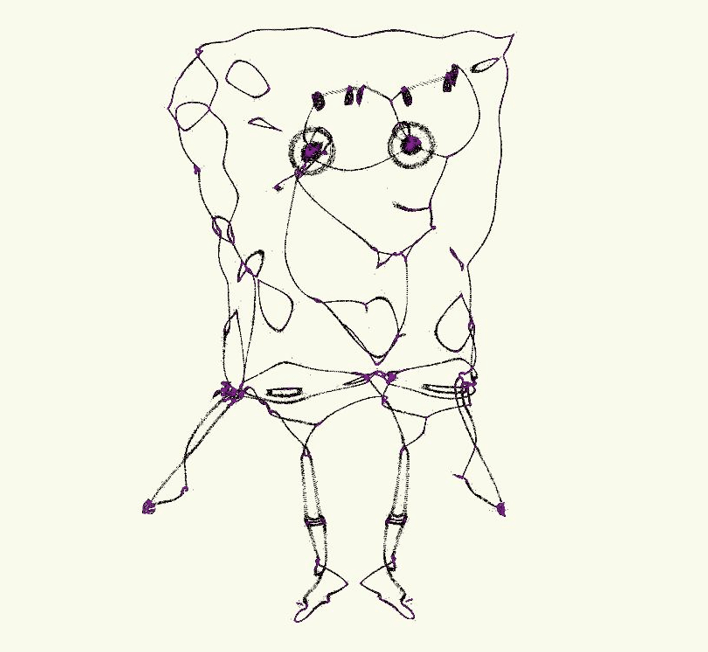
As Rob Beschizza explains, Pere Rosselló, an astrophysics student at Universidad de La Laguna in Tenerife, Spain, has created an animation depicting the gravitational collapse of Spongebob…
Beschizza muses…
Just imagine being part of a civilization on the cusp of attaining a decent model of the universe’s origins—somewhere between Halley and Lemaître, and you start plotting backwards from where we are and where the Big Bang should be you find Spongebob instead. Running the numbers again and again. Such a universe has no need of Lovecraft, cosmic horror would be right there in the maths.
Rosselló [also] solved a three-body problem: the one of animating three bodies to look really cool…
“N-body simulation of the gravitational collapse of Spongebob Squarepants,” by @PeRossello via @Beschizza in @BoingBoing.
* SpongeBob, “Rock Bottom“
###
As we deconstruct deconstruction, we might recall that it was on this date (in an unspecified year) that SpongeBob met the green seahorse Mystery.
“A greenback, greenback dollar bill / Just a little piece of paper, coated with chlorophyll”*…

Americans are increasingly going cashless. Still, as Marcus Lu illustrates, there’s rather a lot of currency in circulation– almost $2.3 Trillion (of which about a third, an estimated $950 Billion [and here] is outside the U.S.)…
Every year, the U.S. Federal Reserve submits a print order for U.S. currency to the Treasury Department’s Bureau of Engraving and Printing (BEP). The BEP will then print billions of notes in various denominations, from $1 bills to $100 bills.
In this graphic, we’ve used the latest Federal Reserve data to visualize the approximate number of bills for each denomination globally, as of Dec. 31, 2022…
“Visualizing All of the U.S. Currency in Circulation” from @VisualCap.
* Ray Charles, “Greenbacks”
###
As we concede that cash is still king, we might send penurious birthday greetings to Kenneth Rogoff; he was born on this date in 1953. An economist who teaches at Harvard and has served as the Chief Economist of the International Monetary Fund, he has been a vocal champion of austerity… thus in conflict with Nobel Laueate and former chief economist of the World Bank Joseph Stiglitz (and radically less consequentially, with your correspondent).
While Rogoff completed his education (at Princeton and MIT), he dropped out of high school at 16 to concentrate on chess (at which time he met Bobby Fischer, who was impressed by Rogoff’s “self-assured style and his knowing exactly what he wanted over the chessboard”). Two years later he returned to school but continued to play competitively. Indeed, In 2012 he drew a blitz game with the world’s highest rated player Magnus Carlsen.

“Are you green and growing or ripe and rotting?”*…

From our old friend (see, e.g., here and here) Flowing Data‘s Nathan Yau…
I read that there are more golf courses than there are McDonald’s locations in the United States, which seemed surprising. There are about 16,000 golf courses and 13,000 McDonald’s locations. How could this be? Obviously, there are a lot of McDonald’s locations, but where are all these golf courses? Some maps made it clear.
[The yellow circles in the map above show] the distribution of McDonald’s locations across the conterminous United States. As you might expect, they concentrate around cities.
An area in East Los Angeles has 110 locations within a 10-mile radius, which makes it the most dense area. This makes sense because McDonald’s was founded in southern California. The second most is an area just outside Chicago with 88 locations. This also makes sense, because McDonald’s headquarters are in Chicago.
At first glance, [the distribution of] golf courses [the green circles in the map above] looks similar to the McDonald’s one. There is a higher concentration around cities, but golf courses are more widespread, especially in the Midwest.
This makes more sense now. You can have a golf course in an area where there aren’t that many people, because people will travel to play golf. Few people are going to travel specifically for McDonald’s.
…
The high number of golf courses along the Florida coast and in the northeast jump out to me, someone who has never played a round of golf. I also noticed it’s fairly common for smaller golf courses to sit next to each other, whereas you’re not going to see neighboring McDonald’s restaurants, which seems to contribute to the higher totals for the former…
Amazing but true: “McDonald’s Locations vs. Golf Courses,” from @flowingdata.
* Ray Kroc (founder of McDonalds-as-we-know-it)
###
As we get down with data, we might recall that it was on this date in 1945 that Byron Nelson teed off in the first round of the 1945 Miami International Four Ball Tournament. For five months– from that swing through August 4– he was untouchable: Nelson won that tournament and his next 10, a record 11 events in a row, and shot 50 consecutive rounds under par.

“In the last analysis civilization is based upon the food supply”*…

From the ever-illuminating Information is Beautiful, a look at the global food supply. Click through for a larger version of the diagram above and for illustrations of what’s being over/under consumed, and how much we really need… then ponder the fact that almost one-in-ten people in the world do not get enough to eat.
* Will Durant
###
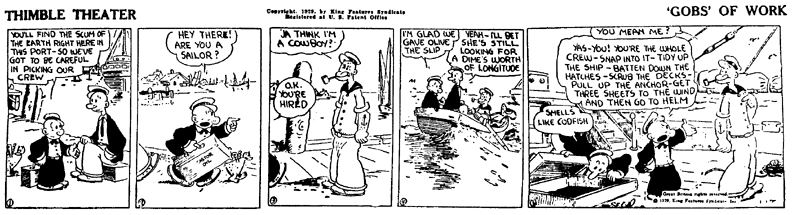
As we pick at our food, we might recall that it was on this date in 1926 that spinach-loving Popeye the Sailor, who made his first appearance in a strip (called “Thimble Theater,” along with Castor Oyle, father of Olive, who “meets” Popeye seven days later).
We might recall Popeye’s wise paraphrase of the old saw “you are what you eat”:
I yam what I yam and tha’s all what I yam.
“Nothing can better cure the anthropocentrism that is the author of all our ills than to cast ourselves into the physics of the infinitely large (or the infinitely small)”*…

And very eye-opening it can be. Jason Kottke reports on an article in the most recent issue of the American Journal of Physics with the understated title of “All objects and some questions.”
You just have to admire a chart that casually purports to show every single thing in the Universe in one simple 2D plot. [As the article’s author explain:]
In Fig. 2 [above], we plot all the composite objects in the Universe: protons, atoms, life forms, asteroids, moons, planets, stars, galaxies, galaxy clusters, giant voids, and the Universe itself. Humans are represented by a mass of 70 kg and a radius of 50 cm (we assume sphericity), while whales are represented by a mass of 10^5 kg and a radius of 7 m.
The “sub-Planckian unknown” and “forbidden by gravity” sections of the chart makes the “quantum uncertainty” section seem downright normal — the paper collectively calls these “unphysical regions.” Lovely turns of phrase all.
But what does it all mean? My physics is too rusty to say, but I thought one of the authors’ conjectures was particularly intriguing: “Our plot of all objects also seems to suggest that the Universe is a black hole.”…
Is the universe a black hole? (and other provocative propositions): @kottke on a recent scientific paper: “The Plot of All Objects in the Universe.”
* Julio Cortázar, Around the Day in Eighty Worlds
###
As we size up scale, we might recall that it was on this date in 451 that a different kind of attempt to reconcile the finite and the infinite began: the first session of the Council of Chalcedon (in modern-day Turkey) was opened. The fourth ecumenical council of the Christian church, it was attended by over 520 bishops or their representatives (making it the largest and best documented of the first seven ecumenical councils). It was convened by the Roman emperor Marcian to re-assert the teachings of the ecumenical Council of Ephesus against the heresies of Eutyches and Nestorius— whose teachings attempted to dismantle and separate Christ’s divine nature from his humanity (Nestorianism) and further, to limit Christ as solely divine in nature (Monophysitism).
The Council succeeded in that task. As Jaroslav Pelikan characterized their findings:
We all teach harmoniously [that he is] the same perfect in godhead, the same perfect in manhood, truly God and truly man, the same of a reasonable soul and body; homoousios with the Father in godhead, and the same homoousios with us in manhood … acknowledged in two natures without confusion, without change, without division, without separation.
… which marked a turning point in the Christological debates. But it also generated heated disagreements between the council and the Oriental Orthodox Church, which saw things differently– a contention that informed the separation of the Oriental Orthodox Churches from the rest of Christianity… and led to the Council being remembered as “Chalcedon, the Ominous.”

You must be logged in to post a comment.