Posts Tagged ‘astronomy’
“No part of mathematics is ever, in the long run, ‘useless’.”*…

The number 1 can be written as a sum of distinct unit fractions, such as 1/2 + 1/3 + 1/12 + 1/18 + 1/36…
Number theorists are always looking for hidden structure. And when confronted by a numerical pattern that seems unavoidable, they test its mettle, trying hard — and often failing — to devise situations in which a given pattern cannot appear.
One of the latest results to demonstrate the resilience of such patterns, by Thomas Bloom of the University of Oxford, answers a question with roots that extend all the way back to ancient Egypt.
“It might be the oldest problem ever,” said Carl Pomerance of Dartmouth College.
The question involves fractions that feature a 1 in their numerator, like 1/2, 1/7 or 1/122. These “unit fractions” were especially important to the ancient Egyptians because they were the only types of fractions their number system contained: With the exception of a single symbol for 23, they could only express more complicated fractions (like 3/4) as sums of unit fractions (1/2 + 1/4).
The modern-day interest in such sums got a boost in the 1970s, when Paul Erdős and Ronald Graham asked how hard it might be to engineer sets of whole numbers that don’t contain a subset whose reciprocals add to 1. For instance, the set {2, 3, 6, 9, 13} fails this test: It contains the subset {2, 3, 6}, whose reciprocals are the unit fractions 1/2, 1/3 and 1/6 — which sum to 1.
More exactly, Erdős and Graham conjectured that any set that samples some sufficiently large, positive proportion of the whole numbers — it could be 20% or 1% or 0.001% — must contain a subset whose reciprocals add to 1. If the initial set satisfies that simple condition of sampling enough whole numbers (known as having “positive density”), then even if its members were deliberately chosen to make it difficult to find that subset, the subset would nonetheless have to exist.
“I just thought this was an impossible question that no one in their right mind could possibly ever do,” said Andrew Granville of the University of Montreal. “I didn’t see any obvious tool that could attack it.”…
Bloom, building on work by Ernie Croot, found that tool. The ubiquity of ways to represent whole numbers as sums of fractions: “Math’s ‘Oldest Problem Ever’ Gets a New Answer,” by Jordana Cepelewicz (@jordanacep) in @QuantaMagazine.
* “No part of mathematics is ever, in the long run, ‘useless.’ Most of number theory has very few ‘practical’ applications. That does not reduce its importance, and if anything it enhances its fascination. No one can predict when what seems to be a most obscure theorem may suddenly be called upon to play some vital and hitherto unsuspected role.” – C. Stanley Ogilvy, Excursions in Number Theory
###
As we recombine, we might send carefully-calculated birthday greetings to Ulugh Beg (or, officially, Mīrzā Muhammad Tāraghay bin Shāhrukh); he was born on this date in 1394. A Timurid sultan with a hearty interest in science and the arts, he is better remembered as an astronomer and mathematician.
The most important observational astronomer of the 15th century, he built the great Ulugh Beg Observatory in Samarkand between 1424 and 1429– considered by scholars to have been one of the finest observatories in the Islamic world at the time and the largest in Central Asia. In his observations he discovered a number of errors in the computations of the 2nd-century Alexandrian astronomer Ptolemy, whose figures were still being used. His star map of 994 stars was the first new one since Hipparchus. Among his contributions to mathematics were trigonometric tables of sine and tangent values correct to at least eight decimal places.

“Eventually everything connects”*…

Long-time readers will know of your correspondent’s fascination with Powers of Ten, a remarkable short film by Charles and Ray Eames, with Philip Morrison, that begins with a couple having a picnic, zooms out by “powers of ten” to the edge of the universe, then zooms in (by those same increments) to a proton.
We’ve looked before at a number of riffs on this meditation on scale: see, e.g., here, here, and here.
Now the BBC has updated the first half of Powers of Ten:
It’s a trip worth taking.
* Charles Eames
###
As we wrestle with relationships, we might light a birthday candle for Sir Francis Bacon– English Renaissance philosopher, lawyer, linguist, composer, mathematician, geometer, musician, poet, painter, astronomer, classicist, philosopher, historian, theologian, architect, father of modern science (The Baconian– aka The Scientific– Method), and patron of modern democracy, whom some allege was the illegitimate son of Queen Elizabeth I of England (and others, the actual author of Shakespeare’s plays)… He was in any event born on this date in 1561.
Bacon (whose Essays were, in a fashion, the first “management book” in English) was, in Alexander Pope’s words, “the greatest genius that England, or perhaps any country, ever produced.” He probably did not actually write the plays attributed to Shakespeare (as a thin, but long, line of enthusiasts, including Mark Twain and Friedrich Nietzsche, believed). But Bacon did observe, in a discussion of sedition that’s as timely today as ever, that “the remedy is worse than the disease.”

“Any sufficiently advanced technology is equivalent to magic”*…

In the 1930s, ATT was rolling out dial phones to the American public…
This short subject newsreel was shown in movie theaters the week before a town’s or region’s telephone exchange was to be converted to dial service. It’s extremely short—a little over a minute, like a PSA. The film concisely explains how to use a dial telephone, including how to dial, how to recognize dial tone, and how to recognize a busy signal…
For a look into the then-future (the now present), fast forward just over 50 years, to the early 90s and to ATT’s predictions…
More in ATT Tech Channel.
[TotH to @BoingBoing for a pointer to the first video]
* Arthur C. Clarke (a 1976 interview with whom is in the Tech Channel trove)
###
As we ponder progress, we might send , ATT-related birthday greetings to Robert Woodrow Wilson; he was born on this date in 1936. An astronomer, he detected– with Bell Labs colleague Arno Penzias– cosmic microwave background radiation: “relic radiation”– that’s to say, the “sound “– of the Big Bang…. familiar to those of old enough to remember watching an old-fashioned television after the test pattern was gone (when there was no broadcast signal received): the “fuzz” we saw and the static-y sounds we heard, were the “relic radiation” being picked up.
Their 1964 discovery earned them the 1978 Nobel Prize in Physics.

“Time and tide wait for no man”*…
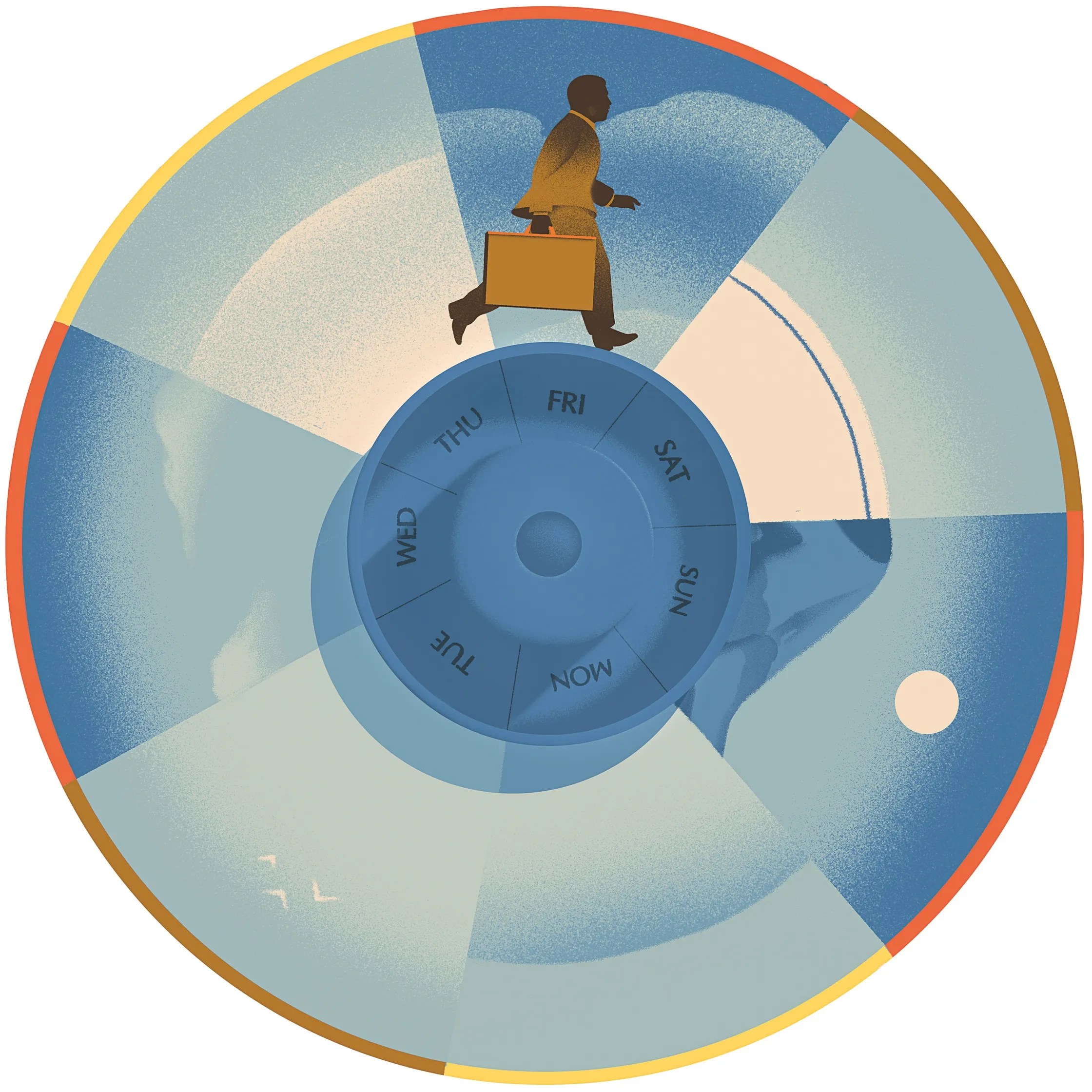
The week both arranges and imposes on our time…
Among many collective discoveries during the pandemic confinement of 2020, Americans learned just how attached we are to our seven weekdays. As complaints about temporal disorientation mounted that April, we focused not on the clock – the classic metonym for the power and experience of time – but rather on the calendar, and specifically the weekly one. A Cleveland news station affiliated with the Fox Media network entertained viewers with a daily feature, much circulated on the internet, entitled ‘What Day Is It? With Todd Meany’ – the answer to which was always a weekday, not a Gregorian calendar date…
Weeks serve as powerful mnemonic anchors because they are fundamentally artificial. Unlike days, months and years, all of which track, approximate, mimic or at least allude to some natural process (with hours, minutes and seconds representing neat fractions of those larger units), the week finds its foundation entirely in history. To say ‘today is Tuesday’ is to make a claim about the past rather than about the stars or the tides or the weather. We are asserting that a certain number of days, reckoned by uninterrupted counts of seven, separate today from some earlier moment. And because those counts have no prospect of astronomical confirmation or alignment, weeks depend in some sense on meticulous historical recordkeeping. But practically speaking, weekly counts are reinforced by the habits and rituals of other people. When those habits and rituals were radically obscured or altered in 2020, the week itself seemed to unravel…
The history of weekly timekeeping, which is only about 2,000 years old. Although taboos and cosmologies in several different cultures attached significance to seven-day cycles much earlier, there is no clear evidence of any society using such cycles to track time in the form of a common calendar before the end of the 1st century CE. As the scholars Ilaria Bultrighini and Sacha Stern have recently documented, it was in the context of the Roman Empire that a standardised weekly calendar emerged out of a combination and conflation of Jewish Sabbath counts and Roman planetary cycles. The weekly calendar, from the moment of its effective invention, reflected a union of very different ways of counting days…
The crucial formation of our modern experience of weekly time took place around the first half of the 1800s, with the rising prominence of… the differentiated weekly schedule…
The week is the most artificial and most recent of the ways we account for time, but it’s effectively impossible to imagine our shared lives without it: “How we became weekly,” by David Henkin in @aeonmag.
See also Jill Lepore‘s characteristically informative review of Henkin’s book on the week: “How the Week Organizes and Tyrannizes Our Lives” (source of the image above)
* Geoffrey Chaucer
###
As we mark time, we might recall that it was on this date in 1839 that John William Draper took a daguerreotype of the moon (the “governor” of months, while the sun determines days, seasons, and years); it was the first celestial photograph (or astrophotograph) made in the U.S. (He exposed the plate for 20 minutes using a 5-inch telescope and produced an image one inch in diameter.) Draper’s picture of his sister, taken the following year, is the oldest surviving photographic portrait.

“‘It’s magic,’ the chief cook concluded, in awe. ‘No, not magic,’ the ship’s doctor replied. ‘It’s much more. It’s mathematics.’*…

Michael Wendl (and here) dissects some variants of the magic separation, a self-working card trick…
Martin Gardner—one of history’s most prolific maths popularisers [see here]—frequently examined the connection between mathematics and magic, commonly looking at tricks using standard playing cards. He often discussed ‘self-working’ illusions that function in a strictly mechanical way, without any reliance on sleight of hand, card counting, pre-arrangement, marking, or key-carding of the deck. One of the more interesting specimens in this genre is a matching trick called the magic separation.
This trick can be performed with 20 cards. Ten of the cards are turned face-up, with the deck then shuffled thoroughly by both the performer and, importantly, the spectator. The performer then deals 10 cards to the spectator and keeps the remainder for herself. This can be done blindfolded to preclude tracking or counting. Not knowing the distribution of cards, our performer announces she will rearrange her own cards ‘magically’ so that the number of face-ups she holds matches the number of face-ups the spectator has. When cards are displayed, the counts do indeed match. She easily repeats the feat for hecklers who claim luck…
All is revealed: “An odd card trick,” from Chalkdust (@chalkdustmag).
* David Brin, Glory Season
###
As we conjure, we might spare a thought for Persian polymath Omar Khayyam; the mathematician, philosopher, astronomer, epigrammatist, and poet died on this date in 1131. While he’s probably best known to English-speakers as a poet, via Edward FitzGerald’s famous translation of the quatrains that comprise the Rubaiyat of Omar Khayyam, Omar was one of the major mathematicians and astronomers of the medieval period. He is the author of one of the most important works on algebra written before modern times, the Treatise on Demonstration of Problems of Algebra (which includes a geometric method for solving cubic equations by intersecting a hyperbola with a circle). His astronomical observations contributed to the reform of the Persian calendar. And he made important contributions to mechanics, geography, mineralogy, music, climatology, and Islamic theology.

You must be logged in to post a comment.