Posts Tagged ‘anthropology’
“This is a cardboard universe”*…

As we rid ourselves of the detritus of the Holiday season, let us pause to consider its signature component: at the turn of the 21st century, corrugated cardboard accounted for just fifteen percent of the United States recycling stream; today, it’s nearly half. Shannon Mattern on the cardboard box…
… As historian Maria Rentetzi writes (“Cardboard Box: The Politics of Materiality,” in Boxes: A Field Guide), “the cardboard box — the waste of our commercial world — is recycled in such a way as to make visible the disorder in our societies, the faults of capitalism.” It is an abject object that touches all parts of the city, from the granite kitchen island to the sewer grate. And for many of us, the cardboard box is our closest touchpoint to globalized trade, structuring our relations with people in distant places. It brings the logistics chain to our doorstep. The magnificently ripped metal freight container may get the Economist cover shot, but the plain brown box delivers messages to our homes. Its very existence in our homes, Marshall McLuhan would say, is the message. In the immortal words of Walter Paepcke, founder of the Container Corporation of America, “packages are not just commodities; they are communications.”
Let’s unpack that, shall we? Boxes are media in multiple senses of the word. They’re lithographed surfaces designed to be read, and they’re dimensional containers that mediate between outside and inside worlds. They’re “media of transport and information, shapers of public opinion and consumer desire, and means of targeting attention.” And they’re “logistical media” that “arrange people and property into time and space,” that “coordinate and control the movement of labor, people, and things situated along and within global supply chains.” The cardboard box is a minimalist form with maximalist ambitions, an arboreal apparatus made from one of the world’s most abundant renewable resources, then filled with plastic and moved around by copious quantities of oil. It doesn’t just coordinate and control landscapes; it transforms them.
Cardboard’s ubiquity rests on simple claims: I can hold that, and I can go there. The Container Corporation of America was founded in 1926, and upon those claims it built an empire with surprising reach. The CCA made collapsible shipping boxes, and it transformed packaging into a science and an art. It advanced market research, shaped mid-century taste, and altered the chromatic universe through color standards. It employed some of the best graphic designers of the period, and as national borders shifted after the Second World War, it commissioned Herbert Bayer, author of the Universal typeface, to revise the World Geo-Graphic Atlas. Even then, the CCA was remaking that new world to meet its logistical needs, rehabbing mining towns and germinating forests, and orchestrating civic discourse about all of this.
How did a packaging company get into the publishing business — into the containment and distribution of information? How were geographic imaginations changed in the process? Soon we’ll dive into the Paepcke archive, to find answers to those questions. But first I want to show you how a cardboard box is made…
In turn, inspiring and horrifying– the social history of the cardboard carton: “World in a Box,” @shannonmattern.bsky.social in @placesjournal.bsky.social.
For an earlier (R)D focused on Mattern’s work: “To clarify, ADD data.”
* Philip K. Dick, The Dark-Haired Girl
###
As we tape it tight, we might recall that it was on this date in 1910 that a federal official who might slowed the onset of the cardboard box was fired: Gifford Pinchot, the first chief of the United States Forest Service, was fired by President William Howard Taft. Pinchot had opposed Taft’s newly appointed Secretary of the Interior, Richard Ballinger, who favored commercial exploitation of federal reserve lands.
During President Theodore Roosevelt’s term, Pinchot had help enable policies for the conservation of natural resources. Roosevelt had designated millions of acres to protect as National Forests. That legacy was threatened, so Pinchot pressured Taft to remove Ballinger from office. In November of 1909, Collier’s Magazine had created a scandal when it accused Ballinger of shady dealings in coal lands in Alaska. When Pinchot criticized both Ballinger and Taft, the president reacted by firing him.

“What is it about maps? I could look at them all day”*…
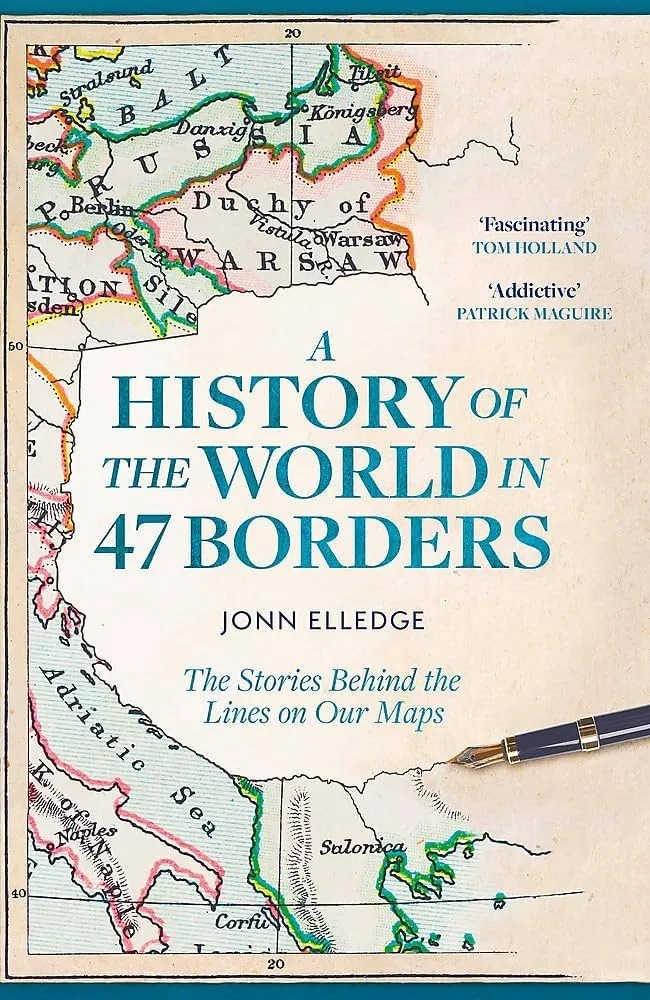
Jonn Elledge devotes the current issue of his nifty newsletter to a series of fascinating facts from his wonderful book, A Brief History of the World in 47 Borders (as it’s known in its U.S. edition, as compared to the less qualified title of the U.K. original pictured above)…
… Back in May, the good people at the UK’s leading maps and travel specialist bookshop Stanfords were kind enough to select my new book A History of the World in 47 Borders as their book of the month. And to promote it, they asked me to make a quick video, talking about it…
My initial thought was to list a single fact from each of the book’s 47 chapters, but that, I soon realised, would go on forever and take an absurd number of takes to get right. So in the end I decided on a top 10: that took an absurd number of takes to get right too, and also features me the wrong way round, for some reason, but at least it’s only three minutes long…
… as a special Christmas treat, not to mention shameless attempt to get more of you to buy the book for yourself or a loved one, here are all 47 of the facts I originally chose…
You’ll find tidbits like these:
The oldest known international border was the one between what today we call Upper Egypt and Lower Egypt. We know about it today because, sometime around 3100BCE, someone abolished it.
The Great Wall is not really one wall, but many. And the first Chinese emperor used to kidnap young men to make them build them.
The Open Borders Policies of Genghis Khan basically created the modern world.
In 1884, the great powers agreed to divide up the entire map of Africa without ever visiting. No Africans were in attendance, and one who’d asked for an invite, the Sultan of Zanzibar, was openly laughed at.
There’s a piece of Africa which two countries, Egypt and Sudan, both aggressively claim belongs to the other.
There’s an opera house in which the US/Canada border divides audience from stage.
There’s a coral atoll a thousand miles from Japan which is technically classed as a suburb of Tokyo.
Air traffic control zones cover the entire planet except the Galapagos Islands and the bit of the Arctic where Santa lives.
So much more at “47 Facts from A History of the World in 47 Borders,” from @jonnelledge.bsky.social
* Bill Bryson
###
As we muse on maps, we might send acutely observant birthday greetings to an astute student of the human animal, anthropologist Margaret Mead; she was born on this date in 1901. Best-known for her studies of the nonliterate peoples of Oceania, she was 23 when she first traveled to the South Pacific to conduct research for her doctoral dissertation. The book that resulted, Coming of Age in Samoa, was– and remains– a best-seller.

“The ultimate hidden truth of the world is that it is something we make and could just as easily make differently”*…

As a new collection of his writing is published, Rebecca Solnit remembers her friend David Graeber, the late activist and anarchist who believed ordinary people have the power to change the world…
David Graeber was a joyful, celebratory person. An enthusiast, voluble, on fire with the possibilities in the ideas and ideologies he wrestled with. Every time we met – from New Haven in the early 00s to London a few years before his death in 2020 – he was essentially the same: beaming, rumpled, with a restless energy that seemed to echo the constant motion of his mind, words tumbling out as though they were, in their unstoppable abundance, overflowing. But he was also much respected in activist circles for being a good listener, and his radical egalitarianism was borne out in how he related to the people around him.
He was always an anthropologist. After doing fieldwork among traditional peoples in Madagascar, he just never stopped, but he turned his focus to his own society. Essays such as Dead Zones of the Imagination: On Violence, Bureaucracy, and ‘Interpretive Labor’ and his book Bullshit Jobs came from using the equipment of an anthropologist on stuff usually regarded as boring, or not regarded at all – the function and impact of bureaucracy. His 2011 bestseller on debt reminded us that money and finance are among the social arrangements that could be rearranged for the better.
He insisted, again and again, that industrialised Euro-American civilisation was, like other societies past and present, only one way of doing things among countless options. He cited times when societies rejected agriculture or technology or social hierarchy, when social groups chose what has often been dismissed as primitive because it was more free. And he rejected all the linear narratives that present contemporary human beings as declining from primordial innocence or ascending from primitive barbarism. He offered, in place of a single narrative, many versions and variations; a vision of societies as ongoing experiments, and human beings as endlessly creative. That variety was a source of hope for him, a basis for his recurrent insistence that it doesn’t have to be this way.
As Marcus Rediker wrote in his review of David’s posthumous book Pirate Enlightenment, “Everything Graeber wrote was simultaneously a genealogy of the present and an account of what a just society might look like.” He was concerned about inequality of all kinds, including gender inequality in this society and others, and the violence that enforces inequality and unfreedom, as well as how they might be delegitimised and where and when societies might have escaped them. He focused, in short, on freedom and its impediments…
…
… The way that, as he wrote, “The ultimate hidden truth of the world is that it is something we make and could just as easily make differently.” If you truly believe that, if you perceive a world that is constructed according to certain assumptions and values, then you see that it can be changed, not least by changing those assumptions and values.
We have to recognise that ideas are tools that we wield – and with them, some power. David wanted to put these tools in everyone’s hands, or remind them that they are already there. Which is part of why he worked hard at – and succeeded in – writing in a style that wasn’t always simple but was always as clear and accessible as possible, given the material. Egalitarianism is a prose style, too. Our mutual friend the writer, film-maker, and debt abolitionist Astra Taylor texted him: “Re-reading Debt. You are such a damn good writer. A rare skill among lefties.” He texted back that August, a month before his demise: “Why thanks! Well at least I take care to do so – I call it ‘being nice to the reader,’ which is an extension of the politics, in a sense.”
In order to believe that people can govern themselves in the absence of coercive institutions and hierarchies, anarchists must have great faith in ordinary people, and David did. A sentence Lyndsey Stonebridge wrote about Hannah Arendt could apply equally well to him: “To fixate on her exceptional mind is to miss something that is important about her lessons in thinking: thinking is ordinary, she teaches; that is its secret power.”…
An edited extract from Solnit’s foreword to The Ultimate Hidden Truth of the World by David Graeber: “‘It does not have to be this way’- the radical optimism of David Graeber,” from @RebeccaSolnit in @guardian.
* David Graeber
###
As we promote possibility (and remember that on this date in 1973 then-President Richard Nixon averred in a speech that “I am not a crook”), we might send never-ending birthday greetings to August Möbius; he was born on this date in 1790. An astronomer and mathematician, he studied under mathematician Carl Friedrich Gauss while Gauss was the director of the Göttingen Observatory. From there, he went on to study with Carl Gauss’s instructor, Johann Pfaff, at the University of Halle, where he completed his doctoral thesis The occultation of fixed stars in 1815. In 1816, he became Extraordinary Professor in the “chair of astronomy and higher mechanics” at the University of Leipzig, where he remained for the rest of his career.
While he was an influential professor, he is best remembered for his creation of the “Möbius strip.”

“What a piece of work is a man”*…

The estimable Samuel Arbesman on the path dependency of our fundamental ideas about ourselves…
Awhile back I wrote about AI and human distinctiveness: basically my argument was that we should be less concerned by whether or not AI can do we what we can and care more about what we want to be doing. In other words, focus on what is quintessentially human, rather than what is uniquely human.
But perhaps some of these concerns are simply Western preoccupations, rather than universal human concerns?
In the recent book Fluke (which is fantastic! [your correspondent heartily agrees]), Brian Klaas noted the following provocative point about differences between Western and Eastern thinking—and their views on human distinctness—and how it might have been due to the ecological milieu that each one arose from:
In this vision of a world humans are distinct from the rest of the natural world. That felt true for the inhabitants of the Middle East and Europe around the time of the birth of Christianity. Camels, cows, goats, mice, and dogs composed much of the encountered animal kingdom, a living menagerie of the beings that are quite unlike us.
In many Eastern cultures, by contrast, ancient religions tended to emphasize our unity with the natural world. One theory suggests that was partly because people lived among monkeys and apes. We recognized ourselves in them. As the biologist Roland Ennos points out, the word orangutan even means “man of the forest.” Hinduism has Hanumen, a monkey god. In China, the Chu kingdom revered gibbons. In these familiar primates, the theory suggests, it became impossible to ignore that we were part of nature—and nature was part of us.
This is almost a Guns, Germs, and Steel-kind of approach, but for ideas. At the risk of creating too much determinism here, it’s intriguing to explore the path dependence of ideas and concepts that organize how we think about the world and ourselves.
This reminds me of other research that examined how small historical distinctions can still affect our modern world, even if they are no longer relevant. For example, there is research that looks at how certain locations betray their histories as portage sites—places where boats or cargo were transported over land, allowing travel between more traversable waterways—despite this being obsolete. And yet it still has a certain long-term effect, as per this paper “Portage and Path Dependence”:

And returning to ideas, there is a paper entitled “Frontier Culture: The Roots and Persistence of ‘Rugged Individualism’ in the United States” that explores whether or not certain differences in location—areas considered the “frontier”—affect the geographical variation of ideas and beliefs in the United States.
In the end, simply being more aware of the ideas and history that suffuse our thinking—rather than taking them for granted—is something important, whether or not we are trying to understand humanity’s place in the world, how technology should impact humanity, or why cities are located where they are…
From his marvelous newsletter, Cabinet of Wonders: “Human Distinctiveness in Different Cultures,” @arbesman.
Pair with his earlier piece: “Archaeology of Biology and Software.”
And for a(nother) taste of Brian Klaas (@brianklaas), see “Curiosity has its own reason for existing.”
* Shakespeare, Hamlet
###
As we ruminate on the roots of our (received) realities, we might recall that it was on this date in 3 BCE that a planetary conjunction of Jupiter and Venus was visible… and may have been the Star of Bethlehem mentioned in the New Testament.
In this pre-dawn, “morning star” conjunction, the two planets appeared very close to each other in the sky (a mere 0.07° apart as viewed from Earth). It occurred when the planets were in the last degrees of the zodiacal sign of Cancer which was the concluding sign for interpreting that astrological year. The same two planets met again just ten months later (June 17, 2 BCE), even more closely, almost touching (0.01°), in an “evening star” conjunction in the first degrees of Leo, the beginning sign of the new astrological year. These two unions of Jupiter and Venus might well have been interpreted as the close of one age in history and the beginning of another age in 2 BCE.
For more on these conjunctions and other potential candidates for “historical Star of Bethlehem” (and an explanation of how/why the astronomers/astrologers who sighted the star became Magi/Wise Men in Church teaching) see here.

“A horse! a horse! my kingdom for a horse!”*…

The horse transformed human history—and now, as Christina Larson reports, scientists have a clearer idea of when humans began to transform the horse…
Around 4,200 years ago, one particular lineage of horse quickly became dominant across Eurasia, suggesting that’s when humans started to spread domesticated horses around the world, according to research published [recently] in the journal Nature.
There was something special about this horse: It had a genetic mutation that changed the shape of its back, likely making it easier to ride.
“In the past, you had many different lineages of horses,” said Pablo Librado, an evolutionary biologist at the Spanish National Research Council in Barcelona and co-author of the new study. That genetic diversity was evident in ancient DNA samples the researchers analyzed from archaeological sites across Eurasia dating back to 50,000 years ago.
But their analysis of 475 ancient horse genomes showed a notable change around 4,200 years ago.
That’s when a specific lineage that first arose in what’s known as the Pontic-Caspian Steppe, a plains region that stretches from what is now northeastern Bulgaria across Ukraine and through southern Russia, began to pop up all across Eurasia and quickly replaced other lineages. Within three hundred years, the horses in Spain were similar to those in Russia.
“We saw this genetic type spreading almost everywhere in Eurasia—clearly this horse type that was local became global very fast,” said co-author Ludovic Orlando, a molecular archaeologist at the Centre for Anthropobiology and Genomics of Toulouse in France.
The researchers believe that this change was because a Bronze Age people called the Sintashta had domesticated their local horse and begun to use these animals to help them dramatically expand their territory.
Domesticating wild horses on the plains of Eurasia was a process, not a single event, scientists say.
Archaeologists have previously found evidence of people consuming horse milk in dental remains dating to around 5,500 years ago, and the earliest evidence of horse ridership dates to around 5,000 years ago. But it was the Sintashta who spread the particular horses they had domesticated across Eurasia, the new study suggests…
People had domesticated other animals several thousand years before horses—including dogs, pigs, cattle, goats and sheep. But the new research shows that the shrinking genetic diversity associated with domestication happened much faster in horses.
“Humans changed the horse genome stunningly quickly, perhaps because we already had experience dealing with animals,” said Laurent Frantz, who studies the genetics of ancient creatures at the Ludwig Maximilian University of Munich and was not involved in the study.
“It shows the special place of horses in human societies.”…
“Scientists have traced the origin of the modern horse to a lineage that emerged 4,200 years ago,” from @larsonchristina in @physorg_com.
* Shakespeare, Richard III
###
As we mount up, we might recall that it was on this date in 1878 that Eadweard Muybridge took a series of photographs to prove that all four feet of a horse leave the ground when it runs. He had been retained by former California Governor (and university founder) Leland Stanford to help settle a bet. While Muybridge was best known in his own day for his large photographs of Yosemite Valley, he did seminal early work on motion picture projection, and the approaches he developed for the study of motion are at the heart of both animation and computer analysis today.

You must be logged in to post a comment.