Posts Tagged ‘anarchy’
“Anarchism is democracy taken seriously”*…
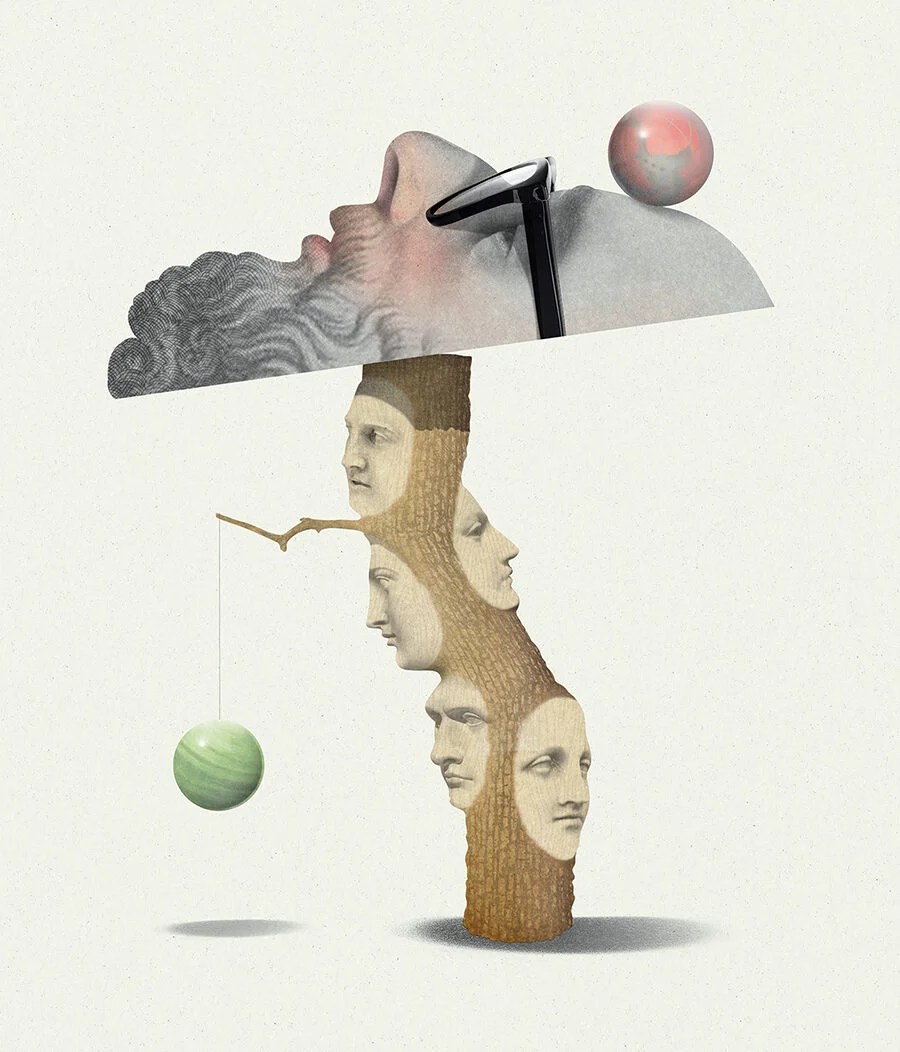
Further (and to some extent, contra) to yesterday’s post– Martin Gurri on the need to reground Liberal Democracy— the estimable Alan Jacobs, who suggests that we need to get in touch with our “inner anarchist.” In a recent post, he shares a “mini-manifesto”…
I am temperamentally and morally a conservative, which is to say: I believe that I am charged with preserving my inheritance, nurturing it, and passing it along to the next generation. That inheritance is spiritual, cultural, natural, and political. (It may or may not be financial; that matters little.) Our largest social problems stem from the fact that our political economy promotes the concentration of power and money, and the concentration of power and money militates against the preservation of any spiritual, cultural, and natural inheritance. That is how we get an unprecedentedly rich and theoretically free society that also features corrupt religious institutions, insipid art, and dying rivers. I will continue to do my best to conserve and promote my Christian faith, my convictions about art, and my natural environment, but I must do so in unpropitious conditions. We need an alternative political economy that encourages rather than inhibiting the work of conservation, and I think anarchism, properly understood, is that alternative.
Citing his “major guides” to thinking about anarchism– Peter Marshall, Demanding the Impossible: A History of Anarchism; James Scott, Two Cheers for Anarchism; and David Graeber, essays— he notes that, on his old blog he posted often on the subject, and directs us to “this essay [source of the image above] and then this reflection on Christian anarchy” for his fundamental thoughts.
But the meat of the post is the “notebook” of thoughts on anarchism that follow. A few examples:
It is vitally important to distinguish anarchism from libertarianism. The highest goods of the libertarian are freedom of action and freedom to own property, both conceived as belonging to the individual. The anarchist, by contrast, seeks some form of the good life in collaboration and cooperation with others. Anarchism is therefore intrinsically social, pluralistic, and unplanned. Because, as Isaiah Berlin says, the Great Goods are not always compatible with one another, you collaborate with people who share your priorities, understanding and accepting that others will find other structures of collaboration. And in pursuing those goods you have the humility to recognize that you don’t know how they may be achieved; that is something you discover through your collaboration. (Related by me: this and this.)
Anarchism is therefore not a system of government but a practice, and one can practice it at any level of social interaction. The parent who tells two squabbling children to work out their differences themselves, rather than appealing to a parental verdict, is practicing anarchism, and a very important form of it too. (See my comments on machi no hoiku and mimamoru in this post. Anarchist pedagogy!)…
The true anarchist can never throw bombs, because when you do that you are making decisions for other people without their consent, which is anthithetical to anarchism…
Anarchism can never be revolutionary in the sense in which political systems (communism, socialism, fascism) can be revolutionary. But the ultimate effects of anarchism can be far greater than the effects of any of those other movements. As Hannah Arendt said, every revolutionary becomes a conservative the day after the revolution; as The Who said, “Meet the new boss, same as the old boss.” Anarchism declines bosses [but importantly, not leaders] altogether. And that is truly revolutionary – but it is only brought about by means so slow and patient that no one can see them at work…
So much more, eminently worth reading in full: “Anarchist Notebook.”
Extra credit opportunity: recognizing that Jacobs’ critique of the status quo is not inconsistent with Gurri’s, how might we take up Gurri’s challenge to reground Democracy in a way that stirs in the “commons” thinking of anarchism?
###
As we rebuild better, we might send revolutionary birthday greetings to Nestor Makhno (AKA Bat’ko Makhno); he was born on this date in 1888 (O.S.). He was a Ukrainian anarchist revolutionary and the commander of the Revolutionary Insurgent Army of Ukraine during the Ukrainian War of Independence (a war to regain independence by the Ukrainian People’s Republic against the Bolsheviks, who had annexed Ukraine into the Soviet Union). He established the Makhnovshchina (loosely translated as “Makhno movement”), a mass movement in the Ukrainian peasantry to establish an anarchist system in the country between 1918 and 1921.
Sadly, that struggle for independence continues to this day.

“The ultimate hidden truth of the world is that it is something we make and could just as easily make differently”*…

As a new collection of his writing is published, Rebecca Solnit remembers her friend David Graeber, the late activist and anarchist who believed ordinary people have the power to change the world…
David Graeber was a joyful, celebratory person. An enthusiast, voluble, on fire with the possibilities in the ideas and ideologies he wrestled with. Every time we met – from New Haven in the early 00s to London a few years before his death in 2020 – he was essentially the same: beaming, rumpled, with a restless energy that seemed to echo the constant motion of his mind, words tumbling out as though they were, in their unstoppable abundance, overflowing. But he was also much respected in activist circles for being a good listener, and his radical egalitarianism was borne out in how he related to the people around him.
He was always an anthropologist. After doing fieldwork among traditional peoples in Madagascar, he just never stopped, but he turned his focus to his own society. Essays such as Dead Zones of the Imagination: On Violence, Bureaucracy, and ‘Interpretive Labor’ and his book Bullshit Jobs came from using the equipment of an anthropologist on stuff usually regarded as boring, or not regarded at all – the function and impact of bureaucracy. His 2011 bestseller on debt reminded us that money and finance are among the social arrangements that could be rearranged for the better.
He insisted, again and again, that industrialised Euro-American civilisation was, like other societies past and present, only one way of doing things among countless options. He cited times when societies rejected agriculture or technology or social hierarchy, when social groups chose what has often been dismissed as primitive because it was more free. And he rejected all the linear narratives that present contemporary human beings as declining from primordial innocence or ascending from primitive barbarism. He offered, in place of a single narrative, many versions and variations; a vision of societies as ongoing experiments, and human beings as endlessly creative. That variety was a source of hope for him, a basis for his recurrent insistence that it doesn’t have to be this way.
As Marcus Rediker wrote in his review of David’s posthumous book Pirate Enlightenment, “Everything Graeber wrote was simultaneously a genealogy of the present and an account of what a just society might look like.” He was concerned about inequality of all kinds, including gender inequality in this society and others, and the violence that enforces inequality and unfreedom, as well as how they might be delegitimised and where and when societies might have escaped them. He focused, in short, on freedom and its impediments…
…
… The way that, as he wrote, “The ultimate hidden truth of the world is that it is something we make and could just as easily make differently.” If you truly believe that, if you perceive a world that is constructed according to certain assumptions and values, then you see that it can be changed, not least by changing those assumptions and values.
We have to recognise that ideas are tools that we wield – and with them, some power. David wanted to put these tools in everyone’s hands, or remind them that they are already there. Which is part of why he worked hard at – and succeeded in – writing in a style that wasn’t always simple but was always as clear and accessible as possible, given the material. Egalitarianism is a prose style, too. Our mutual friend the writer, film-maker, and debt abolitionist Astra Taylor texted him: “Re-reading Debt. You are such a damn good writer. A rare skill among lefties.” He texted back that August, a month before his demise: “Why thanks! Well at least I take care to do so – I call it ‘being nice to the reader,’ which is an extension of the politics, in a sense.”
In order to believe that people can govern themselves in the absence of coercive institutions and hierarchies, anarchists must have great faith in ordinary people, and David did. A sentence Lyndsey Stonebridge wrote about Hannah Arendt could apply equally well to him: “To fixate on her exceptional mind is to miss something that is important about her lessons in thinking: thinking is ordinary, she teaches; that is its secret power.”…
An edited extract from Solnit’s foreword to The Ultimate Hidden Truth of the World by David Graeber: “‘It does not have to be this way’- the radical optimism of David Graeber,” from @RebeccaSolnit in @guardian.
* David Graeber
###
As we promote possibility (and remember that on this date in 1973 then-President Richard Nixon averred in a speech that “I am not a crook”), we might send never-ending birthday greetings to August Möbius; he was born on this date in 1790. An astronomer and mathematician, he studied under mathematician Carl Friedrich Gauss while Gauss was the director of the Göttingen Observatory. From there, he went on to study with Carl Gauss’s instructor, Johann Pfaff, at the University of Halle, where he completed his doctoral thesis The occultation of fixed stars in 1815. In 1816, he became Extraordinary Professor in the “chair of astronomy and higher mechanics” at the University of Leipzig, where he remained for the rest of his career.
While he was an influential professor, he is best remembered for his creation of the “Möbius strip.”

“What is an anarchist? One who, choosing, accepts the responsibility of choice.”*…

Per the Oxford Dictionaries, “anarchy” has two meanings:
1. a state of disorder due to absence or nonrecognition of authority or other controlling systems.
2. the organization of society on the basis of voluntary cooperation, without political institutions or hierarchical government; anarchism.
It’s fair to observe that, in common parlance, it’s the first definition that rules. The estimable Alan Jacobs puts in a word for the second, and positions it as something beyond the political, something spiritual…
Perhaps the most unusual element of my 2022 essay on anarchism is this: I present anarchism not as a political system but as a spiritual discipline. I don’t put the point quite that bluntly, but I come fairly close:
The first target of anarchistic practice ought to be whatever it is in me that resists anarchy — what resists negotiation, the turning toward the Other as neighbor and potential collaborator. I return to Odo’s line, “What is an anarchist? One who, choosing, accepts the responsibility of choice,” but I add this: The responsibility of choice arises when I acknowledge my own participation, in a thousand different ways, in the imposition of order on others. This is where anarchism begins; where the turning aside from the coldest of all cold monsters begins; where I begin. The possibility of anarchic action arises when I acknowledge my own will to power...
It should be obvious that if you are delighted with power politics – if you think the purpose of politics is “defeating the enemy and enjoying the spoils” of your victory – then you won’t be worried about your own will to power. You can just turn off your conscience and go on the attack, thinking only about winning (good) and losing (bad). My suggestion that the desire to impose order on others is a desire that needs to be reflected on will seem obviously silly to you. But there’s another way of thinking about the political order that is equally incompatible with the kind of reflection I counsel in that essay: the libertarian model.
Libertarianism doesn’t want to impose order on others, but its most passionate advocates have a strong tendency to assess existence in terms of winning and losing – winning and losing not in the corridors of political power but in the marketplace; the individual entrepreneur controlling the segment of the market in which he works. As Mark Zuckerberg likes to say, it’s all about DOMINATION; just not domination by law. Anarchism, by contrast — this is my argument in that essay — stands between (libertarian) chaos and (seeking to become) the Man. Some of the most thoughtful anarchists like to say that “anarchy is order” – but order that emerges from collaboration and cooperation rather than being imposed by governmental power. I don’t think it’s possible to create an anarchist system, because an anarchism imposed on people by those in power isn’t anarchism.
Here’s what I think can be done: Try, in every way we can think of, to increase the number of situations in our lives in which we are neither dehumanized by an omnipotent state nor engaged in ceaseless competition with one another in an omnipotent marketplace. As Wendell Berry has written, “Rats and roaches live by competition under the law of supply and demand; it is the privilege of human beings to live under the laws of justice and mercy.” We should assume that privilege whenever we can, and take it upon ourselves as a collaborative of equals to determine what, in any given case facing us, justice and mercy are. In other words, what I call the anarchic imperative is an attempt to rebalance what Berry has called “the two economies”:
For the thing that so troubles us about the industrial economy is exactly that it is not comprehensive enough, that, moreover, it tends to destroy what it does not comprehend, and that it is dependent upon much that it does not comprehend. In attempting to criticize such an economy, it is probably natural to pose against it an economy that does not leave anything out. And we can say without presuming too much, that the first principle of the kingdom of God is that it includes everything; in it the fall of every sparrow is a significant event. We are in it, we may say, whether we know it or not, and whether we wish to be or not. Another principle, both ecological and traditional, is that everything in the kingdom of God is joined both to it and to everything else that is in it. That is to say that the kingdom of God is orderly.
Amen to that. But what is the nature of that order? Eschatologically, it certainly ain’t anarchic: it is the kingdom of the archē, the source of all things, the Lord. But to understand and instantiate that Kingdom here and now – when, as St. Augustine says, the City of God and the City of Man are inevitably and confusingly mixed – we need to collaborate with one another to increase both our knowledge and our ability to act effectively.
I have argued at some length that Christians aren’t pluralists – we believe that “at the name of Jesus every knee will bow” (Phil. 2:10) – but in our current position we should expect, accept, and even embrace plurality. We need to cultivate the virtues appropriate to a plural world, and we can do that by expanding the sphere of voluntary collaboration, negotiation among equals, emergent order, even when such expansion makes life more difficult for us. That’s anarchism as a spiritual discipline…
Charting a course between libertarianism and autocracy: “Anarchism as a spiritual discipline.”
[The image above is from Jacobs’ Harpers essay— eminently worth reading]
* Ursula K. Le Guin, who created Odo (and Odoism) in The Dispossessed
###
As we choose, we might recall that it was (probably) on this date that the first edition of what we know as the Gutenberg Bible was published.
While many believe that Johannes Gutenberg first work using moveable type was the Bible, it was probably the second or maybe even third. [Indeed, there was an earlier (32 line) version of the parts of the Bible, labeled an “indulgence.”] The Gutenberg press was in operation by 1450, and it is known that a German poem had been printed before the Bible. However, it is known that Gutenberg began the painstaking process of hand placing every letter for every page of the new Bible during that same year. It is believed that the 42-line Gutenberg Bible [the one we know as “The Gutenberg Bible”] was completed on this day in 1456. About 180 copies of the book were printed, which seems rather small for a first edition…

Objectiv(ist) advice…

Dear Ayn,
I’m dating a man who I think I love, but I’m afraid he’s having an affair. He comes home late, he acts suspiciously, and he even has red lipstick on his collar. Should I confront him or just hope for the best?
— County Affair
Dear County,
Red lipstick? Your husband is a communist. Divorce him and sell his clothes, children, and pens to make money to spend on cars, human slaves, and bigger pens. This will simultaneously stimulate the economy and punish the slaves for not having jobs. Slaves: what lazybones!
Hope this helps,
Ayn
More advice-for-the-sniveling at Megan Amran’s “Ann Randers” in McSweeney’s.
***
As we remind ourselves that the economic debacle of 9-15-08 was maybe not so surprising after, given Chairman Greenspan’s devotion to Ms. Rand, we might spare a thought for a strong woman of a very different sort; free-thinker Emma Goldman died on this date in 1940. A political activist, writer, and speaker, she founded Mother Earth magazine in 1906. She played a pivotal role in the development of anarchist political philosophy in North America and Europe in the first half of the twentieth century.
Anarchism, then, really stands for the liberation of the human mind from the dominion of religion; the liberation of the human body from the dominion of property; liberation from the shackles and restraint of government. Anarchism stands for a social order based on the free grouping of individuals for the purpose of producing real social wealth; an order that will guarantee to every human being free access to the earth and full enjoyment of the necessities of life, according to individual desires, tastes, and inclinations.
– from the title essay, Anarchism and Other Essays, 1910

Perhaps even more than constituted authority, it is social uniformity and sameness that harass the individual most. His very “uniqueness,” “separateness” and “differentiation” make him an alien, not only in his native place, but even in his own home.
You must be logged in to post a comment.