Posts Tagged ‘frontier’
“What a piece of work is a man”*…

The estimable Samuel Arbesman on the path dependency of our fundamental ideas about ourselves…
Awhile back I wrote about AI and human distinctiveness: basically my argument was that we should be less concerned by whether or not AI can do we what we can and care more about what we want to be doing. In other words, focus on what is quintessentially human, rather than what is uniquely human.
But perhaps some of these concerns are simply Western preoccupations, rather than universal human concerns?
In the recent book Fluke (which is fantastic! [your correspondent heartily agrees]), Brian Klaas noted the following provocative point about differences between Western and Eastern thinking—and their views on human distinctness—and how it might have been due to the ecological milieu that each one arose from:
In this vision of a world humans are distinct from the rest of the natural world. That felt true for the inhabitants of the Middle East and Europe around the time of the birth of Christianity. Camels, cows, goats, mice, and dogs composed much of the encountered animal kingdom, a living menagerie of the beings that are quite unlike us.
In many Eastern cultures, by contrast, ancient religions tended to emphasize our unity with the natural world. One theory suggests that was partly because people lived among monkeys and apes. We recognized ourselves in them. As the biologist Roland Ennos points out, the word orangutan even means “man of the forest.” Hinduism has Hanumen, a monkey god. In China, the Chu kingdom revered gibbons. In these familiar primates, the theory suggests, it became impossible to ignore that we were part of nature—and nature was part of us.
This is almost a Guns, Germs, and Steel-kind of approach, but for ideas. At the risk of creating too much determinism here, it’s intriguing to explore the path dependence of ideas and concepts that organize how we think about the world and ourselves.
This reminds me of other research that examined how small historical distinctions can still affect our modern world, even if they are no longer relevant. For example, there is research that looks at how certain locations betray their histories as portage sites—places where boats or cargo were transported over land, allowing travel between more traversable waterways—despite this being obsolete. And yet it still has a certain long-term effect, as per this paper “Portage and Path Dependence”:

And returning to ideas, there is a paper entitled “Frontier Culture: The Roots and Persistence of ‘Rugged Individualism’ in the United States” that explores whether or not certain differences in location—areas considered the “frontier”—affect the geographical variation of ideas and beliefs in the United States.
In the end, simply being more aware of the ideas and history that suffuse our thinking—rather than taking them for granted—is something important, whether or not we are trying to understand humanity’s place in the world, how technology should impact humanity, or why cities are located where they are…
From his marvelous newsletter, Cabinet of Wonders: “Human Distinctiveness in Different Cultures,” @arbesman.
Pair with his earlier piece: “Archaeology of Biology and Software.”
And for a(nother) taste of Brian Klaas (@brianklaas), see “Curiosity has its own reason for existing.”
* Shakespeare, Hamlet
###
As we ruminate on the roots of our (received) realities, we might recall that it was on this date in 3 BCE that a planetary conjunction of Jupiter and Venus was visible… and may have been the Star of Bethlehem mentioned in the New Testament.
In this pre-dawn, “morning star” conjunction, the two planets appeared very close to each other in the sky (a mere 0.07° apart as viewed from Earth). It occurred when the planets were in the last degrees of the zodiacal sign of Cancer which was the concluding sign for interpreting that astrological year. The same two planets met again just ten months later (June 17, 2 BCE), even more closely, almost touching (0.01°), in an “evening star” conjunction in the first degrees of Leo, the beginning sign of the new astrological year. These two unions of Jupiter and Venus might well have been interpreted as the close of one age in history and the beginning of another age in 2 BCE.
For more on these conjunctions and other potential candidates for “historical Star of Bethlehem” (and an explanation of how/why the astronomers/astrologers who sighted the star became Magi/Wise Men in Church teaching) see here.

“For civilizations, exchange is oxygen”*…

On the worldwide campaign to return sacred objects to the ancestral communities from which they were taken…
… debates about precious artifacts, repatriation and who owns the right to dictate the terms of cultural spaces – and history itself – are not mere academic discourse.
Our cultural narratives have consequences. As the author Chimamanda Ngozi Adichie points out, ‘the danger of a single story’ is that it can all the more easily be manipulated and weaponized by political pundits and the autocrats of empire. In the multiplicity of narratives – told from the vantage points of victor and vanquished, rich and poor, proud and meek – we can approach the richness of truth, which Goethe warns us ‘has to be repeated constantly, because error also is being preached all the time, and not just by a few, but by the multitude’. A proverb from the Ewe-mina people of Benin, Ghana and Togo – with variants across the African continent – puts it aptly, ‘Until the lions tell their stories, the tale of the hunt will always glorify the hunter.’
Consider the case of the European enlightenment. After the invention of the printing press in 1450, there were the New World genocides of Indigenous peoples and the bloody rise of colonization, which led to the rapid seizure, trafficking and enslavement of Africans, who were converted into resources to fuel wars. This led to the ascent of so-called enlightenment science and its attendant technologies for navigation, warfare and industry. The commercial imperatives of war thus became inextricably bound with the shaping of the Eurocentric cognoscenti. In The Silk Roads, Oxford scholar Peter Frankopan puts the distorted history we tell about the European contributions to world culture into focus:
The world changed in the late fifteenth century . . . There was a price for the magnificent cathedrals, the glorious art and the rising standards of living that blossomed from the sixteenth century onwards. It was paid by populations living across the oceans: Europeans were able not only to explore the world but to dominate it. They did so thanks to the relentless advances in military and naval technology that provided an unassailable advantage over the populations they came into contact with. The age of empire and the rise of the west were built on the capacity to inflict violence on a major scale.
As Frankopan goes on to describe, the task before Europe in the fifteenth century was to reinvent the past. The fact that France, Germany, Austria, Spain, Portugal and England had nothing to do with Athens and were largely peripheral to the worlds of the ancient Greeks and Romans ‘was glossed over as artists, writers and architects went to work, borrowing themes, ideas and texts from antiquity to provide a narrative that chose selectively from the past to create a story which over time became not only increasingly plausible but standard’. This was no renaissance; it was revisionism for the sake of empire.
The upshot of this rewriting of history is the strange fruit of a white supremacist fetish for claiming the Greeks and Romans as their ancestors. Societies around the globe are witnessing an acute recrudescence of hate and extremism tied to inadequate schema and inaccurate history. In the US, an assorted rally of neo-Nazis and other hate groups converged in 2017 in Charlottesville, Virginia, home to a major public university founded by Thomas Jefferson. One of the many erroneous views that their signs and chants promoted is that the Greeks emerged somehow independently from their forebears, as a ‘pristine’ white civilization demarcated strictly to continental Europe. Nothing could be further from the truth about ancient Greek civilization, considering the diverse cultures (particularly African, including what we would now call Algerian, Tunisian, Egyptian, Sudanese and Ethiopian) that formed and fueled the intellectual advancements of the Greco-Roman world around the Mediterranean. Several journalistic reviews, some more tongue-in-cheek than others, have quipped that white supremacy’s love for the Greeks and Romans is more a product of the paint peeling from white marble statues than any real historical analysis…
We must ask whether stewardship in our cultural institutions is just about the capacity to procure, store and display objects, or rather if it is also about making visible otherwise obscured histories. The panjandrums of empire promote facile narratives that fall far short of the latter standard. Instead, true stewardship should represent a commitment to making known a balanced rather than blinkered history, reflecting meaningfully on the atrocities perpetrated by the so-called enlightened.
…
It has been said that Western domination of Africa, Asia and the Americas was made possible by centuries of practice in building impregnable fortresses. Perhaps inevitably, these empires have failed to recall, in the incisive words of poet Aimé Césaire, that ‘a civilization that withdraws into itself atrophies’, since, after all, ‘for civilizations, exchange is oxygen.’ The fortress builders, intent only on acquisitiveness and self-protection, have barricaded themselves against external assault but have unwittingly cocooned themselves, closed and sealed off, fearful of an enemy that no weapon or wall could possibly defeat.
“Talismans of Blood and Memory,” from Philip Kurian, director of the Quantum Biology Laboratory at Howard University.– eminently worth reading in full.
* “I admit that it is a good thing to place different civilizations in contact with each other that it is an excellent thing to blend different worlds; that whatever its own particular genius may be, a civilization that withdraws into itself atrophies; that for civilizations, exchange is oxygen; that the great good fortune of Europe is to have been a crossroads, and that because it was the locus of all ideas, the receptacle of all philosophies, the meeting place of all sentiments, it was the best center for the redistribution of energy. But then I ask the following question: has colonization really placed civilizations in contact? Or, if you prefer, of all the ways of establishing contact, was it the best?” — Aimé Césaire
###
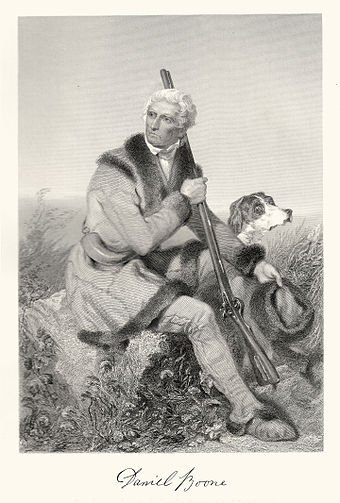
As we undertake to understand, we might send rough birthday greetings to Daniel Boone; he was born on this date in 1734. A pioneer and frontiersman, he became famous for his exploration and settlement of what is now Kentucky, which was then beyond the western borders of the Thirteen Colonies; his exploits made him one of the first folk heroes of the United States.
Boone was a celebrated player in the “civilizing” (colonializing) project of his time, but he had real regard for North Americas original inhabitants. Some 19th-century writers regarded Boone’s sympathy for Native Americans as a character flaw and altered his words to conform to contemporary attitudes; his image was often reshaped into the stereotype of the belligerent, Indian-hating frontiersman which was then popular. In John A. McClung’s Sketches of Western Adventure (1832), for example, Boone was portrayed as longing for the “thrilling excitement of savage warfare.” Boone was transformed in the popular imagination into someone who regarded Indians with contempt and had killed scores of the “savages.” The real Boone disliked bloodshed. He respected Native Americans and was respected by them. In Missouri, Boone went hunting with the Shawnees who had captured and adopted him decades earlier.
Blah, blah, blah…

When designers lay out a page, they need to fill the spaces that will ultimately be occupied with text with something that looks like the text that will ultimately be there– a field of letters, a filler, that allows the composer to assess the propriety of the font, it’s size and weight, and the like. In the vernacular, this placeholder text is called “Greeking” (as in “it’s all Greek to me”); the most commonly used form is (ironically, because it’s actually Latin), Lorem Ipsum.
 (source)
But while Lorem Ipsum does the job, it’s not very exciting… So, the good folks at Bacon Ipsum have devised a way to add a bit of nitrite-laced spice to one’s mock-up and at the same time, to celebrate the emperor of meats.
One can go for text that’s both meat and filler:
Bacon ipsum dolor sit amet ut chicken venison excepteur. Pork loin shoulder pariatur est voluptate fatback. Exercitation cillum dolore jowl minim, jerky corned beef fugiat labore ham tri-tip pastrami pork belly. Mollit flank bacon commodo. T-bone excepteur tri-tip nulla aute. Reprehenderit commodo nisi spare ribs ut. Mollit shank pancetta cow.
Or more adventurously, for the all-meat version…
Bacon ipsum dolor sit amet headcheese ground round ham swine jowl spare ribs turkey ribeye, andouille short ribs. Pork headcheese ham biltong hamburger shankle bacon. Ribeye rump pig meatball hamburger beef swine. Turkey rump tongue pork loin. Hamburger ball tip corned beef shankle, pig pork fatback pork chop andouille strip steak bresaola biltong ham. Sausage pig strip steak fatback t-bone spare ribs, bacon hamburger jowl salami biltong ham hock. Meatball corned beef spare ribs tail.
Make your layouts luscious at Bacon Ipsum.
As we try to remove the grease stains from our mock-ups, we might recall that it was on this date in 1867 that Lucien B. Smith patented barbed wire (U.S. No. 66,182). Eventually competitors produced more than 1,500 different types of barbed wire; but Smith’s patent gave him pride of invention.. His simple idea that was an artificial “thorn hedge” consisting of wire with short metal spikes twisted on by hand at regular intervals. For prairie farmers and cattlemen natural fencing materials were scarce, so the invention gave them an accessible way keep their cattle safely away from crops. It also created tensions between farmers and ranchers: inexpensive barbed wire allowed farmers to fence in their fields, preventing ranchers’ livestock from feeding off of the farmers’ fields, and making it more difficult for cattle drives to cross farmers’ lands. Ultimately ranchers too recognized the benefits of fencing their herds… and the days of the open range came to an end.
 Copy of Lucien B. Smith’s wire fence improvement (barbed wire) Patent, 66,182, dated June 25, 1867 (source)
You must be logged in to post a comment.