Posts Tagged ‘Howard University’
“For civilizations, exchange is oxygen”*…

On the worldwide campaign to return sacred objects to the ancestral communities from which they were taken…
… debates about precious artifacts, repatriation and who owns the right to dictate the terms of cultural spaces – and history itself – are not mere academic discourse.
Our cultural narratives have consequences. As the author Chimamanda Ngozi Adichie points out, ‘the danger of a single story’ is that it can all the more easily be manipulated and weaponized by political pundits and the autocrats of empire. In the multiplicity of narratives – told from the vantage points of victor and vanquished, rich and poor, proud and meek – we can approach the richness of truth, which Goethe warns us ‘has to be repeated constantly, because error also is being preached all the time, and not just by a few, but by the multitude’. A proverb from the Ewe-mina people of Benin, Ghana and Togo – with variants across the African continent – puts it aptly, ‘Until the lions tell their stories, the tale of the hunt will always glorify the hunter.’
Consider the case of the European enlightenment. After the invention of the printing press in 1450, there were the New World genocides of Indigenous peoples and the bloody rise of colonization, which led to the rapid seizure, trafficking and enslavement of Africans, who were converted into resources to fuel wars. This led to the ascent of so-called enlightenment science and its attendant technologies for navigation, warfare and industry. The commercial imperatives of war thus became inextricably bound with the shaping of the Eurocentric cognoscenti. In The Silk Roads, Oxford scholar Peter Frankopan puts the distorted history we tell about the European contributions to world culture into focus:
The world changed in the late fifteenth century . . . There was a price for the magnificent cathedrals, the glorious art and the rising standards of living that blossomed from the sixteenth century onwards. It was paid by populations living across the oceans: Europeans were able not only to explore the world but to dominate it. They did so thanks to the relentless advances in military and naval technology that provided an unassailable advantage over the populations they came into contact with. The age of empire and the rise of the west were built on the capacity to inflict violence on a major scale.
As Frankopan goes on to describe, the task before Europe in the fifteenth century was to reinvent the past. The fact that France, Germany, Austria, Spain, Portugal and England had nothing to do with Athens and were largely peripheral to the worlds of the ancient Greeks and Romans ‘was glossed over as artists, writers and architects went to work, borrowing themes, ideas and texts from antiquity to provide a narrative that chose selectively from the past to create a story which over time became not only increasingly plausible but standard’. This was no renaissance; it was revisionism for the sake of empire.
The upshot of this rewriting of history is the strange fruit of a white supremacist fetish for claiming the Greeks and Romans as their ancestors. Societies around the globe are witnessing an acute recrudescence of hate and extremism tied to inadequate schema and inaccurate history. In the US, an assorted rally of neo-Nazis and other hate groups converged in 2017 in Charlottesville, Virginia, home to a major public university founded by Thomas Jefferson. One of the many erroneous views that their signs and chants promoted is that the Greeks emerged somehow independently from their forebears, as a ‘pristine’ white civilization demarcated strictly to continental Europe. Nothing could be further from the truth about ancient Greek civilization, considering the diverse cultures (particularly African, including what we would now call Algerian, Tunisian, Egyptian, Sudanese and Ethiopian) that formed and fueled the intellectual advancements of the Greco-Roman world around the Mediterranean. Several journalistic reviews, some more tongue-in-cheek than others, have quipped that white supremacy’s love for the Greeks and Romans is more a product of the paint peeling from white marble statues than any real historical analysis…
We must ask whether stewardship in our cultural institutions is just about the capacity to procure, store and display objects, or rather if it is also about making visible otherwise obscured histories. The panjandrums of empire promote facile narratives that fall far short of the latter standard. Instead, true stewardship should represent a commitment to making known a balanced rather than blinkered history, reflecting meaningfully on the atrocities perpetrated by the so-called enlightened.
…
It has been said that Western domination of Africa, Asia and the Americas was made possible by centuries of practice in building impregnable fortresses. Perhaps inevitably, these empires have failed to recall, in the incisive words of poet Aimé Césaire, that ‘a civilization that withdraws into itself atrophies’, since, after all, ‘for civilizations, exchange is oxygen.’ The fortress builders, intent only on acquisitiveness and self-protection, have barricaded themselves against external assault but have unwittingly cocooned themselves, closed and sealed off, fearful of an enemy that no weapon or wall could possibly defeat.
“Talismans of Blood and Memory,” from Philip Kurian, director of the Quantum Biology Laboratory at Howard University.– eminently worth reading in full.
* “I admit that it is a good thing to place different civilizations in contact with each other that it is an excellent thing to blend different worlds; that whatever its own particular genius may be, a civilization that withdraws into itself atrophies; that for civilizations, exchange is oxygen; that the great good fortune of Europe is to have been a crossroads, and that because it was the locus of all ideas, the receptacle of all philosophies, the meeting place of all sentiments, it was the best center for the redistribution of energy. But then I ask the following question: has colonization really placed civilizations in contact? Or, if you prefer, of all the ways of establishing contact, was it the best?” — Aimé Césaire
###
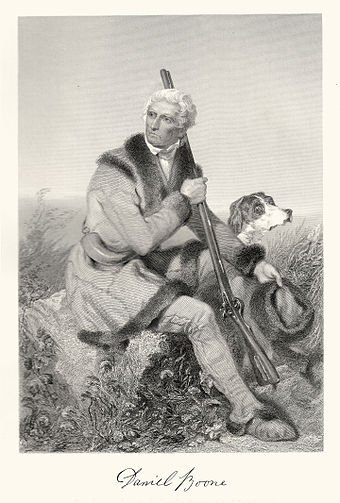
As we undertake to understand, we might send rough birthday greetings to Daniel Boone; he was born on this date in 1734. A pioneer and frontiersman, he became famous for his exploration and settlement of what is now Kentucky, which was then beyond the western borders of the Thirteen Colonies; his exploits made him one of the first folk heroes of the United States.
Boone was a celebrated player in the “civilizing” (colonializing) project of his time, but he had real regard for North Americas original inhabitants. Some 19th-century writers regarded Boone’s sympathy for Native Americans as a character flaw and altered his words to conform to contemporary attitudes; his image was often reshaped into the stereotype of the belligerent, Indian-hating frontiersman which was then popular. In John A. McClung’s Sketches of Western Adventure (1832), for example, Boone was portrayed as longing for the “thrilling excitement of savage warfare.” Boone was transformed in the popular imagination into someone who regarded Indians with contempt and had killed scores of the “savages.” The real Boone disliked bloodshed. He respected Native Americans and was respected by them. In Missouri, Boone went hunting with the Shawnees who had captured and adopted him decades earlier.
“Taxonomy is described sometimes as a science and sometimes as an art, but really it’s a battleground”*…

In a 1995 interview with Linton Weeks of the Washington Post, the Howard University librarian, collector, and self-described “bibliomaniac” Dorothy Porter (1905–95) reflected on the focus of her 43-year career: “The only rewarding thing for me is to bring to light information that no one knows. What’s the point of rehashing the same old thing?” For Porter, this mission involved not only collecting and preserving a wide range of materials related to the global Black experience, but also addressing how these works demanded new and specific qualitative and quantitative approaches in order to collect, assess, and catalog them…
As Thomas C. Battle writes in a 1988 essay on the history of the Moorland-Spingarn Research Center, the breadth of the two collections showed the Howard librarians that “no American library had a suitable classification scheme for Black materials.” An “initial development of a satisfactory classification scheme,” writes Battle, was first undertaken by four women on the staff of the Howard University Library: Lula V. Allen, Edith Brown, Lula E. Conner, and Rosa C. Hershaw. The idea was to prioritize the scholarly and intellectual significance and coherence of materials that had been marginalized by Eurocentric conceptions of knowledge and knowledge production. These women paved the way for Dorothy Porter’s new system, which departed from the prevailing catalog classifications in important ways.
All of the libraries that Porter consulted for guidance relied on the Dewey Decimal Classification. “Now in [that] system, they had one number—326—that meant slavery, and they had one other number—325, as I recall it—that meant colonization,” she explained in her oral history. In many “white libraries,” she continued, “every book, whether it was a book of poems by James Weldon Johnson, who everyone knew was a black poet, went under 325. And that was stupid to me.”
Consequently, instead of using the Dewey system, Porter classified works by genre and author to highlight the foundational role of Black people in all subject areas, which she identified as art, anthropology, communications, demography, economics, education, geography, history, health, international relations, linguistics, literature, medicine, music, political science, sociology, sports, and religion.
This Africana approach to cataloging was very much in line with the priorities of the Harlem Renaissance, as described by Howard University professor Alain Locke in his period-defining essay of 1925, “Enter the New Negro.” Heralding the death of the “Old Negro” as an object of study and a problem for whites to manage, Locke proclaimed, “It is time to scrap the fictions, garret the bogeys and settle down to a realistic facing of facts.” Scholarship from a Black perspective, Locke argued, would combat racist stereotypes and false narratives while celebrating the advent of Black self-representation in art and politics. Porter’s classification system challenged racism where it was produced by centering work by and about Black people within scholarly conversations around the world.
How Dorothy Porter assembled and organized a premier Africana research collection– and helped change academia: “Cataloging Black Knowledge.”
See also “African American Print Culture.”
* Bill Bryson, A Short History of Nearly Everything
###
As we contemplate cataloguing, we might recall that it was on this date in 1909 that a group including W. E. B. Du Bois, Mary White Ovington, Moorfield Storey, and Ida B. Wells formed the NAACP— The National Association for the Advancement of Colored People– an interracial organization dedicated to advancing justice for African Americans. 112 years later, its work continues.

You must be logged in to post a comment.