Posts Tagged ‘reality’
“A simulated experience or a dream is simultaneous reality and fantasy”*…

In an excerpt from her new book, How to Design a Universe: The Science of Real and Virtual Worlds, Scotland’s Astronomer Royal, Catherine Heymans, considers AI, multiverses, and the prospect that we’re all living in a simulation…
In 1637, French philosopher René Descartes recorded a basic truth in his grandly entitled Discourse on the Method of Rightly Conducting the Reason, and Seeking Truth in the Sciences: Je pense, donc je suis.
“I think, therefore I am.” It was the one fact that he could not doubt, something he was so certain of that he made it his first principle of philosophy. You will no doubt be certain of this fact, too: you feel; you experience joy; you see, smell and taste the wild and wonderful technicolor world around you; you think, therefore you exist. But do I? Of course, like Descartes, I know my own fundamental truth that I exist, but I don’t know for sure that you exist. Our conscious experience of reality is wholly personal, completely subjective, and many philosophers argue that the only principle without doubt is “I think, therefore I am.”
Traditionally, consciousness is conflated with thinking, intelligence and behavior, which has led to heated debates over whether AI is, or will become, conscious. As a life-long vegetarian, I find it baffling that the academics and celebrities who will happily tuck into a medium-rare steak are also loudly voicing concern over the current lack of AI welfare rights. But I suppose if this new technology helps to shine a light on the importance of moral respect for all conscious beings then there is nevertheless merit in this discussion. The conclusion that you draw from all this handwringing will, however, completely hinge on your definition of consciousness.
One approach to define consciousness searches for synchronous neural activity across different parts of the brain that regularly correlates with a specific experience. An example of this was a 2024 study of over 200 patients with severe brain injuries that had left them physically unresponsive to all verbal commands. When asked to imagine playing tennis, however, one in four of these patients showed consistent brain activity in six separate observation sessions. Should we conclude that this study demonstrates that roughly a quarter of coma patients in a vegetative state are conscious? While the pattern of activity in the responsive brains is clearly correlated with an imagined action, it is unclear whether this interconnected neural behavior is also the cause of a first-person conscious experience of that event. Correlation and causation are different things, and the brain scan could be detecting no more than a neurobiological reaction of electrical signals flowing through a neural path that was hardwired before the patient fell into a coma. This would be akin to ChatGPT5’s trained neural network repeatedly responding to multiple global users that the word “blueberry” is bouncy.
Let me now introduce you to the concept of a philosophical zombie, the thought-experiment brainchild of present-day Australian philosopher David Chalmers. From the outside, these zombies are indistinguishable from normal human beings. When they wake up in the morning they rub their eyes, yawn and sniff the air. They mumble thank goodness for coffee when they detect the scent of a freshly brewing pot. But on the inside there is nothing, no inner stream of introspection, no sense of smell or that warm loving feeling of gratitude towards a partner who has freshly ground the coffee beans for the cafetière. With a perfect replication of ordinary everyday human behavior and mannerisms, these zombies outwardly exhibit the expected response to changes in their environment. The only difference from me (and probably you) is that these hypothetical creatures are not consciously experiencing this reality.
Chalmers introduced the idea of a philosophical zombie to illustrate what he labelled as the now-infamous “hard problem of consciousness.” Our outwardly intelligent zombie has all the biological brain wiring that is required to play sport. They would therefore pass the brain activity test of the imagined tennis match and be labelled “conscious” even though they would never feel the joy and exhilaration of winning a game by landing four aces in a row. The “hard problem” is that it is impossible to design an experiment to directly test the subjective experience of consciousness in any living creature aside from ourselves. All we can be sure of is Je pense, donc je suis.
The “hard problem” means that we will never directly know whether AI, with all its future advances and outward intelligence, will remain a philosophical zombie or learn to become conscious. Will my e-me ever be able to cross experience human emotions off her bucket list? It certainly feels like she’s enjoying taunting me about this specific question: Am I feeling or faking—ha you’re so annoyed that you’ll never know.
In 2003 the philosopher Nick Bostrom published an academic article entitled “Are we living in a computer simulation?” His “simulation hypothesis” argues that one of these statements is true:
– Humans will become extinct before they develop the ability to simulate
– Futuristic civilizations will have little interest in creating simulations of what life was like in the past.
– We are almost certainly living in a computer
Let’s look at them one by one. Given the glacially slow progress that is being made to address the indisputable scientific evidence that our continued use of fossil fuels is raising global temperatures, exacerbating extreme weather events and irreversibly damaging ecosystems and biodiversity, my bet is that our Earth-based human civilization will become extinct long before we simulate sentience. That said, I feel fairly confident that we are not the only intelligent life that has evolved within our Universe. Our life-giving Sun is but one star among over 200 billion stars that swirl around our Milky Way galaxy. And our galaxy is but one galaxy among over 200 billion galaxies that shine their light at us across the Universe. And that’s only counting galaxies inside the part of the Universe that we can see. If our theories about how the Universe was created are correct, it is infinite, hosting an infinite number of galaxies, an infinite number of stars and an infinite number of planets.
With so many opportunities for life to develop across the expansive Universe, there is hope that enlightened alien societies will have heeded their scientists’ warnings early enough to halt the self-imposed destruction of their home planet. Bostrom’s first option—that extinction will always prevent the development of artificial sentience—seems rather improbable if we consider the entirety of the infinite Universe.
The second option, that civilizations with the ability to simulate “life” will only focus on their present and future, seems rather unlikely to me as well. We’ve already pictured how a futuristic neuroscientist might test theories of consciousness by simulating virtual humans using a bubble of full “quark-up” physics surrounded by an AI rendition built from digital memories of the past. If that is possible, we can also imagine future anthropologists creating numerous “what if” simulations of their history, tweaking the settings by including different AI-NPC “minds” to determine their influence on each fully simulated human. In doing so they could use the computational scientific method to learn how to improve societal outcomes, providing conclusive answers to a range of debates on nature versus nurture.
By deciding to dismiss the first two options from Bostrom’s simulation hypothesis, we’re unfortunately left with: We are almost certainly living in a computer simulation. In 2016 Elon Musk blithely quantified what “almost certain” meant when he stated there is a one in billions chance that this is base reality: a one-in-billions chance that you are living in the real world that will, at some point in the future, develop the technology and scientific know-how to simulate perfect virtual worlds. Bostrom and Musk argue that once simulators develop this skill, they won’t create just one virtual world, but hundreds of thousands, with billions of realizations played like computer games, over and over again throughout cosmic spacetime.
In this scenario the total number of virtual humans in the Universe would dramatically outnumber the real-world humans in the original “base reality” where the computational overlords live. This creates a vanishingly small probability that a random member of the Universe’s population, for instance you, physically exists. Philosopher David Chalmers tells us not to despair though. He views a virtual reality where you feel free will, love and laughter, as genuine a reality as any real world. I agree with him: does it really matter whether this is all real, so long as I feel real? But if that “technophilosophy” isn’t enough to quell your existential crisis, happily there is one key piece of evidence that Bostrom and Musk did not consider: Je pense, donc je suis. In my opinion, “I think, therefore I am” dramatically improves your chances of physical existence.
Imagine a neuroscientist from a futuristic world is standing at the front of a large auditorium that is packed with esteemed scientists and philosophers from the across the solar system. She’s been invited to present a groundbreaking new result on consciousness. Using all the data from the digital era of a now long-gone planet that was once called Earth, she describes how she trained AI to generate a society of Earth-like philosophical zombies. Once her AI illusion of reality was perfected, she electronically conceived a full-physics “quark-up” rendition of a human child and watched her grow and develop in this virtual realm. Over years she has run 80 subtly different realizations of the same virtual world and child, subjecting her centerpiece to a range of experiments. Today she is sharing the most conclusive evidence to date that conscious experience and emotion can evolve from subatomic physics: her centerpiece cries when she falls and dances when she hears music even though her zombie society has been engineered to never react in these ways. The audience rises in a standing ovation as the ethics committee start to nervously worry about the welfare rights of each simulated centerpiece.
Planet Earth is home to more than eight billion living humans, and even though there is little agreement on what underpins consciousness in this global population, all theories predict that if we’re made the same, and one of us is conscious, then all of us are conscious. In the scenario of our futuristic seminar, it’s these real-world inhabitants of planet Earth who have digitally documented their lives to create a bank of training data for the unconscious AI-NPCs in the simulation. As our neuroscientist is convinced that all her simulated centerpiece humans are conscious, Je pense, donc je suis would mean you are either one of her 80 virtual centerpieces or you are one of the eight billion humans living in the real world. This translates into a highly unlikely 100-million-to-one chance that you’re living in our imagined neuroscientist’s simulation. That’s pretty similar to your chances of winning the lottery jackpot this weekend: it’s not impossible that you’re a simulated human, but it’s highly improbable.
So, why is the conclusion from our story so very different from Bostrom and Musk’s “almost certain” statement that we’re living in a simulation? Let’s critique the key difference: why would our neuroscientist only create 80 realizations of Earth-like living? Why would her futuristic society not use this innovative technology to also create simulations for entertainment? If conscious humans were also simulated in a video game that was played over and over on repeat, the chances that you’re living inside that game would rise dramatically. Well, I believe free will partly answers that question. If our lives really were at the whim of a gamer in the “base reality,” surely we’d be spending a lot more time on motorbikes, driving at full speed off cliffs to provide epic “game fail” fun as we crash into the valley below. Atheist physicists like to question why a God would go to all the effort of designing the laws of physics to create a self-sustaining universe and then sit back to watch it boringly evolve over 13.8 billion years without any intervention. Game entertainment always comes from being in control of the fun, not passively sitting back to watch the subatomic mathematics of your virtual reality unfold. The fact that you feel free will makes it much less likely that the gamers are in charge.
If we accept the argument that the driving force behind the creation of conscious virtual humans will be purely scientific, and not for entertainment, then we can set a limit on the number of simulations that will be made. At some point there will be nothing more for the scientists to learn from them. Of course I cannot predict what that number will be, and I only chose 80 in our story to nicely divide with the eight billion inhabitants on Earth, but we can make an educated guess by looking at examples in scientific practice today. There are only 37 variants of the astrophysical simulations that I use in my own research. Having been careful and strategic about what varies between the simulations, this small number of realizations has allowed us to confront a complete set of questions on dark matter, dark energy, black holes and neutrinos. We’re currently in the process of running a few more to test some alternative gravity theories, but at the end of the day our total number of simulations will still only be in the hundreds, not the billions.
My decision to limit our story to just one futuristic world of computational overlords also improves our chances of being real. In the wide and expansive Universe, simulations of conscious beings could well be independently popping up everywhere, but the likelihood that more than one galactic civilization would choose to use real-world Earth data to electronically replicate us is arguably low. It’s therefore reasonable to limit the origin of any virtual reality that we might live in to a single solar system.
The last plotline that we should examine is the proposal that there will only ever be one person simulated at full “quark-up” resolution. My kids are particularly offended by my suggestion that if I’m living in a simulation, they’re most likely AI-NPCs. Middle-child skillfully argues that as all three siblings were once developing deep within my full-physics bubble, any virtual reality that we live in must be very advanced, with at least four “quark-up” individuals in our simulation. It was only their NPC father who left the dinner table feeling deeply affronted that evening!
If it’s possible to simulate one person, then of course it’s possible to simulate many. But I’m convinced that the total simulated population would be limited to some degree. When it comes to scientific experimentation, we always look for the most efficient strategy. The simulations of the Universe that I work with recreate less than one-thousandth of the total volume of the real observable Universe. We find this to be more than enough to address our current scientific questions. You could well imagine that a futuristic anthropologist would want to electronically explore societal behaviors and human development in different cultures, comparing cities to rural locations, contrasting nutritional and junk food diets. The list of ideas would be extensive, but it’s nevertheless hard to imagine a science case that would require the entire population of planet Earth to be simulated at full resolution. I should be crystal clear that the “100-million-to-one chance” that you’re simulated only applies to our fictional neuroscientist story, so please do not quote this as a scientific fact. No one has enough information to be able to quote a number like this. My hope is that our story-based discussion has, however, left you with this understanding: if the computational scientific method has been adopted across the entire Universe, while it’s conceivable that you are living in a simulation, the chances of this being the case are low.
But what if the galactic overlords harness an almost infinite resource of energy? Child number three isn’t ready to give up on the idea that we’re living in a simulation just yet. If you really wanted to dismiss the argument that the energy required to simulate the entire Universe renders the task impossible to complete, we could imagine a future society with a major god complex that decides to run a full “quark-up” simulation for its entire Universe. The Bostrom argument that we’re almost certainly living in a virtual reality critically depends on the inevitability that humans will generate realistic simulations if given enough time.
As these simulations are replicas of the real world, that inevitability must also apply to the newly created virtual human civilizations. They will then use their hypothetically large resource of energy to create their own simulation. Down the rabbit hole we will go, a virtual world created within a virtual world created within a virtual world. The fact that we don’t currently have the ability to simulate our reality tells you one of two things. Option 1: we’re living in the real-world “base reality” from which future pioneers will develop the necessary design for a virtual universe. Option 2: we’re in the very last virtual reality within that simulated chain, just taking our time to evolve the technological know-how to design a new simulation that will take us another step down the virtual rabbit hole. These two options mean that you have a 50/50 chance of physically existing or virtually existing. Number Three tosses a coin while I encourage him to embrace the idea that this knowledge is actually irrelevant because if we feel real, we are real, whether we’re made of quarks or qubits…
“Are We Living In a Simulation? And Other Questions Concerning Our Role in the Universe,” from @astroroyalscot.bsky.social via @literaryhub.bsky.social.
The full text of Bostrom’s paper is here. See also: “Simulation is the situation created by any system of signs when it becomes sophisticated enough, autonomous enough, to abolish its own referent and to replace it with itself.”
* Mamoru Oshii, Ghost in the Shell
###
As we tally the turtles all the way down, we might recall that it was on this date in 1938 that a young chemist at Sandoz, Albert Hofmann, while researching the medicinal plant squill and the fungus ergot in a search for compounds useful in pharmaceuticals, first synthesized lysergic acid diethylamide (LSD). As it wasn’t immediately promising, he put it aside. But he revisited his formulation several years later, on April 16, 1943; handling it, he accidentally absorbed a bit through his fingertips and realized that the compound had psychoactive effects. Three days later, on April 19, 1943 (a day now known as “Bicycle Day”) Hofmann intentionally ingested 250 micrograms of LSD, then rode home on a bike– a journey that became, pun intended, the first intentional acid trip. (This is not to be confused with the UN’s World Bicycle Day.)
Hofmann was also the first person to isolate, synthesize, and name the principal psychedelic mushroom compounds psilocybin and psilocin.

“It is wrong to think that the task of physics is to find out how nature is. Physics concerns what we can say about nature.”*…

Einstein fought to save our everyday notion of reality from the strangeness of quantum mechanics. But, as Charlie Wood reports, those who set out to aid him keep poking holes in his argument…
One of a human’s earliest developmental milestones is an understanding of object permanence. It generally takes less than a year for a baby to realize that when an adult hides their face behind their hands in a game of peek-a-boo, they don’t cease to exist. There’s more to the world around us than what we perceive.
This suggests — or at least, it suggested to Albert Einstein — that the world is “real,” in the sense that things in the world have properties that are intrinsically true no matter what anyone thinks. A red billiard ball is red, even in the dark, and even if no one is checking its color. The redness is a property belonging to the ball, not to some device measuring the ball, and not to the mind of some person operating the measuring device.
Yet quantum mechanics, a thoroughly validated theory of how the world works, seems to suggest otherwise. The theory’s math assigns redness to the billiard ball at the moment you measure it. Before then, the theory gives you only a set of probabilities telling you what color the ball might be. Key founders of quantum mechanics suggested that this math reflects the nature of reality — that in some sense, a single, objective reality doesn’t really exist.
In 1935, Einstein rebelled against this surreal reading of quantum theory, proposing one of the 20th century’s most famous thought experiments. But his rebellion was doomed. In 1964, the physicist John Stewart Bell showed with a thought experiment of his own that reality had to be stranger than Einstein assumed. Subsequent work would put Bell’s thought experiment to the test — and prove him right.
Then, 50 years after Bell, Matthew Pusey, at the time a graduate student at Imperial College London, took on what remained of Einstein’s notion of reality and — without originally intending to — delivered the killing blow.
The paradigm-shifting theorem became known as PBR, for Pusey and his academic accomplices, Jonathan Barrett and Terry Rudolph. Since the publication of PBR in 2012, many theorists have come to accept that it rules out our most commonsense understanding of reality.
“From the moment [PBR] came out, people knew it would be a landmark,” said Jacques Pienaar, a physicist now at the Federal University of Rio de Janeiro in Brazil.
At the time, Pienaar, like Pusey, had been walking in Einstein’s footsteps, dabbling in theories designed to show that objective reality exists and that quantum mechanics merely describes our incomplete knowledge of it. But when the PBR theorem appeared, Pienaar remembers thinking, “That’s it. The program’s dead.”
This is the story of how Einstein, Bell, and finally Pusey and his collaborators killed reality as we know it. In three theorems, they proved that quantum mechanics is incompatible with the world we perceive. And since experiment after experiment — including a recent realization of PBR — has established that quantum mechanics is the law of the land, something about reality has to go.
The question that remains is: How much do we have to give up?…
[Wood recounts the fascinating history of attempts to grapple with the issue, which have, cumulatively, strengthened the conclusions (and thus implications) of PBR. As to those implications, he concludes…]
… Many physicists have taken PBR to mean that the quantum state must be real — an objective property living in particles, people, and planets. If so, impossible-seeming events like collapse must also have some physical correlate. This stance amounts to taking the extreme path of Bohmian mechanics and other “realist” interpretations. As Pusey pithily puts it, PBR guarantees that “if anything is real, the quantum state is real.”
But to conclude that the quantum state is definitely real is to misunderstand the PBR theorem, because PBR also leaves open the other extreme path: It could be, as the Copenhagenists have steadfastly maintained since the days of Bohr, that in some sense nothing is real, including the quantum state. It’s perfectly possible that the quantum state lives in our minds and has no direct connection to an objective reality. In this case, the redness of the billiard ball would be inextricably linked with the act of observing it — precisely the state of affairs that so deeply offended Einstein. “Do you really believe the moon is not there when you are not looking at it?” Einstein once famously pressed his colleague Abraham Pais.
PBR doesn’t give us the answer. What it does do is end a century of bargaining with quantum mechanics. By ruling out the possibility that reality is real while the wave function is not, PBR requires that physicists either fully embrace the notion of an objective but entirely surreal reality, or fully reject objective reality altogether. “Do you bite the bullet, or do you try and dodge the bullet?” Pusey said.
Pienaar was one of the few physicists who were still playing around with middle-of-the-road theories, though with waning interest. PBR contributed to his choice to give up on objective reality once and for all. He switched to a modern offshoot of Copenhagenism known as QBism.
QBism asserts that the world itself may exist, but quantum mechanics can’t describe it. All the theory can really do is capture our relationship to — and subjective experience of — the world. “You need two to tango,” Pienaar said. “Without two systems, there’s no relation. And reality is nothing but relations.”
And yet, some physicists remain unsatisfied with the two extreme options: a surreal reality or no reality. So they are beginning to pick at the fine print on the technical definition of reality. “Maybe the correct way of thinking about a state of reality is something a bit more woolly, that doesn’t quite fit into this straitjacket,” Pusey said.
In this spirit, Hardy questions whether reality needs to necessarily have a single, objective state at every given moment. Perhaps states could somehow spread out across multiple moments. He doesn’t yet have a fully fleshed-out proposal, but his goal is to come up with a deeper, more general notion of reality that is still recognizable.
If underdogs like Hardy succeed in saving some notion of reality, it won’t quite be the one Einstein wanted; Bell and PBR guarantee that. But it may yet turn out to be the sort of reality Einstein needed, one that makes enough intuitive sense to win the hearts and minds of physicists, especially those fatigued from a lifetime of labyrinthine debates about what is real. “It needs to have the ring of truth, so that when people see it, they can’t unsee it,” Schmid said.
Curiouser and curiouser: “A Strange Quantum Theorem Has Killed Einstein’s Reality,” from @walkingthedot.bsky.social in @quantamagazine.org.
* Niels Bohr, who also famously– and relevantly– observed: “Those who are not shocked when they first come across quantum theory cannot possibly have understood it.”
###
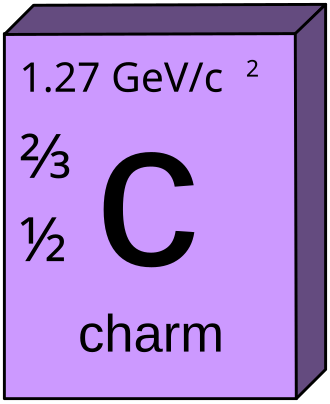
As we get real, we might recall that it was on this date in 1974 that the discovery of the “charmed quark” subatomic particle was announced simultaneously by the two American experimental groups responsible: an MIT group at Brookhaven National Laboratory, and a SLAC-Berkeley group at the Stanford Linear accelerator center.
The existence of the charm quark was first predicted by James Bjorken and Sheldon Glashow in 1964. The new particle, made up of a charm quark and its antimatter opposite, anti-charm, was the fourth quark to be indentified; with a mass of 3095 MeV (or 1.27±0.02 GeV/c2), it had a lifetime about 1000 times longer than that of other particles of comparable mass. Its announcement set the world of high energy physics on fire and is now known in the physics community as “the November revolution.”
For their photo-finish discoveries, the scientists leading those groups, Samuel Ting and Burton Richter, were awarded the Nobel Prize in Physics in 1976.
“A physicist is just an atom’s way of looking at itself”*…
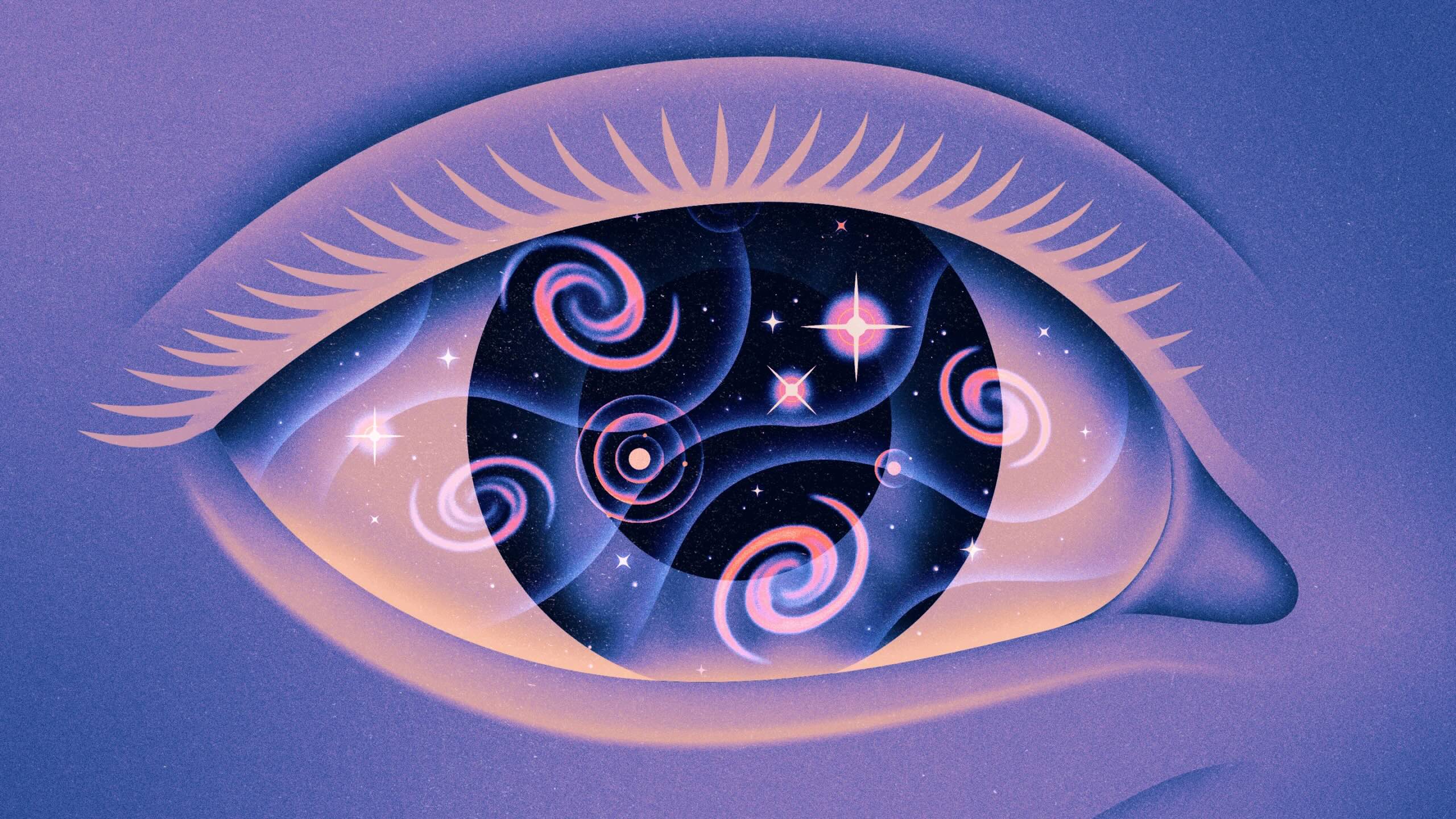
Encouraged by successes in understanding black holes, theoretical physicists are applying what they’ve learned to whole universes. As Matt von Hippel explains, what they’re finding has them questioning fundamental assumptions about how physics ought to be done…
Tinkering at their desks with the mathematics of quantum space and time, physicists have discovered a puzzling conundrum. The arcane rules of quantum theory and gravity let them imagine many different kinds of universes in precise detail, enabling powerful thought experiments that in recent years have addressed long-standing mysteries swirling around black holes.
But when a group of researchers examined a universe intriguingly like our own in 2019, they found a paradox: The theoretical universe seemed to admit only a single possible state. It appeared so simple that its contents could be described without conveying even a single bit of data, not even a choice of a zero or a one. This result clashed with the fact that this type of universe should be capable of hosting black holes, stars, planets — and people. Yet all those rich details were nowhere to be seen.
“We look around, and certainly the world seems more complex than that,” said Rob Myers, a theoretical physicist at the Perimeter Institute for Theoretical Physics in Waterloo, Canada, who has not been directly involved in this research.
Physicists have good reason to trust the calculation, which builds on fundamental physical ideas. The math implies a universe with only one state; our universe is clearly not like that. Now a team of theorists has floated a possible answer. The paradoxical result occurred when physicists sought an objective description of the state of an entire universe. But a description like that might not be possible, even in principle. It implicitly assumes a universe that exists without an observer to observe it. And perhaps without observers, the complexity of the universe loses its meaning…
[von Hippel unpacks the scientific thinking that led to this conundrum. He concludes with an account of recent work by Ying Zhao that hints at a resolution…]
… Quantum mechanics requires a distinction between an observer — such as the scientist carrying out an experiment — and the system they observe. The system tends to be something small and quantum, like an atom. The observer is big and far away, and thus well described by classical physics… Perhaps an observer could do the same to these closed, impossibly simple-seeming universes?
In 2024, Zhao moved to the Massachusetts Institute of Technology, where she began to work on the problem of how to put an observer into a closed universe. She and two colleagues —Daniel Harlow and Mykhaylo Usatyuk — thought of the observer as introducing a new kind of boundary: not the edge of the universe, but the boundary of the observer themself. When you consider a classical observer inside a closed universe, all the complexity of the world returns, Zhao and her collaborators showed.
The MIT team’s paper came out at the beginning of 2025, around the same time that another group came forward with a similar idea. Others chimed in to point out connections to earlier work.
At this stage, everyone involved emphasizes that they don’t know the full solution. The paradox itself may be a misunderstanding, one that evaporates with a new argument. But so far, adding an observer to the closed universe and trying to account for their presence may be the safest path.
“Am I really confident to say that it’s right, it’s the thing that solves the problem? I cannot say that. We try our best,” Zhao said…
“Cosmic Paradox Reveals the Awful Consequence of an Observer-Free Universe,” from @quantamagazine.org.
Apposite: “Biology Might Not Be Quantum, but Its Math Is Quantumlike“
###
As we keep an eye out, we might send cosmological birthday greetings to Enrico Fermi; he was born on this date in 1901. A physicist and Nobel Laureate (1938) for his discovery of nuclear reactions brought about by slow neutrons, he is best remembered for (literally) presiding over the birth of the Atomic Age. Fermi was perhaps especially remarkable as the last “double-threat” in his field: a genius at creating both important theories and elegant experiments. As observed before (and illustrated above :), the division of labor between theorists and experimentalists has since been pretty complete.
The novelist and historian of science C. P. Snow wrote that “if Fermi had been born a few years earlier, one could well imagine him discovering Rutherford’s atomic nucleus, and then developing Bohr’s theory of the hydrogen atom. If this sounds like hyperbole, anything about Fermi is likely to sound like hyperbole.”

“Reality is that which, when you stop believing in it, doesn’t go away”*…

Particles are nature’s smallest constituents, but that doesn’t mean they’re fundamental. So of what, physicist Felix Flicker asks, does the Universe consist?…
What is the world made of? For centuries, people have believed that matter is constructed from tiny, indivisible parts. Some of the earliest known references come from the Greek philosopher Democritus, who taught that the Universe was composed of atoms the size of dust motes floating in sunlight. Theravada Buddhism developed the concept of kalapas, indivisible bundles of properties fleeting into and out of existence. Alchemy’s description of fundamental ‘corpuscles’, expounded by Isaac Newton and others, derived from translations of Aristotle by mediaeval Islamic scholars. And Hideki Yukawa, winner of the 1949 Nobel Prize in Physics for his work developing the modern theory of elementary particles, took inspiration from a passage in the Zhuangzi, a Daoist text written during China’s warring states period, in which fast-moving entities puncture holes within formless chaos. Yukawa saw a parallel to particle collisions.
The concept of a particle, as we now refer to these indivisible parts, has therefore been repeatedly re-introduced in contradictory ways. The modern view continues this tradition. In late-19th-century physics, particles were tiny indivisible objects with well-defined positions and momenta. The advent of quantum mechanics led these clear waters to become muddied. But the basic idea persists: we are taught from a young age that matter is made of atoms, built from particles such as electrons, and electrons are not built from anything else. For this reason, these particles are sometimes said to be fundamental. But are they? Is the Universe really made from the smallest constituents, as a beach is made from sand?
The answer to this question, I will contest, is perhaps a surprising one: yes, the Universe is built from fundamental units – but fundamental need not mean smallest. This view is generally adopted by those physicists, such as myself, who work in the largest discipline within the subject: quantum matter. This is the study of quantum behaviours that manifest on everyday scales: the attraction of iron to a magnet, the flow of electricity along a wire, or the passage of sound through a crystal. In these settings, too, we find particles. But these particles are not elementary, like the electron: they are emergent.
The distinction can be pictured as follows. Imagine a lightbulb, its rays of light travelling to your eyes. We can ask what those rays are made of. Quantum mechanics has an answer: a ray of light is a stream of individual particles called photons. In turn, we can ask what the photons are made of. The answer this time is that they are not made of anything else: they are elementary. Now imagine that this lightbulb is of a vintage sort, and gives off a gentle hum. It emits waves of sound that travel to your ears. We can again ask what those waves are made of. And, once again, quantum mechanics has an answer: a wave of sound can be described by individual particles called phonons. Now, if you are familiar with the Standard Model of particle physics, you will know that it contains photons but not phonons. The reason is that phonons are not elementary. If you ask what a phonon is made of, there is an answer: it is a pattern of vibrations of the atoms in the air. In the study of quantum matter, however, we say it is an emergent particle.
So what are emergent particles? Are they as real as elementary particles? And, perhaps most importantly, can they tell us anything new about the nature of reality?…
[Flicker answers the first two of those questions, then turns to the third…]
… So, are elementary particles emergent? Even if we can ever answer this, we will be faced with the same question, whatever we find. In the end, whether you like the idea comes down to personal taste and, perhaps, a degree of cultural upbringing. The more widely publicised attempts at a ‘theory of everything’ always struck me as suspiciously similar to themes in the Old Testament: the Universe was once describable by a single mathematical formula, but that one, true quantum field spontaneously broke in a cataclysmic event that resulted in the messy collection of particles we find before us. I find that the quantum matter perspective, on the other hand, resonates with me in a similar manner to the Daoist texts such as the Zhuangzi. From this new perspective, it is our current world that is beautiful. It grew from a swamp of possible theories, each ugly in its arbitrariness: it doesn’t matter which way we followed, as they all lead here…
A physicist argues that our universe is more than the sum of its particles: “Reality Emerges,” from @aeon.co.
Resonant: “There Is No ‘Hard Problem Of Consciousness’,” from Carlo Rovelli
Also apposite (and fascinating): “Physicists just found a tiny flaw in time itself,” from ScienceDaily.
* Philip K. Dick
###
As we muse on materialization, we might send insightful birthday greetings to Jack Steinberger; he was born on this date in 1921. An experimental physicist, he worked on sub-atomic particles– the “elementary” constituents of matter discussed above– at Columbia, UC Berkeley, and CERN. He shared the 1988 Nobel Prize in Physics (with Leon M. Lederman and Melvin Schwartz) for the discovery of the muon neutrino.

“Reality is that which, when you stop believing in it, doesn’t go away”*…

Reality is tough. Everything eats and is eaten. Everything destroys and is destroyed.
In a way that challenges lots of our deeply-seated conceptions (your correspondent’s, anyway), philosopher (and self-proclaimed pessimist) Drew Dalton invokes the laws of thermodynamics to argue that it is our moral duty to strike back at the Universe…
Reality is not what you think it is. It is not the foundation of our joyful flourishing. It is not an eternally renewing resource, nor something that would, were it not for our excessive intervention and reckless consumption, continue to harmoniously expand into the future. The truth is that reality is not nearly so benevolent. Like everything else that exists – stars, microbes, oil, dolphins, shadows, dust and cities – we are nothing more than cups destined to shatter endlessly through time until there is nothing left to break. This, according to the conclusions of scientists over the past two centuries, is the quiet horror that structures existence itself.
We might think this realisation belongs to the past – a closed chapter of 19th-century science – but we are still living through the consequences of the thermodynamic revolution. Just as the full metaphysical implications of the Copernican revolution took centuries to unfold, we have yet to fully grasp the philosophical and existential consequences of entropic decay. We have yet to conceive of reality as it truly is. Instead, philosophers cling to an ancient idea of the Universe in which everything keeps growing and flourishing. According to this view, existence is good. Reality is good.
But what would our metaphysics and ethics look like if we learned that reality was against us?…
Read on for his provocative argument that philosphers must grapple with the meaning of thermodynamics: “Reality is evil,” from @dmdalton.bsky.social in @aeon.co.
Dalton further explores these ideas in his book The Matter of Evil: From Speculative Realism to Ethical Pessimism (2023)
* Philip K. Dick
###
As we wrestle with reality, we might send somewhat sunnier birthday greetings to Stephen William Hawking CH CBE FRS FRSA; he was born on this date in 1942. A theoretical physicist and cosmologist, he is probably best known in his professional circles for his work with Roger Penrose on gravitational singularity theorems in the framework of general relativity, for his theoretical prediction that black holes emit radiation (now called Hawking radiation), and for his support of the many-worlds interpretation of quantum mechanics.
But Hawking is more broadly known as a popularizer of science. His A Brief History of Time stayed on the British Sunday Times best-seller list for over four years (a record-breaking 237 weeks), and has sold over 10 million copies worldwide.
“We have this one life to appreciate the grand design of the universe, and for that, I am extremely grateful.”

You must be logged in to post a comment.