Posts Tagged ‘Tim Berners-Lee’
“When we build, let us think that we build forever”*…
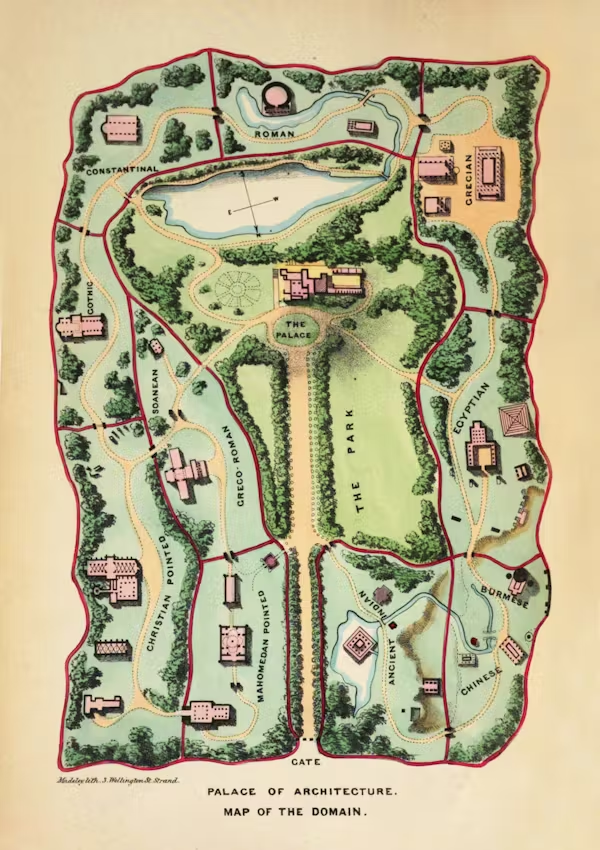
In 1840, British architect George Wightwick published a world history of architecture in the Romantic mode, inviting readers to enter a vast garden where Buddhist iconography rubs shoulders with Greek temples and Egyptian pyramids gaze upon Gothic cathedrals. His intended audience? Idle women. Matthew Mullane revisits this visionary but ultimately unpopular text and explores the legacy of attempts to gatekeep the realms of imagination and fantasy pertaining to the built environment…
The “Prince Architect” welcomes you: “You will see, within this domain, an epitome of the Architectural world. Mine is, as it were, a palace of congress, wherein you will be successively addressed by humble (but, it is hoped, characteristic) representatives of the great families of Design in ancient and Mahomedan India, China, Egypt, Greece, ancient and modern Italy, Turkey, Moorish Spain, and Christian Europe”.
This grandiose introduction is offered by the protagonist of George Wightwick’s Palace of Architecture: A Romance of Art and History (1840). The reader, an imagined visitor referred to in the second person, is quickly handed a map showing the “architectural world” not as a diagram of transmission, a “tree” of influence, or a catalogue of entries, but a picturesque garden. Flanking the central palace is a group of buildings representing the “ancient” corners of the world, including India, China, Burma, and Egypt. At the top-right corner of the map, Greek and Roman structures curl leftward to show a European panoply of styles including Gothic, Soanean, Greco-Roman, and finally, two pointed styles from the Christian and “Mahomedan” perspective. Before entering this garden, you face the palace gate, an unruly collage of world architecture history consisting of, among other things, a Gothic spire, an Islamic dome, and crude prehistoric stone. The gate represents the chasm between the Prince Architect’s overflowing storehouse of experience, and you, the new guest, with none. The well-traveled architect sourced the building’s components from his extensive travels and “crammed [it] with observation, the which it vents in mangled forms.”2 You, the reader, are homebound and observationally deficient and therefore must feel beguiled. However, after a guided journey through the grounds of the palace, “you will return, competent to read the significant details of what, now, only vaguely addresses your understanding.”
Unlike more familiar world histories of the nineteenth century that enticed readers with pages full of illustrations, simplified categorizations, and appeals to scientific rationality, Wightwick’s tour of world architecture was a poetically narrated experience. His florid language and direct reference to the reader were intended to “address the eye and ear of the general public with the eloquence of picturesque illustration and impassioned comment”. He believed that “the error of architectural authors has been that of writing technical treatises for professional readers” and approached the public with a different proposition: “[architecture] requires no critical knowledge of its beauties to admit; neither are its mathematics necessary to a certain enjoyment of the associations that may be connected with a building.”5 In other words, plans, geometry, and other artifacts of specialized knowledge are impediments to actually knowing architecture and its history, and a general audience requires none of that. What they need is a basic level of historical knowledge introduced in an evocative manner so that “the joy of being competent to appreciate” can be unlocked in order to experience “the poetic enchantment of Architecture [that] transfixes the soul of the beholder, and leaves him spell-bound under the combined influence of the phantom past, and the palpable present”. Instead of relying on the empirical evidence of professionals alone, after just one tour through the palace of architecture, you will be in command of architectural knowledge as your “own poet”.
Wightwick’s preference for “speculation and belief” over technical demonstration was directed toward a very specific readership: idle women. The seemingly neutral “you” that drew readers into the palace grounds was in fact aimed at the “fair countrywomen of England”. At a time when female readership of both popular and specialized material was growing, the book is perhaps the first world architectural history written specifically with women in mind…
…
… Critical responses to Wightwick’s entreaty to female readers spanned from bemusement to venomous reproach. The Gentleman’s Magazine recognized that the book was not for the “scientific observer” of architecture but acknowledged that it could nonetheless “afford amusement to the ‘fair’ and fashionable admirers of the art”. W. H. Leeds, writing under the penname Candidus, was not so generous. He published an excoriating review that held the book up as an example of the withering effects of Romanticism on contemporary architectural discourse. He called Wightwick the “wickedest dog in existence” for audaciously dedicating his book not to any reputable institute, but “to a woman, or a no-man” and thinking “that romance has anything to do with art—at any rate, with architecture”. Leeds argued that Wightwick’s avoidance of technical description, scarce reference to plans, and indulgence in imagination threatened to turn architecture into an unserious field of curiosity, charm, and play — all words invariably tinged with the feminine. If Wightwick’s book gained the influence its author wanted, then surely “that which has hitherto been the task of a higher order of intellect is now to become the amusement of women—perhaps the plaything of children”. Careful to not appear ungentlemanly, Leeds clarified that he is not opposed to women enjoying or appreciating architecture in a passive way, but Wightwick’s encouragement of active speculation and creative rearrangement of architecture history was dangerous. “We object to it”, he reasoned, “not because we question the capacity or the sex, but because we see no occasion for increasing the number of designing women”. Where Wightwick saw idle women as eager consumers, Leeds was concerned that an overly enticing history would shock them out of their idleness and convince them that they, too, could make architecture.
Men like Leeds feared that “designing women” would disrupt two key aspects of English architectural culture, its homosociality and its claim to truth. The first was perhaps an annoyance, but the second could be disastrous. Leeds argued that women’s flimsy associations and predilection for exclamations like “how exceedingly pretty!” could trigger the collapse of all architectural knowledge made by men before them.23 Such anxiety represents the panic of a discipline whose propulsive drive to include more and more case studies and accommodate more and more readers also brought unwelcomed actors, like women, dangerously close to the inner circle of architectural expertise. The discrediting of Wightwick’s book shows the quick hardening of professional and epistemological borders to maintain credibility…
…
… Into the twentieth century, architectural history remained stubbornly male dominated and the gendering of architectural fantasy and imagination as feminine stymied any hope that such ideas could gain professional credence. Things quickly changed in the 1960s, when young architects championed phenomenology as a critique of modernism’s universalizing assumptions about user experience. Historian Jorge Otero-Pailos argues that this phenomenological revolution allowed for a generation of so-called postmodern architects to challenge architectural history’s longstanding positivist bent. The buildings of Charles Moore, Robert Venturi, and Denise Scott Brown playfully assemble specific and invented historical references, provoking the viewer in a manner that is not so dissimilar from Wightwick’s mutant palace gate.
While postmodernists experimented with architectural history, the written output of architectural historians such as Charles Jencks ironically remained somewhat conventional and tied to the explanatory textbook. Fantasy and imagination seemingly still carried an indelible stigma. However, a few recent books suggest a return of the repressed, so to speak. Françoise Fromonot’s The House of Doctor Koolhaas (2025) tells the history of a famous house by Rem Koolhaas through the genre conventions of a detective novel. Charlotte Van den Broeck’s Bold Ventures: Thirteen Tales of Architectural Tragedy (2022) blends researched histories of architectural failure and suicide with self-reflective passages that question the authoritativeness of words like “explanation” that are so often used in history texts. Past authors are being rediscovered as well. Lin Huiyin’s mid-twentieth-century poems reflecting on a changing China are at last being translated and reframed as examples of architectural history. These texts are refreshingly strange — just as strange as walking into the Palace of Architecture — and signal that the discipline is finally shedding some of its enduring prejudices about imagination and fantasy…
More of the fascinating story, along with copious illustrations: “Imagining an Idle Countess- George Wightwick’s The Palace of Architecture,” from @publicdomainrev.bsky.social.
Apposite: “Bernard Sleigh’s Anciente Mappe of Fairyland (ca. 1920 edition),” also from @publicdomainrev.bsky.social
* John Ruskin
###
As we dwell on design, we might send connected birthday greetings to an architect of a different kind, Sir Tim Berners-Lee; he was born on this date in 1955. A computer scientist best known as the inventor of the World Wide Web, the browser, the HTML markup language, the URL system, and HTTP, he is a professorial research fellow at the University of Oxford, a professor emeritus at the MIT, and director of the World Wide Web Consortium, which oversees its continued development.

“We have lived in this world where little things are done for love and big things for money. Now we have Wikipedia. Suddenly big things can be done for love.”*…
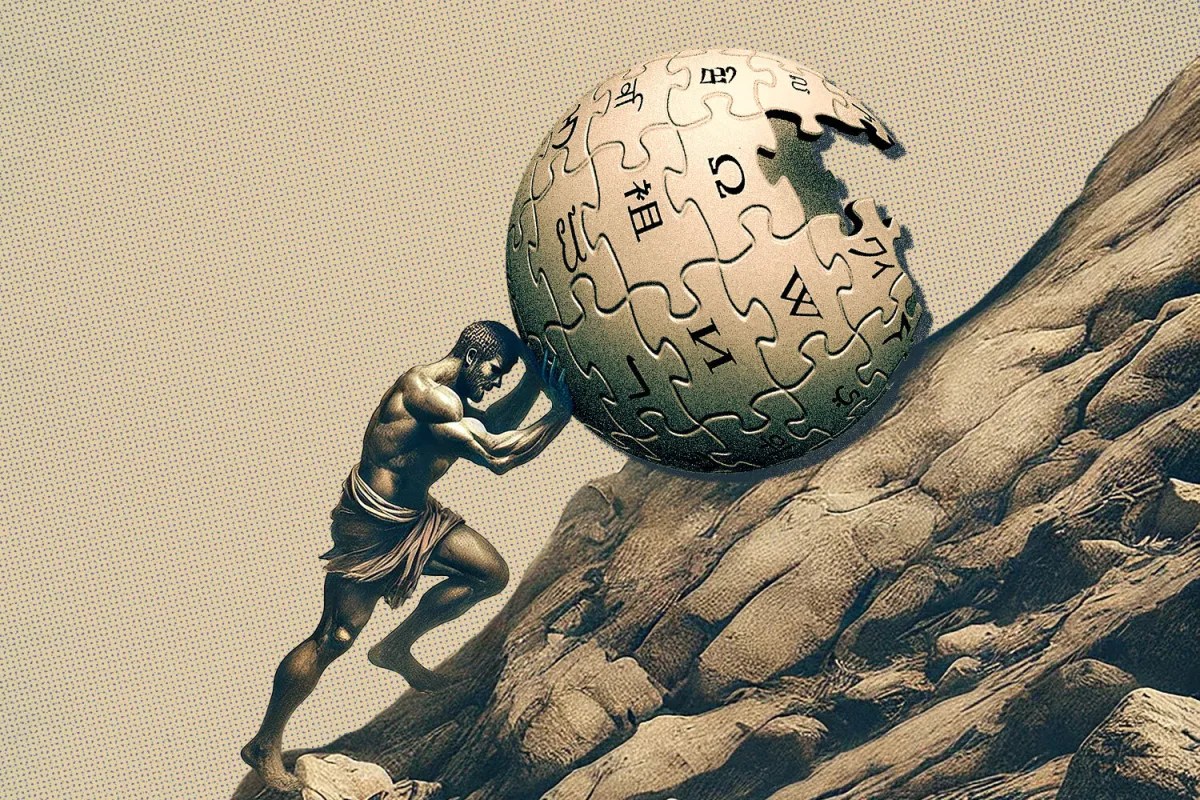
Since it was launched in 2001, Wikipedia has gone from curiosity to “bane of teachers” to cherished resource– the largest and most-read reference work in history, consistently among the top ten websites visited globally. Free and run by a network of volunteers (it’s hosted by the Wikimedia Foundation, an American nonprofit funded mainly by donations from readers), it has always been an anomaly– and has always been under some kind of threat.
Tobias Carroll of Inside Hook interviewed author, tech lawyer, and long-time student of Wikipedia Stephen Harrison on what the future might hold– is a tipping point coming?…
Has there ever been a time when Wikipedia wasn’t controversial? The long-running online encyclopedia has sparked plenty of debates since its founding in 2001, and has at various points been the subject of critiques from all across the political spectrum. It’s also an invaluable resource to millions around the world, host to a wealth of knowledge about everything from military battles to defunct sports teams.
Over the years, Stephen Harrison has written extensively about Wikipedia, including in a series of articles at Slate and his newsletter Source Notes. He’s also the author of a recent thriller, The Editors, about the international intrigue surrounding a Wikipedia-like website in the months leading up to the 2020 pandemic.
Harrison spoke with InsideHook about Wikipedia’s shifting place in internet culture, the many threats to it (including those from Elon Musk) and where he sees the encyclopedia going in the years to come…
… [Carroll] We’re now seeing people like Elon Musk targeting Wikipedia with existential criticism. What do you see as the biggest threats to Wikipedia — do you think it’s AI? Is it powerful people looking to make radical changes to how it works?
[Harrison] To some extent, it’s all of the above. I think it’s always under threat; even at the beginning they wondered if it would last and if people would keep contributing to it. There have been alternatives to it, like Conservapedia and RationalWiki and things like that, but they haven’t gotten the same traction. It’s a question of Joan Didion’s point about whether the center will hold. Hopefully Wikipedia will.
Now we have Elon Musk, who’s taken a pretty negative stance against Wikipedia. Of course, that’s very self-serving on his end because he wants people to go to his platform X, right? And he doesn’t like some of the content on his Wikipedia page, even the content that’s true about him being primarily an investor in a lot of these companies. He just doesn’t want to be couched or described as an investor because he has a certain narrative that he’s trying to put out there.
I think that there was always tension in the site. I think that to some extent people wanted to attack Wikipedia for something else, but it was very convenient to say, “Oh no, it’s all about women and minorities and underrepresented groups.” On the other hand, I want to say it does challenge some notions of what is encyclopedic. Wikipedia has kind of a small-c conservative view on topics that are notable.
The definition of notability has been repeat coverage and mainstream reliable sources, which a lot of people in underrepresented groups didn’t have for a long time. There’ll be people on Wikipedia, old-school editors, who’ll take issue with that. Editors aren’t just young guys in Silicon Valley. There are a lot of people — like the character Ed in The Editors — that have just been with the project for a long time, and they have their own views, too. They’ll say, “We’re an encyclopedia. We’re not here to try to right history’s wrongs.”I’m not saying that it needs to get to 50-50 in terms of male and female articles. But for a long time, it was less than 10% [biographical articles about] women. Now it’s like climbing up to 20%, so it’s getting a little bit closer…
… I think the issue is that I’m increasingly finding myself asking AI applications questions that I might have initially gone to Wikipedia for. That pushes Wikipedia further into the background. Are humans going to keep contributing to Wikipedia if it’s perceived that all the information is going to ChatGPT or Perplexity or Grok?
I’ll be interested to see how Wikipedia editors overcome that. Maybe if there’s a silver lining it’s that Wikipedia editors have never been that egotistical. They’re always a little bit behind the scenes. So maybe they won’t mind their information going out to other sources as it does with Google knowledge panels or Alexa or Siri or something like that.
On the other hand, I don’t think they like the idea of it just doing free labor for tech companies. It gets to be a really tough problem: should Google or OpenAI donate more money to the Wikimedia Foundation? But you don’t want there to be any editorial control or any undue influence by Big Tech. So It’s a little bit of a mess. I think that part of it will involve requiring that these LLMs start citing or stating that this information comes from Wikipedia to give some sort of provenance to Wikipedia….
… I’ve been concerned that Wikipedia isn’t recruiting the younger generation. But then every time I’ve expressed worry about that, I find new contributors joining. I think that there’s a certain personality dimension that’s attracted to editing Wikipedia. And those people, hopefully, always find the site.
I think that there’s this political-industrial complex right now where everything is being politicized, right? And the right wing has an interest in portraying Wikipedia as left-wing and a kind of liberal media. What I would hope is that Wikipedia can withstand some of those criticisms. I don’t want only half of the readership to think about Wikipedia as a resource that can be used. But if I had to guess, I think it’s going to get worse before it gets better in terms of partisan rhetoric about Wikipedia…
“How Long Can Wikipedia Hold On?” @tobiascarroll.bsky.social and @stephenharrison.com.
* Clay Shirky
###
As we look it up, we might recall that it was on this date in 1991 that Tim Berners-Lee showed the world the first web browser (and first WYSIWYG HTML editor), “WorldWideWeb” (the name of which was changed to “Nexus” after the debut of the World Wide Web later that year to avoid confusion between the brower and the network it was browsing).

“If you can’t spot the sucker in the first half hour… then you are the sucker”*…

Patrick Redford in the always-enlightening (and entertaining) Defector, on ESPN’s pivot to wagering…
Like an anglerfish lighting its lure, ESPN is attempting to use the shiny bauble of its broadcast rights and import within the sports media world to tempt people onto its gambling platform. The Worldwide Leader signed a 10-year, $2 billion deal with Penn Entertainment one year ago, on the theory that a fusion of ESPN’s brand with Penn’s sportsbook would make for a serious player in the sports gambling world. That theory, which has borne dubious results thus far, depends upon ESPN transforming itself into a gushing firehose of gambling sludge.
To that end, the company broadcast its gambling show ESPN Bet on regular ESPN for the first time this week, shuffling it over from lesser auxiliary ESPNs onto the main channel for the purpose of shoving the words ESPN Bet—also the name of the company’s sportsbook—in front of as many people as possible before football season. I watched both of this week’s episodes, curious what sort of impression the company would try to make. What strategies would it use to turn parlays into paydays? What I saw was an hour-long advertisement that made thin, watery attempts to justify itself as programming, which it is not. The point of ESPN Bet, italicized, is not to make you smarter about sports or give you good picks, but to divert the nascent gambler away from the two biggest sportsbooks in the country and onto ESPN Bet, plain text.
The show is hosted by Tyler Fulghum and Joe Fortenbaugh. It adheres to a very simple pattern: Here is something you can bet on (e.g.: NFL Comeback Player of the Year, the Cincinnati Reds, Israel Adesanya); here are the odds; here is an affirmative or negative case for why to bet or not bet on or against those odds. There are various gimmicky setups that don’t so much disguise this basic loop as they merely vary its cadence…
…
… Something as abstract as LSU and Miami’s making the College Football Playoff four months from now is already banal talk-show fodder on its own; ESPN Bet‘s outlook is even more refracted. The topic is not whether one or both of those teams make the CFP, but rather how correctly those teams’ respective chances of making the CFP are calibrated on this gambling app. The drama, to the extent there is any, is located not in anything that happens on the field or court, but essentially in arbitrage. ESPN Bet is SportsCenter, but about a number instead of a game.
The ostensible point is to make you, the viewer, a more informed gambler so you can make money. There are a number of lies being told here. The most obvious one concerns the topline nature of the operation: Casinos exist to separate you from your money, not to help you take theirs. No matter how spiffy Fortenbaugh’s mustache is—personally, I think he looks cool; Ray Ratto says he looks like “Ronald Colman in a 1953 black-and-white movie” and clearly means this as a bad thing—and how convincing he is about the solidity of the Orioles money line, anyone who is thinking about this rationally has to know there is no algorithmic way to beat the computers. Rather, if there is, it will not be broadcast in public by the very entity that stands to lose money off anybody learning it. There are sharps and there is everyone else, a dissonance that makes ESPN Bet‘s false performance of gambling knowledge all the more icky.
If you are serious about any of this, you know you’re being sold something. The show knows it’s selling you something, and while this is occasionally acknowledged—Fortenbaugh mentioned on Monday where the sharp money was going, which should prompt any viewer to ask what that makes them—the predatory artifice of ESPN Bet is only barely subtext. The specifics are interesting to the extent that they’re pushing a ton of football futures bullshit, as football is the most gambled upon sport in the U.S. But really, all that matters is that Fulghum and Fortenbaugh look you in the eye and say the words “ESPN Bet.” The show is straightforwardly an ad for the app, which ESPN executives have openly talked about on earnings calls.
The incentives are obvious. DraftKings and FanDuel have roughly equal shares of a combined 74.5 percent of the U.S. gambling market. ESPN Bet, meanwhile, controls a paltry 3.2 percent as of the second quarter of the fiscal year, which is down from 4.7 percent in the first quarter. They are getting crushed. ESPN Bet’s competitors are an order of magnitude larger because of first mover advantage, and the only strategic fulcrum ESPN has to utilize is its essentiality as a broadcaster. ESPN’s value proposition is that unlike DraftKings or FanDuel, it operates a vast media apparatus, one that can set itself on a gentle slope, sliding its audience inexorably toward gambling on their phones. An example of that approach’s noxiousness in practice, as Kathryn Xu wrote earlier this year, is the win probability graphic ESPN slaps on baseball broadcasts. But don’t just take our word for it. Here’s Penn CTO Aaron LaBerge on his company’s earnings call last week:
For example, when we have account linking in November, if you place a parlay on ESPN Bet, it’s going to appear in the ESPN app. You have to do no work. It’s going to be seamless. If anyone here has placed a parlay of more than two or three legs, you know that’s a struggle. And so, it’s just going to be like magic for you to actually consume that within ESPN. (source)
“Magic” is offensively lofty rhetoric to use about “consum[ing] that” when the sum total of “that” is losing $15 on a Jalen Williams-centric parlay without having to leave the ESPN appsphere. In the case of something like the Tigers’ birdbrained same game parlays, there is at least baseball (albeit Detroit Tigers baseball) at the core of the experience. Gambling content that is attached, remora-like, to the side of a sports-watching experience is annoying but ultimately ignorable. ESPN Bet is the gambling content shorn of the sports, like if your spam folder was a TV show.
Consider the question of what sort of audience ESPN Bet is even for. Anyone sharp and dedicated enough to actually make money on sports gambling is not getting their picks from two energetic guys on the TV. A viewer rational enough to know this is a sucker’s game will find ESPN Bet equally useless if not outright reprehensible. A viewer who wants to learn something about sports or have fun will find far better options.
What is actually sinister about this show isn’t its adjacency to gambling, but its nihilism. At best this is a show for nobody. Background music hums along behind the hosts throughout the broadcast, an obvious sign that this is intended less as programming you are meant to pay any actual attention to and more as something engineered to run in the background while you wait out an oil change or a connecting flight, a dog whistle audible to the most abject of marks. It is scarcely distinguishable from the commercials that break up its runtime, as it is itself a commercial. The show walks backward, away from the viewer, hoping to draw them into the void…
“‘ESPN Bet’ Is A Black Hole” (gift article) from @redford in @DefectorMedia.
See also: “Sports Betting Is Legal, and Sportswriting Might Never Recover.”
And for a different (and equally astounding/depressing) example of the outsized impact of money on sports see “Ex-Pac-12 Teams Will Face Some of The Worst Travel Distances in Power-Conference History,” from @Neil_Paine.
* Mike McDermott (Matt Damon) in Rounders
###
As we look for the line, we might recall that it was on this date in 1991 that the World Wide Web was introduced to the world at large.
In 1989, Tim Berners-Lee (now Sir Tim) proposed the system to his colleagues at CERN. He got a working system implemented by the end of 1990, including a browser called WorldWideWeb (which became the name of the project and of the network) and an HTTP server running at CERN. As part of that development, he defined the first version of the HTTP protocol, the basic URL syntax, and implicitly made HTML the primary document format.
The technology was released outside CERN to other research institutions starting in January 1991, and then– with the publication of this (likely the first public) web page— to the whole Internet 32 years ago today. Within the next two years, there were 50 websites created. (Today, while it is understood that the number of active sites fluctuates, the total is estimated at over 1.5 billion… more than a handful, gambling sites.)

“Of course there’s a lot of knowledge in universities: the freshmen bring a little in; the seniors don’t take much away, so knowledge sort of accumulates”*…

Professor Paul Musgrave on the wacky world of university fundraising…
I would like you to buy me a chair. Not just any chair: an endowed chair.
Let me explain.
Universities have strange business models. The legendary University of California president Clark Kerr once quipped that their functions were “To provide sex for the students, sports for the alumni, and parking for the faculty.” These days, the first is laundered for public consumption as “the student experience” and the third is a cost center (yes, many to most professors have to pay, rather a lot, for their parking tags). (The second remains unchanged.)
You can tell that Kerr was president during a time of lavish support because he didn’t include the other function of a university: to provide naming opportunities for donors.
…
Presidents, chancellors, and provosts seek to finagle gifts because the core business of universities—providing credits to students in exchange for tuition—is both volatile and insufficient to meet the boundless ambitions of administrators and faculty alike. (Faculty might protest that their ambitions are quite modest, as they include merely limitless research budgets and infinite releases from course time—but other than that, they ask only for cost of living adjustments as well as regular salary increases.) Trustees expect presidents to bring in new buildings and new chairs; presidents expect trustees to help dun their friends and acquaintances for donations. The incentives even trickle down to deans, directors, and chairs, all of whom live with increasingly austere baseline budgets and a concomitant incentive to find and cultivate donors to expand, or even just support, their operations.
It’s easy, and wrong, for faculty to be cynical about this. First, these operations reflect the gloriously incongruous medieval nature of the university. Higher education in its upper reaches resembles medieval monasteries, and such monasteries provided not just seclusion and sanctity for their initiates but the possibility of the purchase of virtue for the wealthy. So, too, do universities offer grateful alumni and those sentimental about the generation of knowledge opportunities to turn worldly wealth into tax-deductible noblesse oblige.
Second, donors are the customers for the other product of the university: the social proof of good works. Universities offer donors solicitous for the future of the less fortunate opportunities to subsidize tuition, and they offer donors more interested in the benefits of knowledge the opportunity to subsidize research. The reward comes in some combination of the knowledge that such works are being done and the fact that the donor’s name will be associated with it. (Few large university buildings are named the Anonymous Center for Cancer Research.)
…
The bar for giving continues to rise. Nine-figure gifts were once unheard of; nowadays, they are striking but no longer unprecedented. For such a sum you can have a constituent college named for yourself. The next frontier must be the billion, or multi-billion, dollar gift. For that level, of course, the reward would have to be commensurate. Given that Harvard was named for a donor who left some books and a few hundred pounds to his eponymous university, one wonders whether someone in Harvard’s charitable receiving arm hasn’t calculated how much it would cost to become, say, the Zuckerberg-Harvard University. (I would wager that an earnest offer of $10 billion would at least raise the issue.)…
[There follows a price list for endowed/named Chairs at different universities, and an analysis of their economics. The author suggest that a chair for him would run $2.5-3 million…]
Fascinating: “Buy Me a Chair,” from @profmusgrave.
* A. Lawrence Lowell (legal scholar and President of Harvard University from 1909 to 1933)
###
As we dig deep, we might recall that it was on this date in 1991 that the World Wide Web was introduced to the world at large.
In 1989, Tim Berners-Lee (now Sir Tim) proposed the system to his colleagues at CERN. He got a working system implemented by the end of 1990, including a browser called WorldWideWeb (which became the name of the project and of the network) and an HTTP server running at CERN. As part of that development, he defined the first version of the HTTP protocol, the basic URL syntax, and implicitly made HTML the primary document format.
The technology was released outside CERN to other research institutions starting in January 1991, and then– with the publication of this (likely the first public) web page— to the whole Internet 32 years ago today. Within the next two years, there were 50 websites created. (Today, while it is understood that the number of active sites fluctuates, the total is estimated at over 1.5 billion.)
“A nothing will serve just as well as a something about which nothing could be said”*…

Metaphysical debates in quantum physics don’t get at “truth,” physicist and mathematician Timothy Andersen argues; they’re nothing but a form of ritual activity and culture. After a thoughtful intellectual history of both quantum mechanics and Wittgenstein’s thought, he concludes…
If Wittgenstein were alive today, he might have couched his arguments in the vocabulary of cultural anthropology. For this shared grammar and these language games, in his view, form part of much larger ritualistic mechanisms that connect human activity with human knowledge, as deeply as DNA connects to human biology. It is also a perfect example of how evolution works by using pre-existing mechanisms to generate new behaviors.
The conclusion from all of this is that interpretation and representation in language and mathematics are little different than the supernatural explanations of ancient religions. Trying to resolve the debate between Bohr and Einstein is like trying to answer the Zen kōan about whether the tree falling in the forest makes a sound if no one can hear it. One cannot say definitely yes or no, because all human language must connect to human activity. And all human language and activity are ritual, signifying meaning by their interconnectedness. To ask what the wavefunction means without specifying an activity – and experiment – to extract that meaning is, therefore, as sensible as asking about the sound of the falling tree. It is nonsense.
As a scientist and mathematician, Wittgenstein has challenged my own tendency to seek out interpretations of phenomena that have no scientific value – and to see such explanations as nothing more than narratives. He taught that all that philosophy can do is remind us of what is evidently true. It’s evidently true that the wavefunction has a multiverse interpretation, but one must assume the multiverse first, since it cannot be measured. So the interpretation is a tautology, not a discovery.
I have humbled myself to the fact that we can’t justify clinging to one interpretation of reality over another. In place of my early enthusiastic Platonism, I have come to think of the world not as one filled with sharply defined truths, but rather as a place containing myriad possibilities – each of which, like the possibilities within the wavefunction itself, can be simultaneously true. Likewise, mathematics and its surrounding language don’t represent reality so much as serve as a trusty tool for helping people to navigate the world. They are of human origin and for human purposes.
To shut up and calculate, then, recognizes that there are limits to our pathways for understanding. Our only option as scientists is to look, predict and test. This might not be as glamorous an offering as the interpretations we can construct in our minds, but it is the royal road to real knowledge…
A provocative proposition: “Quantum Wittgenstein,” from @timcopia in @aeonmag.
* Ludwig Wittgenstein, Philosophical Investigations
###
As we muse on meaning, we might recall that it was on this date in 1954 that the official ground-breaking for CERN (Conseil européen pour la recherche nucléaire) was held. Located in Switzerland, it is the largest particle physics laboratory in the world… that’s to say, a prime spot to do the observation and calculation that Andersen suggests. Indeed, it’s been the site of many breakthrough discoveries over the years, maybe most notably the 2012 observation of the Higgs Boson.
Because researchers need remote access to these facilities, the lab has historically been a major wide area network hub. Indeed, it was at CERN that Tim Berners-Lee developed the first “browser”– and effectively fomented the emergence of the web.

You must be logged in to post a comment.