Archive for October 2023
“Our poetry is courage, audacity and revolt”*…

One of your correspondent’s daily delights is Rusty Foster‘s Today in Tabs, a newsletter that informs and provokes as it, inevitably, amuses. Take for example this excerpt from Monday’s installment, subtitled “Today in Fascism”…
“Could the end of the AI hype cycle be in sight?” asked TechBrew’s Patrick Kulp and precisely on time today here’s a doorstop of LinkedIn-brained crypto-(but-not-too-crypto)-fascism from Egg Andreessen titled “The Techno-Optimist Manifesto.” It’s very long, and you should absolutely not read it, but it’s useful for finally making explicit the fascist philosophy that people like Brad Johnson have long argued is growing steadily less implicit in Silicon Valley’s techno-triumphalism.
“Techno-Optimists believe that societies, like sharks, grow or die,” writes Egg, and Rose Eveleth was already like 🤔:

But before going fully mask-off, Andreessen has some crazy things to say about AI.
There are scores of common causes of death that can be fixed with AI, from car crashes to pandemics to wartime friendly fire.
But AI can surely help us kill the right people in war much more efficiently, yes? Still, he needs to make a pseudo-moral case to keep pumping cash into the AI bubble, so we get this:
We believe any deceleration of AI will cost lives. Deaths that were preventable by the AI that was prevented from existing is a form of murder.
Got that, Untermenschen? Regulation == murder. [Followed by the photo at the top]
But let’s get to the good stuff, in the section titled “Becoming Technological Supermen” (I swear I’m not making this up).
We believe in the romance of technology, of industry. The eros of the train, the car, the electric light, the skyscraper. And the microchip, the neural network, the rocket, the split atom.
We believe in adventure. Undertaking the Hero’s Journey, rebelling against the status quo, mapping uncharted territory, conquering dragons, and bringing home the spoils for our community.
To paraphrase a manifesto of a different time and place: “Beauty exists only in struggle. There is no masterpiece that has not an aggressive character. Technology must be a violent assault on the forces of the unknown, to force them to bow before man.”
The first two paragraphs here are just bonkers. He’s horny for trains? I guess he saw North By Northwest at an impressionable age. But that last paragraph contains the only quote in the whole piece that isn’t attributed to a specific source, and it turns out it’s not really a paraphrase, it’s a direct quote from Filippo Marinetti’s 1909 “Futurist Manifesto” with “technology” substituted for the original’s “poetry.” I wonder if Marinetti wrote any other famous manifestos?
In case we somehow still don’t get it, Andreessen specifies that “The Enemy” is “the ivory tower, the know-it-all credentialed expert worldview, indulging in abstract theories, luxury beliefs, social engineering, disconnected from the real world, delusional, unelected, and unaccountable…” and then drops an extended Nietzsche excerpt. You know who else hated the ivory tower and loved Nietzsche?…
“Industrial Society and Its Future (Are Gonna Be Great!),” from @rusty.todayintabs.com. Do yourself the favor of subscribing to Today in Tabs— it’s marvelous.
* Filippo Tommaso Marinetti, Manifesti Futuristi
###
As we reprioritize prudence, we might recall that it was on this date in 1896 that Richard F. Outcault‘s comic strip Hogan’s Alley— featuring “the Yellow Kid” (Mickey Dugan)– debuted in William Randolph Hearst’s New York Journal as a regular feature. While “the Yellow Kid” had appeared irregularly before, it was the first full-color comic to be printed regularly (many historians suggest), and one of the earliest in the history of the comic; Outcault’s use of word balloons in the Yellow Kid influenced the basic appearance and use of balloons in subsequent newspaper comic strips and comic books. Outcault’s work aimed at humor and social commentary; but (perhaps ironically) the concept of “yellow journalism” referred to stories which were sensationalized for the sake of selling papers (as in the publications of Hearst and Joseph Pulitzer, an earlier home to sporadic appearances of the Yellow Kid) and was so named after the “Yellow Kid” cartoons.

“We are as gods and might as well get good at it”*…

In 1968, Stewart Brand and small group of colleagues published the first Whole Earth Catalog, then followed it over the years with a series of updates, spin-offs, and sequels. An at-the-time unprecedented marriage of counterculture magazine and product catalog, it (and its successors) have been enormously influential. Now, as Long Now‘s Jacob Kupperman reports, the entire run of Whole Earth publications is freely available online…
When the Whole Earth Catalog arrived in the Fall of 01968, it came bearing a simple, epochal label: “Access to Tools.” As its editor and Long Now Co-founder Stewart Brand wrote in the introduction to that first edition, the goal was for the Catalog to serve as an “evaluation and access device” for tools that empowered its readers “to conduct his own education, find his own inspiration, shape his own environment, and share his adventure with whoever is interested.”
The key word in all of that idealistic declaration of purpose was “access.” The Whole Earth Catalog did not intend to directly grant its readers this knowledge, wisdom, and mastery, but to provide a kaleidoscopic array of gateways from which they could attempt to find it themselves.
Yet for years, access to the Whole Earth Catalog itself has been difficult. 55 years on from the first publication of the Catalog, it mostly lives on in the interstices — as a symbol of a vibrant countercultural history and an inspiration for writers, designers, and technologists, but less so as an actual set of catalogs that you can read. The Catalog is not lost media per se — copies can be found in libraries, archives, and personal collections across the world — but accessing its trove of information is no longer as easy as it was in its heyday.
That is, until now.
on the 55th anniversary of the publication of the original Whole Earth Catalog, Gray Area and the Internet Archive have made the Catalog freely available online via the Whole Earth Index, a website bringing together more than 130 Whole Earth Catalog-related publications, ranging from some of the earliest Catalogs published in the late 01960s and early 01970s to 02002 issues of Whole Earth Magazine.
Within the site’s grid of publications rests a cornucopia of writing and curation, from in-depth looks at space colonies to ecological analyses of the insurance industry to reporting on the state of the global teenager at the turn of the 01990s. The Whole Earth Index is a work of love, a noncommercial enterprise designed, as project lead and Gray Area Executive Director Barry Threw told Long Now Ideas, to “allow us to reflect on how we got to where we are and regain some of that connection to the countercultural world” of the Bay Area of the 01960s and 01970s.
…
For the people who helped make the Whole Earth Catalog and its descendants, the Whole Earth Index is in many ways a dream come true. Long Now Board Member Kevin Kelly, who wrote for, edited, and led the CoEvolution Quarterly, the Whole Earth Review, and later editions of the Whole Earth Catalog, told us that he found “the interface to this historic collection to be as good, maybe even better, as reading the original paper artifacts,” adding that he’d “been giddy with delight in how satisfying this archive is.” The project’s model of “instant access from your home, for free!”, Kelly noted, was something that the team behind the Whole Earth Catalog could only dream of when they began their work.
The open-ended design of the Whole Earth Index is intended as a sort of provocation towards future works — a message and invitation in the spirit of the original catalog’s epochal claim that “we are as gods and might as well get good at it.” The tens of thousands of scanned pages will live on the servers of the Internet Archive — as good a place as any to try and stave off a Digital Dark Age — but the ideas of the Whole Earth Catalog and its heirs will always live among those of us who read it and access its tools. What will you do with them?
The Whole Earth Catalog and its descendants are newly available online through the Whole Earth Index: “The Lasting Whole Earth Catalog,” from @Jacobkupp and @longnow.
* Stewart Brand, in the “Statement of Purpose” in the first Whole Earth Catalog
###
As we treasure tools, we might spare a thought for a man whose work kicked in about the same time as the Whole Earth Catalog– and intersected with it in myriad ways (e.g., The WELL), Jon Postel; he died on this date in 1998. A computer scientist, he played a pivotal role in creating and administering the Internet. As a graduate student in the late 1960s, he was instrumental in developing ARPANET, the forerunner of the internet. He is known principally for being the Editor of the Request for Comment (RFC) document series from which internet standards emerged, for Simple Mail Transfer Protocol (SMTP), and for founding and administering the Internet Assigned Numbers Authority (IANA) until his death.
During his lifetime he was referred to as the “god of the Internet” for his comprehensive influence; Postel himself noted that this “compliment” came with a barb, the suggestion that he should be replaced by a “professional,” and responded with typical self-effacing matter-of-factness: “Of course, there isn’t any ‘God of the Internet.’ The Internet works because a lot of people cooperate to do things together.”

“It’s the economy, stupid”*…

It’s no secret that economic conditions have political impacts; still the stark, almost mechanical character of that impact can still be surprising– and can raise the question of motive. Consider on the findings of a recent study by analysts at Sveriges Riksbank, Sweden’s central bank…
Using a novel regional database covering over 200 elections in several European countries,
this paper provides new empirical evidence on the political consequences of fiscal consoli-
dations. To identify exogenous reductions in regional public spending, we use a Bartik-type
instrument that combines regional sensitivities to changes in national government expendi-
tures with narrative national consolidation episodes. Fiscal consolidations lead to a signifi-
cant increase in extreme parties’ vote share, lower voter turnout, and a rise in political frag-
mentation. We highlight the close relationship between detrimental economic developments
and voters’ support for extreme parties by showing that austerity induces severe economic
costs through lowering GDP, employment, private investment, and wages. Austerity-driven
recessions amplify the political costs of economic downturns considerably by increasing dis-
trust in the political environment.
Here, Adam Tooze:
With a significant data set, this paper argues that post-2008 austerity clearly increased support for far-right parties by deepening recessions and generating social fragmentation. Note that the authors measure support for “extreme” parties, which risks lumping together fascists and socialists through liberal “horseshoe theory” — the most ostensibly objective, empirical social science has a dose of ideology in it! — but this is nonetheless important in confirming the old Keynesian claim that was so starkly forgotten by Eurozone political elites after the financial crisis. The question that arises, then, is why a truth discovered through much pain in the 1930s (slashing demand only deepens economic and social problems) was set aside: was this a case of foolishness or the pursuit of other, narrower [economic self-serving and/or political] interests?
Why do we keep making the same mistakes: “The Political Costs of Austerity,” from @riksbanken and @adam_tooze.
For a sense that there may be some remedial action afoot, at least in the aid available to troubled economies, see “A reboot of the World Bank and IMF tests US influence” (gift article; source of the image above)… though it’s fueled by geopolitical competition for influence, so may simply be trading one problem for another…
And for a contrary view: “The Economic Anxiety Explanation of Fascism Is Wrong” (though the author’s case begins from the assertion that “there just is little to no evidence that economic hardship leads to fascism,” a claim weakened by the paper above; still his larger argument is worth reading).
* James Carville, while he was serving as a strategist to Bill Clinton’s 1992 presidential campaign (which unfolded during a recession)
###
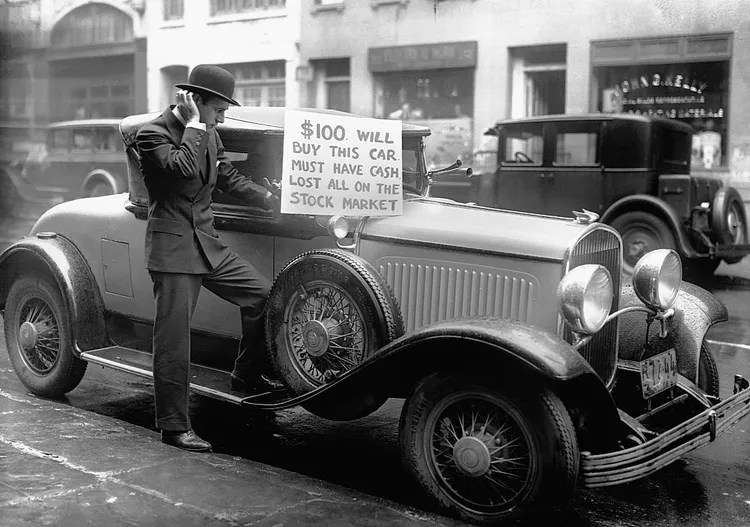
As we wonder if it is, in the end, all about the Benjamins, we might recall that on this date in 1929 Yale economist Irving Fisher wrote in the New York Times that “Stock prices have reached what looks like a permanently high plateau.” Eight days later, on October 24, 1929, the stock market began a four-day implosion on what became known as Black Thursday. This crash cost investors more than World War I and was a main catalyst of the Great Depression.
Fisher’s declaration was in response to Great Britain’s Chancellor of the Exchequer, Philip Snowden, then-recent description of America’s stock market as “a perfect orgy of speculation,” which was quickly followed by U.S. Treasury Secretary Andrew Mellon’s assertion that American investors “acted as if the price of securities would infinitely advance.” Fisher’s prognostication has entered history as the worst stock market prediction of all time.
“The structure of the universe- I mean, of the heavens and the earth and the whole world- was arranged by one harmony through the blending of the most opposite principles”*…
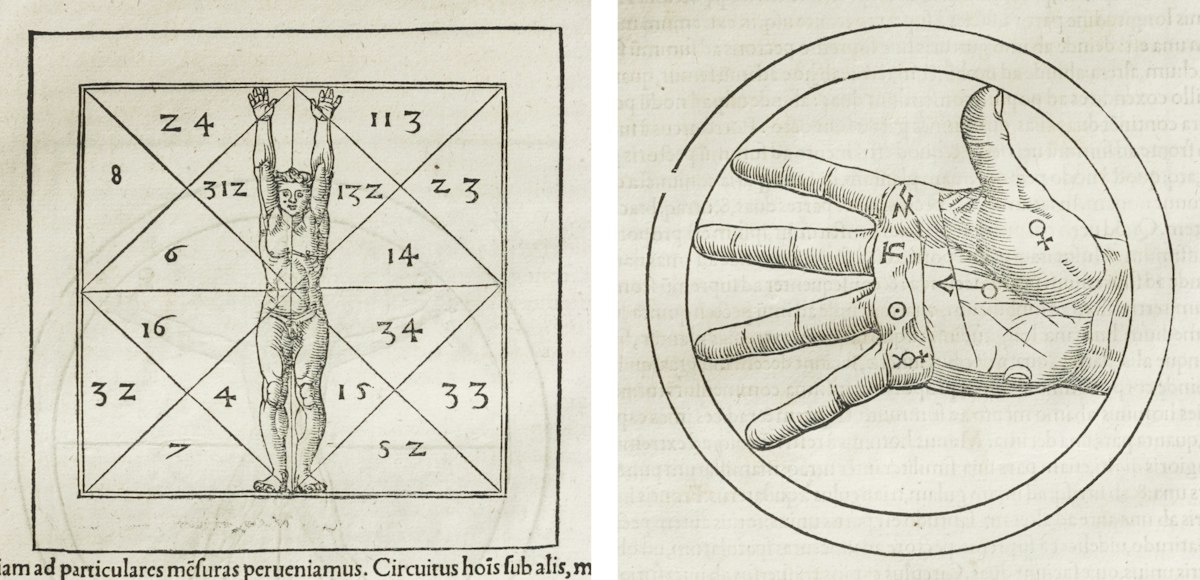
… And as we undertake to understand that structure, we use the lens– the mental models and language– that we have. The redoubtable Anthony Grafton considers and early 16th century attempt: Heinrich Cornelius Agrippa‘s De Occulta Philosophia libri III, Agrippa’s encyclopedic study of magic that was, at the same time, an attempt to describe the structure of the universe, sketching a path that leads both upward and downward: up toward complete knowledge of God, and down into every order of being on earth…
Heinrich Cornelius Agrippa’s manual of learned magic, De occulta philosophia (1533), explicated the ways in which magicians understood and manipulated the cosmos more systematically than any of his predecessors. It was here that he mapped the entire network of forces that passed from angels and demons, stars and planets, downward into the world of matter. Agrippa laid his work out in three books, on the elementary, astrological, and celestial worlds. But he saw all of them as connected, weaving complex spider webs of influence that passed from high to low and low to high. With the zeal and learning of an encyclopedist imagined by Borges, Agrippa catalogued the parts of the soul and body, animals, minerals, and plants that came under the influence of any given planet or daemon. He then offered his readers a plethora of ways for averting evil influences and enhancing good ones. Some of these were originally simple remedies, many of them passed down from Roman times in the great encyclopedic work of Pliny the Younger and less respectable sources, and lacked any deep connection to learned magic.
[Grafton describes the many dimensions of Agrippa’s compilation of the then-current state of magic…]
But few of the dozens of manuscript compilations that transmitted magic through the Middle Ages reflected any effort to impose a system on the whole range of magical practices, as Agrippa’s book did. He made clear that each of the separate arts of magic, from the simplest form of herbal remedy to the highest forms of communication with angels, fitted into a single, lucid structure with three levels: the elementary or terrestrial realm, ruled by medicine and natural magic; the celestial realm, ruled by astrology; and the intellectual realm, ruled by angelic magic. Long tendrils of celestial and magical influence stitched these disparate realms into something like a single great being…
Agrippa offered, in other words, both a grand, schematic plan of the cosmos, rather like that of the London Underground, which laid out its structure as a whole, and a clutch of minutely detailed local Ordinance Survey maps, which made it possible to navigate through any specific part of the cosmos. Readers rapidly saw what Agrippa had to offer. The owner of a copy of On Occult Philosophy, now in Munich, made clear in his only annotation that he appreciated Agrippa’s systematic presentation of a universe in which physical forms revealed the natures of beings and their relations to one another: “Physiognomy, metoposcopy [the interpretation of faces], and chiromancy, and the arts of divination from the appearance and gestures of the human body work through signs.” Agrippa’s book not only became the manual of magical practice, but it also made the formal claim that magic was a kind of philosophy in its own right…
A 16th century attempt to understand the structure of the universe: “Marked by Stars- Agrippa’s Occult Philosophy,” from @scaliger in @PublicDomainRev.
* Aristotle
###
As we take in the totality, we might send more modern birthday greetings to a rough contemporary of Agrippa’s, Evangelista Torricelli; he was born on this date in 1608. Even as Agrippa was trying to understand the world via magic, Torricelli, a student of Galileo, was using observation and reason to fuel the same quest. A physicist and mathematician, he is best known for his invention of the barometer, but is also known for his advances in optics, his work on the method of indivisibles, and “Torricelli’s Trumpet.” The torr, a unit of pressure, is named after him.

“Oh dark, dark, dark, amid the blaze of noon, irrevocably dark, total eclipse without all hope of day”*…

Today is the occasion of an annular eclipse, which will pass through eight U.S. states before crossing the Gulf of Mexico and to transit Mexico, Guatemala, Belize, Honduras, Nicaragua, Costa Rica, Panama, Colombia, and Brazil. While some people in the Western Hemisphere will witness a “ring of fire” during the eclipse, many more will experience the phenomenon of crescent sunlight. Rebecca Boyle has advice on how we might approach it…
… This Saturday, for some people in the Western Hemisphere, the Sun will disappear for a few minutes and appear to leave a flaming hole in the sky. Instead of a ball of fire, the Sun will transform into a ring of fire, a strange and wondrous sight. This is an annular solar eclipse, and it happens because the Moon is right smack in front of the Sun.
A solar eclipse only happens during new Moon phases, when we otherwise wouldn’t be able to see our nearest celestial companion. Though we get a new Moon every month, we do not get solar eclipses as often because of our satellite’s oddball path around the planet. Sometimes the Moon casts a shadow just above Earth, and sometimes just below. This weekend, the Moon’s shadow will fall onto Earth, just right for people in parts of the Western Hemisphere to see it.
The annular eclipse is a preview of a more incredible, rarer event next April, when a total solar eclipse will cross the continental United States. There is no experience on Earth like a total eclipse; make plans to see it, if you can. But this weekend’s “ring of fire” eclipse is an event you should try to see first (safely, with eclipse glasses), if you can get yourself into the western U.S. or parts of Central and South America. Here’s a map showing the eclipse path; if you can’t travel to see it in person, you can watch the eclipse online.
Eclipses happen because the Sun and Moon appear to be roughly the same diameter. The Sun is actually about 400 times larger than the Moon, but it is also about 400 times more distant, so they seem like the same size in our sky.
…
The Moon’s shadow forms two concentric cones, composed of an inner shadow called the umbra, where the sun is completely obscured, and an outer, broader cone called a penumbra, where sunlight still shines but it is partially blocked. The umbra can be seen in a narrow geographic ribbon across the Americas, and it’s where you will see a full eclipse; under the penumbra, which covers much of the western U.S., Central and South America, you will see a partial eclipse.
Like the gears of a clock, a combination of precise positions and movements initiate an eclipse of the Sun. As Earth spins, day breaks. The Sun and Moon appear to trace a path across the sky. The Sun is not moving (at least not perceptibly); Earth’s rotation makes the star’s position change. The Moon is moving around us while the Earth rotates, so it seems to move too, but it appears to go slower than our star. The partial solar eclipse begins as the Sun catches up to the Moon’s position in our sky. On Saturday morning around 8:06 a.m. Pacific time, people in Eugene, Oregon, will be the first to see the Moon appear to take a bite out of the Sun. The bite will get progressively bigger until the full annular eclipse begins at 9:16 a.m. Pacific time.
The annular eclipse only lasts about four minutes (depending on your precise location under the Moon’s shadow) but the partial eclipse, which will be visible over a much wider geographic area, lasts about an hour and 15 minutes before and afterward. During this phase, shadows cast by objects on Earth will change in unusual ways. One lovely place to be during a partial solar eclipse is underneath a tree, if you can find an evergreen or a deciduous tree that has not dropped its leaves yet. Look at the ground. In the dappled light, you will see crescents everywhere: the crescent Sun.
Sunlight is the heavens reaching down to touch us right where we stand; I think about this when I step into the light. But crescent sunlight is the Moon joining this experience. Its darkness, rather than its light, reaches out to touch us, too…
An informative and lyrical guide to today’s eclipse: “During an Annular Eclipse, Look to the Shadows,” from @rboyle31 in @atlasobscura.
* John Milton, Samson Agonistes
###
As we don’t look directly, we might recall that on this date in 1609, Galileo (who has claim to the titles Father of observational astronomy, modern-era classical physics, the scientific method, and modern science) put the telescope to use in his astronomical work. Upon hearing (at age 40) that a Dutch optician had invented a glass that made distant objects appear larger, Galileo crafted his telescope. He continued to improve his device, ultimately achieving 30X magnification, and recorded his observations of the Moon, the moons of Jupiter, the Phases of Venus, Sunspots, The Milky Way, and more. He published his initial telescopic astronomical observations in March 1610 in a brief treatise entitled Sidereus Nuncius (Starry Messenger).
Telescopes were also a profitable sideline for Galileo, who sold them to merchants who found them useful both at sea and as items of trade.

You must be logged in to post a comment.