Posts Tagged ‘Technology’
“Sometimes this high-tech world calls for low-tech solutions”*…

Our human war against infectious microbes has escalated. As bioscience has produced a stream of anti-bacterial and anti-fungal treatments, the continuously-evolving micro-organisms they target evolve in ways to protect themselves… and so our antibiotics become less effective.
This antibiotic resistance is estimated to result in more than 2.8 million infections from antibiotic-resistant bacteria, and more than 35,000 people die as a result. Antibiotic resistance adds $20 billion in excess direct healthcare costs each year in the US. Additional costs to society for lost productivity could be as high as $35 billion a year. All of this is driven in some measure by over-prescription (the CDC reckons that over 25% of antibiotics prescribed in US outpatient settings are unnecessary)– but the evolutionary dynamics of our microbial “enemies” being what they are, the problem would be material in any case.
So effective non-antibiotic treatments are especially valuable. Ian Ingram reports on one of the latest..
The FDA cleared medical-grade Australian sheep blowfly (Lucilia cuprina) larvae in what maker Cuprina Holdings believes marks the first debridement product to use this particular species.
Dubbed Medifly Maggots, the product [pictured above] is indicated for removing dead or infected tissue from non-healing necrotic skin and soft tissue wounds — such as pressure or neuropathic foot ulcers — and non-healing traumatic or post-surgical wounds.
A healthcare worker is required to oversee the application of the prescription maggot product, which was cleared based on demonstration of equivalence to the previously cleared medical-grade green bottle blowfly larvae — Lucilia sericata (Medical Maggots).
“Maggot debridement therapy has earned its place in modern wound care, and adding a second FDA-cleared species strengthens the entire field,” Ronald Sherman, MD, the company’s medical and scientific director, said in a statement.
“Lucilia cuprina has a meaningful international track record,” and the new clearance “gives clinicians and their patients more flexibility in how this therapy is delivered,” added Sherman, who has worked on the development of medical-grade maggots for decades and was instrumental in getting the first product cleared by the FDA in 2004.
According to recent estimates, anywhere from 1-2% of people in developed countries have chronic wounds, which are associated with greater risks of limb amputation and mortality.
Maggots, long used for clearing dead or non-healing tissue before the invention of antibiotics, can spare antibiotics and have also been associated with a lower risk of lower-limb amputation in diabetics with non-healing lesions…
As poet A. R. Ammons wrote (in “Catalyst“): “Honor the maggot, supreme catalyst.”
“New Type of Maggot Cleared by FDA as Medical Treatment,” from @medpagetoday.com.
###
As we rethink remedies, we might spare a thought for Alice Stewart; she died on this date in 2002. A physician and epidemiologist, she specialized in social medicine and the effects of radiation on health. Starting in WW II, she investigated the health effects of exposure to TNT in ammunitions factories, of carbon tetrachloride, and a prevalence of tuberculosis among shoe industry workers.
In the 1950s, Stewart led a pioneering study of x-rays (especially the pre-natal x-rays of expectant mothers) as a cause of childhood cancer. Her results were initially regarded as unsound, but were eventually accepted worldwide; the use of medical x-rays during pregnancy and early childhood was curtailed as a result– though it took around two and a half decades.
And after a visit to the U.S. in 1974, Stewart consulted on a major investigation of the health of workers in the nuclear industry there: she examined the sickness records of employees in the Hanford (WA) plutonium production plant and found a far higher incidence of radiation-induced ill health than was noted in official studies (produced by the nuclear industry).
Stewart was awarded the Right Livelihood Award in 1986 “for bringing to light in the face of official opposition the real dangers of low-level radiation.” In 1997 she was invited to become the first Chair of the European Committee on Radiation Risk.

“Soft as the earth is mankind and both need to be altered”…
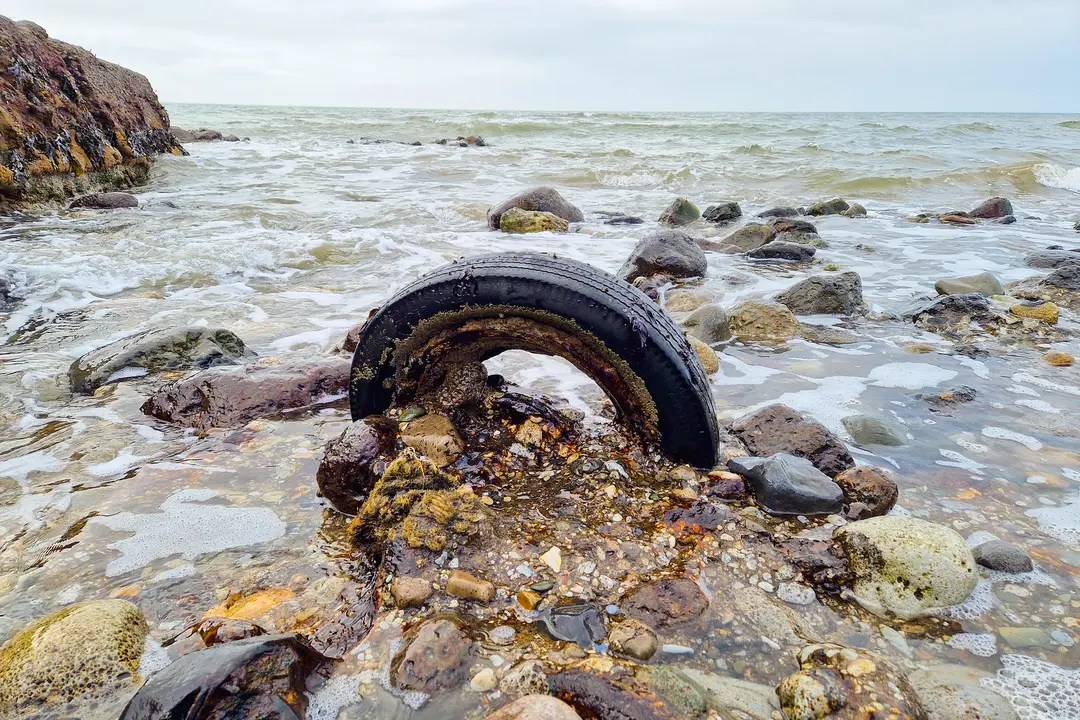
Indeed, especially over the last 150 years or so, both have been. And as a consequence, John MacDonald reports, the Anthropocene is presenting a challenge to geologists:
I’m standing on a beach at Workington, on the western edge of the Lake District in England [pictured above and throughout the article linked below]. Here I find myself contemplating a very unnatural object, while pondering a pretty fundamental question: what, exactly, is a rock? For a geologist like me, this should be easy to answer, but what I’m looking at has made me think otherwise.
At Workington, all seems natural – the sounds of the waves lapping the shore, the call of seabirds, the smell of the ocean, the sight of the stony beach and high cliffs. At first glance, the beach is made largely of a rock platform, which is not a particularly unusual phenomenon – many coastal areas are ‘rock coasts’ made of sandstone, basalt or granite. These rocks are ancient in human years – often millions or even billions of years old – and have been sculpted into their current cliff or platform shapes over hundreds to thousands of years.
Yet among the waves is an object that shouldn’t be there: a wheel and tyre, embedded in the rock that makes up the shore. It’s not stuck in a crevice – the rock has actually formed around it. How can this have happened? The wheel and tyre are of a mid-20th century style, but rocks are ancient, often millions of years old. Aren’t they?
Closer inspection of this hard rock platform shows it is what geologists call conglomerate: a sedimentary rock made of rounded pebbles and cobbles deposited on the Earth surface. Over thousands to millions of years, this material is buried and heated causing minerals to form and fill in the gaps between the pebbles and cobbles, fusing them together into a hard rock mass. At Workington though, this can’t have happened: as well as the tyre, my colleagues and I found several other human-made objects, under 100 years old. The pebbles and cobbles in the conglomerate aren’t natural either: they are all made of slag, a solid by-product of the iron- and steel-making process.
As a geologist, I have studied various types of natural rocks, but recently I have become interested in ‘anthropogenic geomaterials’ – things like industrial slag – and how they become entwined in geological and environmental processes. I came to Workington originally to look at the slag, because I was interested in its potential to scrub-capture carbon dioxide out of the atmosphere. However, when encountering the rock platform with the wheel in it, I was drawn by its incongruity. After studying the geomaterials of Workington more closely with my colleagues Amanda Owen and David Brown, we believe that this little-known section of the English coastline represents a tangible and potentially long-lasting signature of the impact humans are having on the planet.
Unlike many industrial landscapes, nature here has mostly returned, so it would be easy to miss that the beach is composed of human materials. Here a process that normally takes millennia or aeons has happened in a matter of decades. And it’s not the only example: new forms of anthropogenic geology are emerging around the world. These new materials are blurring the borderline between the natural and unnatural. They are also raising a rather fundamental question for geology: what actually is a rock?…
And what becomes of geology as its tasks come to resemble archaeology and anthropogy? Read on for the backstory and the answers.
Not natural, not quite unnatural, the strange new rocks of the Anthropocene stretch the boundaries of geology: “What is this rock?” from @aeon.co.
* W. H. Auden, “In Praise of Limestone“
###
As we ruminate on rocks, we might spare a thought for William Logan; he died on this date in 1875. Born in Montreal in 1798, he was sent to Edinburgh for an education, after which, he lingered in Britain to work in Wales at his uncle’s coal and copper-smelting business. Logan made geologic maps of coal fields in Wales, in attempt to understand the sources of coal and ores. He noted the relationship between the underlying clay layers and fossil tree roots with local coal beds– which helped substantiate the theory that coal beds are formed in place.
On returning to Canada in 1842, he became the founding director of the Geological Survey of Canada. At the time, the country’s geology was virtually unknown; but as a product of two decades of his research, the CGS published the monumental Report on the Geology of Canada in 1863. Known as “the father of Canadian geology,” Logan was knighted by Queen Victoria; and after his death Mount Logan, Canada’s highest mountain, was named in his honor.

“The remedy is worse than the disease”*…

Your correspondent is a co-founder and director of Common Sense Media, an organization devoted to understanding the fraught media environment in which we live, to helping children, their families, and educators navigate it, and to advocating for “common sense” protections for kids. When we began, over 20 years ago, the terrain was largely TV, movies, books, and video games. They remain, of course, but the spotlight moved to social media, and now, to AI.
Advocacy, as it turns out, can be a tricky needle to thread. As Francis Bacon (and following him, a stream of others) observe, sometimes “the cure can be worse that the disease.” And that’s especially true when the “disease” one is fighting is the province of a powerful, richly funded cabal who market their moves as cures, even though, through their lens, disease is the desired state.
By way of one (chilling) example, Joe Wilkins outlines one dimension of the current state-of-play…
The White House and Congress are working on a deal to clamp down on what US citizens are allowed to say online. According to new reporting by Axios, the Trump administration is negotiating with key senators in an effort to shoehorn a massive legislation package which would limit states’ abilities to regulate AI in exchange for placing broad federal limits on digital speech.
Plenty of ink has been spilled about the Trump administration’s push to revoke AI regulation from individual states. Though the White House and its allies frame this as a matter of “safety” and “national security,” the timing is telling, coming as progressive state governments move to restrict the building of AI data centers and hold tech companies liable for harms their AI systems cause.
What makes this deal particularly insidious is the trade-off at its core. Per Axios, congressional lawmakers lead by Republican Marsha Blackburn are essentially offering to surrender their ability to regulate AI in exchange for three federal censorship bills: the Kids Online Safety Act, the NO FAKES Act, and a federal age verification mandate.
While the language around these three measures suggests common-sense cyber regulation, activists say they really amount to a massive censorship regime that is fundamentally anti-democratic.
In a blistering statement, the first amendment group Foundation for Individual Rights and Expression (FIRE) warns that “taken together, these bills would fundamentally change the internet as we know it.” That’s especially striking because FIRE is funded by conservative private interests like billionaire Charles Koch, meaning its opposition highlights the degree to which Trump is butting heads against fellow members of the US ruling class.
The Kids Online Safety Act (KORA) for example, would force social media giants to restrict lawful speech based on Federal Trade Commission regulations. FIRE complains that this would give the federal government too much power to hold platforms like Meta accountable for their harms — which, many would argue, is long overdue. But given that just a few corporations own the vast majority of web infrastructure and social media, KORA would give the Trump-controlled FTC major power to bend the internet to its will.
To put this power into perspective, just regulating Meta’s Instagram would impact about 71 percent of US citizens who say they regularly use the app.
It’s a powerful weapon, in other words — and like any weapon, it matters a great deal who wields it. Should the White House and Congress push KORA through, it’s likely it would functionally end the possibility of surfing the internet anonymously, while supercharging Trump’s efforts to criminalize left wing opposition groups in the US.
Whether it passes will depend on some shrewd maneuvering on the Trump administration’s part to secure Congressional support. But it all underscores a frustrating reality of AI regulation in the US: Americans overwhelmingly support stricter regulation on AI — but with the current cabal running the Oval Office, there’s no guarantee that the cure won’t be worse than the disease…
Common Sense Media continues to fight– both overt malignancies and the faux remedies that promise to be as bad or worse. So, I would argue, should we all.
Pending federal bills would fundamentally change the internet as we know it: “Trump Moves to Deeply Censor the Entire Internet,” from @joeonhere.bsky.social in @futurism.com.
A resonant reminder of the poisonous program to be resisted: “The Side That Won the Civil War is Now Banning Books About Why the Civil War Was Fought.”
And a look at the politicial economics that may drive it.
(Image above: source)
###
As we seek sanity, we might recall that it was on this date in 1788, with the ratification of the ninth state (New Hampshire), that the Constitution of the United States came into effect. It was, of course, briskly amended to include what we call the Bill of Rights— the first 10 of 27 amendments (so far).

“The system, to a large extent, causes its own behavior”*…

Alan Jacobs quotes from Freeman Dyson‘s epic 1998 book, Imagined Worlds…
It often happens that a scientific revolution is accompanied by a change in style. I like to use the names of Napoleon and Tolstoy to symbolize two contrasting styles: rigid organization and discipline represented by Napoleon, creative chaos and freedom represented by Tolstoy. In the world of computers, Napoleon is the massive IBM main-frame; Tolstoy is the humble Macintosh. The computer revolution was an escape from the Napoleonic ambitions of von Neumann to the Tolstoyan anarchy of the Internet. Future revolutions will bring more such escapes.
Jacobs goes on to observe…
The big AI companies are the apotheosis — literally, in the view of many who work for them — of Napoleonic science. The open web and the world of hobbyist and small-scale devices (often built on the Raspberry Pi) are our remaining refuges of Tolstoyan computing.
See also: “Twenty Five Years After Imagined Worlds, What World Are We Living In? – Our surprisingly Napoleonic twenty-first century,” in which Erik Larson unpacks Dyson’s thinking and reconciles it to the world of 2022 (when Larson wrote the piece).
###
As we contemplate culture, we might spare a thought for Jack Kilby; he died on this date in 2005. An electrical engineer, he made a– if not the— foundational advance that moved us into the age we’re now navigating: the integrated curcuit (or as we know it, the chip).
In mid-1958, as a newly employed engineer at Texas Instruments, Kilby didn’t yet have the right to a summer vacation. So he spent the summer working on the problem in circuit design known as the “tyranny of numbers” (how to add more and more components, all soldered to all of the others, to improve performance). He finally came to the conclusion that manufacturing the circuit components en masse in a single piece of semiconductor material could provide a solution. On September 12, he presented his findings to the management: a piece of germanium with an oscilloscope attached. Kilby pressed a switch, and the oscilloscope showed a continuous sine wave– proving that his integrated circuit worked and thus that he had solved the problem.
Kilby is generally credited as co-inventor of the integrated circuit, along with Robert Noyce (who independently made a similar circuit a few months later). Kilby has been honored in many ways for his breakthrough, probably most augustly with the 2000 Nobel Prize in Physics.


“Adaptation and mitigation are two sides of the same coin. If mitigation is about preventing the unmanageable, adaptation is about managing the unavoidable.”*…

Adapting to climate change is quickly becoming part of everyday life. Nabig Chaudhry outlines seven trends we’re seeing for 2026 and beyond…
Within the climate and scientific communities, there’s growing concern about how quickly the world is approaching (and may exceed) 2°C of warming. 2024 was the first calendar year in which global average temperature exceeded 1.5°C above preindustrial levels. The impacts of rapid warming are becoming harder to miss: The climate is changing quickly almost everywhere, local and global climate risks are growing, progress on mitigation has become more politically constrained and uncertain, and many of our systems and policies aren’t prepared for the conditions ahead.
Growing climate risk is increasing the demand for new technologies, tools, strategies, and ways of thinking about climate adaptation. Since publishing our Insights on Climate Adaptation in 2025 report, the practice of climate adaptation has continued to develop, as more people, communities, organizations, and institutions work to understand and respond to climate risks.
People use different language to describe climate adaptation (including climate resilience), but the work centers on helping people, communities, and organizations manage the risks of a changing climate. Those activities are expanding, and we can already see signs. For example, new funding and investment vehicles are emerging, such as Tailwind Futures, and adaptation is receiving more dedicated space at major climate convenings, including The Adaptation Forum, a co-hosted gathering of thought leaders in the adaptation space during Climate Week NYC 2025.
In my role as Director of Climate Adaptation Research at Probable Futures and through my PhD program at the University of California, Berkeley, I speak with experts, read emerging research, and study adaptation developments every day. Through these conversations and insights, I’ve reflected on which adaptation trends are likely to emerge and strengthen…
Chaudhry npacks seven different trends; here, let me highlight two. The first is one that (Roughly) Daily has visited before, insurance…
Elevating insurance as a force in adaptation planning, policy, and behavior
Insurance is a valuable adaptation tool, as it can transfer risk, support recovery after climate shocks, and help signal where danger is increasing through premiums, deductibles, coverage limits, or insurer retreat. It can also shape incentives, because the way risk is priced can influence whether and how people and institutions reduce exposure, strengthen buildings, or avoid certain kinds of development.
As climate risks grow, damage to property and homes becomes more frequent and severe. Property owners are experiencing those shocks both physically (flooding, fire, wind damage, etc.) and financially as insurance markets adjust and recalibrate in response to changing probabilities and severities. Insurance markets have begun reflecting climate risk, and those changes are starting to influence where and how people build homes and infrastructure, where they invest in property, and where they choose to live.
A useful example of how insurance is beginning to influence adaptation efforts in the public sphere is Strengthen Alabama Homes, a program of the Alabama Department of Insurance. The program provides grants to help homeowners retrofit their homes and roofs to reduce wind damage from extreme winds and storms. Homeowners who participate can receive discounts on the wind portion of their homeowner’s insurance premium, which makes insurance not only a tool for recovery but also a tool for encouraging adaptation before exposure occurs.
Insurance pricing is one way climate risk is made visible, priced, and acted on through adaptation. I expect that insurance will increasingly influence adaptation planning, policy, and behavior, not only by helping people recover after climate shocks, but by shaping the choices people make before those shocks occur. The development of the insurance industry will therefore be an important factor in adaptation. If insurers become a source not only of risk pricing but also of risk information, adaptation guidance, and incentives to reduce risk, they could help more people act before losses occur. But that would require a meaningful shift in the role of insurance companies, from mainly pricing and transferring risk to also helping people reduce it…
The second goes to the contentious topic of geoengineering…
Expanding debate around the role of climate intervention
As warming continues, risks keep growing. We have more, clearer, worrisome signals that irreversible change, tipping points, and local climate changes so severe that adaptation is impractical if not impossible, are not far off. In response, people and institutions are starting new conversations about global-scale responses. One of those responses is climate intervention, sometimes called geoengineering.
Climate intervention generally refers to intentional efforts to alter Earth’s systems in order to counteract some of the effects of climate change. It can include approaches that remove carbon dioxide from the atmosphere, as well as approaches that reflect a portion of sunlight back into space, such as stratospheric aerosol injection.
Its relationship to adaptation is uneasy, but important. If climate intervention is, at its core, an effort to manage the otherwise unmanageable risks of global climate change, then is it another tool for adapting to climate change, or is it something fundamentally different? There is no consensus, and there may never be, not least because global action will cause uneven responses locally. We don’t know much about the potential impacts of some climate interventions, how they could affect different regions unequally, or what long-term consequences they may have for Earth’s climate and natural systems.
There are good reasons to have informed conversations and do fundamental research on intervention. People with adaptation expertise can help explore, illuminate, and explain what climate intervention could mean for society and nature. There are also likely to be benefits for adaptation professionals to participate in these conversations and research projects. Even if climate intervention is never widely deployed, the debate itself may shape adaptation thinking, climate policy, research funding, public trust, and international governance.
Climate change requires people to consider risks and options, whether for mitigation, adaptation, or intervention. Treating strategies for managing the rate, pace, and impacts of climate change as distinct and separate is unlikely to lead to good outcomes. I am hopeful that there will be more collaboration across these new fields as society faces new challenges that have a common root cause. This may include more discussion about how these technologies should be governed, whether they should receive more investment, and whether climate intervention is a possible third leg alongside mitigation and adaptation…
Eminently worth reading in full: “The near-term future of climate adaptation: emerging trends.”
* U. N. Environmental Program
###
As we prepare, we might recall (wistfully) that it was on this date in 1942 that Bing Crosby, with the Trotter Orchestra and the Darby Singers, recorded Irving Berlin’s song, “White Christmas.” According to the Guinness Book of World Records, this version is the best-selling single of all time with an excess of 50 million copies sold worldwide. (In fact, the version most often heard today is not the original. After frequent use, the master had become damaged, so on March 18, 1947, Crosby re-recorded the holiday hit.)

You must be logged in to post a comment.