Posts Tagged ‘religion’
“The mind is its own place, and in itself can make a heaven of hell, a hell of heaven”*…
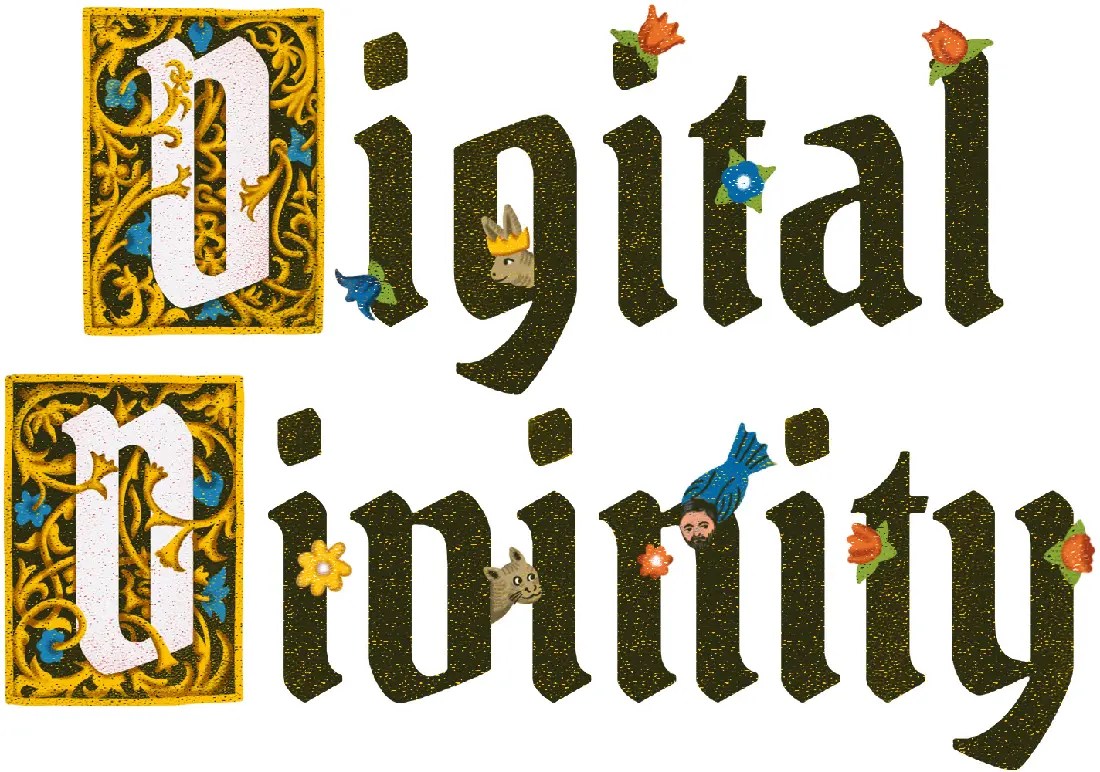
… and now, as Cengiz Yar demonstrates in the always-illuminating newsletter Rest of World, technology is here to help…
Technology has transformed how we spend, study, live, eat — even how we sleep. And for the 6.75 billion people around the world who consider themselves religious, technology is also changing their faith. How people worship, pray, and commune with the divine is transforming from Seoul to Lagos.
Earlier this year, Rest of World set out to document the myriad of ways that religious believers are using new technologies in their daily practices. This illustrated storybook represents a broad spectrum of themes and trends playing out across a number of religions and countries that include Hindu temples made by 3D printers to priests that dance on TikTok. They speak to the unraveling tensions of our time as people turn to technology to simplify their lives, search for answers, or find platform-born fame.
These short stories offer insight into trends that range from the unique and unexpected to the artificial and financial. Just as influence, power, and need are shaping the world, they are also moving ancient faiths. This push and pull between old and new, between the ancient and modern, is now happening at lightning speed.
22 arresting examples of ancient traditions meeting modern technology: “Digital Divinity,” from @CengizYar in @restofworld. (Work supported by @HLuceFdn.)
* John Milton, Paradise Lost
###
As we ponder piety, we might recall that this was the date in 1582 that a new “technology” obliterated 10 days from the lives of Catholics in the Holy Roman Empire: Italy, Spain, Portugal, Poland (and the miscellaneous states in the HRE) introduced the Gregorian calendar. While this was “October 5” in the rest of the world, those countries, adopting Pope Gregory XIII’s innovation, skipped ten days– so that there, the date shifted from October 4 to October 15. With the shift, the calendar was aligned with the equinoxes (and the lunar cycles used to establish the celebration of Easter). Britain and its colonies resisted this Popish change and used the Julian calendar for another century and a half, until September 2, 1752.

“All the world is made of faith, and trust, and pixie dust”*…

The Gen Z gender divide, especially as it relates to ever-more conservative males and ever-more liberal females, is widely remarked. (E.g., see here [gift article].) Ruth Graham explores that divide in a different dimension– one that may be fueling the political divergence…
… For the first time in modern American history, young men are now more religious than their female peers. They attend services more often and are more likely to identify as religious.
“We’ve never seen it before,” Ryan Burge, an associate professor of political science at Eastern Illinois University, said of the flip.
Among Generation Z Christians, this dynamic is playing out in a stark way: The men are staying in church, while the women are leaving at a remarkable clip.
Church membership has been dropping in the United States for years. But within Gen Z, almost 40 percent of women now describe themselves as religiously unaffiliated, compared with 34 percent of men, according to a survey last year of more than 5,000 Americans by the Survey Center on American Life at the American Enterprise Institute.
In every other age group, men were more likely to be unaffiliated. That tracks with research that has shown that women have been consistently more religious than men, a finding so reliable that some scholars have characterized it as something like a universal human truth.
The men and women of Gen Z are also on divergent trajectories in almost every facet of their lives, including education, sexuality and spirituality.
Young women are still spiritual and seeking, according to surveys of religious life. But they came of age as the #MeToo movement opened a national conversation about sexual harassment and gender-based abuse, which inspired widespread exposures of abuse in church settings under the hashtag #ChurchToo. And the overturning of Roe v. Wade in 2022 compelled many of them to begin paying closer attention to reproductive rights.
Young men have different concerns. They are less educated than their female peers. In major cities, including New York and Washington, they earn less.
At the same time, they place a higher value on traditional family life. Childless young men are likelier than childless young women to say they want to become parents someday, by a margin of 12 percentage points, according to a survey last year by Pew…
… This growing gender divide has the potential to reshape the landscape of not just religion, but also of family life and politics. In a Times/Siena poll of six swing states in August, young men favored former President Donald J. Trump by 13 points, while young women favored Vice President Kamala Harris by 38 points — a 51-point gap far larger than in other generational cohorts.
It is too early to know if this new trend in churchgoing indicates a long-term realignment, said Russell Moore, the editor in chief of Christianity Today.
But he marveled at its strangeness in Christian history.
“I’m not sure what church life looks like with a decreasing presence of women,” he said, pointing out that they historically have been crucial forces in missionary work and volunteering. “We need both spiritual mothers and spiritual fathers.”…
Eminently worth reading in full: “In a First Among Christians, Young Men Are More Religious Than Young Women” (gift article) by @publicroad in @nytimes.
* J.M. Barrie, Peter Pan
###
As we ponder piety, we might spare a thought for Aimee Semple McPherson; she died on this date in 1944. A Pentecostal evangelist and media celebrity in the 1920s and 1930s, she is best known for founding the Los Angeles-based Foursquare Church and for pioneering the use of media to build her following. She broadcast on radio (spiced with popular entertainment and stage techniques) to draw in both audience and revenue for her weekly sermons at Foursquare’s Angelus Temple, an early megachurch. In her time, she was the most well-known (and publicized) Protestant evangelist, surpassing Billy Sunday and other predecessors.
While McPherson certainly undertook her own promotion, her fame was ignited in 1926, when (a la Agatha Christie) she disappeared– in McPherson’s case for five weeks. The evangelist insisted that she had been kidnapped and taken to Mexico; many believed that she had “retreated” into a tryst with a male colleague. Indeed, she was investigated and charged by L.A. authorities with fabricating a hoax. That charge was never proved, though many still believe that she was in fact the architect of her own disappearance. In any event, the turmoil was national news– and supercharged her rise.

“What is an anarchist? One who, choosing, accepts the responsibility of choice.”*…

Per the Oxford Dictionaries, “anarchy” has two meanings:
1. a state of disorder due to absence or nonrecognition of authority or other controlling systems.
2. the organization of society on the basis of voluntary cooperation, without political institutions or hierarchical government; anarchism.
It’s fair to observe that, in common parlance, it’s the first definition that rules. The estimable Alan Jacobs puts in a word for the second, and positions it as something beyond the political, something spiritual…
Perhaps the most unusual element of my 2022 essay on anarchism is this: I present anarchism not as a political system but as a spiritual discipline. I don’t put the point quite that bluntly, but I come fairly close:
The first target of anarchistic practice ought to be whatever it is in me that resists anarchy — what resists negotiation, the turning toward the Other as neighbor and potential collaborator. I return to Odo’s line, “What is an anarchist? One who, choosing, accepts the responsibility of choice,” but I add this: The responsibility of choice arises when I acknowledge my own participation, in a thousand different ways, in the imposition of order on others. This is where anarchism begins; where the turning aside from the coldest of all cold monsters begins; where I begin. The possibility of anarchic action arises when I acknowledge my own will to power...
It should be obvious that if you are delighted with power politics – if you think the purpose of politics is “defeating the enemy and enjoying the spoils” of your victory – then you won’t be worried about your own will to power. You can just turn off your conscience and go on the attack, thinking only about winning (good) and losing (bad). My suggestion that the desire to impose order on others is a desire that needs to be reflected on will seem obviously silly to you. But there’s another way of thinking about the political order that is equally incompatible with the kind of reflection I counsel in that essay: the libertarian model.
Libertarianism doesn’t want to impose order on others, but its most passionate advocates have a strong tendency to assess existence in terms of winning and losing – winning and losing not in the corridors of political power but in the marketplace; the individual entrepreneur controlling the segment of the market in which he works. As Mark Zuckerberg likes to say, it’s all about DOMINATION; just not domination by law. Anarchism, by contrast — this is my argument in that essay — stands between (libertarian) chaos and (seeking to become) the Man. Some of the most thoughtful anarchists like to say that “anarchy is order” – but order that emerges from collaboration and cooperation rather than being imposed by governmental power. I don’t think it’s possible to create an anarchist system, because an anarchism imposed on people by those in power isn’t anarchism.
Here’s what I think can be done: Try, in every way we can think of, to increase the number of situations in our lives in which we are neither dehumanized by an omnipotent state nor engaged in ceaseless competition with one another in an omnipotent marketplace. As Wendell Berry has written, “Rats and roaches live by competition under the law of supply and demand; it is the privilege of human beings to live under the laws of justice and mercy.” We should assume that privilege whenever we can, and take it upon ourselves as a collaborative of equals to determine what, in any given case facing us, justice and mercy are. In other words, what I call the anarchic imperative is an attempt to rebalance what Berry has called “the two economies”:
For the thing that so troubles us about the industrial economy is exactly that it is not comprehensive enough, that, moreover, it tends to destroy what it does not comprehend, and that it is dependent upon much that it does not comprehend. In attempting to criticize such an economy, it is probably natural to pose against it an economy that does not leave anything out. And we can say without presuming too much, that the first principle of the kingdom of God is that it includes everything; in it the fall of every sparrow is a significant event. We are in it, we may say, whether we know it or not, and whether we wish to be or not. Another principle, both ecological and traditional, is that everything in the kingdom of God is joined both to it and to everything else that is in it. That is to say that the kingdom of God is orderly.
Amen to that. But what is the nature of that order? Eschatologically, it certainly ain’t anarchic: it is the kingdom of the archē, the source of all things, the Lord. But to understand and instantiate that Kingdom here and now – when, as St. Augustine says, the City of God and the City of Man are inevitably and confusingly mixed – we need to collaborate with one another to increase both our knowledge and our ability to act effectively.
I have argued at some length that Christians aren’t pluralists – we believe that “at the name of Jesus every knee will bow” (Phil. 2:10) – but in our current position we should expect, accept, and even embrace plurality. We need to cultivate the virtues appropriate to a plural world, and we can do that by expanding the sphere of voluntary collaboration, negotiation among equals, emergent order, even when such expansion makes life more difficult for us. That’s anarchism as a spiritual discipline…
Charting a course between libertarianism and autocracy: “Anarchism as a spiritual discipline.”
[The image above is from Jacobs’ Harpers essay— eminently worth reading]
* Ursula K. Le Guin, who created Odo (and Odoism) in The Dispossessed
###
As we choose, we might recall that it was (probably) on this date that the first edition of what we know as the Gutenberg Bible was published.
While many believe that Johannes Gutenberg first work using moveable type was the Bible, it was probably the second or maybe even third. [Indeed, there was an earlier (32 line) version of the parts of the Bible, labeled an “indulgence.”] The Gutenberg press was in operation by 1450, and it is known that a German poem had been printed before the Bible. However, it is known that Gutenberg began the painstaking process of hand placing every letter for every page of the new Bible during that same year. It is believed that the 42-line Gutenberg Bible [the one we know as “The Gutenberg Bible”] was completed on this day in 1456. About 180 copies of the book were printed, which seems rather small for a first edition…

“We ceased to be the lunatic fringe. We’re now the lunatic core.”*…

Further, in a fashion, to yesterday’s post on analog computing, an essay from Benjamin Labatut (the author of two remarkable works of “scientific-historical fiction,” When We Cease to Understand the World and The MANIAC, continuing the animating theme of those books…
We will never know how many died during the Butlerian Jihad. Was it millions? Billions? Trillions, perhaps? It was a fantastic rage, a great revolt that spread like wildfire, consuming everything in its path, a chaos that engulfed generations in an orgy of destruction lasting almost a hundred years. A war with a death toll so high that it left a permanent scar on humanity’s soul. But we will never know the names of those who fought and died in it, or the immense suffering and destruction it caused, because the Butlerian Jihad, abominable and devastating as it was, never happened.
The Jihad was an imagined event, conjured up by Frank Herbert as part of the lore that animates his science-fiction saga Dune. It was humanity’s last stand against sentient technology, a crusade to overthrow the god of machine-logic and eradicate the conscious computers and robots that in the future had almost entirely enslaved us. Herbert described it as “a thalamic pause for all humankind,” an era of such violence run amok that it completely transformed the way society developed from then onward. But we know very little of what actually happened during the struggle itself, because in the original Dune series, Herbert gives us only the faintest outlines—hints, murmurs, and whispers, which carry the ghostly weight of prophecy. The Jihad reshaped civilization by outlawing artificial intelligence or any machine that simulated our minds, placing a damper on the worst excesses of technology. However, it was fought so many eons before the events portrayed in the novels that by the time they occur it has faded into legend and crystallized in apocrypha. The hard-won lessons of the catastrophe are preserved in popular wisdom and sayings: “Man may not be replaced.” “Once men turned their thinking over to machines in the hope that this would set them free. But that only permitted other men with machines to enslave them.” “We do not trust the unknown which can arise from imaginative technology.” “We must negate the machines-that-think.” The most enduring legacy of the Jihad was a profound change in humankind’s relationship to technology. Because the target of that great hunt, where we stalked and preyed upon the very artifacts we had created to lift ourselves above the seat that nature had intended for us, was not just mechanical intelligence but the machinelike attitude that had taken hold of our species: “Humans had set those machines to usurp our sense of beauty, our necessary selfdom out of which we make living judgments,” Herbert wrote.
Humans must set their own guidelines. This is not something machines can do. Reasoning depends upon programming, not on hardware, and we are the ultimate program!
The Butlerian Jihad removed a crutch—the part of ourselves that we had given over to technology—and forced human minds to develop above and beyond the limits of mechanistic reasoning, so that we would no longer depend on computers to do our thinking for us.
Herbert’s fantasy, his far-flung vision of a devastating war between humanity and the god of machine-logic, seemed quaint when he began writing it in the Sixties. Back then, computers were primitive by modern standards, massive mainframe contraptions that could process only hundreds of thousands of cycles per second (instead of billions, like today), had very little memory, operated via punch cards, and were not connected to one another. And we have easily ignored Herbert’s warnings ever since, but now the Butlerian Jihad has suddenly returned to plague us. The artificial-intelligence apocalypse is a new fear that keeps many up at night, a terror born of great advances that seem to suggest that, if we are not very careful, we may—with our own hands—bring forth a future where humanity has no place. This strange nightmare is a credible danger only because so many of our dreams are threatening to come true. It is the culmination of a long process that hearkens back to the origins of civilization itself, to the time when the world was filled with magic and dread, and the only way to guarantee our survival was to call down the power of the gods.
Apotheosis has always haunted the soul of humankind. Since ancient times we have suffered the longing to become gods and exceed the limits nature has placed on us. To achieve this, we built altars and performed rituals to ask for wisdom, blessings, and the means to reach beyond our capabilities. While we tend to believe that it is only now, in the modern world, that power and knowledge carry great risks, primitive knowledge was also dangerous, because in antiquity a part of our understanding of the world and ourselves did not come from us, but from the Other. From the gods, from spirits, from raging voices that spoke in silence.
[Labatut invokes the mysteries of the Vedas and their Altar of Fire, which was meant to develop “a mind, (that) when properly developed, could fly like a bird with outstretched wings and conquer the skies.”…]
Seen from afar by people who were not aware of what was being made, these men and women must surely have looked like bricklayers gone mad. And that same frantic folly seems to possess those who, in recent decades, have dedicated their hearts and minds to the building of a new mathematical construct, a soulless copy of certain aspects of our thinking that we have chosen to name “artificial intelligence,” a tool so formidable that, if we are to believe the most zealous among its devotees, will help us reach the heavens and become immortal…
[Labatut recounts the stories– and works– of some of the creators of AI’s DNA: George Boole (and his logic), Claude Shannon (who put that logic to work), and Geoffrey Hinton (Boole’s great-great-grandson, and “the Godfather of AI,” who created of the first neural networks, but has more recently undergone a change of opinion)…]
… Hinton has been transformed. He has mutated from an evangelist of a new form of reason into a prophet of doom. He says that what changed his mind was the realization that we had, in fact, not replicated our intelligence, but created a superior one.
Or was it something else, perhaps? Did some unconscious part of him whisper that it was he, rather than his great-great-grandfather, who was intended by God to find the mechanisms of thought? Hinton does not believe in God, and he would surely deny his ancestor’s claim that pain is an instrument of the Lord’s will, since he was forced to have every one of his meals on his knees, resting on a pillow like a monk praying at the altar, because of a back injury that caused him excruciating pain. For more than seventeen years, he could not sit down, and only since 2022 has he managed to do so long enough to eat.
Hinton is adamant that the dangers of thinking machines are real. And not just short-term effects like job replacement, disinformation, or autonomous lethal weapons, but an existential risk that some discount as fantasy: that our place in the world might be supplanted by AI. Part of his fear is that he believes AI could actually achieve a sort of immortality, as the Vedic gods did. “The good news,” he has said, “is we figured out how to build things that are immortal. When a piece of hardware dies, they don’t die. If you’ve got the weights stored in some medium and you can find another piece of hardware that can run the same instructions, then you can bring it to life again. So, we’ve got immortality. But it’s not for us.”
Hinton seems to be afraid of what we might see when the embers of the Altar of Fire die down at the end of the sacrifice and the sharp coldness of the beings we have conjured up starts to seep into our bones. Are we really headed for obsolescence? Will humanity perish, not because of the way we treat all that surrounds us, nor due to some massive unthinking rock hurled at us by gravity, but as a consequence of our own irrational need to know all that can be known? The supposed AI apocalypse is different from the mushroom-cloud horror of nuclear war, and unlike the ravages of the wildfires, droughts, and inundations that are becoming commonplace, because it arises from things that we have, since the beginning of civilization, always considered positive and central to what makes us human: reason, intelligence, logic, and the capacity to solve the problems, puzzles, and evils that taint even the most fortunate person’s existence with everyday suffering. But in clawing our way to apotheosis, in daring to follow the footsteps of the Vedic gods who managed to escape from Death, we may shine a light on things that should remain in darkness. Because even if artificial intelligence never lives up to the grand and terrifying nightmare visions that presage a nonhuman world where algorithms hum along without us, we will still have to contend with the myriad effects this technology will have on human society, culture, and economics.
In the meantime, the larger specter of superintelligent AI looms over us. And while it is less likely and perhaps even impossible (nothing but a fairy tale, some say, a horror story intended to attract more money and investment by presenting a series of powerful systems not as the next step in our technological development but as a death-god that ends the world), it cannot be easily dispelled, for it reaches down and touches the fibers of our mythmaking apparatus, that part of our being that is atavistic and fearful, because it reminds us of a time when we shivered in caves and huddled together, while outside in the dark, with eyes that could see in the night, the many savage beasts and monsters of the past sniffed around for traces of our scent.
As every new AI model becomes stronger, as the voices of warning form a chorus, and even the most optimistic among us begin to fear this new technology, it is harder and harder to think without panic or to reason with logic. Thankfully, we have many other talents that don’t answer to reason. And we can always rise and take a step back from the void toward which we have so hurriedly thrown ourselves, by lending an ear to the strange voices that arise from our imagination, that feral territory that will always remain a necessary refuge and counterpoint to rationality.
Faced, as we are, with wild speculation, confronted with dangers that no one, however smart or well informed, is truly capable of managing or understanding, and taunted by the promises of unlimited potential, we may have to sound out the future not merely with science, politics, and reason, but with that devil-eye we use to see in the dark: fiction. Because we can find keys to doors we have yet to encounter in the worlds that authors have imagined in the past. As we grope forward in a daze, battered and bewildered by the capabilities of AI, we could do worse than to think about the desert planet where the protagonists of Herbert’s Dune novels sought to peer into the streaming sands of future time, under the heady spell of a drug called spice, to find the Golden Path, a way for human beings to break from tyranny and avoid extinction or stagnation by being more diverse, resilient, and free, evolving past purely logical reasoning and developing our minds and faculties to the point where our thoughts and actions are unpredictable and not bound by statistics. Herbert’s books, with their strange mixture of past and present, remind us that there are many ways in which we can continue forward while preserving our humanity. AI is here already, but what we choose to do with it and what limits we agree to place on its development remain decisions to be made. No matter how many billions of dollars are invested in the AI companies that promise to eliminate work, solve climate change, cure cancer, and rain down miracles unlike anything we have seen before, we can never fully give ourselves over to these mathematical creatures, these beings with no soul or sympathy, because they are neither alive nor conscious—at least not yet, and certainly not like us—so they do not share the contradictory nature of our minds.
In the coming years, as people armed with AI continue making the world faster, stranger, and more chaotic, we should do all we can to prevent these systems from giving more and more power to the few who can build them. But we should also consider a warning from Herbert, the central commandment he chose to enshrine at the heart of future humanity’s key religious text, a rule meant to keep us from becoming subservient to the products of our reason, and from bowing down before the God of Logic and his many fearsome offspring:
Thou shalt not make a machine in the likeness of a human mind…
Before and after artificial intelligence: “The Gods of Logic” in @Harpers. Eminently worth reading in full.
For a less pessimistic view, see: “A Journey Through the Uncanny Valley: Our Relational Futures with AI,” from @dylanhendricks at @iftf.
* Geoffrey Hinton
###
As we deliberate on Daedalus’ caution, we might we might send fantastically far-sighted birthday greetings to a tecno-optimist who might likely have brushed aside Labatut’s concerns: Hugo Gernsback, a Luxemborgian-American inventor, broadcast pioneer, writer, and publisher; he was born on this date in 1884.
Gernsback held 80 patents at the time of his death; he founded radio station WRNY, was involved in the first television broadcasts, and is considered a pioneer in amateur radio. But it was as a writer and publisher that he probably left his most lasting mark: In 1926, as owner/publisher of the magazine Modern Electrics, he filled a blank spot in his publication by dashing off the first chapter of a series called “Ralph 124C 41+.” The twelve installments of “Ralph” were filled with inventions unknown in 1926, including “television” (Gernsback is credited with introducing the word), fluorescent lighting, juke boxes, solar energy, television, microfilm, vending machines, and the device we now call radar.
The “Ralph” series was an astounding success with readers; and later that year Gernsback founded the first magazine devoted to science fiction, Amazing Stories. Believing that the perfect sci-fi story is “75 percent literature interwoven with 25 percent science,” he coined the term “science fiction.”
Gernsback was a “careful” businessman, who was tight with the fees that he paid his writers– so tight that H. P. Lovecraft and Clark Ashton Smith referred to him as “Hugo the Rat.”
Still, his contributions to the genre as publisher were so significant that, along with H.G. Wells and Jules Verne, he is sometimes called “The Father of Science Fiction”; in his honor, the annual Science Fiction Achievement awards are called the “Hugos.”
(Coincidentally, today is also the birthday– in 1906– of Philo T. Farnsworth, the man who actually did invent television.)

“What a piece of work is a man”*…

The estimable Samuel Arbesman on the path dependency of our fundamental ideas about ourselves…
Awhile back I wrote about AI and human distinctiveness: basically my argument was that we should be less concerned by whether or not AI can do we what we can and care more about what we want to be doing. In other words, focus on what is quintessentially human, rather than what is uniquely human.
But perhaps some of these concerns are simply Western preoccupations, rather than universal human concerns?
In the recent book Fluke (which is fantastic! [your correspondent heartily agrees]), Brian Klaas noted the following provocative point about differences between Western and Eastern thinking—and their views on human distinctness—and how it might have been due to the ecological milieu that each one arose from:
In this vision of a world humans are distinct from the rest of the natural world. That felt true for the inhabitants of the Middle East and Europe around the time of the birth of Christianity. Camels, cows, goats, mice, and dogs composed much of the encountered animal kingdom, a living menagerie of the beings that are quite unlike us.
In many Eastern cultures, by contrast, ancient religions tended to emphasize our unity with the natural world. One theory suggests that was partly because people lived among monkeys and apes. We recognized ourselves in them. As the biologist Roland Ennos points out, the word orangutan even means “man of the forest.” Hinduism has Hanumen, a monkey god. In China, the Chu kingdom revered gibbons. In these familiar primates, the theory suggests, it became impossible to ignore that we were part of nature—and nature was part of us.
This is almost a Guns, Germs, and Steel-kind of approach, but for ideas. At the risk of creating too much determinism here, it’s intriguing to explore the path dependence of ideas and concepts that organize how we think about the world and ourselves.
This reminds me of other research that examined how small historical distinctions can still affect our modern world, even if they are no longer relevant. For example, there is research that looks at how certain locations betray their histories as portage sites—places where boats or cargo were transported over land, allowing travel between more traversable waterways—despite this being obsolete. And yet it still has a certain long-term effect, as per this paper “Portage and Path Dependence”:

And returning to ideas, there is a paper entitled “Frontier Culture: The Roots and Persistence of ‘Rugged Individualism’ in the United States” that explores whether or not certain differences in location—areas considered the “frontier”—affect the geographical variation of ideas and beliefs in the United States.
In the end, simply being more aware of the ideas and history that suffuse our thinking—rather than taking them for granted—is something important, whether or not we are trying to understand humanity’s place in the world, how technology should impact humanity, or why cities are located where they are…
From his marvelous newsletter, Cabinet of Wonders: “Human Distinctiveness in Different Cultures,” @arbesman.
Pair with his earlier piece: “Archaeology of Biology and Software.”
And for a(nother) taste of Brian Klaas (@brianklaas), see “Curiosity has its own reason for existing.”
* Shakespeare, Hamlet
###
As we ruminate on the roots of our (received) realities, we might recall that it was on this date in 3 BCE that a planetary conjunction of Jupiter and Venus was visible… and may have been the Star of Bethlehem mentioned in the New Testament.
In this pre-dawn, “morning star” conjunction, the two planets appeared very close to each other in the sky (a mere 0.07° apart as viewed from Earth). It occurred when the planets were in the last degrees of the zodiacal sign of Cancer which was the concluding sign for interpreting that astrological year. The same two planets met again just ten months later (June 17, 2 BCE), even more closely, almost touching (0.01°), in an “evening star” conjunction in the first degrees of Leo, the beginning sign of the new astrological year. These two unions of Jupiter and Venus might well have been interpreted as the close of one age in history and the beginning of another age in 2 BCE.
For more on these conjunctions and other potential candidates for “historical Star of Bethlehem” (and an explanation of how/why the astronomers/astrologers who sighted the star became Magi/Wise Men in Church teaching) see here.

You must be logged in to post a comment.