Posts Tagged ‘religion’
“I have said that Texas is a state of mind, but I think it is more than that. It is a mystique closely approximating a religion”*…

The estimable cultural historian Fred Turner, a seasoned observer of Silicon Valley, on what’s happening as Bay Area tech entrepreneurs turn their eyes (or, indeed, relocate) to the Lone Star State. He opens with the story of Tesla’s Gigafactory outside of Austin, then looks more broadly…
… For Elon Musk and his backers in the state capitol the Gigafactory is much more than a place to make cars. The complex’s enormous assembly floor, with its shiny red robots and twenty thousand employees, sends a Texas-sized message to entrepreneurs everywhere: the future won’t be built in California or New York. It will be built in the Bible Belt, by men—always men—with the willpower to tame the forces of technology, wrestle profit from the land, and create new industries out of whole cloth. It will rise up like the oil derricks of a hundred years before and give evidence of the limitless, God-given natural bounty of the region. It will make some men rich and when it does, it will provide evidence that the land still breeds heroes like Jim Bowie and Davy Crockett, defenders of the Alamo.
You can see where this is going. In press releases and feature stories, Tesla’s Gigafactory is a translation device, turning decades and even centuries of Texas lore into elements of a new cultural formation, a Texan Ideology. Thirty years ago, when political theorist Richard Barbrook and artist Andy Cameron published their canonical essay “The Californian Ideology” in Mute, a British journal devoted to critiquing early internet culture, the computer industry of Silicon Valley was surrounded by the remnants of San Francisco’s 1960s counterculture. The collision of these worlds produced a new orthodoxy, they wrote, one that “promiscuously combines the freewheeling spirit of the hippies and the entrepreneurial zeal of the yuppies.”
Today, the hippies have aged out of the computer industry entirely, the yuppies are retired, and high-tech entrepreneurs like Musk are leaving California for Texas. The world of digital technology has changed too. In the 1990s, everyone from modem makers to software developers was focused on building the global network. Connection was the order of the day. Today, the World Wide Web is in place, our computers are in our pockets, and the smart money bets on turning the data we generate into patterns that can be sold to the highest bidder. The global system of connection built out in the 1990s has turned the social world into a resource for the oldest form of capitalism, extraction.
For that kind of work Texas makes an ideal home. Built early on from the profits of cattle ranching and slave-picked cotton, propelled to national prominence by the oil booms of the early twentieth century, Texas has long been synonymous with turning natural and human resources into money. Its promoters have been expert, too, in turning cowboys and oilmen into emblems of American masculinity and celebrating a muscular Christianity. From its earliest days as part of Mexico, when the Mexican government required settlers to convert to Catholicism, extraction has been entwined with religion and racial politics. In the 1920s and 1930s, fundamentalist Christian radio echoed across the state. In 1953, Reverend Billy Graham staged a revival that filled the Cotton Bowl with seventy-five thousand Texans. Since the 1950s, Southern Baptists, whose conservatism has increased over the decades, have dominated the state’s religious scene. Today, they and right-wing members of other denominations help organize and fund the state’s politics…
[Turner unpacks the history, both formative and recent, and explores the motives of the tech migrants, and the ways in which the culture, attitudes– and the economic and legal structures in Texas– suit them…]
… In the 1990s of the Californian Ideology, a loose hippie spiritualism prevailed, but going to church was for the hopelessly square. Today, as Silicon Valley leaders turn to the right, and particularly when they migrate to Texas, many are embracing the simultaneous celebration of entrepreneurship and Christian discipleship at the heart of the Texan Ideology. Elon Musk has announced that although he doesn’t go to church, he considers that the “teachings of Jesus Christ are good and wise” and thinks of himself as a “cultural Christian.” [Palantir co-founder] Joe Lonsdale is Jewish, but he regularly promotes “Judeo-Christian” values as fundamental to the good society. When he moved to Texas, he brought with him the Cicero Institute, a free market and public policy think tank he founded in California. Once there, he helped establish the University of Austin, a school devoted to teaching the great books of the Western canon. For Lonsdale, as for [oil billionaire and “the state’s most powerful figure” Tim] Dunn and, increasingly, Musk, the high-tech future will have to be built in a way that blends church, state and market, to the benefit of those most able to seize public resources and turn them to private profit.
That fusion is the essence of the Texan Ideology. The millenarian impulse that animates it could be felt in 1990s California too, but the Californian Ideology grew from the counterculture, a movement driven by the search for a new consciousness, for new ways to understand our collective interconnection and so leave earthly politics behind. Its spiritual tendencies proved ideal for motivating and legitimating the construction of a global digital network. The Texan Ideology grows out of two centuries of resource extraction in the heart of the Bible Belt. Its Christianity emphasizes the idea that saints walk among us and should be venerated over the notion that we should tend to the least among us first and foremost. The Christian elements of the Texan Ideology lead to the building of private compounds, not soup kitchens.
Then again, maybe the Texan Ideology has more in common with its Californian forebear than we think. After all, it was precisely the failure of the digital industries to build an egalitarian society that led to homelessness on San Francisco’s streets. And it may be that in due course, the economic inequalities that have long plagued Texas will drown out the self-serving voices of the high-tech entrepreneurs. If the schools become bad enough, the housing expensive enough, and the Christian nationalist ethos constraining enough, Texans might finally find a way to undo Republicans’ gerrymandering and kick the current regime out of office.
In the meantime, the Texan Ideology is making its way back to California. In February 2025, the Stanford Review, a conservative student publication cofounded by Lonsdale’s former mentor Peter Thiel when he was an undergraduate, published an essay titled “Manifest Destiny is the Antidote to Bureaucracy.” The essay reached deep into the heart of Texas history to justify its calls for massive deregulation of industry, the liberation of entrepreneurial innovation, and the conquest of Greenland and Mars. “Without the frontier, elites would have monopolized land, blocking progress—just like in Europe,” said the authors. “In the oil boom, Texas’ loose regulations let wildcatters drill freely, giving rise to Exxon, Shell and Texaco. More recently, SpaceX was capable of innovating in hard tech when everything from airplanes to automobiles stagnated precisely because space remained a wholly unregulated frontier.”
In the authors’ view, as in that of multiple generations of technology entrepreneurs, the state has to set the regulatory stage for exploration and then get out of the way. The measure of America’s success will not be equality among its people. On the contrary. Only when the right men are allowed to roam the plains will oil be found. And only when oil is found will God’s mission for America finally be fulfilled…
Silicon Valley looks for Lebensraum in the Bible Belt: “The Texan Ideology,” from @thebaffler.com. Eminently worth reading in full.
* John Steinbeck, Travels With Charley: In Search of America
###
As we mess with Texas, we might remark that today is the birthday of a man with a claim to being the “father of modern Texas” (and who in any case certaibly embodied many of the key traits illustrated by Turner above), Stephen F. Austin; he was born on this date in 1793.** Austin (for whom the state capital is named) was the first successful “empresario,” a grantee of the right to settle on land in the eastern areas of Coahuila y Tejas in Mexico in exchange for recruiting settlers in the early nineteenth century. Austin brought 300 families and their slaves from the United States to the Tejas region in 1825.
Throughout the 1820s, Austin sought to maintain good relations with the Mexican government and helped suppress the Fredonian Rebellion. He also helped ensure the introduction of slavery into Texas despite the Mexican government’s opposition to the institution, and he led the initial actions against the indigenous Karankawa people in this area.
By the 1830s Texas settlers had become dissatisfied with the Mexican government and Austin abandoned his conciliatory posture. In the Texas Revolution, Austin led Texas forces at the successful Siege of Béxar, after which he served as the Republic of Texas’ commissioner to the United States. He ran as a candidate in the 1836 Texas presidential election but was defeated by Sam Houston, who appointed Austin as Secretary of State for the new republic, a position Austin held until his death in December 1836.
** year of birth corrected; apologies for your correspondent’s fat fingers…

“I once wanted to become an atheist, but I gave up – they have no holidays”*…
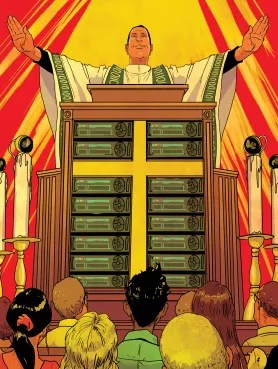
We used to relate to different spheres of our lives– and they to us– differently: we were consumers in the marketplace; citizens in the civic arena; worshipers in the spiritual; sudents in school; etc. We had expectations and obligations that were different, different in kind, from one to the next. The homogenizing logic of the marketplace is systematically taking over those other spheres… and we’re behaving– and being treated– more and more like consumers across them all. As this Wired article article from 1995 suggests, that’s been underway for a long time.
Case in point:
As of the end of last year, 63% of Americans identified as Christians; down roughly 12% over the last 20 years. As of 2024, 33% said they attended services in person at least monthly, with another 23% saying that they participated in virtual services at least once a month.
So it’s no surprise that churches are goosing their efforts to attract and keep worshipers, cultivating a more “experiential” (even “charismatic“) style– and turning to the same kind of CRM (customer relationship management) tools that Salesforce and others provide commercial ventures.
Alex Ashely reports on a purpose-driven (and purpose-built) vendor that means to enable churchs to “manage” their relationships with their parishioners in a way (and to an extent) that sounds more like Palantir than Salesforce…
On a Sunday morning in a Midwestern megachurch, worshippers step through sliding glass doors into a bustling lobby—unaware they’ve just passed through a gauntlet of biometric surveillance. High-speed cameras snap multiple face “probes” per second, isolating eyes, noses, and mouths before passing the results to a local neural network that distills these images into digital fingerprints. Before people find their seats, they are matched against an on-premises database—tagged with names, membership tiers, and watch-list flags—that’s stored behind the church’s firewall.
Late one afternoon, a woman scrolls on her phone as she walks home from work. Unbeknownst to her, a complex algorithm has stitched together her social profiles, her private health records, and local veteran outreach lists. It flags her for past military service, chronic pain, opioid dependence, and high Christian belief, and then delivers an ad to her Facebook feed: “Struggling with pain? You’re not alone. Join us this Sunday.”
These hypothetical scenes reflect real capabilities increasingly woven into places of worship nationwide, where spiritual care and technology converge in ways few congregants ever realize. Where Big Tech’s rationalist ethos and evangelical spirituality once mixed like oil and holy water, this unlikely amalgam has given birth to an infrastructure already reshaping the theology of trust—and redrawing the contours of community and pastoral power in modern spiritual life. The emerging nerve center of this faith-tech nexus is in Boulder, Colorado, where the spiritual data and technology firm Gloo has its headquarters.
Gloo is constructing a digital infrastructure meant to bring churches into the age of algorithmic insight.
The church is “a highly fragmented market that is one of the largest yet to fully adopt digital technology,” the company said in a statement by email. “While churches have a variety of goals to achieve their mission, they use Gloo to help them connect, engage with, and know their people on a deeper level.”…
… The company refers to itself as “a technology platform for the faith ecosystem.” Either way, this information is integrated into its “State of Your Church” dashboard—an interface for the modern pulpit.
Since its launch in 2013, Gloo has steadily increased its footprint, and it has started to become the connective tissue for the country’s fragmented religious landscape. According to the Hartford Institute for Religion Research, the US is home to around 370,000 distinct congregations. As of early 2025, according to figures provided by the company, Gloo held contracts with more than 100,000 churches and ministry leaders…
… [In March] Gloo… unveiled a strategic investment in Barna Group, the Texas-based research firm whose four decades of surveying more than 2 million people underpin its annual reports on worship, beliefs, and cultural engagement. Barna’s proprietary database—covering every region, age cohort, and denomination—has made it the go-to insight engine for pastors, seminaries, and media tracking the pulse of American faith…
… Barna’s troves of behavioral, spiritual, and cultural data offer granular insight into the behaviors, beliefs, and anxieties of faith communities. While the two organizations frame the collaboration in terms of serving church leaders, the mechanics resemble a data-fusion engine of impressive scale: Barna supplies the psychological texture, and Gloo provides the digital infrastructure to segment, score, and deploy the information…
… Gloo is also now focused on supercharging its services with artificial intelligence and using these insights to transcend market research. At a September 2024 event in Boulder called the AI & the Church Hackathon, Gloo unveiled new AI tools called Data Engine, a content management system with built-in digital-rights safeguards, and Aspen, an early prototype of its “spiritually safe” chatbot, along with the faith-tuned language model powering that chatbot, known internally as CALLM (for “Christian-Aligned Large Language Model”).
[Ashley describes the growth of Gloo (largely through acquisition), the advent and integration of biometric surveillance, and the Salesforce-like growth of third-party apps; he explores several use cases and raises the concerns– privacy and others– that arise in absence of any meaningful regulation or oversight…]
… With guardrails still scarce, though, faith-tech pioneers and church leaders are peering ever more deeply into congregants’ lives. Until meaningful oversight arrives, the faithful remain exposed to a gaze they never fully invited and scarcely understand.
In April, [Intel CEO until he was ousted last year, now Gloo’s executive chair and head of technology Phil] Gelsinger took the stage at a sold-out Missional AI Summit, a flagship event for Christian technologists that this year was organized around the theme “AI Collision: Shaping the Future Together.” Over 500 pastors, engineers, ethicists, and AI developers filled the hall, flashing badges with logos from Google DeepMind, Meta, McKinsey, and Gloo.
“We want to be part of a broader community … so that we’re influential in creating flourishing AI, technology as a force for good, AI that truly embeds the values that we care about,” Gelsinger said at the summit. He likened such tools to pivotal technologies in Christian history: the Roman roads that carried the gospel across the empire, or Martin Luther’s printing press, which shattered monolithic control over scripture. A Gloo spokesperson later confirmed that one of the company’s goals is to shape AI specifically to “contribute to the flourishing of people.”
“We’re going to see AI become just like the internet,” Gelsinger said. “Every single interaction will be infused with AI capabilities.”
He says Gloo is already mining data across the spectrum of human experience to fuel ever more powerful tools.
“With AI, computers adapt to us. We talk to them; they hear us; they see us for the first time,” he said. “And now they are becoming a user interface that fits with humanity.”
Whether these technologies ultimately deepen pastoral care or erode personal privacy may hinge on decisions made today about transparency, consent, and accountability. Yet the pace of adoption already outstrips the development of ethical guardrails. Now, one of the questions lingering in the air is not whether AI, facial recognition, and other emerging technologies can serve the church, but how deeply they can be woven into its nervous system to form a new OS for modern Christianity and moral infrastructure.
“It’s like standing on the beach watching a tsunami in slow motion,” Kriel says.
Gelsinger sees it differently.
“You and I both need to come to the same position, like Isaiah did,” he told the crowd at the Missional AI Summit. “‘Here am I, Lord. Send me.’ Send me, send us, that we can be shaping technology as a force for good, that we could grab this moment in time.”…
Spiritual care and technology are converging across the country, reshaping the theology of trust: “When tech gets religion: How churches use data and AI,” from @technologyreview.com.
* Henny Youngman
###
As we pray for guidance, we might recall that Henry VIII, King of England from 1509 until his death in 1547, known for his six marriages, attempted to have his first marriage (to Catherine of Aragon) annulled. His disagreement with Pope Clement VII over the issue led Henry to initiate the English Reformation, separating the Church of England from papal authority. He appointed himself Supreme Head of the Church of England and dissolved convents and monasteries– for which, on this date in 1535, he was excommunicated by (Clement’s successor) Pope Paul III.

“I didn’t study theology out of piety. I studied it because I wanted to know.”*…

Beatrice Marovich on a discipline declining…
People often assume that theology is only for true believers: those who want to defend the existence of God against the skepticism of secular outsiders. But there’s an old open secret in the field: theologians often have a complicated relationship with belief, and some theologians are even non-believers. I’ve always been a secular—or non-religious—person. That’s the “tradition” I was raised in. But I’m also a theologian.
I knew that it was a risk, going into the field of theology. There are conversations I’ve been shut out of because I’m not religious enough. And I’m often marked as a troubling outsider by scholars who see themselves taking a purely secular approach to the interdisciplinary study of religion. But as a graduate student, and even early in my career as a faculty member at a small liberal arts college, I believed the field of theology was opening up, and becoming more complex. It felt, to me, as if there were a creative disintegration happening that might make more room for scholars like me. But after more than a decade in the field, I’ve come to feel that something else is happening instead. It feels like the field is dying.
People are still doing theology in public (if, by doing theology we mean talking about gods, spirits, and other divine powers). But the field I was trained in as a scholar—academic theology—feels like it’s dying. It’s a field that’s often philosophical, but always theoretical. Because of this, theology can verge quickly into the abstract, and the speculative. Theologians might make use of anthropological, sociological, and historical studies of religion. But they tend not to feel beholden to any of those disciplines. Indeed, theologians are often wading into explicitly interdisciplinary conversations about science, politics, gender, and race (among other things). In its lack of clear focus, theology might be the most undisciplined discipline in the American academy today. And that undisciplined discipline feels like it’s dying. At least to me.
But is theology really dying? Or is this just the feeling I have, as I’m being squeezed out of the field? Or, perhaps I’m I fixated on the mortality of this collective project because I’ve been writing, thinking, and teaching about death. When I looked at enrollment numbers at seminaries and theological schools, the numbers aren’t necessarily damning. At least not yet. They don’t necessarily confirm my feeling, or my mood. Neither did Sean Larsen’s 2020 State of Theology study, funded by the Templeton Religion Trust. There were people, in that study, who remained optimistic about the discipline’s prospects. And while Ted Smith’s 2023 book The End of Theological Education does acknowledge that the institutions that built theology in America are collapsing, he remains optimistic about what the church can do for the future of theology.
I needed to know if others shared my feeling, or mood. So, I decided to have a conversation with my colleagues. I reached out to people in my network, to see who felt compelled to weigh in. I had three questions for them: Is academic theology really dying? If so, how do you feel about this death? And, finally, If you could save one thing from the sinking ship that is academic theology, what would it be? This essay is a kind of report: it’s what my colleagues told me.
What you’ll read here does reflect a bias: these are voices from within my network. Nevertheless, I think their words are worth sharing. Whether or not academic theology is really dying, it may still be worth thinking about its mortality. If I’ve learned any lesson from writing and thinking about death, it’s that when we acknowledge that it’s there, when we remember that we’re always living in death’s shadows, we take what’s in front of us much more seriously. We can see the full fragility of things, and we can try—against the odds—to resist entropy and protect what we think is worth saving, inheriting, or carrying on into the future. And we can think about what we’re ready to let go of. Because all things, in time, do die. It’s only a question of when…
[Marovich examines the state of the field v ia a recounting of highlights from her conversations with colleagues…]
… I conducted these interviews in the spring of 2024, in what feels to me (now) like a different world. What David Kline so succinctly described as the “institutional frameworks for intellectual life” seem more fragile and threatened than ever, as the Trump administration rapidly defunds education and research, and attacks media outlets. And we can’t forget, of course, about the many threats that Artificial Intelligence—in the form of Large Language Models like ChatGPT—poses to these fragile frameworks for intellectual life. I’m aware that it may seem small-minded and naïve to worry about my own obscure little academic discipline, when the whole structure is falling apart. So, it does seem important for me to clarify that I have spent (and will continue to spend) many hours grieving, as if in anticipation, what feels like the evaporation of intellectual possibilities—intellectual life itself!—in America. I am torn up about all of this. And yet, simultaneously, I do remain concerned about the strange little ecosystem that comprises my corner of the world.
As I think over these conversations with my colleagues, I find myself torn between letting go and holding on—or, perhaps better said, trying to hold space. I agree with Hanna Reichel when they suggest that letting go of the growth mindset is painful and difficult for Americans, perhaps more than anyone else. And this contributes to so much of the damage that American life does to the planet we share with others. I recognize that this is a problem. And I am compelled by Colby Dickinson’s suggestion that perhaps learning to die—learning an ars moriendi—might be the best thing that theology could do right now. So much of what is good about theology is probably already in diaspora, as Amaryah Armstrong has suggested. I do have a certain kind of faith that much of the power of theology will live on, in some shape and form, wherever it goes.
And yet Sameer Yadav’s point about academic theology existing as a kind of “nowhere” space strikes me as so deeply true. That nowhere space has given me so much room to explore, it’s opened dimensions of life to me that I would never have seen, and it’s introduced me to so many incredible people—living and dead. I am grateful for this community, and I feel like I owe it something. I feel compelled to somehow preserve that generative and undisciplined nowhere space for others. Like Meg Mercury, I would like to see this nowhere space open up and expand, for those people who don’t feel as if they belong in traditional religious structures. And yet, I also recognize that the cash value of this sort of space—for the church and for the academy—is more or less zero. The odds that it will survive, even if (as David Congdon noted) there is some educational New Deal that revives higher education, are slim. But perhaps this is one of the reasons why I felt compelled to speak with my colleagues, and write this piece, in the first place. Perhaps it was a gesture at letting go. Or perhaps it was a little leap of faith—a little gesture towards expanding space and time for this nowhere community to find new forms of shelter in which to gather…
On doing hospice care for an academic discipline: “Is Theology Dying?” from @beamarovich.bsky.social in The Other Journal.
###
As we ponder the preservation of perspicacity, we might send controversial birthday greetings to a man whose experience illustrates (one episode in) the long history of theology’s peril, Bernard Lamy; he was born on this date in 1640. A French Oratorian and mathematician, he was was also an important theologian… whose teachings were judged alternately either controversial or irrelevent at the series of institutions to which he was forced continually to move throughout his career.

“Religion is regarded by the common people as true, by the wise as false, and by rulers as useful”*…

On the rise of organized religion in human life: our species has, for thousands of years, been affected by widespread belief in a watchful presence above us. But did moralizing Big Gods spark a surge in cooperation, or did they simply grow out of complex civilization? Brian Klaas explores….
… For most of human history, our species lived in small bands, often groups of fewer than a hundred people. Then, suddenly, around 12,000 years ago, complex civilizations began to pepper the landscape, as cooperation and coordination surged. This presents a puzzle: why the sudden shift in our behavior?
Some have argued that “Big Gods”—complete with their watchful eyes gazing down on us from above and threatening to punish us for sin—were the key component in social cooperation and the rise of civilization, moving us from our simple hunter-gatherer roots to sophisticated, sprawling empires. But is that true?…
… Intellectual historians often point to two major divergent explanations for the emergence of religion. The great philosopher David Hume argued that religion is the natural, but arbitrary, byproduct of human cognitive architecture.
Since the beginning, Homo sapiens experienced disordered events, seemingly without explanation. To order a disordered world, our ancestors began to ascribe agency to supernatural beings, to which they could offer gifts, sacrifices, and prayers to sway them to their personal whims. The uncontrollable world became controllable. The unexplainable was explained—a comforting outcome for the pattern detection machines housed in our skulls.
By contrast, thinkers like Émile Durkheim argued that religion emerged as a social glue. Rituals bond people across space and time. Religion was instrumental, not intrinsic. It emerged to serve our societies, not comfort our minds. As Voltaire put it: “If there were no God, it would be necessary to invent him.”
In the last two decades, a vibrant strand of scholarship has sought to reconcile these contrasting viewpoints, notably through the work of Ara Norenzayan, author of Big Gods: How Religion Transformed Cooperation and Conflict.
Norenzayan’s “Big Gods” refer to deities that are omniscient, moralizing beings, careful to note our sins and punish us accordingly. Currently, roughly 77 percent of the world’s population identifies with one of just four religions (31% Christian; 24% Muslim; 15% Hindu; 7% Buddhist). In all four, moral transgressions produce consequences, some immediate, others punished in the afterlife.
Norenzayan aptly notes that the omniscience of Big Gods assumes total knowledge of everything in the universe, but that the divine is always depicted as being particularly interested in our moral behavior. If God exists, He surely could know which socks you wore yesterday, but deities focus their attentions not on such amoral trifles, but rather on whether you lie, covet, cheat, steal, or kill.
However, Norenzayan draws on anthropology evidence to argue that early supernatural beings had none of these traits and were disinterested in human affairs. They were fickle demons, tricksters and spirits, not omniscient gods who worried about whether any random human had wronged his neighbor…
… These deities may have fulfilled the conditions outlined by Hume—they explained the unexplainable as machinations of supernatural forces—but they didn’t serve much of a social deterrence function, because you wouldn’t need to fear being struck down by a lightning bolt from above if you wronged a rival.
Every social species that thrives, from wasps to humans, requires a mechanism of stopping individual members from working against the group’s interests. In complex hives, specialized “police wasps” serve as enforcers, seeking out and destroying any wasps producing larvae that may lead to an excess number of queens in the colony. When detected, any rogues are “beheaded or torn apart by the workers soon after they emerge from their cells in the brood comb,” explain Professors Francis Ratnieks and Tom Wenseleers.
Unlike wasps, early human societies didn’t have police forces. Without an enforcement mechanism, social complexity and large civilizations came with enormous risks of predatory, anti-social behavior that could undermine survival.
Over time, Norenzayan argues, divine forces shifted within these administratively weak human groupings. Thus emerged what Norenzayan calls “supernatural monitoring,” a belief in an omniscient presence that never averts His gaze from sin. Everything is tracked, monitored, then punished…
… It is now a nearly universal feature of religious belief systems that a divine presence prohibits certain behaviors—and rewards others. And that presence is always watching. In addition to the omniscient sky gods of today’s major religions, ancient Egypt was home to Horus of Two Eyes. The Incans were watched by Viracocha. Today, in modern Tibet and Nepal, Buddhist depictions of eyes are dotted across villages, reminding everyone that nothing can ever be truly hidden.
The “Big Gods” hypothesis argues that divine gazes provided a far more effective form of deterring anti-social behavior than any mortal police force…
Did the watchful gaze of moralizing gods produce the rise of complex civilizations? “Big Gods and the Origin of Human Cooperation,” from @brianklaas.bsky.social. Eminently worth reading in full.
* Seneca the Younger
###
As we brood on belief, we might recall that on this date in 1349 a group of Christian guilds, fearful of the Black Death, carried out the Basel Massacre…
… an anti-Semitic massacre in Basel, which occurred in 1349 in connection with alleged well poisoning as part of the Black Death persecutions, carried out against the Jews in Europe at the time of the Black Death. A number of Jews, variously given as between 300 and 600 (according to contemporary Medieval chronicles) or 50 to 70 (according to some modern historians) were burned alive, after being locked in a wooden structure built on a nearby island in the Rhine. Jewish children were apparently spared, but forcibly baptized and sent to monasteries…
…Contemporary chronicler Matthias of Neuenburg describes the event with these words:
Therefore all the Jews of Basel, without a legal sentence [being passed] and because of the clamor of the people, were burned on an island in the Rhine River in a new house” (Cremati sunt igitur absque sentencia ad clamorem populi omnes Judei Basilienses in una insula Rheni in domo nova).
Similar pogroms took place in Freiburg on 30 January, and in Strasbourg on 14 February. The massacre had notably taken place before the Black Death had even reached the city. When it finally broke out in April to May 1349, the converted Jews were still blamed for well poisoning. The officials of Basel placed judgement on some baptized Jews, and on 4 July four of them were tortured on the wheel, “confessing” that they had poisoned Basel’s fountains (Juden … Offenlich vor gerichte verjahen und seiten, das sie die brunnen ze unserre state etlich vergift hettent).[4] The remaining converted Jews were partly executed, partly expulsed. By the end of 1349, the Jews of Basel had been murdered, their cemetery destroyed and all debts to Jews declared settled.
– source

“The whole problem with the world is that fools and fanatics are always so certain of themselves, and wiser people so full of doubts”*…

In a recent post we considered “agnotology”—the study of ignorance. Today, John Timmer unpacks a related phenomenon…
The world is full of people who have excessive confidence in their own abilities. This is famously described as the Dunning-Kruger effect, which describes how people who lack expertise in something will necessarily lack the knowledge needed to recognize their own limits. Now, a different set of researchers has come out with what might be viewed as a corollary to Dunning-Kruger: People have a strong tendency to believe that they always have enough data to make an informed decision—regardless of what information they actually have.
The work, done by Hunter Gehlbach, Carly Robinson, and Angus Fletcher, is based on an experiment in which they intentionally gave people only partial, biased information, finding that people never seemed to consider they might only have a partial picture. “Because people assume they have adequate information, they enter judgment and decision-making processes with less humility and more confidence than they might if they were worrying whether they knew the whole story or not,” they write. The good news? When given the full picture, most people are willing to change their opinions…
[Timmer explains the experiment and runs through the particulars of the results]
… This is especially problematic in the current media environment. Many outlets have been created with the clear intent of exposing their viewers to only a partial view of the facts—or, in a number of cases, the apparent intent of spreading misinformation. The new work clearly indicates that these efforts can have a powerful effect on beliefs, even if accurate information is available from various sources…
The full PLOS One paper is here.
When given partial info, most feel confident that’s all they need to know: “People think they already know everything they need to make decisions,” from @jtimmer.bsky.social in @arstechnica.com.
* Bertrand Russell
###
As we read widely, we might spare a thought for a victim of just this sort of misplaced confidence, John Scopes; he died on this date in 1970. A teacher in Dayton, Tennessee, he was prosecuted in 1925 for teaching evolution in the local high school.
… [Scopes] was accused of violating Tennessee’s Butler Act, which had made it illegal for teachers to teach human evolution in any state-funded school. The trial was deliberately staged in order to attract publicity to the small town of Dayton, Tennessee, where it was held. Scopes was unsure whether he had ever actually taught evolution, but he incriminated himself deliberately so the case could have a defendant.
Scopes was found guilty and was fined $100 (equivalent to $1,700 in 2023), but the verdict was overturned on a technicality. The trial served its purpose of drawing intense national publicity, as national reporters flocked to Dayton to cover the high-profile lawyers who had agreed to represent each side. William Jennings Bryan, three-time presidential candidate and former secretary of state, argued for the prosecution, while Clarence Darrow served as the defense attorney for Scopes. The trial publicized the fundamentalist–modernist controversy, which set modernists, who said evolution could be consistent with religion, against fundamentalists, who said the word of God as revealed in the Bible took priority over all human knowledge. The case was thus seen both as a theological contest and as a trial on whether evolution should be taught in schools…
… In 1958 the National Defense Education Act was passed with the encouragement of many legislators who feared the United States education system was falling behind that of the Soviet Union. The act yielded textbooks, produced in cooperation with the American Institute of Biological Sciences, which stressed the importance of evolution as the unifying principle of biology. The new educational regime was not unchallenged. The greatest backlash was in Texas where attacks were launched in sermons and in the press. Complaints were lodged with the State Textbook Commission. However, in addition to federal support, a number of social trends had turned public discussion in favor of evolution. These included increased interest in improving public education, legal precedents separating religion and public education, and continued urbanization in the South. This led to a weakening of the backlash in Texas, as well as to the repeal of the Butler Law in Tennessee in 1967…

You must be logged in to post a comment.