Posts Tagged ‘public health’
“Without debatement further, more or less, / He should the bearers put to sudden death, / Not shriving time allow’d.”*…
“Cell suicide” is inherently self-destructive, and yet it’s an essential and productive process in complex organisms. How did cells evolve a process to end their own lives? As Veronique Greenwood reports, recent research suggests it first arose, first arose billions of years ago… but why?…
It can be hard to tell, at first, when a cell is on the verge of self-destruction.
It appears to be going about its usual business, transcribing genes and making proteins. The powerhouse organelles called mitochondria are dutifully churning out energy. But then a mitochondrion receives a signal, and its typically placid proteins join forces to form a death machine.
They slice through the cell with breathtaking thoroughness. In a matter of hours, all that the cell had built lies in ruins. A few bubbles of membrane are all that remains.
“It’s really amazing how fast, how organized it is,” said Aurora Nedelcu, an evolutionary biologist at the University of New Brunswick who has studied the process in algae.
Apoptosis, as this process is known, seems as unlikely as it is violent. And yet some cells undergo this devastating but predictable series of steps to kill themselves on purpose. When biologists first observed it, they were shocked to find self-induced death among living, striving organisms. And although it turned out that apoptosis is a vital creative force for many multicellular creatures, to a given cell it is utterly ruinous. How could a behavior that results in a cell’s sudden death evolve, let alone persist?…
The story in full: “Cellular Self-Destruction May Be Ancient. But Why?“, from @vero_greenwood in @QuantaMagazine.
* Shakespeare, Hamlet (Act 5, Scene 2)
###
As we appreciate apoptosis, we might send healthy birthday greetings to Lillian Wald; she was born on this date in 1867. A nurse, humanitarian, political reformer, and author, she was instrumental in establishing a nationwide system of nurses in public schools. Known as “the Angel of Henry Street” (for her founding and running of the Henry Street Settlement in New York City), she directed the Henry Street Visiting Nurse Service, while at the same time tirelessly opposing political and social corruption. She helped initiate the revision of child labor laws, improved housing conditions in tenement districts, drove the enactment of pure food laws, championed and improved education for the mentally handicapped, and led the passage of enlightened immigration regulations.

“I discovered that if one looks a little closer at this beautiful world, there are always red ants underneath”*…
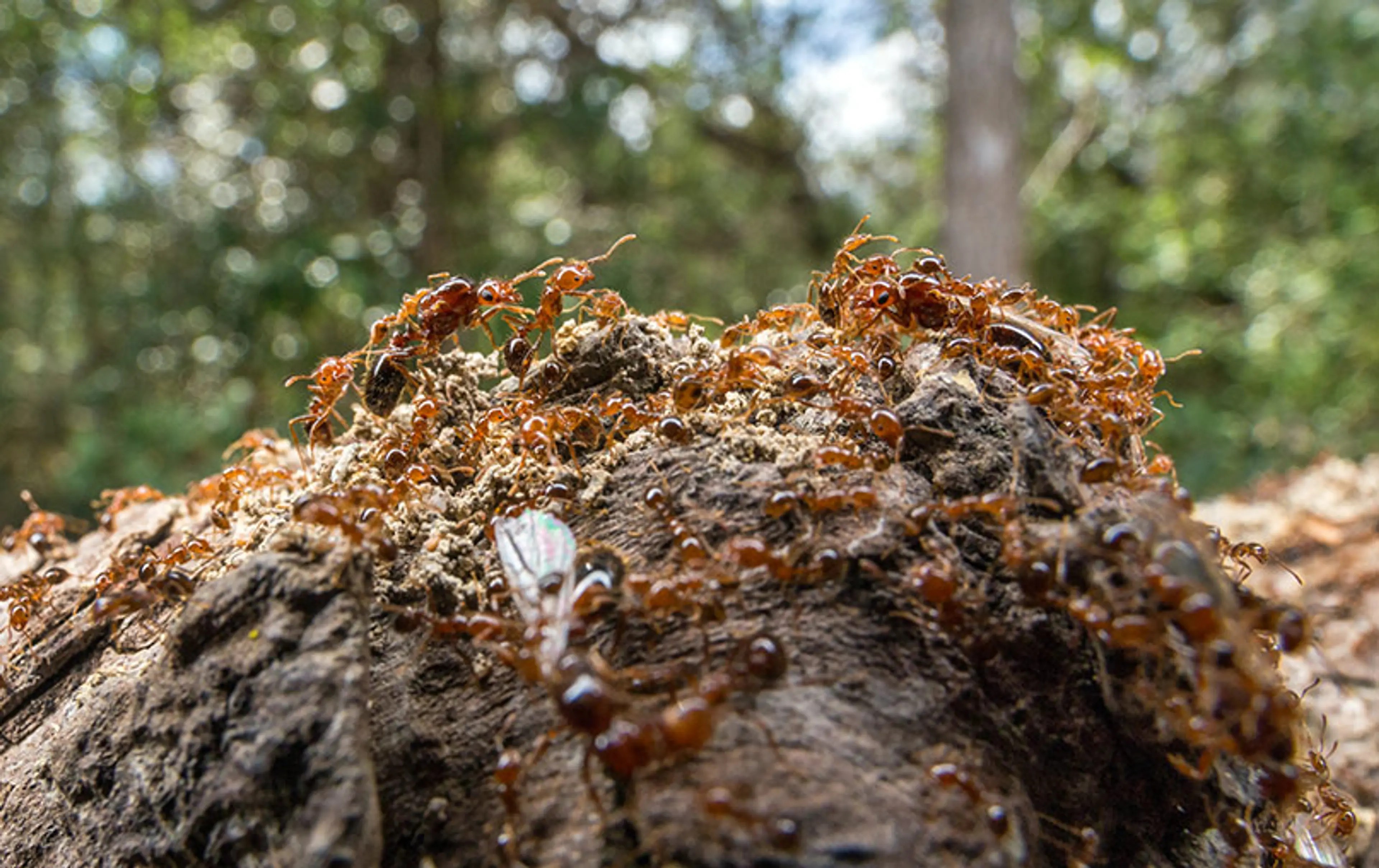
E.O. Wilson once observed that “Ants have the most complicated social organization on earth next to humans.” John Whitfield explores the way in which, over the past four centuries, quadrillions of ants have created a strange and turbulent global society that shadows our own…
It is a familiar story: a small group of animals living in a wooded grassland begin, against all odds, to populate Earth. At first, they occupy a specific ecological place in the landscape, kept in check by other species. Then something changes. The animals find a way to travel to new places. They learn to cope with unpredictability. They adapt to new kinds of food and shelter. They are clever. And they are aggressive.
In the new places, the old limits are missing. As their population grows and their reach expands, the animals lay claim to more territories, reshaping the relationships in each new landscape by eliminating some species and nurturing others. Over time, they create the largest animal societies, in terms of numbers of individuals, that the planet has ever known. And at the borders of those societies, they fight the most destructive within-species conflicts, in terms of individual fatalities, that the planet has ever known.
This might sound like our story: the story of a hominin species, living in tropical Africa a few million years ago, becoming global. Instead, it is the story of a group of ant species, living in Central and South America a few hundred years ago, who spread across the planet by weaving themselves into European networks of exploration, trade, colonisation and war – some even stowed away on the 16th-century Spanish galleons that carried silver across the Pacific from Acapulco to Manila. During the past four centuries, these animals have globalised their societies alongside our own.
It is tempting to look for parallels with human empires. Perhaps it is impossible not to see rhymes between the natural and human worlds, and as a science journalist I’ve contributed more than my share. But just because words rhyme, it doesn’t mean their definitions align. Global ant societies are not simply echoes of human struggles for power. They are something new in the world, existing at a scale we can measure but struggle to grasp: there are roughly 200,000 times more ants on our planet than the 100 billion stars in the Milky Way…
…
The more I learn, the more I am struck by the ants’ strangeness rather than their similarities with human society. There is another way to be a globalised society – one that is utterly unlike our own. I am not even sure we have the language to convey, for example, a colony’s ability to take bits of information from thousands of tiny brains and turn it into a distributed, constantly updated picture of their world. Even ‘smell’ seems a feeble word to describe the ability of ants’ antennae to read chemicals on the air and on each other. How can we imagine a life where sight goes almost unused and scent forms the primary channel of information, where chemical signals show the way to food, or mobilise a response to threats, or distinguish queens from workers and the living from the dead?
As our world turns alien, trying to think like an alien will be a better route to finding the imagination and humility needed to keep up with the changes than looking for ways in which other species are like us. But trying to think like an ant, rather than thinking about how ants are like us, is not to say that I welcome our unicolonial insect underlords. Calamities follow in the wake of globalised ant societies. Most troubling among these is the way that unicolonial species can overwhelmingly alter ecological diversity when they arrive somewhere new. Unicolonial ants can turn a patchwork of colonies created by different ant species into a landscape dominated by a single group. As a result, textured and complex ecological communities become simpler, less diverse and, crucially, less different to each other. This is not just a process; it is an era. The current period in which a relatively small number of super-spreading animals and plants expands across Earth is sometimes called the Homogecene. It’s not a cheering word, presaging an environment that favours the most pestilential animals, plants and microbes. Unicolonial ants contribute to a more homogenous future, but they also speak to life’s ability to escape our grasp, regardless of how we might try to order and exploit the world. And there’s something hopeful about that, for the planet, if not for us.
The scale and spread of ant societies is a reminder that humans should not confuse impact with control. We may be able to change our environment, but we’re almost powerless when it comes to manipulating our world exactly how we want. The global society of ants reminds us that we cannot know how other species will respond to our reshaping of the world, only that they will…
Bracing: “Ant geopolitics,” from @gentraso in @aeonmag.
* David Lynch
###
As we investigate insects, we might spare a thought for Sara Josephine Baker; she died on this date in 1945. A physician, she was a pioneer in public health and child welfare in the United States in her roles as assistant to the Commissioner for Public Health of New York City, and later, head of the city’s Department of Health in “Hell’s Kitchen” for 25 years. Convinced of the value of well-baby care and the prevention of disease, in 1908 she founded the Bureau of Child Hygiene– and decreased the death rate by 1200 from the previous year. Her work made the New York City infant mortality rate the lowest in the USA or Europe at the time. She set up free milk clinics, licensed midwives, and taught the use of silver nitrate to prevent blindness in newborns.
Baker is also remembered as the public health official who (twice) tracked down “Typhoid Mary.”

“Just because you’re paranoid doesn’t mean they aren’t after you”*…

The wages of anxiety…
A large Swedish study has uncovered a paradox about people diagnosed with an excessive fear of serious illness: They tend to die earlier than people who aren’t hypervigilant about health concerns.
Hypochondriasis, now called illness anxiety disorder, is a rare condition with symptoms that go beyond average health worries. People with the disorder are unable to shake their fears despite normal physical exams and lab tests. Some may change doctors repeatedly. Others may avoid medical care…
The researchers found that people with the diagnosis have an increased risk of death from both natural and unnatural causes, particularly suicide. Chronic stress and its impact on the body could explain some of the difference, the authors wrote…
“In hypochondria paradox, Swedish study finds a higher death rate in those who fear serious illness,” by @CarlaKJohnson in @AP.
* Joseph Heller, Catch-22
###
As we stew over self-fulfilling prophecies, we might recall that it was on this date in 2021 that Paul E. Marek, et al. published a paper in Scientific Reports reporting the discovery of the first millipede species that lived up to its name. Although called millipedes, meaning 1000 legs, never before had a species been found with truly that many legs.
In fact, the new species, Eumillipes persephone has 1306 legs. This diminutive animal has a greatly elongated, thread-like body (0.95 mm wide, 95.7 mm long) with 330 segments, a cone-shaped head with enormous antennae, and a beak for feeding. It was found 60 m below ground in a drill hole created for mineral exploration in Western Australia. Living as a troglobite, it lacks eyes and pigmentation.

“A cigarette is a pinch of tobacco rolled in paper with fire at one end and a fool at the other”*…

Any number of social and culture issues that one might have thought resolved, have come unraveled over the last decade or so; issues thought resolved are again open. Max Read suggests (in a not altogether tongue-in-cheek way) that smoking might be next…
One way of thinking about this newsletter (Read Max) is as equities analysis for the discursive marketplace, answering important questions for the armchair take trader: What discourses have peaked? What concepts should you short? How are you balancing your take portfolio?
My longtime professional and personal experience as a poster has left me adept at seeing the hidden structures that lurk behind the peaks and valleys of “the discourse”; paid subscribers in particular are well-positioned to profit from the insight offered by Read Max’s sophisticated and proprietary models.
For a while now, Read Max analysts have been intrigued by what is often called on Twitter “smoking discourse,” as in “cigarettes.” Now, following certain recent events on Twitter, we’re prepared to advise clients that we believe strong “pro-smoking” positions grounded in socio-political identities are poised to have a “moment” soon. Our analysis indicates that certain structural factors are in place to encourage arguments like “smoking is good for society, actually” and “anti-smoking laws are bad science/policy” to move past “trolling” and be adopted as common sense by a loose confederation of IDW [“intellectual dark web”] Substackers, trad nutritionists, and downtown cool kids, building on the ties formed between these groups around the COVID-19 pandemic…
Read on for a too-plausible take on the future of public debate: “The coming pro-smoking discourse,” from @readmaxread.
* George Bernard Shaw
###
As we brush away the ashes, we might recall that it was on this date in 1962 that recently-appointed Surgeon General Luther L. Terry announced that he would convene a committee of experts to conduct a comprehensive review of the scientific literature on the smoking question. In June 1961, the American Cancer Society, the American Heart Association, the National Tuberculosis Association, and the American Public Health Association had addressed a letter to President John F. Kennedy, in which they called for a national commission on smoking, dedicated to “seeking a solution to this health problem that would interfere least with the freedom of industry or the happiness of individuals.” The Kennedy administration responded the following year (after prompting from a widely circulated critical study on cigarette smoking by the Royal College of Physicians of London).
Terry issued the commission’s report– highlighting the deleterious health consequences of tobacco use– on January 11, 1964, choosing a Saturday to minimize the effect on the stock market and to maximize coverage in the Sunday papers. As Terry remembered the event, two decades later, the report “hit the country like a bombshell. It was front page news and a lead story on every radio and television station in the United States and many abroad.”

“Infant mortality and life expectancy are reasonable indicators of general well-being in a society”*…
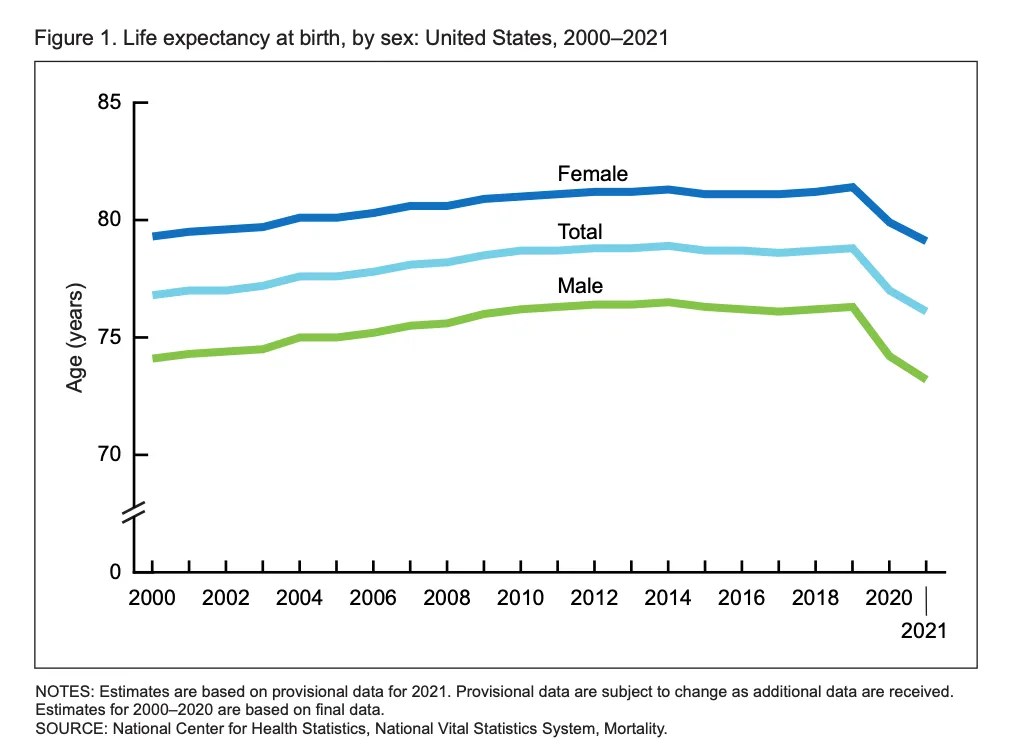
… and in the U.S., as Adam Tooze explains, we’re doing not so well of late…
In August America’s Center for Disease Control (CDC) published a set of data that ought to have brought political, economic and social debate to a standstill. If there is one question that should surely dominate public policy debate, it is the question of life and death. What did the Declaration of Independence promise, after all, if not “life, liberty and the pursuit of happiness”. But on that score the CDC in 2022 delivered alarming news. In the last three years, life expectancy in the United States has plunged in a way not seen at any point in recent history.
America is inured to bad news about its health. Life expectancy in the United States has stagnated since 2011, a trend which separates the United States not just from rich peer countries but from most other countries in the world, rich or poor.
Given economic growth and advances in medicine for life expectancy to stagnate requires serious headwinds. In the United States those headwinds include, homicides and suicides, the opioid epidemic (so-called deaths of despair) car accidents and obesity. As John Burn-Murdoch shows in the FT, without those factors the US would have tracked its peer societies much more closely…

But stagnation is one thing, the collapse since 2019 is a phenomenon of a different quality. It is a full measure of the disaster that was the COVID pandemic in the United States. Over a million Americans died of COVID, one of the worst outcomes on the planet.
…
…it is not only China that has overtaken the United States based on this metric. In 2021 Cuba has a higher life expectancy than the US. So does Albania.
In a society marked by inequality as deep as modern America’s, to speak in terms of national averages is not very meaningful. The circumstances of life and health outcomes are vastly different…

…One might think that faced with these stark facts all other subjects of political debate would pale into insignificance. Whatever else a society should do, whatever else a political system promises, it should ensure that its citizens have a healthy life expectancy commensurate with their nation’s overall level of economic development. An ambitious society should aim to do more, as Japan does for instance. Judged by this basic metric, the contemporary United States fails and for a substantial minority of its population, it fails spectacularly. And yet that extraordinary and shameful fact barely registers in political debate, a silence that is both symptom and cause.
“Life, liberty and the pursuit of happiness? How China, Cuba and Albania came to have higher life expectancy than the USA,” from @adam_tooze. Eminently worth reading in full.
For an example of the ways in which these wounds are self-inflicted: “The Human Psyche Was Not Built for This.”
* P. J. O’Rourke
###
As we ponder priorities, we might recall that it was on this date in 1892 that the first diagnostic public heath laboratory in the U.S. was founded by New York City (as its “Division of Pathology, Bacteriology and Disinfection”). Spurred by the cholera epidemic of the time, it soon took on the diagnosis and tracing of diphtheria and tuberculosis; in 1895, it began production of a smallpox vaccine.
The New York City public health laboratory became a model for other cities’ public health departments. Within a few years, similar labs had become essential components of an effective health departments across the nation.

You must be logged in to post a comment.