Posts Tagged ‘Life expectancy’
“Of all the forms of inequality, injustice in health is the most shocking and inhumane”*…

We tend to encounter data about public health in the form of averages over the population as a whole. But as a recent study published in The Lancet painfully demonstrates, the underlying reality is much more complicated– and alarming…
The differences in U.S. life expectancy are so large it’s as if the population lives in separate Americas instead of one.
Nearly two decades ago, a team of researchers published the landmark “Eight Americas” study, which examined drivers of U.S. health inequities between 1982 and 2001 by dividing the U.S. population into groups based on geography, race, income, and other factors.
A new research study, published this month by the University of Washington and the Council on Foreign Relations, revisits that landmark research project, adding two new “Americas” to account for Latino populations.
This new study finds that U.S. life expectancy disparities have grown over the last two decades between 2001 and 2021, with the differences between the best and worst of those “Americas” increasing from 12.6 years in 2000 to 20.4 years in 2021. COVID-19 exacerbated this divide, but gaps in longevity had already been growing before the pandemic hit…

“The 10 Americas: How Geography, Race, and Income Shape U.S. Life Expectancy,” from @thinkglobalhealth.org. Both this summary article and the underlying paper are eminently worth reading in full.
* Martin Luther King, Jr.
###
As we unpack unfairness, we might send preventative birthday greetings to Ernst Wynder; he was born on this date in 1922. An epidemiologist and public health researcher, he is best remembered for his pioneering work in identifying the link (in 1950) between smoking and lung cancer.
Wynder devoted his career to the study and prevention of cancer and chronic disease, publishing hundreds of scientific papers. Through the 1950s and 1960s, he worked at Sloan-Kettering Institute for Cancer Research. In 1969, he founded the American Health Foundation. In 1972, he founded the academic journal Preventive Medicine and served as the founding editor.

“The greatest wealth is health”*…

On the state of healthcare around the world, three charts…


* Virgil
###
As we contemplate care, we might send revealing birthday greetings to Leopold Auenbrugger; he was born on this date in 1722. A physician, he devised the diagnostic technique of percussion (the art of striking a surface part of the body with short, sharp taps to diagnose the condition of the parts beneath the sound)– by which he could estimate the amount of fluid in a patient’s chest and the size of his/her heart.
Auenbrugger was simply applying an approach he’d learned as boy, tapping his father’s wine casks to determine how full they were. After seven years of clinical investigation, he published the method in Inventum Novum (1761), though his technique did not gain recognition and acceptance until years after his death. When a translator republished the work in French (1808) the method gained acceptance around the world, and through time (to the present) as a fundamental diagnostic procedure… for which Auenbrugger is considered one of the fathers of modern medicine.

“Infant mortality and life expectancy are reasonable indicators of general well-being in a society”*…
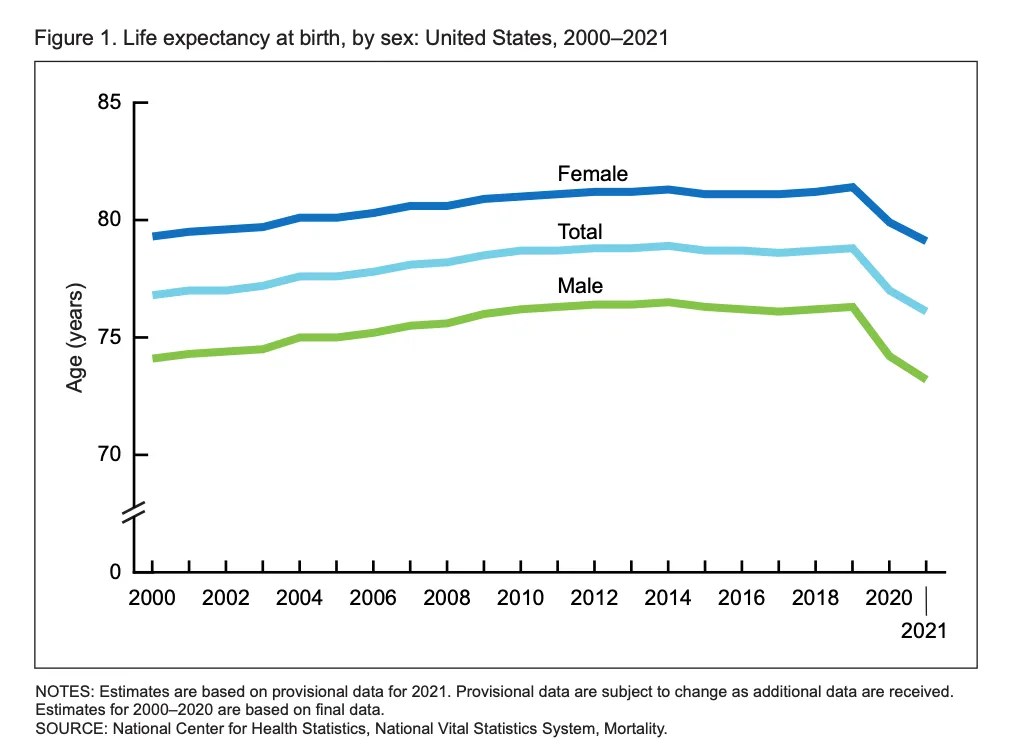
… and in the U.S., as Adam Tooze explains, we’re doing not so well of late…
In August America’s Center for Disease Control (CDC) published a set of data that ought to have brought political, economic and social debate to a standstill. If there is one question that should surely dominate public policy debate, it is the question of life and death. What did the Declaration of Independence promise, after all, if not “life, liberty and the pursuit of happiness”. But on that score the CDC in 2022 delivered alarming news. In the last three years, life expectancy in the United States has plunged in a way not seen at any point in recent history.
America is inured to bad news about its health. Life expectancy in the United States has stagnated since 2011, a trend which separates the United States not just from rich peer countries but from most other countries in the world, rich or poor.
Given economic growth and advances in medicine for life expectancy to stagnate requires serious headwinds. In the United States those headwinds include, homicides and suicides, the opioid epidemic (so-called deaths of despair) car accidents and obesity. As John Burn-Murdoch shows in the FT, without those factors the US would have tracked its peer societies much more closely…

But stagnation is one thing, the collapse since 2019 is a phenomenon of a different quality. It is a full measure of the disaster that was the COVID pandemic in the United States. Over a million Americans died of COVID, one of the worst outcomes on the planet.
…
…it is not only China that has overtaken the United States based on this metric. In 2021 Cuba has a higher life expectancy than the US. So does Albania.
In a society marked by inequality as deep as modern America’s, to speak in terms of national averages is not very meaningful. The circumstances of life and health outcomes are vastly different…

…One might think that faced with these stark facts all other subjects of political debate would pale into insignificance. Whatever else a society should do, whatever else a political system promises, it should ensure that its citizens have a healthy life expectancy commensurate with their nation’s overall level of economic development. An ambitious society should aim to do more, as Japan does for instance. Judged by this basic metric, the contemporary United States fails and for a substantial minority of its population, it fails spectacularly. And yet that extraordinary and shameful fact barely registers in political debate, a silence that is both symptom and cause.
“Life, liberty and the pursuit of happiness? How China, Cuba and Albania came to have higher life expectancy than the USA,” from @adam_tooze. Eminently worth reading in full.
For an example of the ways in which these wounds are self-inflicted: “The Human Psyche Was Not Built for This.”
* P. J. O’Rourke
###
As we ponder priorities, we might recall that it was on this date in 1892 that the first diagnostic public heath laboratory in the U.S. was founded by New York City (as its “Division of Pathology, Bacteriology and Disinfection”). Spurred by the cholera epidemic of the time, it soon took on the diagnosis and tracing of diphtheria and tuberculosis; in 1895, it began production of a smallpox vaccine.
The New York City public health laboratory became a model for other cities’ public health departments. Within a few years, similar labs had become essential components of an effective health departments across the nation.

“Everything has a time of being – a birth, a life span, and a death”*…

In 2014, the United States ranked 41st in the world in life expectancy, with an average American expected to live to age 78. But, like most averages, that doesn’t paint the whole picture. Life expectancy is more like Norway’s in some parts of the country and more like Kazakhstan’s in others.
That’s why it’s more useful to look at it county by county…
An interactive map that allows one to do exactly that: “How life expectancy in U.S. counties compares to other countries.”
*Dixie Lee Ray
###
As we take our vitamins, we might send carefully-conserved birthday greetings to Gifford Pinchot; he was born on this date in 1865. An American forester, he became the first chief of the Forest Service in 1905. By 1910, with President Theodore Roosevelt’s backing, he built 60 forest reserves covering 56 million acres into 150 national forests covering 172 million acres. Roosevelt’s successor, President Taft– no environmentalist– fired Pinchot. Still Pinchot’s efforts earned him the honorific, “the father of conservation.”

Life expectancy is a statistical phenomenon. You could still be hit by the proverbial bus tomorrow.”*…
Still…

Life expectancy has risen across the U.S. steadily over the last few decades; but the gains are not equally distributed. Flowing Data illustrates why one might prefer Minnesota to Mississippi: “Life expectancy by state, against the US average.”
* Ray Kurzweil
###
As we muse on moving, we might send heart-felt birthday greetings to Willem Einthoven; he was born on this date in 1860. A physician and physiologist, he introduced a new era in the diagnosis and treatment of diseases of the heart with his invention of the electrocardiograph, for which he was awarded the 1924 Nobel Prize for Physiology or Medicine. His creation became an essential clinical instrument for displaying the electrical properties of the heart– especially useful, of course, in the diagnosis of heart disease.

You must be logged in to post a comment.