Posts Tagged ‘tracking’
“Tell me to what you pay attention and I will tell you who you are”*…

… and then I’ll sell you something.
D. Graham Burnett on how an alliance between psychologists and advertisers at the turn of the 20th century taught us how to measure (and monetize) human attention…
Our eyes are worth money. We know that, now. It has become a commonplace that our “attention economy” is functionally an eyeball economy. But how did eyeballs come to look like dollar signs? Let’s dig into what we might think of as the original Faustian Bargain by which the sciences of human perception (with their sophisticated technologies of precision monitoring and measurement) cut a deal with those who move the money around…
An illuminating account of the history of a powerful– and profitable– alliance: “Fracking Eyeballs,” from @asterisk_mag_.
* Jose Ortega y Gasset
###
As we analyze attentiveness, we might recall that it was on this date in 1994 that Laurence Cantor unleashed the “Green Card” spam (advertising the law firm that he operated with his wife, Martha Siegel, and its immigration law services) on the Usenet. While it wasn’t the very first instance of spam, it was the first commercial Usenet spam; and its unapologetic authors are seen as having pioneered the modern global practice of spamming.

“Infant mortality and life expectancy are reasonable indicators of general well-being in a society”*…
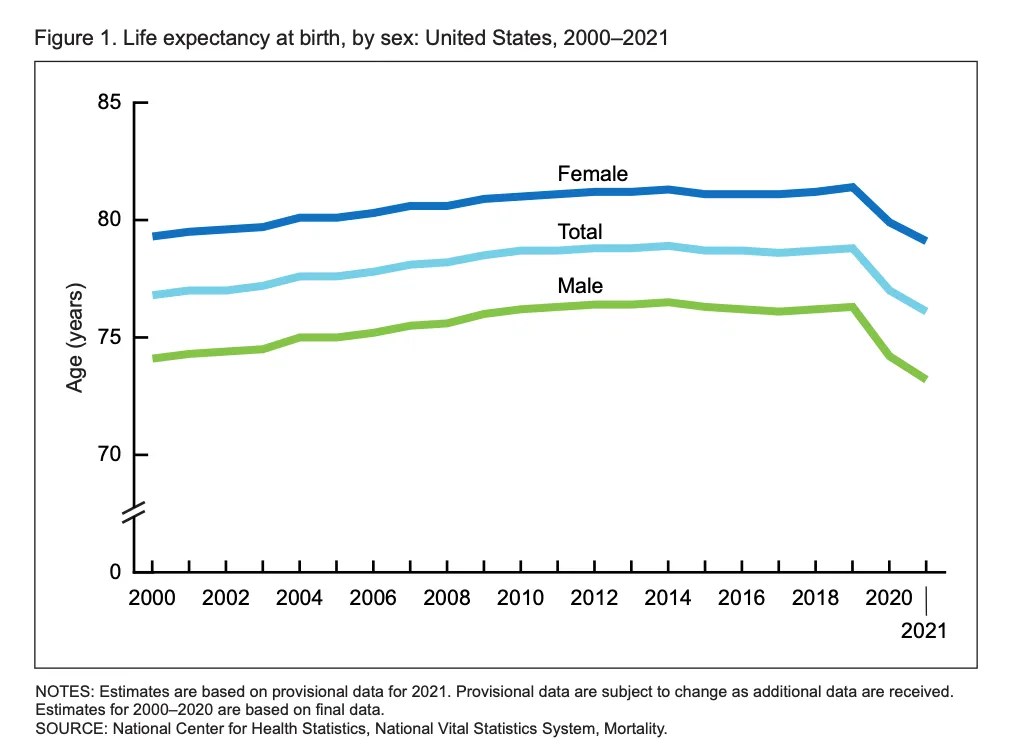
… and in the U.S., as Adam Tooze explains, we’re doing not so well of late…
In August America’s Center for Disease Control (CDC) published a set of data that ought to have brought political, economic and social debate to a standstill. If there is one question that should surely dominate public policy debate, it is the question of life and death. What did the Declaration of Independence promise, after all, if not “life, liberty and the pursuit of happiness”. But on that score the CDC in 2022 delivered alarming news. In the last three years, life expectancy in the United States has plunged in a way not seen at any point in recent history.
America is inured to bad news about its health. Life expectancy in the United States has stagnated since 2011, a trend which separates the United States not just from rich peer countries but from most other countries in the world, rich or poor.
Given economic growth and advances in medicine for life expectancy to stagnate requires serious headwinds. In the United States those headwinds include, homicides and suicides, the opioid epidemic (so-called deaths of despair) car accidents and obesity. As John Burn-Murdoch shows in the FT, without those factors the US would have tracked its peer societies much more closely…

But stagnation is one thing, the collapse since 2019 is a phenomenon of a different quality. It is a full measure of the disaster that was the COVID pandemic in the United States. Over a million Americans died of COVID, one of the worst outcomes on the planet.
…
…it is not only China that has overtaken the United States based on this metric. In 2021 Cuba has a higher life expectancy than the US. So does Albania.
In a society marked by inequality as deep as modern America’s, to speak in terms of national averages is not very meaningful. The circumstances of life and health outcomes are vastly different…

…One might think that faced with these stark facts all other subjects of political debate would pale into insignificance. Whatever else a society should do, whatever else a political system promises, it should ensure that its citizens have a healthy life expectancy commensurate with their nation’s overall level of economic development. An ambitious society should aim to do more, as Japan does for instance. Judged by this basic metric, the contemporary United States fails and for a substantial minority of its population, it fails spectacularly. And yet that extraordinary and shameful fact barely registers in political debate, a silence that is both symptom and cause.
“Life, liberty and the pursuit of happiness? How China, Cuba and Albania came to have higher life expectancy than the USA,” from @adam_tooze. Eminently worth reading in full.
For an example of the ways in which these wounds are self-inflicted: “The Human Psyche Was Not Built for This.”
* P. J. O’Rourke
###
As we ponder priorities, we might recall that it was on this date in 1892 that the first diagnostic public heath laboratory in the U.S. was founded by New York City (as its “Division of Pathology, Bacteriology and Disinfection”). Spurred by the cholera epidemic of the time, it soon took on the diagnosis and tracing of diphtheria and tuberculosis; in 1895, it began production of a smallpox vaccine.
The New York City public health laboratory became a model for other cities’ public health departments. Within a few years, similar labs had become essential components of an effective health departments across the nation.

You must be logged in to post a comment.