Posts Tagged ‘smoking’
“Of all the forms of inequality, injustice in health is the most shocking and inhumane”*…

We tend to encounter data about public health in the form of averages over the population as a whole. But as a recent study published in The Lancet painfully demonstrates, the underlying reality is much more complicated– and alarming…
The differences in U.S. life expectancy are so large it’s as if the population lives in separate Americas instead of one.
Nearly two decades ago, a team of researchers published the landmark “Eight Americas” study, which examined drivers of U.S. health inequities between 1982 and 2001 by dividing the U.S. population into groups based on geography, race, income, and other factors.
A new research study, published this month by the University of Washington and the Council on Foreign Relations, revisits that landmark research project, adding two new “Americas” to account for Latino populations.
This new study finds that U.S. life expectancy disparities have grown over the last two decades between 2001 and 2021, with the differences between the best and worst of those “Americas” increasing from 12.6 years in 2000 to 20.4 years in 2021. COVID-19 exacerbated this divide, but gaps in longevity had already been growing before the pandemic hit…

“The 10 Americas: How Geography, Race, and Income Shape U.S. Life Expectancy,” from @thinkglobalhealth.org. Both this summary article and the underlying paper are eminently worth reading in full.
* Martin Luther King, Jr.
###
As we unpack unfairness, we might send preventative birthday greetings to Ernst Wynder; he was born on this date in 1922. An epidemiologist and public health researcher, he is best remembered for his pioneering work in identifying the link (in 1950) between smoking and lung cancer.
Wynder devoted his career to the study and prevention of cancer and chronic disease, publishing hundreds of scientific papers. Through the 1950s and 1960s, he worked at Sloan-Kettering Institute for Cancer Research. In 1969, he founded the American Health Foundation. In 1972, he founded the academic journal Preventive Medicine and served as the founding editor.

“A cigarette is a pinch of tobacco rolled in paper with fire at one end and a fool at the other”*…

Any number of social and culture issues that one might have thought resolved, have come unraveled over the last decade or so; issues thought resolved are again open. Max Read suggests (in a not altogether tongue-in-cheek way) that smoking might be next…
One way of thinking about this newsletter (Read Max) is as equities analysis for the discursive marketplace, answering important questions for the armchair take trader: What discourses have peaked? What concepts should you short? How are you balancing your take portfolio?
My longtime professional and personal experience as a poster has left me adept at seeing the hidden structures that lurk behind the peaks and valleys of “the discourse”; paid subscribers in particular are well-positioned to profit from the insight offered by Read Max’s sophisticated and proprietary models.
For a while now, Read Max analysts have been intrigued by what is often called on Twitter “smoking discourse,” as in “cigarettes.” Now, following certain recent events on Twitter, we’re prepared to advise clients that we believe strong “pro-smoking” positions grounded in socio-political identities are poised to have a “moment” soon. Our analysis indicates that certain structural factors are in place to encourage arguments like “smoking is good for society, actually” and “anti-smoking laws are bad science/policy” to move past “trolling” and be adopted as common sense by a loose confederation of IDW [“intellectual dark web”] Substackers, trad nutritionists, and downtown cool kids, building on the ties formed between these groups around the COVID-19 pandemic…
Read on for a too-plausible take on the future of public debate: “The coming pro-smoking discourse,” from @readmaxread.
* George Bernard Shaw
###
As we brush away the ashes, we might recall that it was on this date in 1962 that recently-appointed Surgeon General Luther L. Terry announced that he would convene a committee of experts to conduct a comprehensive review of the scientific literature on the smoking question. In June 1961, the American Cancer Society, the American Heart Association, the National Tuberculosis Association, and the American Public Health Association had addressed a letter to President John F. Kennedy, in which they called for a national commission on smoking, dedicated to “seeking a solution to this health problem that would interfere least with the freedom of industry or the happiness of individuals.” The Kennedy administration responded the following year (after prompting from a widely circulated critical study on cigarette smoking by the Royal College of Physicians of London).
Terry issued the commission’s report– highlighting the deleterious health consequences of tobacco use– on January 11, 1964, choosing a Saturday to minimize the effect on the stock market and to maximize coverage in the Sunday papers. As Terry remembered the event, two decades later, the report “hit the country like a bombshell. It was front page news and a lead story on every radio and television station in the United States and many abroad.”

“A prudent question is one-half of wisdom”*…

What a difference five decades makes…
1971 was an eventful year: Intel released the world’s first commercial microprocessor, the 4004; the Aswan Dam was completed; Charles Manson and three of his followers received the death penalty: National Public Radio (NPR) broadcast for the first time; Walt Disney World opened in Florida: Mount Etna erupted (again): The “Pentagon Papers” were made public; the Attica Prion riots happened; the 26th Amendment (lowering the voting age to 18) was ratified; Amtrak, FedEx, the Nasdaq, and Greenpeace were created; China was admitted to the U.N.; Qatar and what is now the UAE were freed from British colonial rule; and so very much more…
Richard Nixon was U.S. President. Average income in the U.S. was $10,600; the average home price was $25,250. A movie ticket cost $1.50; a gallon of gas, $0.33. We listened to music the featured the albums pictured above; we saw Dirty Harry, A Clockwork Orange, The Last Picture Show, and Diamonds Are Forever at the movies; and we watched The Mary Tyler Moore Show, The Partridge Family, McCloud, and Walter Cronkite on TV.
As we look back fifty years, we can see that 1971 seems– beyond the idiosyncratic consequences of the many events that distinguished it– to have been a point of inflection, of sustained changes in direction economically, politically, socially, and culturally:


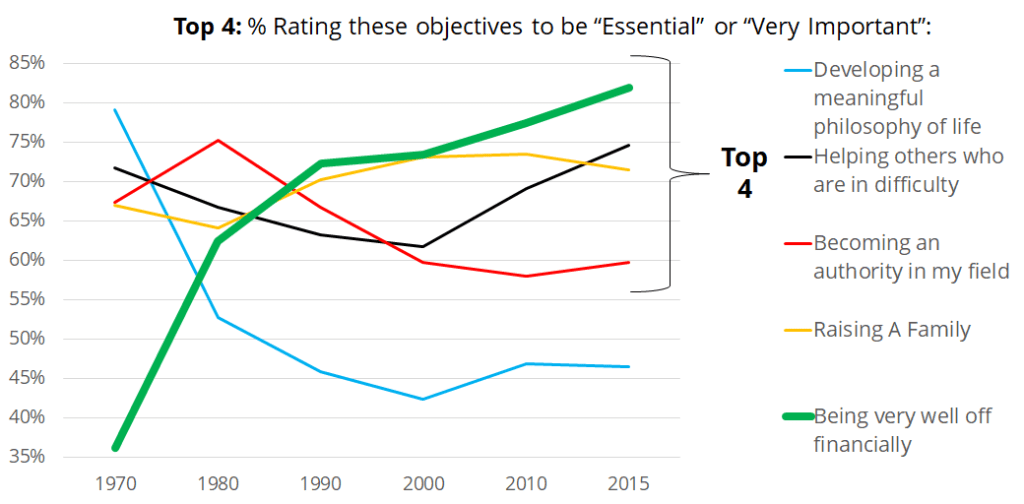


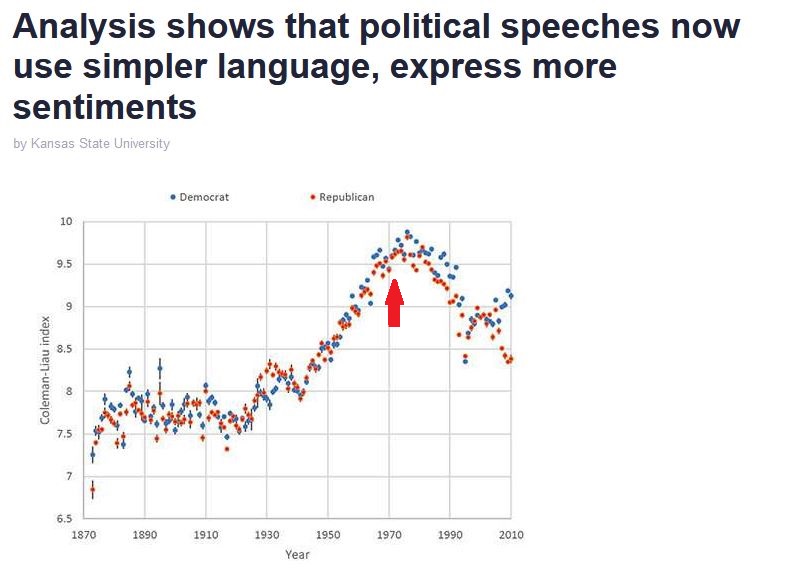

A small selection from a plethora of charts that ask: “WTF Happened In 1971?“
* Francis Bacon
###
As we hit the stacks, we might recall that it was on this date in 1964 that the Surgeon General of the United States, Dr. Luther Terry, M.D., published the landmark report Smoking and Health: Report of the Advisory Committee to the Surgeon General of the United States saying that smoking may be hazardous to health– and sparking national (and worldwide) anti-smoking efforts. While it wasn’t the first such declaration (nor even the first declaration by a U.S. official), it is notable for being arguably the most famous such declaration for its lasting and widespread effects both on the tobacco industry and on the worldwide perception of smoking. A federal ban on cigarette advertising on television went into effect… in 1971.

“Alcohol is the anesthesia by which we endure the operation of life”*…

Alcohol consumption in the U.S has been trending down for several years; in 2018, alcohol consumption in the United States dropped for the third-straight year. Nevertheless…
America is in the middle of an alcohol epidemic.
That’s one takeaway from a new study published this month in Alcoholism, which found the number of alcohol-related deaths more than doubled between 1999 and 2017 from nearly 36,000 to nearly 73,000, and the rate of alcohol-related deaths rose by more than 50 percent from 16.9 per 100,000 people to 25.5.
To put that in perspective, there were roughly 70,000 drug overdose deaths in the US in 2017. Based on the Alcoholism study, alcohol was linked to more deaths than all overdoses — even at the height of America’s opioid epidemic. Alcohol accounted for 2.6 percent of all deaths among people 16 and older in 2017, up from 1.5 percent in 1999…
The study speaks to a problem in American public health and drug policy: While crises like the opioid epidemic (deservedly) get a lot of attention, even deadlier drug crises are often neglected by the public, policymakers, and media…
Alcohol isn’t even the deadliest drug. The Centers for Disease Control and Prevention previously estimated that tobacco smoking is linked to 480,000 deaths each year, or roughly 1 in 5 deaths. In other words, preventing just 30 percent of smoking deaths would prevent more deaths than preventing all drug overdose deaths and alcohol-related deaths combined.
Yet alcohol and tobacco haven’t filled a big part of public discussions about drugs in the past few years, especially compared to the opioid epidemic…
More at “The number of US alcohol deaths per year has doubled since 1999.”
* George Bernard Shaw
###
As we contemplate cocktails, we might recall that it was on this date in 1912, during the First International Opium Conference at The Hague, that the first international drug control treaty, the International Opium Convention, was signed.

Opium article from The Daily Picayune, February 24, 1912, New Orleans
“Well, I hate to break it to you, but there is no big lie. There is no system. The universe is indifferent”*…

Did you ever notice that almost every Mad Men episode ends with Don Draper staring blankly?

On the occasion of tomorrow’s series finale, the exquisite Tumbler, “Don Draper Staring Blankly.”
* Don Draper
###
As we get in touch with our motivations, we might recall that it was on this date in 1988, 24 years after the first Surgeon General’s report enumerating the dangers of smoking, that then-SG C. Everett Koop, delivered the second installment: a report that declared nicotine to be addictive in ways similar to heroin and cocaine.

You must be logged in to post a comment.