Posts Tagged ‘poverty’
“An imbalance between rich and poor is the oldest and most fatal ailment of all republics”*…

Plutarch’s warning is one to take seriously–as then, now. So, how is the American Dream doing?…
In late 20th-century music, the elusiveness of the American Dream is a recurring theme. From Stevie Wonder’s ode to a boy “born in hard time Mississippi” in 1973 to Bruce Springsteen’s anthems to the working class in factory-shuttered towns in the 1980s, frustration with people’s inability to outgrow their circumstances is rife. The timing of the peak of that genre is no coincidence: whereas nearly all American children born in 1940 could still expect to do better than their parents, only two in five could by 1984…
… A new study by Raj Chetty, of Harvard University, and colleagues provides fresh data on how America’s landscape of opportunity has shifted sharply over the past decades. Although at the national level there have been only small declines in mobility, the places and groups that have become more (or less) likely to enable children to rise up have changed a lot. The most striking finding is that, compared with the past, a child’s race is now less relevant for predicting their future and their socioeconomic class more so.
The greatest drops in mobility have been not in the places evoked in song, but on the coasts and the Great Plains, which historically provided pathways up (see maps). “Fifteen years ago, the American Dream was alive and well for white children born to low-income parents in much of the North-east and West Coast,” says Benjamin Goldman of Cornell University, one of the co-authors. “Now those areas have outcomes on par with Appalachia, the rustbelt and parts of the South-east.”
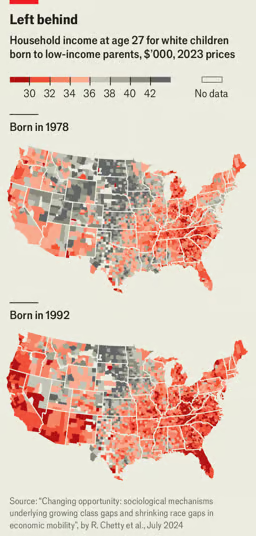
The fact that white children have become more likely to remain in poverty than before, whereas for black children the reverse is true, raises many questions. The finding comes from tracing the trajectories of 57m children born in America between 1978 and 1992 and looking at their outcomes by the age of 27. “This is really the first look with modern big data into how opportunity can change within a place over time,” says Mr Goldman. For children born into high-income families, household income increased for all races between birth cohorts. Yet among those from low-income families, earnings rose for black children and fell for white children.
A black child born to poor parents in 1992 earned $1,400 a year more than one born in 1978. A similar white child earned $2,000 less than one born in 1978. But on average, a poor white child still earned $9,500 more than a poor black child.
This pattern has played out in virtually every county, though with big regional differences. As a result, the earnings gap between rich and poor white children (the “class gap”) grew by 27%, whereas the earnings gap between poor white and poor black children (the “race gap”) fell by 28%…
… None of this means that race is no longer relevant for Americans’ chances in life. Although the reversal of the direction of travel is striking, a young black American born in 1992 to poor parents was still four percentage points more likely to remain in poverty than a poor white peer, down from a 15 percentage-point gap for those born in 1978. And while the near doubling in rates of mortality among young, lower-income white Americans is deeply alarming, mortality rates for their black counterparts have increased too, and they are still (a bit) more likely to die young…
… Convergence has not yet brought equality. Despite improvements across America for poor black children, there is still no county where their outcomes match those of poor white ones. Yet the decline of the white working class is steep, and bound to cause grief. Telling a young white man with lower life outcomes than previous generations that he is still doing better than the average black peer is about as useful as telling a young black man that he’s doing well “for a black man”.
Another possible misconception is that social mobility is a zero-sum game: that poor white children are doing worse because poor black children are doing better. The authors tackle this by showing how in places where black children have done well, white children’s outcomes have remained stable; and in places where white children have done particularly poorly, their black peers have also not thrived.
In his previous work Mr Chetty demonstrated [see here for a summary of his 2018 study] just how much a child’s chances of outperforming their parents depended on their race and where they grew up. One of the questions the authors were left with was how “sticky” these effects would be over time: could opportunities for the next cohorts of children change within these same places, or were they fixed? The new study’s most hopeful finding is that, far from being fixed, opportunities within a place can change significantly and rapidly. Neither history nor place is destiny…
… Americans love a rags-to-riches story. In his acceptance speech [at the Republican Convention], Mr Vance pledged to “make this country a place where every dream…will be possible once again”. In his bestselling book “Hillbilly Elegy” he writes that the assumption “that only a truly extraordinary person could have made it to where I am today…I think that theory is a load of bullshit.”
But the story of Mr. Vance, who grew up in a poor part of the rustbelt, rose to be a venture capitalist and now, at 39, is a potential American president, remains extraordinarily rare. While there has been a reshuffling of opportunities for Americans trying to escape the lowest rung, there has been no progress at all for routes into the upper class. For the vast majority of poor black children, who continue to have a 3% chance of rising from the bottom to the top quintile, and poor white children, whose chances have fallen from 14% to 12%, that door remains firmly shut…
“Class, race and the chances of outgrowing poverty in America,” a big-data analysis– a gift article from @TheEconomist.
* Plutarch
###
As we optimize opportunity, we might send mortgaged birthday greetings to Charles Darrow; he was born on this date in 1889. He designed (in 1933) and patented (in 1935) the board game Monopoly. He later sold his patent to Parker Brothers, which credits him as its creator.
In fact, the history of Monopoly is much longer. It can be traced back to 1903, when American anti-monopolist Lizzie Magie created a game called The Landlord’s Game that she hoped would explain the single-tax theory of Henry George. It was intended as an educational tool to illustrate the negative consequences of concentrating land in private monopolies.
After losing his job at a sales company following the Stock Market Crash of 1929, Darrow worked at various odd jobs. Seeing his neighbors and acquaintances play a board game in which the object was to buy and sell property, he decided to publish his own version of the game.
In fact, Darrow and his friends were just a few of many people in the American Midwest and East Coast who had been playing a game of buying and trading property– all based on Magie’s original… but most having morphed as warnings of that sort too often do) into the opposite of Magie’s intent– a celebration of accumulation. The game was used by college professors and their students, and another variant, called The Fascinating Game of Finance, was published in the Midwest in 1932. From there the game traveled back east, where it had remained popular in Pennsylvania, and became popular with a group of Quakers in Atlantic City. Darrow was taught to play the game by Charles Todd, who had played it in Atlantic City, where it had been customized with that city’s street and property names– to wit Monopoly‘s nomenclature.

“Economic problems have no sharp edges. They shade off imperceptibly into politics, sociology, and ethics. Indeed, it is hardly an exaggeration to say that the ultimate answer to every economic problem lies in some other field.”*…

The number of households that live above the poverty line but are barely scraping by is ticking higher…
Over time, higher costs and sluggish wage growth have left more Americans financially vulnerable, with many known as “ALICEs.”
Nearly 40 million families, or 29% of the population, fall in the category of ALICE — Asset Limited, Income Constrained, Employed — according to United Way’s United for ALICE program, which first coined the term to refer to households earning above the poverty line but less than what’s needed to get by.
That figure doesn’t include the 37.9 million Americans [individuals, as opposed to families as measured above] who live in poverty, comprising 11.5% of the total population, according to data from the U.S. Census Bureau.
“ALICE is the nation’s child-care workers, home health aides and cashiers heralded during the pandemic — those working low-wage jobs, with little or no savings and one emergency from poverty,” said Stephanie Hoopes, national director at United for ALICE…
Read on for an explanation of how high inflation and higher interest rates have aggravated what was already a problem: “29% of households have jobs but struggle to cover basic needs,” from @CNBC.
Apposite: “Millions of Americans are about to lose internet access, and Congress is to blame.”
(Image above: source)
***
As we knit a safety net, we might recall that, on this date in 2020, as a product of the COVID-19 recession, the U.S. unemployment rate to hit 14.9 percent, its worst rate since the Great Depression. Federal legislators enacted six major bills, centered on the American Rescue Plan and costing about $5.3 trillion, to help manage the pandemic and mitigate the economic burden on families and businesses. Those programs have now expired.

“The only people who can fix Africa are talented young Africans. By unlocking and nurturing their creative potential, we can create a step change in Africa’s future.”*…

And there are about to be a great many of those young people… As we exit the Holidays looking forward, our global foci tend to be the Middle East, Eastern Europe, and East Asia. In an updated re-post (the original of which was featured here), the estimable Noah Smith reminds us not to neglect Africa…
Africa has been mostly out of the news in the U.S. these days. But if you think about the rest of this century, and what that’s going to look like, it’s impossible not to think about the world’s second-largest continent. The two reasons, simply put, are 1) population, and 2) poverty. Africa’s fertility rate is shrinking, just like everywhere else, but it started doing so much later. So population momentum is going to make Africa VERY populous by the time it peaks (which some forecasters think will happen at around the end of the century). [See the chart above, taken from this IMF report.]
You’ll notice that these estimates are quite a bit lower than the ones in my first graph in the [original post]. This is because Africa’s fertility rates have been falling a lot more than people expected. But even with these lower estimates, Africa is projected to be absolutely huge by the end of the century. And its fraction of the young population will be far higher still. There will come a time, not too long from now, when countries around the world are clamoring for African migrants instead of trying to keep them out.
The other reason Africa is important is poverty; it’s now clear that Africa will be the last major world region to escape a subsistence standard of living. The question of whether and how it can escape this fate is the subject of the post below. But notice that the flip side of poverty is potential; being poor means you have a lot of room to grow, and by the end of this century, most labor-intensive tasks will probably be done in Africa.
And growth is actually doing well. Despite all the talk of decoupling and the big slowdown in China, and despite the occasional hand-wringing in the Western press, growth in Sub-Saharan Africa has been pretty robust in 2022 and 2023. And that’s projected to continue this year…
…
Just how to jump-start productivity growth in African manufacturing is a difficult question. Should countries make their exchange rates cheaper? Improve infrastructure? Spend more on education and health? Are free trade agreements important here? Do industrial policies and/or export promotion have any role to play? Or does the rise of automation simply mean that countries can’t get rich with labor-intensive manufacturing anymore?
I don’t know. But… the fact that Africa has some productive manufacturers and the fact it has managed to shift more people into factory work are both good signs. And though Asia’s growth boom is still going strong, it can’t last forever, and Africa’s day as the workshop of the world may come soon.
But economists, leaders, policymakers, businesspeople, and international organizations need to be focusing on this challenge more than they are. The fate of humanity in the 21st century and beyond hinges on whether African countries can figure out the riddle of industrialization…
Smith may be over-optimistic… in which case, economic, political, and climate migrants will stream out of Africa. Or, it may be that Africa’s development will follow a new and different social, political, and economic logic (see. e.g., here, here, and here).
In any event, Africa matters absolutely: “All futurism is Afrofuturism,” from @Noahpinion.
See also: Reynaldo Anderson‘s contribution, “In a post-American world order, Africa becomes a power player,” to Politico‘s “The Unpredictable But Entirely Possible Events That Could Throw 2024 Into Turmoil” (all of which are provocative).
If I were not African, I wonder whether it would be clear to me that Africa is a place where the people do not need limp gifts of fish but sturdy fishing rods and fair access to the pond. I wonder whether I would realize that while African nations have a failure of leadership, they also have dynamic people with agency and voices.
Chimamanda Ngozi Adichie
###
As we devote ourselves to development, we might recall that it was on this date in 1912 (the anniversary of the 1806 Battle of Blaauwberg, as a result of which the British gained sovereignty over the Dutch Cape Colony, which we now know as South Africa) that the African National Congress was founded. Originally known as the South African Native National Congress, it began as a liberation movement, then became a political party. It has governed South Africa since 1994, when the first post-apartheid election resulted in Nelson Mandela‘s election as President of South Africa.

“Poverty is the worst form of violence”*…

Two economic historians, Peter A. Coclanis and Louis M. Kyriakoudes, on why about 20% of counties in the U.S. South are marked by “persistent poverty”…
For a brief moment in the summer of 2023, the surprise No. 1 song “Rich Men North of Richmond” focused the country’s attention on a region that often gets overlooked in discussions of the U.S. economy. Although the U.S. media sometimes pays attention to the rural South — often concentrating on guns, religion and opioid overdoses — it has too often neglected the broad scope and root causes of the region’s current problems.
As economic historians based in North Carolina and Tennessee, we want a fuller version of the story to be told. Various parts of the rural South are struggling, but here we want to focus on the forlorn areas that the U.S. Department of Agriculture refers to as “rural manufacturing counties” — places where manufacturing is, or traditionally was, the main economic activity.
You can find such counties in every Southern state, although they were historically clustered in Alabama, Georgia, North and South Carolina, and Tennessee. And they are suffering terribly.
First, let’s back up. One might be tempted to ask: Are things really that bad? Hasn’t the Sun Belt been booming? But in fact, by a range of economic indicators — personal income per capita and the proportion of the population living in poverty, for starters – large parts of the South, and particularly the rural South, are struggling.
Gross domestic product per capita in the region has been stuck at about 90% of the national average for decades, with average income even lower in rural areas. About 1 in 5 counties in the South is marked by “persistent poverty” — a poverty rate that has stayed above 20% for three decades running. Indeed, fully 80% of all persistently poor counties in the U.S. are in the South.
Persistent poverty is, of course, linked to a host of other problems. The South’s rural counties are marked by low levels of educational attainment, measured both by high school and college graduation rates. Meanwhile, labor-force participation rates in the South are far lower than in the nation as a whole.
Unsurprisingly, these issues stifle economic growth.
Meanwhile, financial institutions have fled the region: The South as a whole lost 62% of its banks between 1980 and 2020, with the decline sharpest in rural areas. At the same time, local hospitals and medical facilities have been shuttering, while funding for everything from emergency services to wellness programs has been cut.
Relatedly, the rural South is ground zero for poor health in the U.S., with life expectancy far lower than the national average. So-called “deaths of despair” such as suicides and accidental overdoses are common, and rates of obesity, diabetes, hypertension, heart disease and stroke are high – much higher than in rural areas in other parts of the U.S. and in the U.S. as a whole…
Although some people think that these areas have forever been in crisis, this isn’t the case. While the South’s agricultural sector had fallen into long-term decline in the decades following the Civil War — essentially collapsing by the Great Depression — the onset of World War II led to an impressive economic growth spurt.
War-related jobs opening up in urban areas pulled labor out of rural areas, leading to a long-delayed push to mechanize agriculture. Workers rendered redundant by such technology came to constitute a large pool of cheap labor that industrialists seized upon to deploy in low-wage processing and assembly operations, generally in rural areas and small towns.
Such operations surged between 1945 and the early 1980s, playing a huge role in the region’s economic rise. However humble they may have been, in the South — as in China since the late 1970s — the shift out of a backward agricultural sector into low-wage, low-skill manufacturing was an opportunity for significant productivity and efficiency gains.
This helped the South steadily catch up to national norms in terms of per-capita income: to 75% by 1950, 80% by the mid-1960s, over 85% by 1970, and to almost 90% by the early 1980s…
By the early 1980s, however, the gains made possible by the shift out of agriculture began to play themselves out. The growth of the rural manufacturing sector slowed, and the South’s convergence upon national per capita income norms stopped, remaining stuck at about 90% from then on.
Two factors were largely responsible: new technologies, which reduced the number of workers needed in manufacturing, and globalization, which greatly increased competition. This latter point became increasingly important, since the South, a low-cost manufacturing region in the U.S., is a high-cost manufacturing region when compared to, say, Mexico.
Like Mike Campbell’s bankruptcy in Hemingway’s “The Sun Also Rises,” the rural South’s collapse came gradually, then suddenly: gradually during the 1980s and 1990s, and suddenly after China’s entry into the World Trade Organization in December 2001…
A sobering read: “Poor men south of Richmond? Why much of the rural South is in economic crisis.”
* Mahatma Gandhi
###
As we dive into the dynamics of development, we might recall that it was on this date in 1718 that the famous pirate Edward Teach– better known as Blackbeard– was killed off the coast of North Carolina.
Edward Teach, also known as Blackbeard, is killed off North Carolina’s Outer Banks during a bloody battle with a British navy force sent from Virginia.
Believed to be a native of England, Edward Teach likely began his pirating career in 1713, when he became a crewman aboard a Caribbean sloop commanded by pirate Benjamin Hornigold. In 1717, after Hornigold accepted an offer of general amnesty by the British crown and retired as a pirate, Teach took over a captured 26-gun French merchantman, increased its armament to 40 guns, and renamed it the Queen Anne’s Revenge.
During the next six months, the Queen Anne’s Revenge served as the flagship of a pirate fleet featuring up to four vessels and more than 200 men. Teach became the most infamous pirate of his day, winning the popular name of Blackbeard for his long, dark beard, which he was said to light on fire during battles to intimidate his enemies. Blackbeard’s pirate forces terrorized the Caribbean and the southern coast of North America and were notorious for their cruelty.
In May 1718, the Queen Anne’s Revenge and another vessel were shipwrecked, forcing Blackbeard to desert a third ship and most of his men because of a lack of supplies. With the single remaining ship, Blackbeard sailed to Bath in North Carolina and met with Governor Charles Eden. Eden agreed to pardon Blackbeard in exchange for a share of his sizable booty.
At the request of North Carolina planters, Governor Alexander Spotswood of Virginia dispatched a British naval force under Lieutenant Robert Maynard to North Carolina to deal with Blackbeard. On November 22, Blackbeard’s forces were defeated and he was killed in a bloody battle of Ocracoke Island. Legend has it that Blackbeard, who captured more than 30 ships in his brief pirating career, received five musket-ball wounds and 20 sword lacerations before dying…
Source

“It is easier to build strong children than to repair broken men”*…

Your correspondent is headed into a particularly busy period of travel/work, so (Roughly) Daily will be more roughly than daily for next few days. Regular service should resume on September 20…
Grim, but important…
Legal protections for children in the United States and in every individual state fall short of international children’s rights standards, Human Rights Watch said [in a report released this week]. Children in the US can be legally married in 41 states, physically punished by school administrators in 47 states, sentenced to life without parole in 22 states, and work in hazardous agriculture conditions in all 50 states. As the only UN member state that has failed to ratify the Convention on the Rights of the Child, the US falls far below internationally adopted standards.
One year after the release of a scorecard that measures US compliance with key international child rights standards, 11 states have enacted reforms that improve their rankings. Absent federal ratification and federal laws regarding many of the issues the convention addresses, jurisdiction is left to individual states. As a result, the protection and advancement of child rights varies from state to state…

While only seven states score higher than a “D” grade, four states shed their “F” grade, three moved up to a “C,” and several significantly improved their rankings. Alaska, Colorado, Connecticut, Illinois, Maryland, Minnesota, New Hampshire, New Mexico, New York, Vermont, and West Virginia showed improvement over the last year.
The policy changes that improved states’ grades were most frequently in the areas of banning sentencing children to life without parole, raising the minimum age of prosecuting children in the juvenile system, and limiting or prohibiting child marriage. Progress was limited on banning corporal punishment. On child labor, some states moved to roll back child labor protections…
The updated scorecard shows improvement, but many states still fail children: “No US State Meets Child Rights Standards,” from @hrw.
Related:

* Frederick Douglass
###
As we protect our progeny, we might recall that it was on this date in 1924 that the League of Nations passed the Declaration of the Rights of the Child (AKA The Geneva Declaration), a historic document drafted by Eglantyne Jebb that recognized and affirmed for the first time the existence of rights specific to children and the responsibility of adults towards children.
The U.S. was not a member of the League. But in 1959 the Declaration was adopted in an extended form by the United Nations.


You must be logged in to post a comment.