Posts Tagged ‘magic’
“Sitting with a deck of cards in your hand all day is an obsession”*…
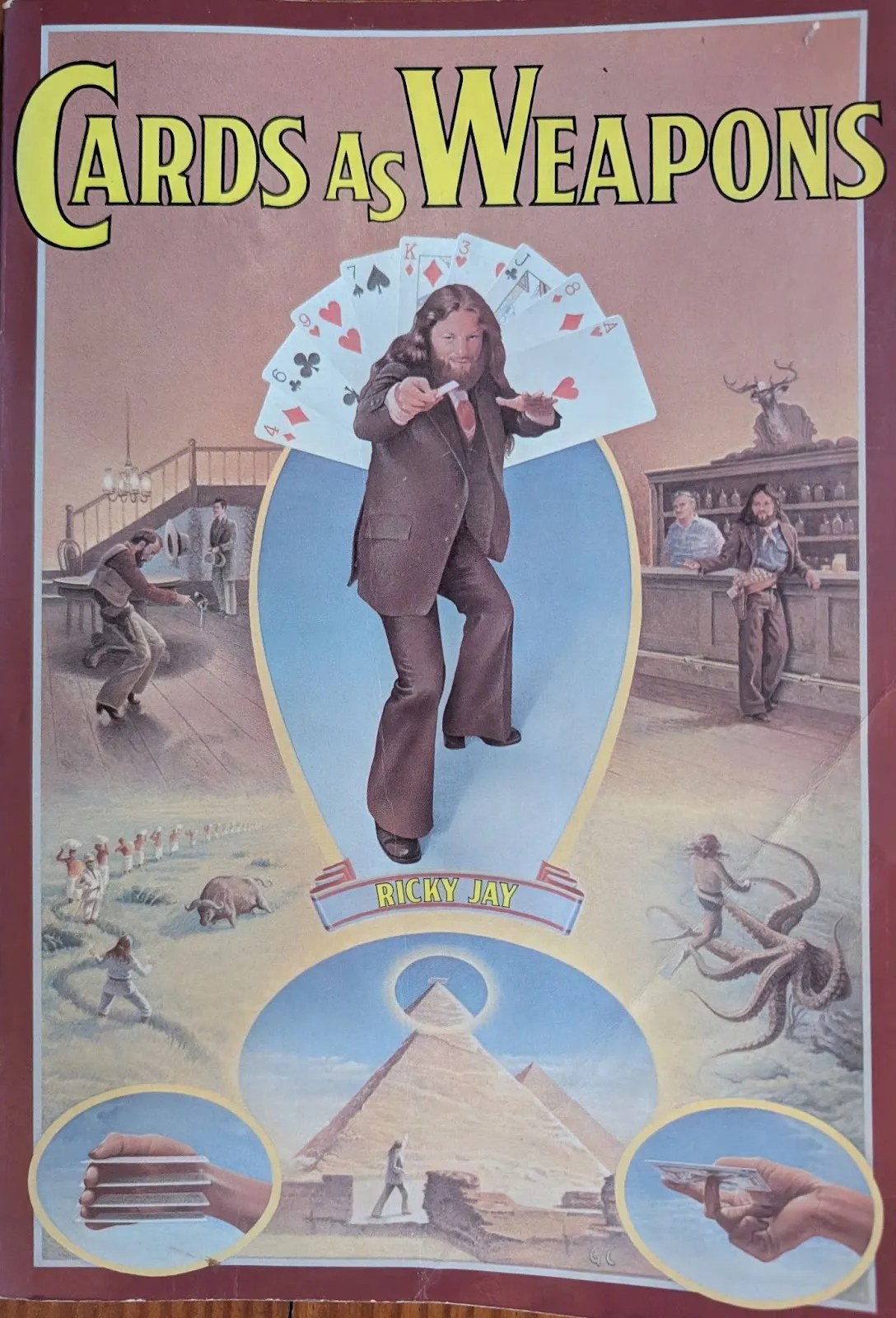
Long-time reader will know of your correspondent’s affection and respect for the late, great Ricky Jay (see. e.g., here and here). The estimable Quentin Hardy (and here), recalls the happy experience of seeing Jay perform his remarkable stage show, “Ricky Jay and His 52 Assistants” (“who were, of course, an ordinary deck of cards, serving under his complete domination”) and the realization that it triggered…
… Ricky Jay – it seems absurd to reduce that mellifluous name to its given or surname components, and parodically stuffy to write “Mr. Jay” – was primarily a close magician, moving cards and coins in all sorts of magical ways. He was also renowned as a card thrower, onstage penetrating a watermelon at 10 paces, and tossing a card as far as 190 feet, or at 90 miles per hour. He was an actor, an engaging writer, a bibliophile, and a deeply learned historian of freaks, cons, conjurers, armless calligraphers, and other nonstandard humans.
What I saw of his secret, I believe, illuminated his talent and his other motivating interests.
I don’t remember details of his lacerating onstage game, though it was excellent entertainment for us marks and his audience. After a couple of minutes we were swept off so he could move on to another amazement. But not before I saw his thumb.
Ricky Jay’s thumb was a seemingly unassuming digit, at rest beneath the clever patter, the astonishing cards dancing across the table, and the beautiful fingers controlling the cards’ movements, then recalling them to their correct place in the deck. By chance, I noticed this thumb running alongside the deck in between deals, and even though the magician was talking to me I sensed a sensitive side communication between the thumb and the man.
It was akin to watching wild nature, when an animal’s excellence is at one with its environment. No, it was better: It was wild nature guided by a fierce human intelligence. I saw him talking to the audience, but he was in a side conversation with a thumb that knew by feel where every card was. This knowledge was the outcome of focused years, which had extended the man’s talent beyond his body into the deck of cards. The state would be aspirational, except a dolt such as I (and, sorry, likely you too, dear reader) can hardly imagine this state of perfection.
What was his trick? The trick was training so deep that his thumb knew where every card was, and could say where it needed to go next. While he was talking, he was checking in with it, making sure everything was in its place as he readied himself for the next seamless adventure.
This may sound comical, but I was awed by a moment of man and thumb, and all that had gone into it. I saw hours of work, a pursuit beyond training with the goal of melding oneself with an object, until the practitioner and the object are completely attuned.
There are other examples of this fusion of identity with an action or object. Jimi Hendrix, as he moved from a band guitarist to a phenomenon, practiced leaning against a wall, so he wouldn’t hurt himself when he fell asleep. W.C. Fields, like Ricky Jay the product of a childhood he’d as soon forget, practiced the juggling that made him a vaudeville star over a boardinghouse bed, so he could likewise collapse, then get up and resume. The classical violinist Chee-yun Kim, who fell asleep playing the piano at age 3 (her mother, terrified, moved her to the fiddle), once forgot to eat during a three-day recording session. There are many more examples…
… I think about Ricky Jay’s thumb, and practicing so hard that part of you enters a physical object, when I think of his breakthrough book, “Learned Pigs and Fireproof Women.” A compendium of extraordinary performers in history, it memorializes the high divers, master memorizers, poison drinkers and fire resisters, and the woman who wrote, simultaneously, four different words with her hands and feet. Some performers are mountebanks, but the most moving passages are about people whose circumstances compelled them to will themselves into something superhuman.
It may be necessity, as in the case of the armless pianist who played with his toes. Or it may be pure chance, as befell Leon Rauch, a hallucinating teenage runaway who met a conjuror, and threw himself into close magic and contortionism. He gained worldwide fame as LaRoche, when he trapped himself in a small sphere and shifted his center of gravity sufficiently to roll up a 50-foot vertical spiral, an adult curled up like a fetus, dazzling the world as he climbed far above them. Far from his origins, too. Call it “dedication” or “obsession.” The goal is transformation, and an escape into a new self.
Ricky Jay, and many other extraordinary entertainers, encourage their reputation as hard-edged guys in a hard world. Indeed, both he and his mentor, the magician Dai Vernon, sought out card cheats, con men, fakes, and other scoundrels. They were searching for the mechanics of their treachery on the unwitting. These villains were presumably not interested in transformation, but simply grift.
Over the years. I have given copies of “Learned Pigs” to more than one acquaintance going through a difficult time, and to this day I keep a few spare copies on hand. It works like magic. Until today I have not disclosed Ricky Jay’s secret: There is no secret, there is only the desire and will for transformation that is inside us all…
A great magician, and an estimable escape artist of a different kind: “Ricky Jay’s Thumb.”
* Ricky Jay
###
As we shuffle and cut, we might recall that it was on this date in 1975 that the master tapes of the ELO album, Face the Music, went to the pressing plant. It featured “Strange Magic” and was their first to earn a platinum record.

“If you would be a real seeker after truth, it is necessary that at least once in your life you doubt, as far as possible, all things.”*…

René Descartes, the founder of modern philosophy, was furiously condemned by his contemporaries. Why did they fear him? Sandrine Parageau explains…
The French philosopher René Descartes (1596-1650) is generally presented as one of the founders of modern Western philosophy and science, the man who made reason the principle of the search for truth, and who formulated the cogito, ‘I think, therefore I am.’ His assertion of mind-body dualism has given rise to a great number of objections over time, from those of 17th-century theologians to those of 20th-century feminists. In France, even though the decision of the 1792-95 National Convention to transfer Descartes’s remains to the Pantheon in Paris was not followed through, the philosopher is nonetheless regarded as ‘un grand homme’, a national hero, and being labelled ‘Cartesian’ is still today a compliment that emphasises one’s common sense, good judgment and methodical use of reason.
Yet Descartes was not always the undisputed champion of reason that he is today. In 17th-century England and the Netherlands, he was publicly and repeatedly accused of being a fraud and of lying to his readers so as to manipulate them into becoming his disciples. Of course, as one would expect, many intellectual and scientific objections were raised by his contemporaries against Descartes’s philosophy. But those ad hominem allegations were of a different nature altogether: they implied that the French philosopher resorted to well-crafted and dishonest strategies to make his readers ignorant, and therefore gullible, with the aim of making them submit to his control. Thus, according to those critics, the founder of modern science was, in truth, a purveyor of ignorance.
Such an accusation was made for example by the Protestant scholar and theologian Meric Casaubon (1599-1671 [a classicist and the first translators of the Meditations of Marcus Aurelius into English]), a Geneva-born clergyman of the Church of England, in a long manuscript letter on ‘general learning’ written in 1668, in which he deplores what he perceives as the growing ignorance of his contemporaries. In this text, Casaubon accuses Descartes of deliberately encouraging his readers to make themselves ignorant by urging them to renounce their beliefs and forget all the knowledge that they have previously acquired: ‘a man must first strip himself of all that he has ever known, or believed.’
This accusation against the champion of rationalism may seem paradoxical at first, but it should not come as a complete surprise: if Descartes did not praise ignorance as such, and certainly not as an end in itself, he did encourage his readers to get rid of all their previous opinions, prejudices and false knowledge, as he himself had done after realising the uncertainty of the knowledge he had been taught as a child. Indeed, in the Discourse on Method (1637), Descartes relates how he initially loved philosophy, theology, poetry and mathematics, which he had been taught at the prestigious Collège Royal de La Flèche, before he became aware of the variety of opinions and the pervasiveness of error, which made him doubt all his knowledge and beliefs. In the Meditations (1641), a few years after the Discourse, Descartes further explains that, in the face of such doubt and uncertainty, he decided to get rid of all the opinions he had formed or acquired in order to rebuild science and knowledge on a firm basis. This experience of ‘radical’ or ‘hyperbolical’ doubt, as it has later been called, which results in the rejection of all knowledge, implying a form of self-induced ignorance, was unsurprisingly construed as an extreme stance by 17th-century commentators, and we may understand how it could be interpreted as a promotion of complete ignorance…
[Parageau unpacks Casaubon’s critique…]
… The 17th-century manipulation techniques here described by Casaubon are strikingly similar to what we now call ‘gaslighting’, a form of emotional and psychological abuse that leads the victim to question their own cognitive faculties and sometimes even their very sanity. As a matter of fact, the Dutch scholar and theologian Martin Schoock (1614-1669), Descartes’s contemporary, had, even more clearly than Casaubon and 25 years earlier, accused Descartes’s ‘new philosophy’ of leading to mental disorder, because choosing ignorance, according to Schoock in his Admirable Method (1643), amounts to deliberately putting off the light of reason in one’s mind: ‘A grown man who forgets everything is ignorant of everything, and where there is ignorance of everything, there is mental disorder.’ (My translation.)
As this passage makes clear, Schoock also thought that Descartes’s radical doubt could not but result in complete ignorance – Descartes’s philosophy was therefore a mere tool devised to spread ignorance. This call for radical doubt, as Schoock understood it, was based on the Cartesian idea that certain and evident truth can come only from within oneself. The French philosopher had allegedly ‘waged a war on books and reading’ and encouraged laziness, especially among young people, who were invited to spend all day lying down and ‘meditating’, in other words doing nothing. Descartes’s victims, Schoock adds, were primarily less-educated or naive people, who fell more readily for his deceptive arguments as they were dazzled by his reputation and influence. Indeed, the example of Descartes’s alleged use of ignorance also reveals the insidious domination of the intellectual elite over less-educated people. Thus, for Schoock as for Casaubon, the aim of Descartes’s so-called philosophy was to turn ignorant people into disciples and ensure their obedience.
If we are to believe Casaubon and Schoock, Descartes’s alleged manipulation was fairly successful, and a great number of people joined ‘the Cartesian sect’. So how come Descartes could so easily dupe his contemporaries? One answer might be that his deception did not rely on lying, but on the more strategic use and abuse of doubt. Doubt is indeed more subtle than crude lies, and therefore more efficient, provided the audience who is being manipulated is not entirely ignorant at first (otherwise, lies would work just as well), yet not educated or sagacious enough to be able to detect and expose the deception straight away. The efficiency of doubt as a strategy may also reside in its versatility. Doubt is indeed both an epistemic virtue, or the first step on the path to truth (the philosopher is always initially a doubter, someone who questions what they have been taught or what seems self-evident), and an epistemic vice, as it can lead to destabilisation and even dissolution of truth and knowledge altogether when it is excessive or misplaced…
… The condemnation of Descartes by Casaubon and Schoock should also be seen as the manifestation of a desperate effort to resist change in the intellectual context that led to the emergence of modern science. The conservative Casaubon feared and lamented the coming destruction of traditional knowledge, which he believed was brought forth by an undue insistence on method to the detriment of learning itself. One must admit that Cartesianism is indeed obsessed with method – Descartes’s famous Discourse is evidence enough. Moreover, Descartes’s call for the rejection by each individual of all their knowledge and opinions was not only interpreted as a means to get power over those who would make themselves ignorant, but also as the programmed extinction of established knowledge, which would give way to something new and therefore suspicious. Schoock shared those preoccupations but was probably even more worried about the psychological consequences of Descartes’s philosophy on his followers and the larger public if ever it managed to spread, which he seriously feared because the mere ‘novelty’ of this philosophy made it attractive to the ignorant multitude. Surprising as it may seem, Schoock’s fears about the sanity of Cartesians were not entirely unjustified. Indeed, if the allegation that Descartes deliberately produced ignorance to control people can be easily dismissed, the claim that his philosophy was likely to lead to madness is more convincing.
Most specialists of Descartes’s philosophy have ignored the affective experience described in the Discourse and the Meditations to focus instead on the order of reason in those texts. Radical doubt and the cogito have thus been interpreted as literary and rhetorical devices, or mere fables (the word is used by Descartes himself in the Discourse). They are generally seen as fictions or thought experiments, rather than as a cognitive process that Descartes actually experienced. If the autobiographical and emotional dimension of self-induced ignorance has been neglected so far, it might be because this aspect does not match the overarching interpretation of Cartesianism as the rule of reason. Descartes urged people to reject all their opinions and knowledge only as a temporary precondition to accessing truth, not as a permanent state. But still, he did encourage self-induced ignorance.
The epistemic anxiety that followed was described by Casaubon and Schoock, as mentioned above. But the origin of the search for truth is emotionally charged as well, as it is grounded in disillusionment and existential despair following the discovery that one was taught erroneous opinions as a child and was therefore deceived. This painful discovery gives rise to the need for purification through the rejection of one’s opinions and withdrawal from the world. The emotional impact of the search for truth is attested in Adrien Baillet’s late 17th-century biography of Descartes, which precisely describes Descartes’s physical and psychological distress.
As Tristan Dagron argues in his book Pensée et cliniques de l’identité (2019), or ‘Thoughts and Treatments of Identity’, the experience that Descartes relates in the First Meditation, where he describes the need for the purification of his mind, can be interpreted as a reappropriation of three dreams that he had in November 1619, which left him confused and mentally disturbed as he was confronted with radical doubt about the distinction between dreaming and waking. When he narrates those dreams, Baillet talks of Descartes’s violent agitations, exhaustion, despair and ‘enthusiasm’, some form of divine inspiration and madness (hence also Descartes’s association with religious sects by his opponents). Dagron shows that those dreams were a traumatic experience for Descartes, which is echoed in the First Meditation and its presentation of radical doubt.
The emotionally unsettling confrontation with radical doubt and madness should be acknowledged as the starting point of the search for truth in what is commonly hailed today as a radically rationalist, emotion-free system of thought – perhaps a consequence of Michel Foucault’s influential reading of the Meditations as a violent and successful attempt at muzzling madness, or a ‘coup de force’, in his book Madness and Civilization (1961). Thus, Casaubon and Schoock were right in arguing that radical doubt implied epistemic anxiety and madness, but madness is not rejected by Descartes – on the contrary, it is embraced and then healed, so to speak, by his philosophy. This might actually be the true reason why Descartes is indeed the founder of modern Western science and philosophy…
“The French Liar,” from @sparageau.bsky.social in @aeon.co.
* René Descartes
###
As marshall our marbles, we might send magical birthday greetings to John Dee, the mathematician, astronomer, and geographer who was a consultant to Elizabeth I– and who was born on this date in 1527. Dee was a translator of Euclid, and a friend of both Gerardus Mercator and Tycho Brahe; he revolutionized navigation by applying geometry; and he coined the word “Brittannia” and the phrase “British Empire.” He had a tremendous impact on architecture and theater– and was the model for Shakespeare’s Prospero.
“So how come such a significant philosopher– one of very few in a country then considered an intellectual backwater– barely features in British history books? Because of his notorious links with magic” (observed BBC’s Discover). Dee was indeed involved (most heavily, toward the end of his life) in the Hermetic Arts: alchemy, astrology, divination, Hermetic philosophy and Rosicrucianism (the Protestant answer to the Jesuits, which Dee founded). Perhaps most (in)famously, Dee put a hex on the Spanish Armada, a spell widely credited at the time for the misfortunes that befell the Iberian fleet (which readers may recall).
In a way that presaged Isaac Newton, Dee’s work spanned the world’s of science and magic at just the point that those world’s began to separate.

“The recognition of oneself as a part of nature, and reliance on natural things, are disappearing for hundreds of millions of people who do not know that anything is being lost.”*…

The estimable Alan Jacobs on the (glorious) novels of Robertson Davies, and (what Jacobs suggests is) a central question running throughout them: What ways of Wisdom have been discarded by modern Knowledge?…
Long ago every village in England had a cunning man, or woman—an untrained but intuitive healer, a person with a good nose for other people’s troubles and a tactical shrewdness about how to handle them. If your problems were simple and obvious, if you needed a broken bone set or a bad tooth pulled, you’d go to the surgeon. Everyone knew that. But what if you weren’t quite sure what was wrong with you? What if your spirit was troubled but also your digestion, and you didn’t know which was causing which, or if they were separate miseries? Then you needed to consult the cunning ones.
The Cunning Man is the last novel by the great Canadian writer Robertson Davies, and its titular figure is a man of the late twentieth century named Jonathan Hullah, who grew up in a remote outpost in northern Ontario and got his first ideas about healing by hanging around with Elsie Smoke, an Ojibwa herbalist and healer, a “wise woman”—a cunning woman. Hullah ultimately becomes a doctor and a practitioner of what some now call “holistic medicine,” though that term is not used in the book by Hullah or anyone else. Hullah thinks of himself as a disciple of the great Renaissance physician Paracelsus— the first person to theorize that physical disease can be the product of what we now would call psychological distress. As Hullah comments, “The problem for a Paracelsian physician like me is that I see diseases as disguises in which people present me with their wretchedness.” It is a problem because people are happy to speak of their diseases but reluctant to acknowledge their wretchedness.
Hullah’s creator almost certainly learned about Paracelsus through reading Carl Jung, who was perhaps the most important guiding figure of Davies’s intellectual and religious life. From my point of view, which is that of a generally orthodox Christian, Davies’s embrace of Jungian ideas is a convenient way to get all the benefits of belief in transcendent order with none of the obligations of obedience to a personal God. Nevertheless, there is much in Davies’s picture of the cunning man—and in closely related ideas that he developed in the latter part of his career as a novelist—from which thinking Christians can and should learn. Above all, I think, we should adopt a kind of historically aware intellectual pluralism, a willingness to learn from and make use of the past, and especially those elements of the past that have been discarded by modernity as refuse and waste. The thoughtful Christian should be a cunning practitioner of filth therapy.
In Davies’s wicked and wonderful novel The Rebel Angels, a scholar named Clement Hollier—whom Davies refers to as a “paleo-psychologist,” a student of ancient and discarded ways of thinking—grows fascinated by what he calls “Filth Therapy.” He suspects that a scientific colleague is pursuing a similar path: “He works with human excrement—what is rejected, what is accounted of no worth to mankind—and in it I suppose he hopes to discover something that is of worth.”…
…
… In his many novels Davies returns over and over again to this theme. He portrays modernity as a world in which we love our crowns even as we despise and try to rip up our roots. The Rebel Angels is the first novel in what has come to be known as the Cornish Trilogy because it deals with the Cornish family, and in the novel that follows it, What’s Bred in the Bone, a young painter named Francis Cornish struggles with his love of Renaissance painting— struggles because he doesn’t just admire the Old Masters but wants to paint as they painted. And yet, he thinks, “surely one must paint in the manner of one’s day?” Anything else is “a kind of fakery, or a deliberate throw-back, like those PreRaphaelites.” And he has a very specific reason for believing that one must choose between “the manner of one’s own day” and a historically informed “fakery”: “Even if you are a believer, you cannot believe as the great men of the past believed.”
Cornish’s mentor, a brilliant restorer of art named Saraceni, disputes this, and constantly holds out to young Cornish the challenge of acquiring “the ability to work truly in the technique and also in the spirit of the past.” And Cornish achieves this ability, at least to Saraceni’s satisfaction; but when his masterful painting is discovered to be new rather than old, it is immediately and universally decried as a fake— even though Cornish never pretended that the painting was by anyone else. For artists and connoisseurs of our age, only the crown—the thought-world of the moment—can provide an authentic and valid mode of artistic (or religious) experience. To work from the root is necessarily to be inauthentic…
…
In a city in Paraguay you may find a curious assembly of musicians called La Orquesta de Instrumentos Reciclados de Cateura—the Recycled Instruments Orchestra of Cateura. But these instrumentos are not professionally designed and built objects that have been discovered and repaired: they have been made out of recycled materials. Violins are constructed from cans and bent forks, a discarded oil drum forms the body of a cello, a saxophone somehow emerges from a drainpipe and a few bent spoons. Most of the musicians are teenagers from Cateura, which is a slum, and a slum built on and around a landfill. They too are among the world’s discards, thought to be without value, people in whom society invests no hope. But Fabio Chavez, the creator and director of the orchestra, has invested in them. He has said, “People realize that we shouldn’t throw away trash carelessly. Well, we shouldn’t throw away people either.”
In The Rebel Angels Maria’s mother healed the souls of great instruments that had been damaged by time and use. This is a wondrous art and worthy of great praise.
But then what praise is appropriate for those who have taken the filth of the world and given it souls, souls capable of the loveliest utterance? And what wonder is adequate to the imaginative dedication of Fabio Chavez, whose name should be known throughout the world? “The world sends us garbage,” he says. “We send back music.”…
Eminently worth reading in full: “Filth Therapy: A Cunning Word.” Also eminently worth reading: every one of Robertson Davies’ novels.
This essay dates from 2017. Jacobs brought it back up in response to his reading of a fascinating new book: Cunning Folk: Life in the Era of Practical Magic, by Tabitha Stanmore. It’s on Google Books, here.
* Robertson Davies, The Rebel Angels
###
As we find treasure in trash, we might recall that it was in this date in 1953 that John Kraft (the younger brother of James Kraft, the founder of Kraft Cheese [later Kraft Foods]) received U.S. patent No. 2,641,545 for the manufacture of soft surface cured cheese. Just one year earlier, the company had introduced Cheez Whiz.

“The structure of the universe- I mean, of the heavens and the earth and the whole world- was arranged by one harmony through the blending of the most opposite principles”*…
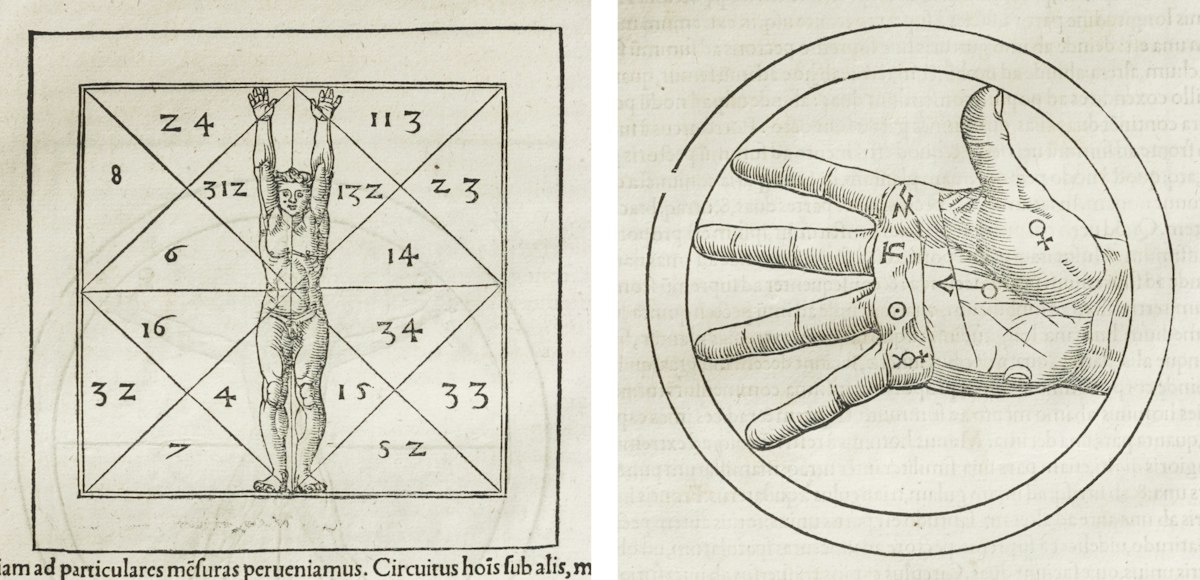
… And as we undertake to understand that structure, we use the lens– the mental models and language– that we have. The redoubtable Anthony Grafton considers and early 16th century attempt: Heinrich Cornelius Agrippa‘s De Occulta Philosophia libri III, Agrippa’s encyclopedic study of magic that was, at the same time, an attempt to describe the structure of the universe, sketching a path that leads both upward and downward: up toward complete knowledge of God, and down into every order of being on earth…
Heinrich Cornelius Agrippa’s manual of learned magic, De occulta philosophia (1533), explicated the ways in which magicians understood and manipulated the cosmos more systematically than any of his predecessors. It was here that he mapped the entire network of forces that passed from angels and demons, stars and planets, downward into the world of matter. Agrippa laid his work out in three books, on the elementary, astrological, and celestial worlds. But he saw all of them as connected, weaving complex spider webs of influence that passed from high to low and low to high. With the zeal and learning of an encyclopedist imagined by Borges, Agrippa catalogued the parts of the soul and body, animals, minerals, and plants that came under the influence of any given planet or daemon. He then offered his readers a plethora of ways for averting evil influences and enhancing good ones. Some of these were originally simple remedies, many of them passed down from Roman times in the great encyclopedic work of Pliny the Younger and less respectable sources, and lacked any deep connection to learned magic.
[Grafton describes the many dimensions of Agrippa’s compilation of the then-current state of magic…]
But few of the dozens of manuscript compilations that transmitted magic through the Middle Ages reflected any effort to impose a system on the whole range of magical practices, as Agrippa’s book did. He made clear that each of the separate arts of magic, from the simplest form of herbal remedy to the highest forms of communication with angels, fitted into a single, lucid structure with three levels: the elementary or terrestrial realm, ruled by medicine and natural magic; the celestial realm, ruled by astrology; and the intellectual realm, ruled by angelic magic. Long tendrils of celestial and magical influence stitched these disparate realms into something like a single great being…
Agrippa offered, in other words, both a grand, schematic plan of the cosmos, rather like that of the London Underground, which laid out its structure as a whole, and a clutch of minutely detailed local Ordinance Survey maps, which made it possible to navigate through any specific part of the cosmos. Readers rapidly saw what Agrippa had to offer. The owner of a copy of On Occult Philosophy, now in Munich, made clear in his only annotation that he appreciated Agrippa’s systematic presentation of a universe in which physical forms revealed the natures of beings and their relations to one another: “Physiognomy, metoposcopy [the interpretation of faces], and chiromancy, and the arts of divination from the appearance and gestures of the human body work through signs.” Agrippa’s book not only became the manual of magical practice, but it also made the formal claim that magic was a kind of philosophy in its own right…
A 16th century attempt to understand the structure of the universe: “Marked by Stars- Agrippa’s Occult Philosophy,” from @scaliger in @PublicDomainRev.
* Aristotle
###
As we take in the totality, we might send more modern birthday greetings to a rough contemporary of Agrippa’s, Evangelista Torricelli; he was born on this date in 1608. Even as Agrippa was trying to understand the world via magic, Torricelli, a student of Galileo, was using observation and reason to fuel the same quest. A physicist and mathematician, he is best known for his invention of the barometer, but is also known for his advances in optics, his work on the method of indivisibles, and “Torricelli’s Trumpet.” The torr, a unit of pressure, is named after him.

“Amaze Your Friends!”*…

Divergent thinking, courtesy of Carla Sinclair…
Here’s a fun party trick. Fill a plastic cup halfway with water and ask guests how to make the cup full without pouring. They might try thinking of other ways to get more water into the cup without having to pour, when they should actually be thinking of how to shrink the cup down to size.
Here’s the simple stunt in action:
Ingenuity: “How do you make a half-filled cup of water full without actually pouring?,” from @Carla_Sinclair in @BoingBoing.
* Frequently-used marketing copy
###
As we light it up, we might recall that it was on this date in 1926 that J. Gordon Whitehead punched Harry Houdini– resulting, some days later, in Houdini’s death.
Jocelyn Gordon Whitehead was the McGill University student who punched Houdini in his dressing room at the Princess Theater in Montreal on October 22, 1926. Whitehead’s blows either started, contributed, or covered-up the appendicitis that would take Houdini’s life nine days later.
J. Gordon Whitehead was born November 25, 1895 in Montreal, Quebec, Canada. He was 31 when the dressing room incident occurred. Popular mythology states that he was a boxer, but this is not true. It’s also not clear whether Whitehead’s intent was to harm Houdini that day, or if it was a misunderstanding.
Whitehead was not charged in the incident and lived out a solitary life in Montreal. At some point he had an accident which resulted in a steal plate being placed in his head. In 1928 Whitehead was charged twice for shoplifting books. In his later years the troubled Whitehead lived as a recluse and hoarder. He died of malnutrition on July 5, 1954…
Wild About Harry

You must be logged in to post a comment.