Posts Tagged ‘Robertson Davies’
“The recognition of oneself as a part of nature, and reliance on natural things, are disappearing for hundreds of millions of people who do not know that anything is being lost.”*…
The estimable Alan Jacobs on the (glorious) novels of Robertson Davies, and (what Jacobs suggests is) a central question running throughout them: What ways of Wisdom have been discarded by modern Knowledge?…
Long ago every village in England had a cunning man, or woman—an untrained but intuitive healer, a person with a good nose for other people’s troubles and a tactical shrewdness about how to handle them. If your problems were simple and obvious, if you needed a broken bone set or a bad tooth pulled, you’d go to the surgeon. Everyone knew that. But what if you weren’t quite sure what was wrong with you? What if your spirit was troubled but also your digestion, and you didn’t know which was causing which, or if they were separate miseries? Then you needed to consult the cunning ones.
The Cunning Man is the last novel by the great Canadian writer Robertson Davies, and its titular figure is a man of the late twentieth century named Jonathan Hullah, who grew up in a remote outpost in northern Ontario and got his first ideas about healing by hanging around with Elsie Smoke, an Ojibwa herbalist and healer, a “wise woman”—a cunning woman. Hullah ultimately becomes a doctor and a practitioner of what some now call “holistic medicine,” though that term is not used in the book by Hullah or anyone else. Hullah thinks of himself as a disciple of the great Renaissance physician Paracelsus— the first person to theorize that physical disease can be the product of what we now would call psychological distress. As Hullah comments, “The problem for a Paracelsian physician like me is that I see diseases as disguises in which people present me with their wretchedness.” It is a problem because people are happy to speak of their diseases but reluctant to acknowledge their wretchedness.
Hullah’s creator almost certainly learned about Paracelsus through reading Carl Jung, who was perhaps the most important guiding figure of Davies’s intellectual and religious life. From my point of view, which is that of a generally orthodox Christian, Davies’s embrace of Jungian ideas is a convenient way to get all the benefits of belief in transcendent order with none of the obligations of obedience to a personal God. Nevertheless, there is much in Davies’s picture of the cunning man—and in closely related ideas that he developed in the latter part of his career as a novelist—from which thinking Christians can and should learn. Above all, I think, we should adopt a kind of historically aware intellectual pluralism, a willingness to learn from and make use of the past, and especially those elements of the past that have been discarded by modernity as refuse and waste. The thoughtful Christian should be a cunning practitioner of filth therapy.
In Davies’s wicked and wonderful novel The Rebel Angels, a scholar named Clement Hollier—whom Davies refers to as a “paleo-psychologist,” a student of ancient and discarded ways of thinking—grows fascinated by what he calls “Filth Therapy.” He suspects that a scientific colleague is pursuing a similar path: “He works with human excrement—what is rejected, what is accounted of no worth to mankind—and in it I suppose he hopes to discover something that is of worth.”…
…
… In his many novels Davies returns over and over again to this theme. He portrays modernity as a world in which we love our crowns even as we despise and try to rip up our roots. The Rebel Angels is the first novel in what has come to be known as the Cornish Trilogy because it deals with the Cornish family, and in the novel that follows it, What’s Bred in the Bone, a young painter named Francis Cornish struggles with his love of Renaissance painting— struggles because he doesn’t just admire the Old Masters but wants to paint as they painted. And yet, he thinks, “surely one must paint in the manner of one’s day?” Anything else is “a kind of fakery, or a deliberate throw-back, like those PreRaphaelites.” And he has a very specific reason for believing that one must choose between “the manner of one’s own day” and a historically informed “fakery”: “Even if you are a believer, you cannot believe as the great men of the past believed.”
Cornish’s mentor, a brilliant restorer of art named Saraceni, disputes this, and constantly holds out to young Cornish the challenge of acquiring “the ability to work truly in the technique and also in the spirit of the past.” And Cornish achieves this ability, at least to Saraceni’s satisfaction; but when his masterful painting is discovered to be new rather than old, it is immediately and universally decried as a fake— even though Cornish never pretended that the painting was by anyone else. For artists and connoisseurs of our age, only the crown—the thought-world of the moment—can provide an authentic and valid mode of artistic (or religious) experience. To work from the root is necessarily to be inauthentic…
…
In a city in Paraguay you may find a curious assembly of musicians called La Orquesta de Instrumentos Reciclados de Cateura—the Recycled Instruments Orchestra of Cateura. But these instrumentos are not professionally designed and built objects that have been discovered and repaired: they have been made out of recycled materials. Violins are constructed from cans and bent forks, a discarded oil drum forms the body of a cello, a saxophone somehow emerges from a drainpipe and a few bent spoons. Most of the musicians are teenagers from Cateura, which is a slum, and a slum built on and around a landfill. They too are among the world’s discards, thought to be without value, people in whom society invests no hope. But Fabio Chavez, the creator and director of the orchestra, has invested in them. He has said, “People realize that we shouldn’t throw away trash carelessly. Well, we shouldn’t throw away people either.”
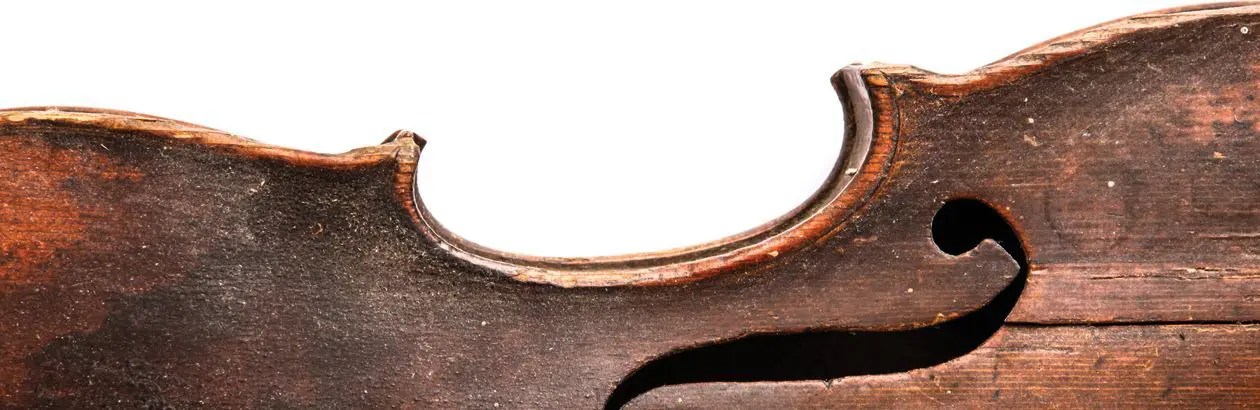
In The Rebel Angels Maria’s mother healed the souls of great instruments that had been damaged by time and use. This is a wondrous art and worthy of great praise.
But then what praise is appropriate for those who have taken the filth of the world and given it souls, souls capable of the loveliest utterance? And what wonder is adequate to the imaginative dedication of Fabio Chavez, whose name should be known throughout the world? “The world sends us garbage,” he says. “We send back music.”…
Eminently worth reading in full: “Filth Therapy: A Cunning Word.” Also eminently worth reading: every one of Robertson Davies’ novels.
This essay dates from 2017. Jacobs brought it back up in response to his reading of a fascinating new book: Cunning Folk: Life in the Era of Practical Magic, by Tabitha Stanmore. It’s on Google Books, here.
* Robertson Davies, The Rebel Angels
###
As we find treasure in trash, we might recall that it was in this date in 1953 that John Kraft (the younger brother of James Kraft, the founder of Kraft Cheese [later Kraft Foods]) received U.S. patent No. 2,641,545 for the manufacture of soft surface cured cheese. Just one year earlier, the company had introduced Cheez Whiz.

Unfinished business…

“Justice delayed is justice denied.”
– William E. Gladstone
Peter Straus, honorary archivist to the Booker Prize Foundation, begs to differ. Now, thanks to him, Melvyn Bragg, Len Deighton, J.G. Farrell, Susan Hill, David Lodge, Ruth Rendell and Patrick White are just some of the authors who could win The Lost Man Booker Prize— a one-off prize to honor books published in 1970 which missed out on the opportunity to win the Booker Prize. As the Man Booker’s web site explains:
In 1971, just two years after it began, the Booker Prize ceased to be awarded retrospectively and became, as it is today, a prize for the best novel in the year of publication. At the same time, the date on which the award was given moved from April to November. As a result of these changes, there was whole year’s gap when a wealth of fiction, published in 1970, fell through the net. These books were simply never considered for the prize.
Now, 40 years on, a panel of three judges – all of whom were born in or around 1970 – has been appointed to select a shortlist of six novels from those books…
Their shortlist will be chosen from a longlist of 22 books which would have been eligible and are still in print and generally available today. They are:
o Brian Aldiss, The Hand Reared Boy
o H.E.Bates, A Little Of What You Fancy?
o Nina Bawden, The Birds On The Trees
o Melvyn Bragg, A Place In England
o Christy Brown, Down All The Days
o Len Deighton, Bomber
o J.G.Farrell, Troubles
o Elaine Feinstein, The Circle
o Shirley Hazzard, The Bay Of Noon
o Reginald Hill, A Clubbable Woman
o Susan Hill, I’m The King Of The Castle
o Francis King, A Domestic Animal
o Margaret Laurence, The Fire Dwellers
o David Lodge, Out Of The Shelter
o Iris Murdoch, A Fairly Honourable Defeat
o Shiva Naipaul, Fireflies
o Patrick O’Brian, Master and Commander
o Joe Orton, Head To Toe
o Mary Renault, Fire From Heaven
o Ruth Rendell, A Guilty Thing Surprised
o Muriel Spark, The Driver’s Seat
o Patrick White, The Vivisector
I noticed that when Robertson Davies’ Fifth Business was first published it carried encomiums from Saul Bellow and John Fowles both of whom judged the 1971 Booker Prize. However judges for 1971 said it had not been considered or submitted. This led to an investigation which concluded that a year had been excluded. I am delighted that, even in a Darwinian way, this year, with so many extraordinary novels, can now be covered by the Man Booker Prize.
Your correspondent notes, with some regret, that in the end, Davies’ novel didn’t make the list…
As thoughts of 1971 lead us to muse that we still don’t know what became of D.B. Cooper, we might pause to celebrate a master of quantity, if not quality: Stephen J. Cannell was born on this date in 1941. Cannell created or co-created nearly 40 television series, mostly crime dramas, including The Rockford Files, The Greatest American Hero, The A-Team, Wiseguy, 21 Jump Street, Silk Stalkings, and The Commish. In the process he scripted more than 450 episodes, and produced or executive produced over 1,500 episodes. At the turn of the century, Cannell turned his attention to the novel; he has to date written 14.

You must be logged in to post a comment.