Posts Tagged ‘cheese’
“The poets have been mysteriously silent on the subject of cheese”*…

… not so, Americans, who have been, as Millie Giles reports, speaking loudly with their wallets…
Topping off a pizza. Eyeballing a slice for cracker-stacking. Perfecting your own combination for a grilled sandwich. Many of us have spent time ruminating on one of life’s great questions: what’s the right amount of cheese?
The answer turns out to be exactly the same reply you’d give to a Parmesan-doling server: just a little more…
A great report from Bloomberg’s Ilena Peng last week outlined how America’s dairy processors are planning to build new facilities across the US to meet surging demand, which is a headline that could have been from just about any decade in the last 50 years. Indeed, data from the US Department of Agriculture shows that American consumption of cheese amounted to a record-breaking ~42 pounds per year for the average person in 2022, the latest figure available — more than double the amount reported in 1975.
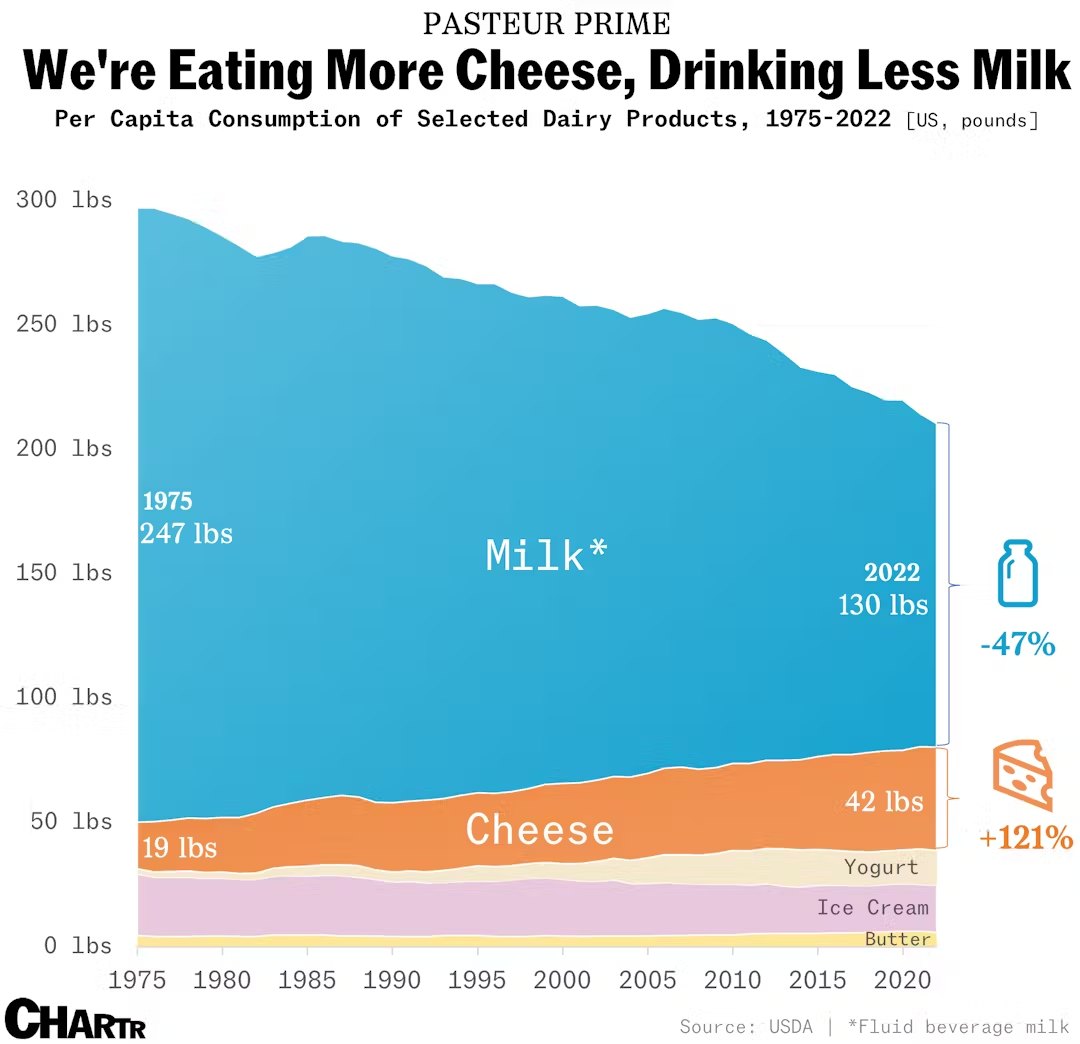
Interestingly, cheese is something of an exception in the world of dairy. As America has sprinkled, grated, and sliced its way through more and more cheese, there’s also been a concurrent 47% decline in fluid milk consumption observed over the same period. In the 20th century, drinking milk was a mainstay of daily life, with its nutritional completeness cementing its place in the American ideal of “growing big and strong” (as well as giving us arguably the best ad campaign of the ‘90s).
Today, a considerable number of people have ditched dairy in favor of plant-based milks like almond, soy, and oat for ethical and dietary reasons (parallel with a counterculture of anti-milk drinking, which some people think is simply “gross”). The boom in alt-milks created a lucrative landscape for fledgling brands like Oatly, which at one point was worth an eye-watering $13 billion (although it is now worth just a tiny fraction of that, some $530 million).
Meanwhile, non-dairy cheeses haven’t taken off in quite the same way. Iterations have struggled to recreate the flavor and texture, with some people, frankly, scarred by sampling a few of these pseudo-cheese attempts, as even VeganCheese.co itself admits.
The discrepancy between these dairy dupes might boil down to one of the unique selling points of regular dairy cheese. As outlined by Bloomberg, the process of making a complex, artisan-derived product from a few simple ingredients, which is hard to do at home, carries weight with an increasingly organic-oriented public.
As well as this, the high protein content of dairy cheese is resonating with a growing number of “gains-conscious” consumers. For example, typically divisive but protein-dense cottage cheese has recently blown up on social media. The longer list of generally viral TikTok recipes also has a very high hit rate for having cheese as a main ingredient.
As Americans dine out more, they may also err on the side of their favorite foods — many of which involve at least some degree of cheese (think: pizza, burgers, pasta)…
Americans eat mozzarella more than any other cheese, with the average citizen getting through 12.55 pounds in 2022, per the USDA.
Consumption of the semi-soft Italian cheese has been sharply on the rise since it knocked cheddar off the top spot back in 2010; though, cheddar has hardly fallen out of favor, with the average person eating over 11 pounds of it each year. Interestingly, processed cheese (think: melty slices) has been mounting a comeback since 2020, after consumption dropped at the turn of the millennium.
What do crude oil and cheese have in common? Not a lot, except that America can’t seem to function without either… and, in recent years, they’ve both become an important American export.
Indeed, while most of America’s favorite cheeses originally derive from elsewhere in the world, the US still makes much of its own supply, accounting for some 29% of the world’s cheese production, second only to the European Union, per the USDA. And, in recent years, it’s started selling more of it abroad.
The US has been a net exporter of cheese since 2010, sending over 450,000 metric tons at its 2022 peak to large international markets like Mexico, where America accounts for 87% of all imported cheese… sales of American cheese abroad are only expected to grow, with the USDA forecasting cheese exports to rise 17% from 2023-24…
… While authentic varieties from places like France and Italy must still be shipped into the country, the US has gone all-in on its own overseas sales. Part of this can be chalked up to the continued drive in global demand for cheese, but the US also has a history of having too much of it lying around.
In 1981, when faced with a milk surplus, the federal government under Ronald Reagan began storing the product as cheese in huge quantities. In fact, the ~560 million pounds of cheese mostly kept in subterranean facilities was at one point costing the government ~$1 million a day in storage and interest costs, according to the Washington Post.
While many countries follow the same food stockpiling rulebook to stabilize prices, a recent surge in milk production, alongside the decline in milk consumption, has meant that America’s cheese pile hasn’t gone anywhere. New, tariff-subsidized deals and a greater national appetite for the yellow stuff have helped… but not by enough. As of August 2024, the total cheese cold in storage holdings in the US was reported to be ~1.4 billion pounds…
More on “Making America Grate Again”: “America is eating, and exporting, more cheese than ever before,” from @chartrdaily.
* G. K. Chesterton
###
As we stuff the crust, we might note that today is National Farmers Day in the U.S.

“The recognition of oneself as a part of nature, and reliance on natural things, are disappearing for hundreds of millions of people who do not know that anything is being lost.”*…
The estimable Alan Jacobs on the (glorious) novels of Robertson Davies, and (what Jacobs suggests is) a central question running throughout them: What ways of Wisdom have been discarded by modern Knowledge?…
Long ago every village in England had a cunning man, or woman—an untrained but intuitive healer, a person with a good nose for other people’s troubles and a tactical shrewdness about how to handle them. If your problems were simple and obvious, if you needed a broken bone set or a bad tooth pulled, you’d go to the surgeon. Everyone knew that. But what if you weren’t quite sure what was wrong with you? What if your spirit was troubled but also your digestion, and you didn’t know which was causing which, or if they were separate miseries? Then you needed to consult the cunning ones.
The Cunning Man is the last novel by the great Canadian writer Robertson Davies, and its titular figure is a man of the late twentieth century named Jonathan Hullah, who grew up in a remote outpost in northern Ontario and got his first ideas about healing by hanging around with Elsie Smoke, an Ojibwa herbalist and healer, a “wise woman”—a cunning woman. Hullah ultimately becomes a doctor and a practitioner of what some now call “holistic medicine,” though that term is not used in the book by Hullah or anyone else. Hullah thinks of himself as a disciple of the great Renaissance physician Paracelsus— the first person to theorize that physical disease can be the product of what we now would call psychological distress. As Hullah comments, “The problem for a Paracelsian physician like me is that I see diseases as disguises in which people present me with their wretchedness.” It is a problem because people are happy to speak of their diseases but reluctant to acknowledge their wretchedness.
Hullah’s creator almost certainly learned about Paracelsus through reading Carl Jung, who was perhaps the most important guiding figure of Davies’s intellectual and religious life. From my point of view, which is that of a generally orthodox Christian, Davies’s embrace of Jungian ideas is a convenient way to get all the benefits of belief in transcendent order with none of the obligations of obedience to a personal God. Nevertheless, there is much in Davies’s picture of the cunning man—and in closely related ideas that he developed in the latter part of his career as a novelist—from which thinking Christians can and should learn. Above all, I think, we should adopt a kind of historically aware intellectual pluralism, a willingness to learn from and make use of the past, and especially those elements of the past that have been discarded by modernity as refuse and waste. The thoughtful Christian should be a cunning practitioner of filth therapy.
In Davies’s wicked and wonderful novel The Rebel Angels, a scholar named Clement Hollier—whom Davies refers to as a “paleo-psychologist,” a student of ancient and discarded ways of thinking—grows fascinated by what he calls “Filth Therapy.” He suspects that a scientific colleague is pursuing a similar path: “He works with human excrement—what is rejected, what is accounted of no worth to mankind—and in it I suppose he hopes to discover something that is of worth.”…
…
… In his many novels Davies returns over and over again to this theme. He portrays modernity as a world in which we love our crowns even as we despise and try to rip up our roots. The Rebel Angels is the first novel in what has come to be known as the Cornish Trilogy because it deals with the Cornish family, and in the novel that follows it, What’s Bred in the Bone, a young painter named Francis Cornish struggles with his love of Renaissance painting— struggles because he doesn’t just admire the Old Masters but wants to paint as they painted. And yet, he thinks, “surely one must paint in the manner of one’s day?” Anything else is “a kind of fakery, or a deliberate throw-back, like those PreRaphaelites.” And he has a very specific reason for believing that one must choose between “the manner of one’s own day” and a historically informed “fakery”: “Even if you are a believer, you cannot believe as the great men of the past believed.”
Cornish’s mentor, a brilliant restorer of art named Saraceni, disputes this, and constantly holds out to young Cornish the challenge of acquiring “the ability to work truly in the technique and also in the spirit of the past.” And Cornish achieves this ability, at least to Saraceni’s satisfaction; but when his masterful painting is discovered to be new rather than old, it is immediately and universally decried as a fake— even though Cornish never pretended that the painting was by anyone else. For artists and connoisseurs of our age, only the crown—the thought-world of the moment—can provide an authentic and valid mode of artistic (or religious) experience. To work from the root is necessarily to be inauthentic…
…
In a city in Paraguay you may find a curious assembly of musicians called La Orquesta de Instrumentos Reciclados de Cateura—the Recycled Instruments Orchestra of Cateura. But these instrumentos are not professionally designed and built objects that have been discovered and repaired: they have been made out of recycled materials. Violins are constructed from cans and bent forks, a discarded oil drum forms the body of a cello, a saxophone somehow emerges from a drainpipe and a few bent spoons. Most of the musicians are teenagers from Cateura, which is a slum, and a slum built on and around a landfill. They too are among the world’s discards, thought to be without value, people in whom society invests no hope. But Fabio Chavez, the creator and director of the orchestra, has invested in them. He has said, “People realize that we shouldn’t throw away trash carelessly. Well, we shouldn’t throw away people either.”
In The Rebel Angels Maria’s mother healed the souls of great instruments that had been damaged by time and use. This is a wondrous art and worthy of great praise.
But then what praise is appropriate for those who have taken the filth of the world and given it souls, souls capable of the loveliest utterance? And what wonder is adequate to the imaginative dedication of Fabio Chavez, whose name should be known throughout the world? “The world sends us garbage,” he says. “We send back music.”…
Eminently worth reading in full: “Filth Therapy: A Cunning Word.” Also eminently worth reading: every one of Robertson Davies’ novels.
This essay dates from 2017. Jacobs brought it back up in response to his reading of a fascinating new book: Cunning Folk: Life in the Era of Practical Magic, by Tabitha Stanmore. It’s on Google Books, here.
* Robertson Davies, The Rebel Angels
###
As we find treasure in trash, we might recall that it was in this date in 1953 that John Kraft (the younger brother of James Kraft, the founder of Kraft Cheese [later Kraft Foods]) received U.S. patent No. 2,641,545 for the manufacture of soft surface cured cheese. Just one year earlier, the company had introduced Cheez Whiz.

“Planchet, my friend, said d’Artagnan, you reason like a cheese.”*…
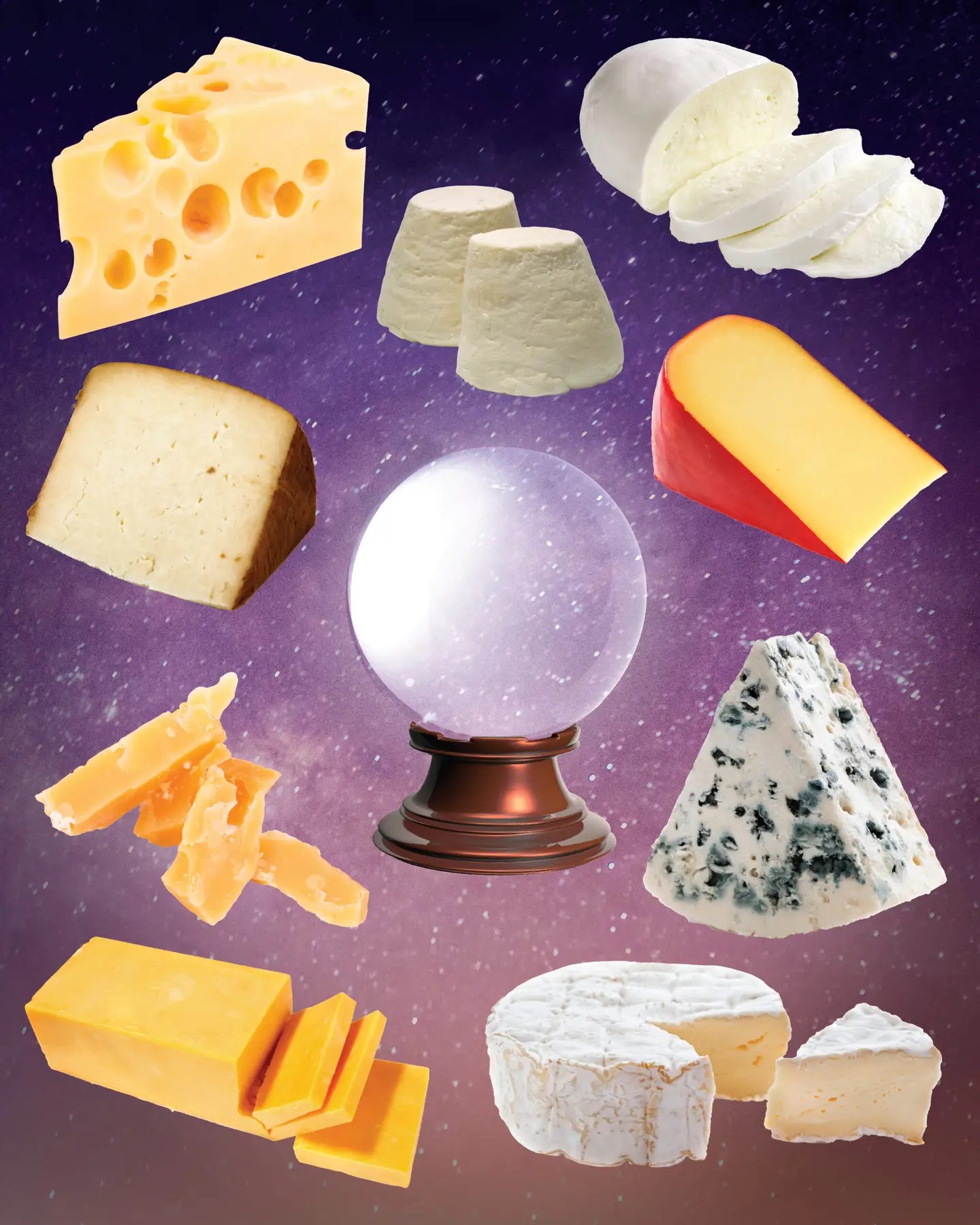
An age-old fortune-telling practice uses cheese to predict everything from one’s future spouse to one’s next career move…
A few months ago, I told a chef in Vancouver that he would soon experience major growth in his career and take on much more responsibility, and that the letter B would somehow be involved. How did I know? Some cheese told me. He’d been standing next to a particularly veiny piece of blue cheese, and asked me to read his fortune from it. Predicting the future using cheese is something I do as a side business, and from what I can tell, there aren’t very many of us doing this anymore.
This isn’t some cheesy divination method I just made up. Tyromancy, or the practice of telling fortunes with cheese, was first officially mentioned in the second century in the writings of Greek historian and professional diviner Artemidorus of Daldis (also known as Artimedorus of Ephesus) on dream interpretation. He apparently didn’t think cheese was a great invention: he noted at the time that the food signifies “trickery and ambushes” and that tyromancers sullied the work of true diviners like sacrificers and liver examiners. Tyromancers, he argued, were more in league with those who practiced evil types of divination, including dice diviners and necromancers. It feels like a bit of a leap to go from cheese to death, but Artimedorus had some opinions, I guess.
Tyromancy reached peak popularity in England during the Middle Ages and early modern period (1500–1800). The country was primarily an agrarian society at the time, with most families having some sort of livestock that produced milk for cheese—and people loved to dabble in the paranormal. Christianity was ingrained in most people, so looking for insight into one’s predestined future, or trying to find a way to gain control over it, led to widespread interest in divination. One used whatever tools were on hand to achieve that, and at that particular point in history, that meant cheese. It was a much more convenient choice than previous divination methods, which included dumping a ladle of molten lead into a bucket of water to see what shapes it made.
People used cheese to divine all sorts of things: who committed a crime, whether the year would bring a fruitful harvest, and how a child’s life would turn out. Those who practiced it generally used farmer’s cheese, though some tried it with runnier options, like fondue.
Back then, a typical use for tyromancy was to determine who you would marry. You’d simply carve the names of all potential suitors into some pieces of cheese, then wait to see which one molded first. And there it was—your life partner! People also analyzed the number and size of holes in a block of cheese, the patterns of the mold and veins, and the shapes that curds made as they coagulated. The process is similar to that of reading tea leaves or coffee grounds—you tell a story through the shapes you see. A heart shape, for example, signifies love and happiness, while an odd number of holes predicts that something negative might happen…
“The Un-Brie-Lievable History of Tyromancy,” from @JenniferBillock in @SAVEURMAG.
* Alexandre Dumas
###
As we foretell with fromage, we might send distributed birthday greetings to Oveta Culp Hobby; she was born on this date in 1905. A journalist, (self-described) businesswoman, and government official, she is best remembered as the first Secretary of Health, Education, and Welfare (a position she took in 1953 on appointment by Dwight Eisenhower). While her most notable achievement in that role was surely the approval and mass roll-out of the polio vaccine, she also worked with her counterpart in the Department of Agriculture to establish the program under which excess cheese production was bought by the government and distributed to public schools for use in their lunch programs.

“There is not a thing that is more positive than bread”*…

A plate from The Book of Bread, by Owen Simmons (London: Maclaren and Sons, 1903).
A remarkable volume, published at the turn of the 20th century, anticipated the rise of molecular gastronomy in the 1990s and 2000s…
“A little knowledge is a dangerous thing”, writes Owen Simmons at the outset of The Book of Bread (1903), a work he hopes will definitively establish “the link between the bakery and the laboratory” and speak to “the needs of the baker and of the miller”. And the text, at times, does indeed read like a lab manual for commercial bakeries: Simmons was a breadmaker’s breadmaker, co-founder of the National School of Bakery in London and frequent contributor to The British Baker. The book contains equations for the conversion of starch into alcohol (by way of maltose, dextrin, and glucose), chemical explanations for why viscoelasticity is “injurious to the proper manufacture of several kinds of biscuits”, and intricate discussions of nitrogenic proteids, which, once transformed into peptones, “nourish the yeast by percolating its cellulose”.
In addition to its scientific learning, the preface notes two unique aspects that set The Book of Bread apart from competitors: a tabulated appendix, featuring the results of more than 360 baking experiments, and its “most expensive illustrations”, which will force readers “to admit that never before have they seen such a complete collection of prize loaves illustrated in such an excellent manner”. An early entry in Martin Parr and Gerry Badger’s history of the photobook, the attention lent to loaves left the writers in awe: “Here, at the beginning of the twentieth century, one of the humblest, yet most essential of objects is catalogued as precisely, rigorously and objectively as any work by a 1980s Conceptual artist.” Kenneth Josephson’s later photographic experiment, The Bread Book (1973), seems to directly reference Simmons’ work…

More at “The Book of Bread,” in @PublicDomainRev.
Browse the book at the Internet Archive.
* Fyodor Dostoevsky
###
As we contemplate carbs, we might recall that it was on this date– National Cheese Lovers Day— in 1964 that, with the aid of a $36,000 grant from the Wisconsin Cheese Foundation, work began on what would be the World’s Largest Cheese, which was displayed, starting later that year, in the Wisconsin Pavilion at the 1964-65 World’s Fair. The 14 1/2′ x 6 1/2′ x 5 1/2′, 17-ton cheddar original– the product of 170,000 quarts of milk from 16,000 cows– was cut and eaten in 1965; but a replica was created and put on display near Neillsville, Wisconsin… next to Chatty Belle, the World’s Largest Talking Cow.
In 2018, Wisconsin added a second record– World’s Largest Cheeseboard. Weighing in at 4,437 lbs, and measuring 35 feet long and 7 feet wide, it featured 145 different varieties, types and styles of Wisconsin cheese.

The replica on display (source)
“Poets have been mysteriously silent on the subject of cheese”*…

Unintended consequences…
The year was 1981, and President Ronald Reagan had a cheese problem. Specifically, the federal government had 560 million pounds of cheese, most of it stored in vast subterranean storage facilities. Decades of propping up the dairy industry—by buying up surplus milk and turning it into processed commodity cheese—had backfired, hard.
The Washington Post reported that the interest and storage costs for all that dairy was costing around $1 million a day. “We’ve looked and looked at ways to deal with this, but the distribution problems are incredible,” a USDA official was quoted as saying. “Probably the cheapest and most practical thing would be to dump it in the ocean.”
Instead, they decided to jettison 30 million pounds of it into welfare programs and school lunches through the Temporary Emergency Food Assistance Program. “At a time when American families are under increasing financial pressure, their Government cannot sit by and watch millions of pounds of food turn into waste,” Reagan said in a written statement. The New York Times declared that the bill would “give poor Americans a slice of the cheese surplus.”
But the surplus was growing so fast that 30 million pounds barely made a dent. By 1984, the U.S. storage facilities contained 1.2 billion pounds, or roughly five pounds of cheese for every American. “Government cheese,” as the orange blocks of commodity cheese came to be called, wasn’t exactly popular with all of its recipients…
The long, strange saga of ‘government cheese’: “Why Did the U.S. Government Amass More Than a Billion Pounds of Cheese?,” from @DianaHubbell in @atlasobscura.
See also: “How the US Ended Up With Warehouses Full of ‘Government Cheese’,” from @HISTORY (source of the image above).
* G.K. Chesterton
###
As we chew on it, we might recall that it was on this date in 1916 that Joseph L. Kraft was grated a United States patent for processed cheese… the very process used to create ‘government cheese.”
Kraft had become curious about an issue that plagued his industry: cheese went bad, very fast, especially in the summer. He hypothesized this was caused by the same bacteria that produced the cheese in the first place. He began experimenting with different heating techniques to destroy the bacteria while preserving the cheesy flavor and consistency; he perfected the process in 1914 and patented it two years later.
Though the cheese industry condemned Kraft’s creation as an abomination, by 1930, 40 percent of all cheese consumed in the United States was made by Kraft.

You must be logged in to post a comment.