Posts Tagged ‘baking’
“There is not a thing that is more positive than bread”*…

A plate from The Book of Bread, by Owen Simmons (London: Maclaren and Sons, 1903).
A remarkable volume, published at the turn of the 20th century, anticipated the rise of molecular gastronomy in the 1990s and 2000s…
“A little knowledge is a dangerous thing”, writes Owen Simmons at the outset of The Book of Bread (1903), a work he hopes will definitively establish “the link between the bakery and the laboratory” and speak to “the needs of the baker and of the miller”. And the text, at times, does indeed read like a lab manual for commercial bakeries: Simmons was a breadmaker’s breadmaker, co-founder of the National School of Bakery in London and frequent contributor to The British Baker. The book contains equations for the conversion of starch into alcohol (by way of maltose, dextrin, and glucose), chemical explanations for why viscoelasticity is “injurious to the proper manufacture of several kinds of biscuits”, and intricate discussions of nitrogenic proteids, which, once transformed into peptones, “nourish the yeast by percolating its cellulose”.
In addition to its scientific learning, the preface notes two unique aspects that set The Book of Bread apart from competitors: a tabulated appendix, featuring the results of more than 360 baking experiments, and its “most expensive illustrations”, which will force readers “to admit that never before have they seen such a complete collection of prize loaves illustrated in such an excellent manner”. An early entry in Martin Parr and Gerry Badger’s history of the photobook, the attention lent to loaves left the writers in awe: “Here, at the beginning of the twentieth century, one of the humblest, yet most essential of objects is catalogued as precisely, rigorously and objectively as any work by a 1980s Conceptual artist.” Kenneth Josephson’s later photographic experiment, The Bread Book (1973), seems to directly reference Simmons’ work…

More at “The Book of Bread,” in @PublicDomainRev.
Browse the book at the Internet Archive.
* Fyodor Dostoevsky
###
As we contemplate carbs, we might recall that it was on this date– National Cheese Lovers Day— in 1964 that, with the aid of a $36,000 grant from the Wisconsin Cheese Foundation, work began on what would be the World’s Largest Cheese, which was displayed, starting later that year, in the Wisconsin Pavilion at the 1964-65 World’s Fair. The 14 1/2′ x 6 1/2′ x 5 1/2′, 17-ton cheddar original– the product of 170,000 quarts of milk from 16,000 cows– was cut and eaten in 1965; but a replica was created and put on display near Neillsville, Wisconsin… next to Chatty Belle, the World’s Largest Talking Cow.
In 2018, Wisconsin added a second record– World’s Largest Cheeseboard. Weighing in at 4,437 lbs, and measuring 35 feet long and 7 feet wide, it featured 145 different varieties, types and styles of Wisconsin cheese.

The replica on display (source)
“The Big Rock Candy Mountain”*…

Rock candy (or sugar candy or rock sugar or crystal sugar) is a type of sweet composed of relatively large sugar crystals, formed by allowing a supersaturated solution of sugar and water to crystallize onto a surface suitable for crystal nucleation (e.g.,a string, a stick, or plain granulated sugar). As Anna and Kelly Pendergrast explain, they have a pattern embedded through the entire length, using techniques perfected by master candy craftspeople over generations…
A 1957 film shows the making of rock candy (often better known by its place of origin, for instance, Blackpool rock or Brighton rock..
A more recent demonstration shows the technique has remained practically unchanged for 75 years…
Crafting a confection: How Rock Candy is Made, from @APndrgrst and @k_pendergrast in The Prepared (@the_prepared).
###
As we let it melt in our mouths, we might note that this is National Caramel Custard Day. A caramel custard is an egg custard, lightly topped with caramel, on a caramel base; a variation, Creme Brulee, is a distant cousin of rock candy, in that the caramel is not at the bottom, but only the top of the custard, and is “carmelized” (hardened) with a red-hot salamander (a cast-iron disk with a long wooden handle) or with a butane torch.

“At this season of the year, darkness is a more insistent thing than cold. The days are short as any dream.”*…

Tis the season. Kathryn Jezer-Morton explores…
We are burrowed deep within cozy season on social media. It surrounds us in clouds of neutral-toned knits, it shrouds us in the steam of freshly-brewed hot drinks. Our socks encase our ankles with soulful seasonal droopiness. Our beanies threaten to envelop our entire heads in their snuggly embrace. We have a candle burning, we have a new book ready to crack. We are not getting up from this spot.
The momfluencers are big into representations of coziness, but this is one social media theme that it seems like everyone embraces. At the start of the season, I noticed that coziness was coming on with extra ferocity this year, although one never can be sure — seasons always seem so loud online. I can say for certainty that over the last year or so, coziness has become a powerful social media aesthetic, probably due to the pandemic and people being homebound.
Whatever the origins of the aesthetic of coziness online might be, it started out as a feeling, not a collection of objects. The aesthetic tries to conjure the feeling, and I have two questions: How well does it succeed, and why do we want that feeling so bad?..
Find out: “Is ‘cozy season’ a cry for help?,” from @KJezerMorton.
C.f. also: “It’s Decorative Gourd Season, Motherf**kers.”
* E.B. White
###
As we settle in, we might recall that today is National Bundt Cake Day, an annual celebration on this date of the Bundt cake and the Bundt pan that makes it possible.

“A party without cake is really just a meeting”*…

The pandemic has been, for many, a time of home confinement. So, in search of both solace and diversion, lots of folks turned to baking… with mixed results…

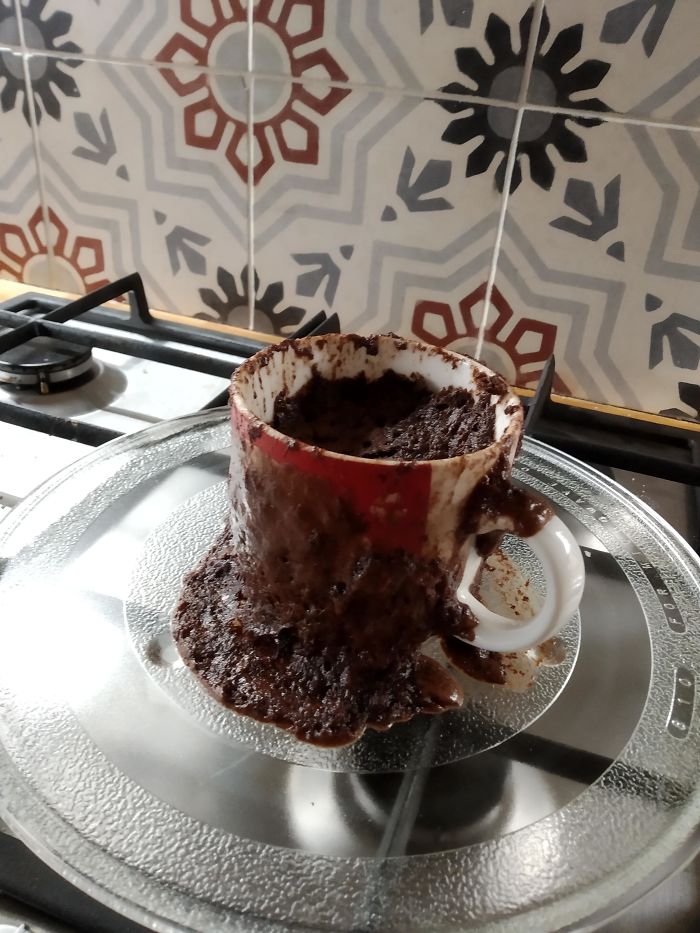
27 more at “Failed Quarantine Baking Attempts.”
* Julia Child
###
As we go back to the bakery, we might recall that today is National Empanada Day. The savory turnovers were born in Galicia, the northwest corner of Spain (and across the border in Portugal), where they were large baked “pies” served in slices; they made their way with Spanish settlers to Latin America, where they took their current form. They are typically baked, but sometimes fried (in which form, your correspondent can attest, they are at least as delicious as they are baked).

“All food is comfort food. Maybe I just like to chew.”*…

In January 2015, food sales at restaurants overtook those at grocery stores for the first time. Most thought this marked a permanent shift in the American meal.
Thanks to the coronavirus pandemic, that trend took a U-turn. Restaurant revenue cratered, while shoppers emptied grocery shelves stocking up on food to cook at home. And with sales of pantry items soaring, shoppers found themselves reaching for an old reliable.
In April, sales of Kraft macaroni and cheese were up 27% from the same time last year. General Mills, the maker of Annie’s mac and cheese, has seen a similar bump.
The cheap, boxed meal has long been a poster child for processed food. While it’s often dismissed as stuff for kids, a lot of grownups secretly savor it… It’s also played an important role in kitchen science, wars, and women’s liberation…
How boxed macaroni and cheese became a pantry principal– the story of a staple: “An ode to mac and cheese, the poster child for processed food.”
* Lewis Black
###
As we say (processed) cheese, we might send tasty birthday greetings to Ruth Graves Wakefield; she was born on this date in 1903. A dietitian, educator, business owner, and author, she is probably best remembered as the inventor of the Toll House cookie– the first chocolate chip cookie.
In 1930, she and her husband bought a tourist lodge (the Toll House Inn) in Whitman in Plymouth County. Massachusetts. Located about halfway between Boston and New Bedford, it was a place where passengers had historically paid a toll, changed horses, and eaten home-cooked meals. Ruth cooked and served all the food and soon gained local fame for her lobster dinners and desserts. Around 1937, she first added added chopped up bits from a Nestlé semi-sweet chocolate bar into a cookie: “We had been serving a thin butterscotch nut cookie with ice cream. Everybody seemed to love it, but I was trying to give them something different. So I came up with Toll House cookie.” Wakefield wrote a best selling cookbook, Toll House Tried and True Recipes. that went through 39 printings starting in 1930; the 1938 edition was the first to include the recipe for a chocolate chip cookie, the “Toll House Chocolate Crunch Cookie.”

You must be logged in to post a comment.